Community Platform Comparison 2026: How to Choose by Pricing, Fees, and Fit
Plenty of people trip on the very first step when they set out to launch a community or an event. You line up feature lists and compare them, but "which one actually fits me" never comes into focus. You cobble together free tools and then operations grind to a halt. Or you get moving, only to realize the fees leave almost nothing in your pocket. These failures happen when you choose "because it's famous, I guess" without a framework for comparison.
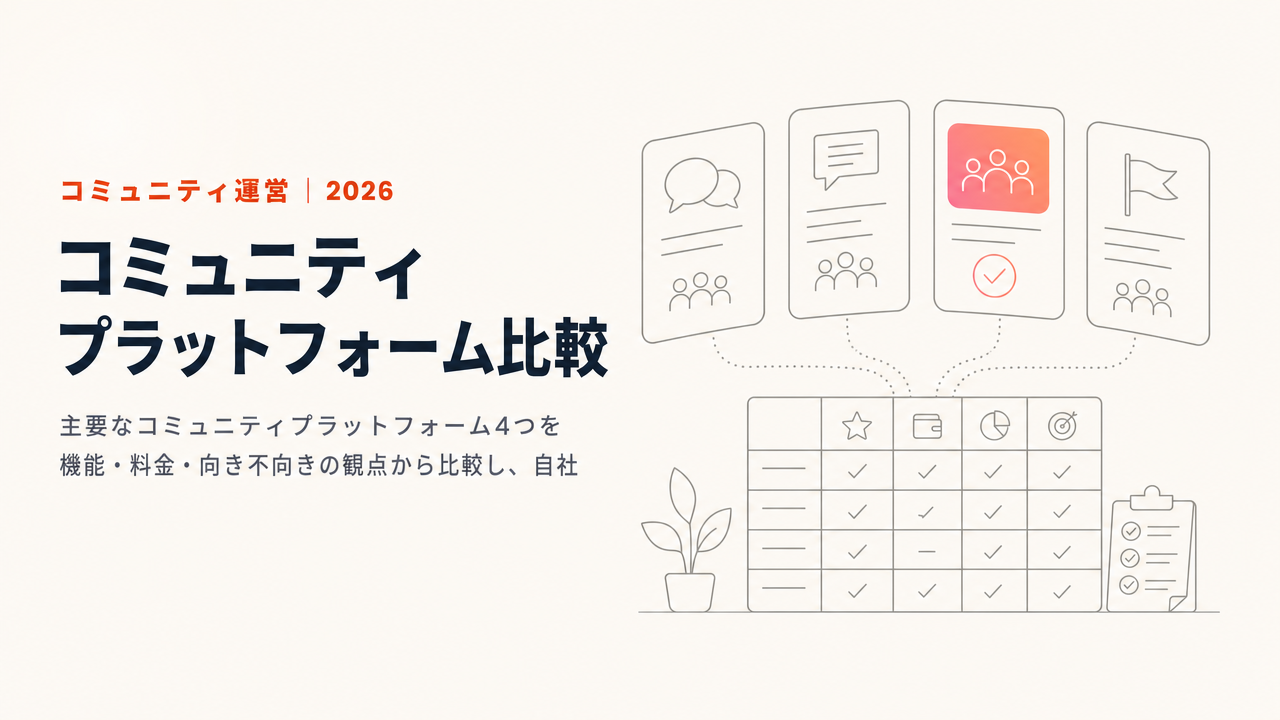
This article organizes the major community and event platforms across four lenses: pricing, payment fees, features, and fit. We get into when to reach for a general-purpose tool like Slack or Discord instead, the evaluation criteria you should settle before you compare, and even a calculation of how much money you actually keep after fees. By the end, the goal is for you to confidently pick the one service that matches your purpose and budget.
The bottom line (a quick-reference table by goal)
Here is the big picture up front. We break down the details later, but if your goal is clear, the type you should pick is almost decided.
| If your goal is | Best-fit type | Representative choice |
|---|---|---|
| Event promotion and ticket sales | Event-specialized / all-in-one | TIMEWELL BASE, or a dedicated event platform |
| Daily interaction / membership community | Community-focused / all-in-one | TIMEWELL BASE, or a community-focused platform |
| Fan world-building / salon monetization | Fan-focused / all-in-one | TIMEWELL BASE, or a fan-focused platform |
| Customer community / customer success | Community-focused | A community-focused platform |
| Unifying events and daily interaction | AI-native all-in-one | TIMEWELL BASE |
There is one key point. If your use case is fully committed to "events only" or "interaction only," a specialized platform is plenty. But if you want to run both in one place, an all-in-one platform keeps both your operational effort and your costs lower. We dig into why below.
Note that the pricing and fees cited for each type in this article are a comparison based on information publicly available as of 2026. Plans change, so confirm the latest terms on each service's official site before making a final decision.
Where most operators stumble first
Across the community-management conversations we have, people who get stuck on selection tend to fall into a few common patterns.
The first is choosing by feature count. The more capable a service looks, the more appealing it seems -- but in practice you use only a fraction of the features, and you keep paying a monthly fee for the ones you don't. On a small team of one to three people, too many features actually eat your time in setup and pull you away from the interaction that matters.
The second is running on a patchwork of free tools that eventually breaks down. Chat on Discord, sign-ups through a form, membership fees on a separate payment service, announcements on social media. It looks like you can start at zero cost, but every hop between tools creates manual data re-entry. You cannot see across the seams -- which event a member attended, who has paid their dues. The manual glue work piles up, and the invisible cost of the operator's time balloons.
The third is migrating later and losing members. A service you picked for its price or its momentum turns out not to fit, and when you try to switch midway you get stuck on member notifications and URL changes. Each migration sheds a certain number of members. An early selection mistake comes back many times over.
And the one most easily overlooked: fees eating your profit. You signed up looking only at the low monthly price, but the fees on paid tickets or subscription billing are high, and even as revenue grows, almost nothing is left. The trouble with this trap is that you rarely notice it until you're already running.
Most of these failures can be avoided if you settle your evaluation criteria before you choose.
Six criteria to settle before you choose (a checklist)
Before you stare at a comparison table, put into words what matters for your own operation, and your judgment won't waver. Fill in the following six before you start comparing.
1. Purpose: Event promotion, day-to-day interaction, fan monetization, or customer success for existing clients? Once your purpose is set, the feature set you need narrows automatically.
2. Scale: A study group of a few dozen, or a conference of several thousand? Scale completely changes the concurrent-load resilience and check-in operation you require.
3. Total cost of ownership: Don't compare on the monthly price alone. Look at total cost including payment fees and subscription-billing fees. The larger your monthly revenue, the more the fees matter compared with the monthly price.
4. Monetization method: Free operation, paid tickets, or monthly membership? Confirm whether the fee level can withstand the revenue model you envision.
5. Data sovereignty and export: Can you export member data, posts, and event information via CSV or API? If this is blocked, you cannot switch in the future. Checking the "exit" from the start is the smart way to choose.
6. AI leverage, operating effort, and mobile support: How much of the production work can you automate, and can a small team keep it running? Because most participants view on their phones, mobile usability is not to be overlooked either.
Face the comparison table with your own answers to these six, and what was a jumble of symbols starts to look like "the optimal choice for me."
A map of platform types
Community and event services split into a few types by philosophy. You could just as well call it a difference in generation.
General-purpose chat tools (Slack, Discord): Originally chat tools for internal teams or gamers. They excel as a place to interact, but they don't include the machinery of member management, promotion, or billing. They're free to start, but you're signing up to fill in the operational features with separate tools.
Event-specialized platforms: Strong at promotion, ticket sales, and check-in for events. They suit one-off large events, but they're thin as a vessel for "day-to-day interaction" -- keeping a relationship with attendees after the event ends.
Community-specialized platforms: Designed for corporate user communities and customer success. Their strengths are CRM integration and advanced analytics, but the pricing sits in the enterprise band and tends to be overkill for small operations.
Fan-specialized platforms: Optimized for the fan communities of artists, creators, and salon operators. They're strong at building a distinct world and monetizing through monthly billing, but you need to choose with the understanding that subscription fees are set on the higher side.
AI-native all-in-one (TIMEWELL BASE): A new generation of platform that unifies events and day-to-day interaction and hands the production work to AI. Because AI takes over page creation and thumbnail generation, operators can focus on the interaction itself.
What matters in a 2026 selection is exactly this "difference in generation." Older types assume you switch tools by use case, whereas the AI-native type takes on production and management together. If you want to cut operating effort, this gap is impossible to ignore.
A thorough comparison of the main types (use case, pricing, fit)
From here we go through the representative types in order: characteristics, strengths, weaknesses, pricing and fees, and the use cases they suit.
TIMEWELL BASE
An AI-native community and event platform. You can create an event page in 60 seconds and handle everything from planning to day-of operations, member management, and content distribution in one place. Its biggest feature is that AI auto-generates the event page, thumbnail, and social posts from a simple chat prompt, sharply reducing the hours spent on production.
Pricing is transparent, with four tiers: FREE (0 JPY/month), LITE (2,980 JPY/month, tax included), PRO (14,800 JPY/month, tax included), and ENTERPRISE (custom quote). FREE starts with no credit card required and includes the basics -- two active events, one community, QR tickets, analytics, and CSV export. Payment fees are 4.8% on paid tickets (among the lowest in the industry) and 10% on monthly subscription billing such as online salons.
Its strengths are unified management of events and community, AI-driven production automation, and a clear pricing structure you can start for free. Monthly active users exceed 15,000 and monthly page views top 80,000, and it runs stably even for large events with thousands of attendees. If we name a weakness, it's that the external-integration ecosystem -- of the kind Slack or Discord have -- is still developing. It suits a wide range of use cases, from event promotion to daily interaction to salon monetization.
Community-specialized platforms
These focus on community success for companies. Their strengths are CRM integration and advanced analytics dashboards, and adoption is notable among customer success teams aiming to raise the LTV of existing customers. You can build a community no-code, and they suit data-driven design of the customer experience.
Pricing is by custom quote and sits in the enterprise band. They deliver for companies with a solid budget and a dedicated customer success team, but they tend to be overkill for a small community. A strong option for companies that want to run a B2B customer community in earnest.
Fan-specialized platforms: brand world-building
Strong at building the world of a fan community. Many offer a dedicated app and let you craft the world of a brand or creator. High design freedom makes them suited to nurturing a passionate fan base.
Setup fees start from the several-hundred-thousand-yen range, and subscription-billing fees are said to run around 20%. They fit brands and artists who won't spare investment in their world, but you need to factor in the setup and fee burden in advance. Suited to operations that prize a deep relationship with fans.
Fan-specialized platforms: fan clubs and salons
Specialized for fan clubs and online salons. Strong at the mechanics of connecting with fans through monthly billing, with the features for salon operation bundled together. Delivery is mainly through a dedicated app.
Subscription-billing fees are said to run roughly 10-30%, with a range depending on plan and terms. Because the fee burden bites more the larger your monthly revenue, it's worth weighing your revenue scale as you consider it. Suited to individuals and small operators who want to spin up a fan club or salon quickly.
Enterprise event platforms
Platforms for large events. They have the features needed to run big events such as conferences and exhibitions, and support check-in and session management.
Pricing is said to start from around 100,000 JPY/month with a setup fee near 300,000 JPY, and there is no free plan. It's the price band for large-event organizers with a budget. A good option when you want to run a sizable event -- even a one-off -- with a solid operational setup.
Ticketing-focused event platforms
Specialized in event promotion and ticket sales. Many have a free plan (fee-based), which makes them easy to start small, and they support QR check-in.
Payment fees are said to run around 8%, and session management or lead management may be a paid option. They suit selling tickets easily on an event-by-event basis, but they're thin as a vessel for day-to-day interaction, so if you're looking ahead to running a community, you'll need a separate vessel.
Grasp the whole picture with comparison tables
Because the metrics you should watch differ by use case, we split this into community use and event use. Figures are based on public information as of 2026; confirm the latest terms on each service's official site.
Community / salon use
| Item | TIMEWELL BASE | Community-focused | Fan-focused (brand) | Fan-focused (salon) |
|---|---|---|---|---|
| Free plan | Yes (from 0 JPY) | No | No | No |
| Setup fee | 0 JPY | By quote | From several hundred thousand yen | By quote |
| Subscription fee | 10% | -- | ~20% | ~10-30% |
| AI content generation | Yes | Limited | Limited | No |
| Analytics dashboard | Yes | Advanced | Yes | Yes |
| CRM integration | Limited | Yes | Limited | Limited |
| Mobile support | Mobile-first design | Dedicated app | Dedicated app | Dedicated app |
| Pricing transparency | Public | By quote | By quote | By quote |
Event use
| Item | TIMEWELL BASE | Enterprise event platform | Ticketing-focused platform |
|---|---|---|---|
| Free plan | Yes (from 0 JPY) | No | Yes (fee-based) |
| Lowest monthly fee | From 0 JPY | From 100,000 JPY | 0 JPY (fee-based) |
| Payment fee | 4.8% | Bundled in high monthly fee | ~8% |
| Setup fee | 0 JPY | ~300,000 JPY | 0 JPY |
| Check-in (QR) | Yes | Yes | Yes |
| Session / booth management | Yes | Yes | Paid option |
| Lead / customer management | Yes (CSV export) | Yes | Paid option |
Laid out in numbers like this, it's clear that a low monthly price and a low fee level are two different things. Especially if you're chasing subscription revenue, the gap in fees translates directly into a gap in profit.
A concrete example: payment fee simulation
"Do 10% and 20% fees really differ that much?" A lot of people feel this way. Convert it into actual money and the size of the gap comes into view.
An online salon earning 500,000 JPY/month
Assume a salon with 500,000 JPY of monthly revenue from membership fees. We compare how much is left after subscription-billing fees are deducted.
| Platform (fee) | Monthly fee | Amount you keep | Annual fee |
|---|---|---|---|
| 10% fee (TIMEWELL BASE level) | 50,000 JPY | 450,000 JPY | 600,000 JPY |
| 20% fee (a fan-focused example) | 100,000 JPY | 400,000 JPY | 1,200,000 JPY |
| 30% fee (fan-focused upper example) | 150,000 JPY | 350,000 JPY | 1,800,000 JPY |
For the same revenue, a 10% versus 20% fee produces a 600,000 JPY annual difference, and 10% versus 30% a 1,200,000 JPY annual difference. That difference is money you could have put toward an honorarium for a guest speaker or the production budget for your next project. Fees keep biting every month and every year, so the larger you grow, the higher the price of a selection mistake.
Selling 100 paid tickets at 5,000 JPY each
Revenue is 500,000 JPY. At a 4.8% payment fee that's 24,000 JPY deducted; at 8%, 40,000 JPY. That's a 16,000 JPY difference per event -- about 190,000 JPY over 12 events a year. It looks small on a single event, but it adds up to a figure you can't ignore across repeated occasions.
A selection guide by goal (by persona)
Now that we have the criteria and the comparison tables, here are realistic ways to choose for representative cases.
A 150-person startup community / a large municipal event: If you're running everything from promotion to community management with a small team, an all-in-one type fits. TIMEWELL BASE has been adopted for large events such as YOXO Festival (a Yokohama-based startup-support event), TechGALA (a startup conference in the Aichi/Nagoya area), and KID 2026 (Kanagawa Prefecture), and it runs stably even at the scale of thousands. It handles everything from check-in to daily interaction end to end.
Online salons / fan clubs: This splits on whether you prioritize monetization or world-building. If crafting the world is your top priority and you'll spare no upfront investment, a fan-focused type. If you want to keep fees down and retain profit, an all-in-one type with a 10% subscription fee is realistic. As the simulation above shows, the difference in fees bites heavily on a yearly basis.
A B2B customer community / customer success: If you prioritize CRM integration and data analytics, a community-focused type comes into its own. If you have the setup to pursue LTV improvement for existing customers with a dedicated team, the investment here pays off.
Unifying events and daily interaction: For cases where you want to run events and continuous community activity in one place -- like EMC Global, a global business community, or the WARP program for developing AI talent -- an AI-native all-in-one type is the most compatible choice.
How to avoid failing at platform migration
Changing platforms later is harder than you'd imagine. If you're considering a migration, cover the following in advance.
First, confirm whether you can export member data, post history, and event information via CSV or API. A service that doesn't allow export has the exit blocked. That's exactly why a mindset of "confirm exportability up front, assuming migration" matters at the moment you first sign.
When you do migrate, notify members carefully. Switching without explaining the reason and the benefits of the new home is a trigger for cancellations. Run the old and new in parallel for at least two to four weeks and move over in stages to suppress churn. Anticipate the impact of shared links and bookmarks going dead, and setting up redirects is the safe move.
Selection approaches to avoid
Finally, four traps to steer clear of in your selection.
Choosing by feature count alone is dangerous. Paying a monthly fee for features you won't use is waste; prioritize a feature set matched to your operational scale and purpose.
Choosing by low price alone is just as risky. A patchwork of free tools keeps upfront costs down, but cross-tool data linking and manual work pile up, inflating the invisible cost of the operator's time.
Copying another company's success story wholesale is also best avoided. When the community's scale, purpose, and audience differ, the optimal platform differs too.
And treating fees lightly. Sign up looking only at the monthly price, and when revenue grows the fees swallow your profit. Judge on total cost of ownership. Don't forget this one point.
A new option -- AI-native: TIMEWELL BASE
You're chased by production work and can't carve out time for the interaction that matters. TIMEWELL BASE answers this worry -- one many community operators carry -- with an AI-native approach.
Event pages, thumbnails, social posts: just ask in chat and AI generates them. Page creation takes 60 seconds, and production hours can drop by roughly 80%. You can start from the free FREE plan with no credit card, and with a 4.8% fee on paid tickets and 10% on subscription billing, it's designed to leave revenue in your hands. It has a track record of running stably even at events with thousands of attendees.
If you'd like to check whether it fits you before considering it, you can first assess your current state with a free diagnostic tool.
- Check your community's current state: Community Health Check
- See features, pricing, and track record in detail: TIMEWELL BASE service page
- Discuss adoption in concrete terms: Contact us (for businesses)
There's no hard sell intended. If your use case is fully committed to event promotion only, or interaction only, a specialized type can be plenty. But if you want to bring events and daily interaction into one place and hand production to AI to cut operating effort, it's an option worth a look.
Frequently asked questions
Can I start for free? It depends on the service. TIMEWELL BASE offers a FREE plan (0 JPY/month) you can start with no credit card on file. Some ticketing-focused event platforms also provide a fee-based free plan. Many community-focused and fan-focused platforms, on the other hand, have no free plan and typically charge a setup fee or a monthly fee. If you first want to get a feel for running one, starting with a service that offers a free plan is the realistic move.
Won't Slack or Discord do? They work perfectly well as a place for people to interact. But they don't include operational features like member management, event promotion, ticket sales, or membership billing. If all you need is day-to-day conversation, a chat tool is fine; if you want to manage promotion and monetization in one place, a dedicated platform is a better fit.
Can I change plans partway through? With a service that has tiered plans, you can move up as your operation grows. TIMEWELL BASE has four tiers from FREE to ENTERPRISE, so you can re-select based on your event count and email-sending needs. It's reassuring to confirm before you sign that moving up to a higher plan is smooth.
How much are the fees? The level differs between paid tickets and subscription billing. TIMEWELL BASE charges 4.8% on paid tickets and 10% on monthly subscription billing. On fan-focused platforms, subscription fees can reach 20-30%, and the gap bites more the higher your monthly revenue. Compare on total cost including fees, not on the low monthly price alone.
Can I export my member data? It depends on the service. TIMEWELL BASE supports CSV export of participant data. With a future switch or external tool integration in mind, always confirm before you sign whether you can export member, post, and event data -- that's the safe approach.
Can an individual use these? Yes. With a service that has a free plan, you can start from an individual's online salon or a small study group. As it grows, switching up to a higher plan is the realistic way to run it.
Can they withstand events with thousands of attendees? Yes, if you pick a service built for large events. TIMEWELL BASE has a track record running events with thousands of attendees such as TechGALA and YOXO Festival, handling check-in, session management, and lead capture end to end. For large events, the deciding factors are resilience under concurrent load and a proven check-in operation.
Summary
- If event promotion is the focus, choose an event-specialized type or an all-in-one type
- For daily interaction or a customer community, a community-focused type or an all-in-one type fits
- If you prize fan world-building and monetization, gauge the fee level and choose a fan-focused type or an all-in-one type
- Compare on total cost of ownership -- payment fees and subscription fees included -- not on the low monthly price
- Confirm data exportability before you sign, and secure the exit for migration
- If you want to bring events and daily interaction into one place and hand production to AI, an AI-native all-in-one type is a strong option
In the end, it's decided by the product of your purpose, budget, and operating setup. Every service has its strengths and weaknesses. Rather than choosing by trend or fame, apply your own answers to this article's six criteria and choose with conviction.
Related Articles
- Community Building Fundamentals - How to Create a Thriving Community
- Community Launch Checklist: Preparation and Initial Design
- Community Monetization Models: Subscriptions, Event Fees, and Sponsorships
- Community KPI Design - Choosing the Right Metrics to Measure Success
References (public information)
- TIMEWELL BASE service page
- TIMEWELL BASE pricing plans
- Pricing and fees for each type are a comparison based on public information as of 2026. Confirm the latest terms on each service's official site.
This article was produced with the help of AI. A human verified the primary sources and edited the text before publication.
More Articles in This Category
Community Building Fundamentals - How to Build a Community That Thrives
A clear guide to the value a community brings to a business, what makes one succeed, and the playbook from launch to operations -- grounded in the latest 2026 trends and real examples.
The Complete Event Management Guide: Planning, Promotion, Day-of Operations, and Review (2026 Edition)
A start-to-finish playbook for event planning, promotion, day-of operations, review, and lead nurturing, grounded in 2026 data. Turn unpredictable turnout, chaotic event days, and unmeasured outcomes into a system a small team can actually run.
Community KPI Design: Choosing Metrics That Prove Your Results
How to design community KPIs that prove results in numbers, from working backward off a KGI and choosing a North Star Metric to size-based benchmarks and quarterly reviews, with a full worked example and the 2026 community industry context.