Five Techniques to Improve Community Member Retention: Practical Retention Design
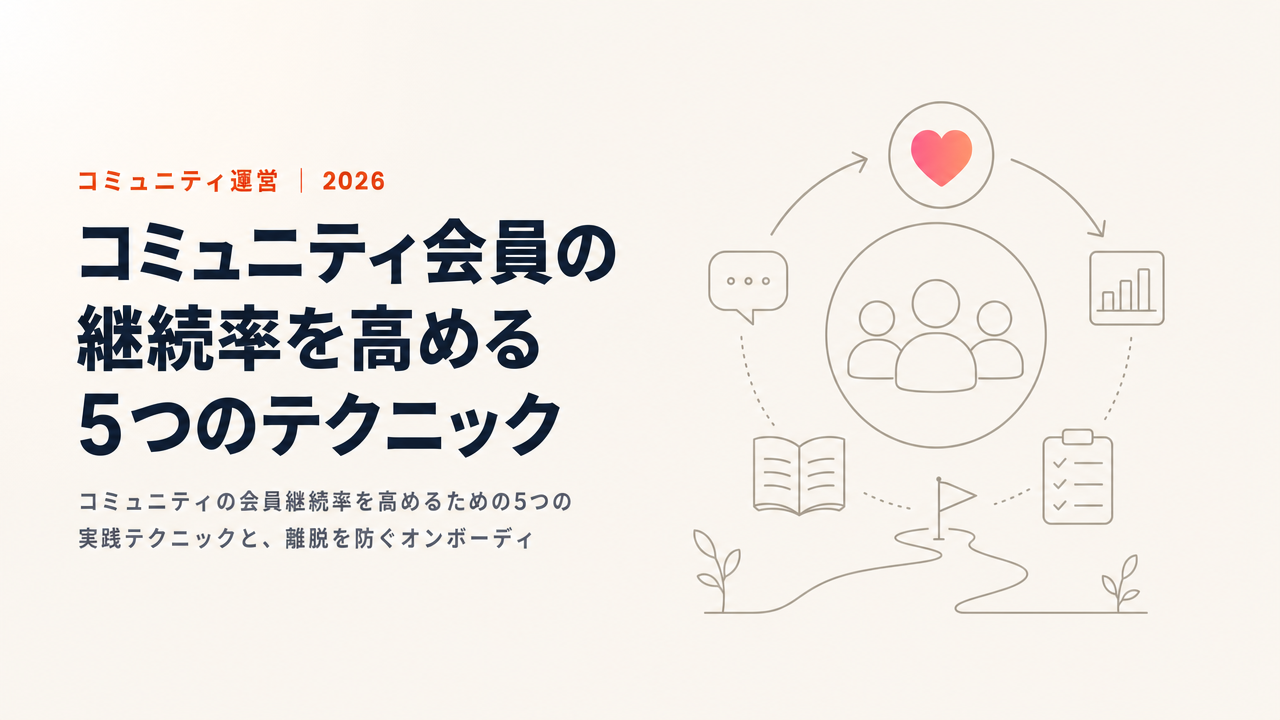
In the first month after launch there were posts almost every day, but three months in, no one writes anything anymore. New people keep joining, yet members slip away quietly, faster than they arrive. The complaint you hear most often in community management is exactly this state, where the entrance is open but the exit is moving faster. This article organizes five techniques for improving member retention, from the experience immediately after joining to getting ahead of the warning signs of departure, in a form you can put to work right away.
What you will learn in this article
The factors that shape retention break down into five broad categories. Knowing in advance where each one takes effect makes it clear where to direct your limited operational resources.
| Factor that shapes retention | Where it takes effect | Corresponding technique |
|---|---|---|
| The experience right after joining | Prevents drop-off in the first 7 days | Technique 1 |
| A reason to come back (a regular rhythm) | Turns visits into a habit | Technique 2 |
| A felt sense of recognition and contribution | Retains the core members | Technique 3 |
| Sensing the warning signs of departure | Getting ahead of dormancy | Technique 4 |
| Peer connections between members | Deepens the sense of belonging | Technique 5 |
To state our editorial conclusion up front: the top priority is onboarding, Technique 1. If that part is broken, no amount of polishing the other four will help; you will be pouring water into a leaky bucket.
What retention actually means
Retention is the proportion of members active at a given point who are still around after a set period. In community management, you track it mainly with the following metrics.
- 30-day retention. The share of members still actively involved one month after joining. The quality of the early experience shows up directly here.
- 90-day retention. The survival rate at three months. People who stay this long have a high chance of becoming settled members and form the foundation of the community.
- Annual retention. For a subscription model, this is the flip side of your churn rate.
- MAU rate. The share of all members who took any action at all during the month. A rough thermometer for how alive the community is.
What matters here is not to chase other organizations' averages. Typical retention differs completely by the type of community. A free knowledge-sharing community and a paid membership salon start from entirely different notions of what a healthy number is. Keep external benchmarks to a shape-level understanding, a sense of the order in which numbers tend to decline, and use figures measured in your own community as the baseline, comparing before and after each initiative.
Why prioritize retention over new acquisition? The reason is simple: keeping existing members is cheaper than continuously recruiting new ones, and it takes effect faster. A community that keeps losing members will not raise its water level even by pouring in people through ads or outreach. In a paid monthly community especially, retention comes right back at you as monthly revenue. We think of retention as the operational stamina of the community itself.
Technique 1: Design the first 7 days of onboarding
The period right after joining, and especially the first week, has the greatest single influence on retention. When the state of "I signed up, but I have no idea what to do" lasts for a few days, people simply drift away in silence. Filling that gap by design is the most cost-effective measure of all.
Ideally, you prepare in advance a flow that deepens involvement little by little over the week from the moment someone joins.
| Timing | What the team does | Aim |
|---|---|---|
| Immediately | Deliver a welcome message | Give a real sense of being welcomed |
| Day 1 | Prompt a self-introduction (three fields at most) | Lower the barrier to the first post |
| Day 3 | Point to recommended places and content | Help members find where they belong |
| Day 7 | Invite to a first event or interaction | Create touchpoints with other members |
The fewer fields you ask for in a self-introduction, the more people fill it in. Just three, name, work, and what you want to do in this community, is plenty. Handing over a format takes much of the psychological weight off that first step.
One more thing that works is a system where existing members serve as a go-to person for newcomers. When a one-to-one relationship forms early, it creates the feeling that "there is someone here who cares about me." Whether or not a member has that experience makes a real difference to whether they settle in afterward. Specific numbers vary with the scale and theme of the community, but that members who form even one relationship early tend to stay is something many organizers say with one voice.
With TIMEWELL BASE, you can manage everything from event planning to the application form and reminder emails on a single screen. That means you can naturally nudge the Day 7 touchpoint, "invite to a first event," through a reminder email. The welcome message and guidance copy themselves should be written in the organizer's own voice, but since the production of announcement banners and guidance content can be handed to AI, the organizer can concentrate on the warmth of the wording.
Technique 2: Create a reason to come back with a regular rhythm
People come back to a community because there is a reason to come back, on a regular basis. When the reasons are irregular, visits become irregular too. Conversely, once "there is that thing on this day every week" sinks into the body, access turns into a habit.
- A weekly themed post. For example, every Monday you throw out a "question of the week" and members answer.
- A monthly get-together. A loose gathering in a fixed slot, such as the evening of the second Friday of each month.
- A member introduction relay. A series that introduces one member at a time, in turn.
- A quarterly retrospective. Share three months of results and think together about the next direction.
The point lies less in the flashiness of the content and more in repeating on a fixed day and time. A plain event that people remember as "the one at noon every Wednesday" produces more stable attendance than a lavish but irregular one. Rhythm is a little like trust; the very fact that you keep going becomes a source of reassurance. Here too, leaning on AI for the production of event pages and reminders lets the organizer spend energy on the harder part, which is keeping it going.
Technique 3: Make contributions visible and recognize them properly
When members feel that "my posts and actions are useful to this community," their sense of belonging rises and retention improves. Conversely, when the state of contributing without anyone noticing continues, it is precisely the most dedicated members who quietly fade out.
A common trap is that an active member's contributions are recognized only inside the organizer's head and are invisible on the outside. The organizer means to be grateful, but it reaches neither the person nor those around them. That is a waste.
To turn recognition into a system, you have options like these.
- Sharing highlights. Each week or month, feature the most helpful post or the exchange that drew the most reactions. The knack is to shine a light on quality, not just on post counts.
- Handing over roles. Formally ask a dedicated member to take on a role such as operations assistant or ambassador. When responsibility arises, ownership deepens a notch.
- Turning outcomes into stories. Share events like "this member's question sparked a new project," making the value of the community visible.
BASE's community features offer, in addition to member management and discussions, the delivery of exclusive content. Using it to deliver special content aimed only at the core members you want to recognize lets you build the experience of "being valued" right into the design. Recognition looks like a matter of emotion, but in fact a large part of it can be reproduced through systems.
Technique 4: Catch the warning signs of departure and get ahead of them
Departures look as if they happen suddenly one day, but they are usually the accumulated result of quiet warning signs. If you notice at the warning-sign stage, there is still something you can do. The easy misunderstanding here is to assume that warning signs are delivered to you automatically. They do not fall into your lap; the operator defines in advance "what counts as a danger signal" and goes after it themselves.
First, organize the signals to track and the responses like this.
| Signal | Rough threshold | Response |
|---|---|---|
| Drop in login frequency | Fell from 3x/week to once a week or less | Personally point to content that matches their interests |
| Posts and reactions stop | Zero for 2 weeks or more | Reach out directly from the team to ask how they are |
| Event non-attendance | Missed the last 3 in a row | Personally invite to the next one and ask about their interests |
| Profile not updated | Still in the default state 30 days after joining | Unlock exclusive content on completing the profile |
BASE's lead and customer management can be used for this extraction work. If you gather participant data and export it to CSV, you can identify, at hand, members whose login frequency or attendance history has fallen off. That is where the data's job ends. Beyond that, saying "we have not seen you around lately, how are you?" is a person's job. This line matters: even if you automate the extraction, automating the outreach itself makes the warmth disappear.
For members who are starting to go dormant, work in stages. At 30 days dormant, deliver "recent highlights" to convey the value they are missing. At 60 days dormant, send an invitation that gives them a reason to come back. At 90 days dormant, before they leave, honestly ask "what made you drift away" and use it for the next improvement. The knack is to change how you reach out at each stage.
Win-back contact backfires if you send too much. We touch on this again in the later "common mistakes" section, but the balance of frequency and content is everything. For reference, an email to encourage a return needs only about this level of warmth.
Hi [Name], how have you been?

Here is what has been happening in the community lately:
- [Member]'s post "[Title]" drew a lot of reactions
- Registration opened for next month's event "[Event]"
- A new themed space, "[Space]," was created

There are members who would welcome your perspective.
Drop by when you have a moment.
Technique 5: Grow peer connections between members
If the only relationship is the vertical one between organizer and member, the community is being held up by dependence on the organizer. When peer connections form between members, the sense of belonging deepens a notch, and conversation continues even during hours when the organizer is not around. Once you reach this point, retention starts to run on its own.
There are several moves that create peer connections.
- Forming small groups. Build groups of five to eight people around a shared interest and encourage interaction within them.
- Pair matching. Once a month, introduce two people with something in common and create a chance for them to talk one-to-one.
- Joint projects. Provide experiences of working toward a shared goal together, such as planning a study session or co-producing content.
Why five to eight people? The sizes of groups people form naturally turn out to be noticeably clustered rather than evenly spread. An analysis of human grouping data by a research team including Robin Dunbar (Proceedings of the Royal Society B, 2005) found that group sizes fall into a discrete hierarchy with a scaling ratio close to three, clustering around 3-5, 9-15, and 30-45 people. A unit of five to eight sits between that innermost layer of 3-5 and the next one at 9-15, at a density where everyone can keep track of one another and speak without holding back. Rather than dropping people into a large room, creating many small circles increases each person's chance to speak.
The phrase "Dunbar's number is 150" is widely known, but more recent re-examination has found the confidence intervals around such estimates to be so wide that pinning down any single figure is not possible. Treat these sizes as a starting point for forming groups, and in the end fit them to the numbers you measure in your own community.
To confirm whether an initiative is working, it helps to look at cohorts. Group members by when they joined and line up how each group's survival rate changes over time. If you export a CSV from BASE's lead and customer management and total it by join month in a spreadsheet, you can make a comparison like the following (the numbers are illustrative).
| Join cohort | 30-day retention | 90-day retention | What we were doing then |
|---|---|---|---|
| Before the initiative | 55% | 35% | No onboarding designed |
| After introducing the go-to-person system | 68% | 48% | One-to-one relationship right after joining |
| After adding an interaction event | 72% | 52% | Go-to person plus a first-event design |
Lining things up by period like this makes it visible, in numbers rather than by feel, which initiative pushed retention up. It takes effort to tally, but it is the effort that gets you out of "it kind of feels like it got better."
Common misunderstandings and mistakes
The patterns where people stumble around retention share a few common types.
Sending too much win-back contact. Frequently sending "please come back" emails leaves the opposite impression, that of a "pushy community," and drives the person away for good. Contact with dormant members should proceed in stages and be limited in number. What you deliver is not a nag but the value they are missing.
The organizer hogging recognition. When the organizer reacts to every post and runs everything, members stay in the role of "customers." Creating a place where members recognize one another lets the sense of belonging put down deeper roots. We think of recognition as something to circulate, not something to hand out.
Running on feel without measuring. If you keep or stop initiatives based on "it feels lively lately," you will never know what worked. At the very least, track 30-day and 90-day retention and cohorts. The thing we consider most forbidden, as an editorial team, is this "management without measurement."
Chasing scale above all. When growing the member count becomes the goal in itself, the per-person experience thins out and retention actually falls. Headcount is a result, not a goal. It is not rare for a dense, small community to be stronger on both retention and lifetime value.
The 2026 trend: retention design in the age of AI
According to CMX's "2026 Community Industry Report," 93% of practitioners involved in community management report using some kind of AI tool in their work. That is a big jump from 81% the previous year. Retention measures cannot stay untouched by this current either.
That said, it is essential not to mix up which parts to leave to AI and which parts people handle. What AI is good at is production. Announcement copy, thumbnails, content for social, first drafts of guidance emails. Such "making" work now takes shape in tens of seconds if you ask a chat tool. On the other hand, what truly moves retention is the work of forming relationships, a word of welcome, thanks for a contribution, reaching out to someone who is drifting away. That can only be done by people.
That is exactly why 2026-style retention design turns on the division of labor of "AI for production, people for relationship-building." Cut the time taken up by production with AI and pour that time into interaction instead. The idea TIMEWELL BASE puts forward, "leave production work to AI and concentrate on interacting with participants," is precisely this way of thinking. If AI can cut working time by up to 80%, the organizer can spend time on the work that is most valuable in the first place, which is engaging with people.
Another current is the spread of subscription communities. In paid monthly online salons and membership communities, retention links directly to revenue as the flip side of the churn rate. What got by with "sort of staying" in a free community becomes, once it is paid, a monthly question of "is this worth the money." Before the renewal month, look back on the value gained that month and deliver it. This one small effort quietly reduces cancellations.
Running retention initiatives with TIMEWELL BASE
The measures introduced here can be run without any tools. But if you keep it going with manual work alone, the organizer's time runs dry quickly. TIMEWELL BASE is a foundation for keeping retention initiatives going without strain. You can manage everything from event planning to applications and reminders in one stop, and the community features offer member management, discussions, and delivery of exclusive content. Combine lead and customer management with CSV export, and you have the material at hand for extracting warning signs of departure and tallying cohorts. Since AI takes on production such as announcements and thumbnails, the organizer can concentrate on relationship-building. With industry-low fees of 4.8% on paid tickets and 10% on subscriptions, the revenue design of a membership community is realistic too. There is a free plan, and you can start without registering a credit card.
If you first want an objective grasp of your community's current state, try the Community Health Check. A few minutes of questions will show you your current health and where the key improvements lie. Details on features and pricing are gathered on the BASE service page. If you want to discuss concretely whether it fits your own community, reach out through BASE individual consultation.
Frequently asked questions
What is a reasonable benchmark for community retention?
There is no single correct number, because healthy retention varies enormously by the type of community. The practical approach is to measure your own 30-day, 90-day, and annual retention first, treat those figures as your baseline, and compare before and after each initiative. Watching whether your own cohorts are improving is far more useful for day-to-day management than chasing other organizations' numbers.
To reduce departures, what should we tackle first?
The top priority is the experience right after someone joins. Members who do not feel "there is a place for me here" within the first week are hard to win back no matter what you try later. Concentrating your operational resources on the welcome message, an easy self-introduction, and the design of that first interaction is the most cost-effective retention measure there is.
Do small communities need retention measures too?
If anything, the effect is larger when the community is small, because a single departure changes the whole atmosphere. At a scale of a few dozen people, hands-on work such as greeting each member, remembering names, and responding to posts works directly. With less machinery to run, small communities can lift retention through careful early attention.
How much of retention work can AI automate?
What AI can automate is production work such as announcements, thumbnails, and guidance content. The relationship-building itself, offering a word of welcome, recognizing contributions, reaching out to members who are drifting away, can only be done by people. Handing production to AI and spending the freed-up time on interaction is the realistic design for 2026.
How do you prevent cancellations in a subscription community?
In a paid monthly community, retention translates directly into revenue. Cancellations happen not at the moment someone stops seeing value, but as the result of a stretch with no opportunity to feel value, so the key is to deliver outcomes and interaction on a regular cadence. A little effort to look back on the value gained that month, delivered just before the renewal date, goes a long way.
Summary
There are many measures for raising retention, but if you get the priorities right, you can make them work even with limited resources. Let us restate the editorial rules of thumb.
- The top priority is the early experience of onboarding. Concentrate your operational resources on the design of the first 7 days above all.
- Create a reason to come back with a regular rhythm, and turn visits into a habit.
- Make contributions visible and recognize them, then circulate that recognition among members.
- Define the warning signs of departure yourself and go after them; split the work so data does the extraction and people do the outreach.
- Grow peer connections between members and shift from dependence on the organizer to a self-sustaining community.
And the thing you must not do is manage without measuring. As long as you keep or stop things by feel, retention stays a matter of luck. Leave production to AI, and pour your time into the relationship-building that only people can do. That, we believe, is the surest way to move retention in community management in 2026.
References (primary sources)
- CMX Community Industry Report (latest benchmarks, including AI tool adoption)
- Dunbar, R.I.M. (1992) "Neocortex size as a constraint on group size in primates," Journal of Human Evolution 22(6): 469-493 (the original paper behind the popular term "Dunbar's number": neocortex size and group size in primates)
- Dunbar, R.I.M. (1993) "Coevolution of neocortical size, group size and language in humans," Behavioral and Brain Sciences 16(4): 681-694
- Zhou, W.-X., Sornette, D., Hill, R.A. & Dunbar, R.I.M. (2005) "Discrete hierarchical organization of social group sizes," Proceedings of the Royal Society B 272(1561): 439-444 (finds group sizes form a discrete hierarchy scaling by about three; the source for the group-size layers cited in this article)
- Lindenfors, P., Wartel, A. & Lind, J. (2021) "'Dunbar's number' deconstructed," Biology Letters 17(5): 20210158 (re-examination concluding that no single figure can be specified)
- TIMEWELL BASE service page (features, pricing, results)
Related Articles
This article was produced with the help of AI. A human verified the primary sources and edited the text before publication.
More Articles in This Category
Community Building Fundamentals - How to Build a Community That Thrives
A clear guide to the value a community brings to a business, what makes one succeed, and the playbook from launch to operations -- grounded in the latest 2026 trends and real examples.
The Complete Event Management Guide: Planning, Promotion, Day-of Operations, and Review (2026 Edition)
A start-to-finish playbook for event planning, promotion, day-of operations, review, and lead nurturing, grounded in 2026 data. Turn unpredictable turnout, chaotic event days, and unmeasured outcomes into a system a small team can actually run.
Community KPI Design: Choosing Metrics That Prove Your Results
How to design community KPIs that prove results in numbers, from working backward off a KGI and choosing a North Star Metric to size-based benchmarks and quarterly reviews, with a full worked example and the 2026 community industry context.