Once Considered Science Fiction
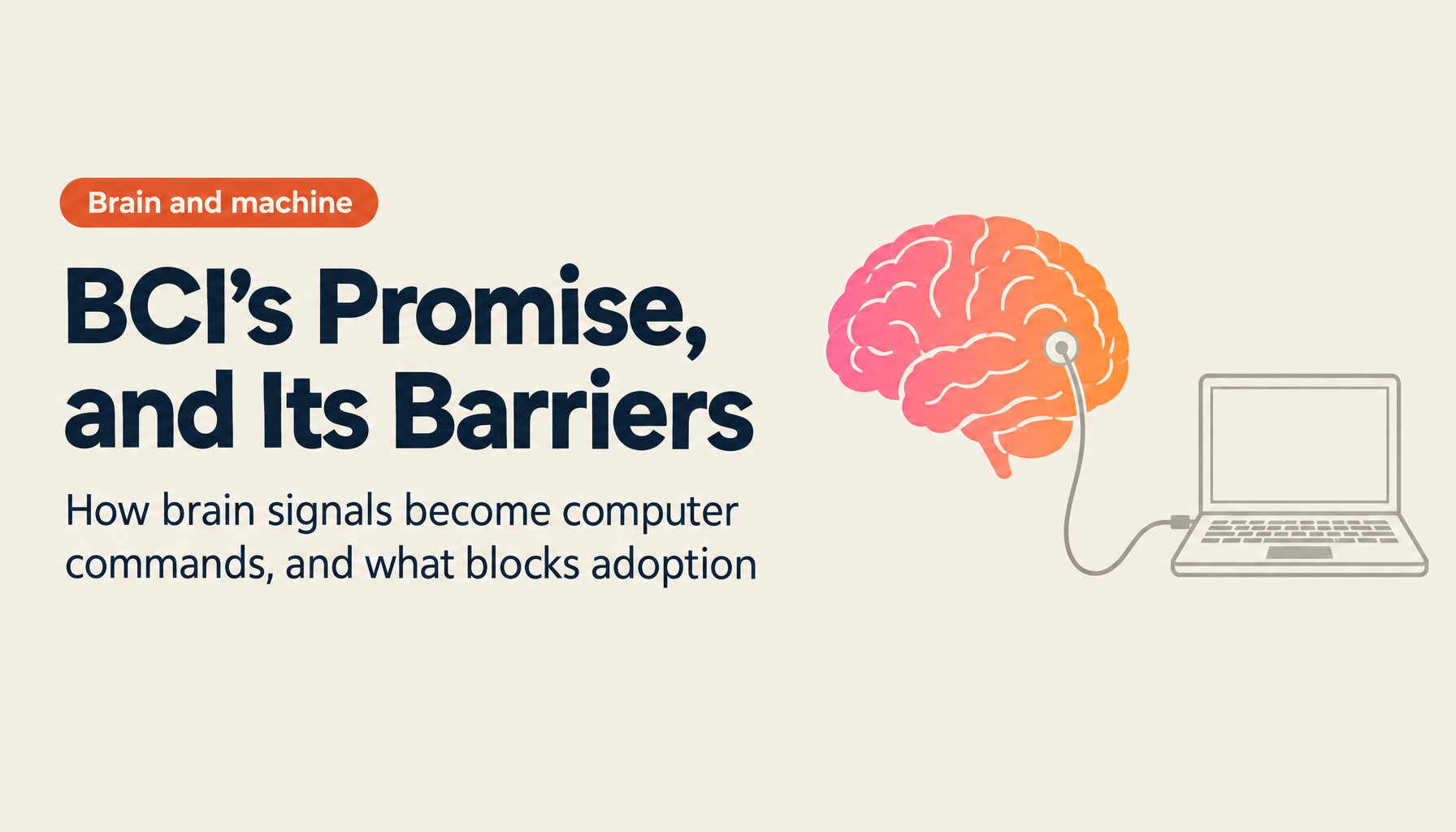
Brain-Computer Interface (BCI) — the technology that directly connects the human brain to a computer — once seemed like the stuff of science fiction. But in recent years, two-way communication between brain and computer, mediated by electrical signals, is becoming a reality. The faint electrical signals generated by neurons in the brain are read by specialized electrodes, and this digitized bitstream is translated by machine learning algorithms into the movement or thought the person intends. This cutting-edge technology has the potential not only to enrich everyday life but to offer new hope to patients who have lost movement due to spinal cord injury, stroke, or ALS.
This article explains in detail — through the eyes of specialists and concrete examples — how BCI technology works, what the experience is like, and what lies ahead, including the challenges. The astonishing possibilities created by the fusion of brain and computer could fundamentally change how we live, how medicine is practiced, and how we communicate in the future. As the technology evolves, BCI is being studied for applications beyond assistive use — including the potential transmission of thoughts, partial reconstruction of dreams, and analysis of emotion-related signals. Here, we introduce BCI's basic principles, current applications, and future development, grounded in concrete examples and expert perspectives — examining both the promise and the shadows of this frontier technology.
- How BCI works: From brain signals to computer control
- Future BCI applications: Dream reconstruction, thought transmission, and AI integration
- Safety, security, and ethics — the barriers to BCI adoption
- Summary
Looking for AI training and consulting?
Learn about WARP training programs and consulting services in our materials.
How BCI Works: From Brain Signals to Computer Control
The fundamental mechanism of BCI is reading the electrical signals that the brain uses to communicate with itself and the outside world, and transmitting that digital information to a computer. In practice, the brain operates by having countless neurons send one another tiny electrical signals, enabling complex thought, movement, and sensation. BCI captures those signals by placing extremely small electrodes inside or on the surface of the brain, then analyzing the resulting data. The electrode contact regions are primarily the motor cortex — the area where signals originate to move hands, feet, face, and the muscles involved in speech. The technology depends on a process that converts thoughts into commands the computer can directly receive: machine learning algorithms process large volumes of electrical signal data and "translate" it into the movement the user intends.
For example, when a user first attempts to "move the cursor" or "draw a picture," signals from specific areas of the brain are recorded by electrodes, and machine learning algorithms analyze those patterns. The result: the cursor actually moves and the drawing happens on the computer — a complete chain of events. This process requires significant effort and concentration at first, but with repeated use it becomes natural — like becoming comfortable with a new tool — and users sometimes describe it as "a magical experience."
In early applications, BCI technology offered major benefits to patients with motor impairments. For those who retain normal cognition but have lost movement due to spinal cord injury, ALS, or stroke, BCI-mediated communication represents a critical tool for communication and everyday operation — enabling more intuitive and responsive control than traditional assistive devices. As a concrete example, patients have used electrical signals in the brain to move a computer cursor and perform text input and image selection, successfully expressing their intentions directly.
Here, alongside BCI's enormous potential, some technical challenges also emerge. Signal noise and differences in brain structure from person to person mean that the same algorithm cannot always perform accurate translation. Moreover, the surgery to implant electrodes directly in the brain carries inherent risks. While the surgery itself is now relatively brief (currently 1–2 hours), maintenance considerations — such as the possibility of future electrode replacement or upgrades as the technology advances — must also be factored in. Researchers are developing thin-film electrodes that could be more easily replaced or upgraded in the future, enabling long-term safe use. These technological innovations are also generating solutions for how to handle devices that become obsolete over time, as well as responses to security risks.
An important practical point: BCI technology is expected to expand beyond assisting movement to encompass other brain regions such as the visual cortex and sensory areas. Connecting to the visual cortex, for example, opens up the possibility of reconstructing dreams or images, and even directly transmitting personal thoughts.
BCI technology thus holds enormous potential in medicine and rehabilitation. Improving operational precision and response time must go hand in hand with security measures and privacy protections. To overcome these technical challenges, developers are constantly improving algorithms and adopting safer communication methods. Today's BCI is no longer just a research-stage technology — it is transitioning into a real-world tool that supports patients' daily lives and participation in society. As further advances continue, the likelihood that brain and machine will connect ever more seamlessly is very high, and the impact on our lives will be revolutionary.
Future BCI Applications: Dream Reconstruction, Thought Transmission, and AI Integration
The potential of BCI extends far beyond supporting physical disability — it opens a door to a future in which our thoughts, emotions, and even dreams are extracted and transmitted as digital data. One question often posed: "Can you move a cursor in your mind and draw a picture?" In practice, many users initially give the operation command by "thinking of moving their hand," but with experience they describe the sensation of their intentions being reflected directly on the computer — as if riding a bicycle, the user wields the BCI like a new, natural instrument. Response delay has not been entirely eliminated, but it has been shortened to a level that is practically negligible — reflecting the fact that even in normal movement, a delay of several milliseconds exists between the brain's command and the body's response.
Another question: Can BCI directly play back "complete thoughts" or "dreams and psychedelic experiences"? Currently, experiments are underway to detect activity in the visual cortex using electrodes and reconstruct blurry images and patterns from that information. Recording and replaying the images and experiences seen in dreams with full precision still faces major technical challenges. Researchers are conducting experiments in which, while a subject dreams, patterns generated in the brain are analyzed and extracted to reconstruct visual images. This kind of process works only through a sophisticated interplay of modern technology and AI algorithms — and in the future, it may be possible to visually transmit an individual's dream or inner world, like a scene from a film.
BCI's integration with artificial intelligence (AI) will also lead to dramatically improved user experiences. Currently, users transmit large volumes of information to AI in text form and then review the output — but in the future, scenarios where AI responses are delivered directly to the brain are being contemplated. This would make human-AI collaboration smoother and realize new forms of communication independent of conventional interfaces. One expert has stated: "A future in which the brain and LLMs merge is already being partially experienced by users via text — and deeper integration will follow." In practice, experiments in which patients use BCI to operate computers and converse with AI are already being conducted in clinical settings, and the technology is steadily progressing.
Looking ahead, the following uses in everyday life and healthcare are anticipated. First, enabling people with physical disabilities to control computers simply by thinking offers major independence support. Second, converting dreams and internal experiences into digital data could lead to applications in psychotherapy and psychiatric care. Third, a future in which brain and computer communicate directly without a conventional interface — made possible by AI integration — would bring revolutionary changes to how information is transmitted.
As this transformative technology becomes real, various ethical and technical challenges are also emerging. The information obtained directly from the brain through BCI is extremely sensitive, and if that data is communicated externally, the risks to privacy and security are unavoidable. The danger that an individual's thoughts and emotions could be accessed without authorization cannot be dismissed, and current technology demands rigorous encryption and security measures. The possibility that BCI devices could malfunction or be hacked into unintended operations must also be anticipated, and preparing for these risks is critical. Engineers are designing systems with modularity in mind — not just electrode durability, but the ability to quickly replace and repair in the event of failure.
On the topic of BCI implantation surgery, some users express concern that "implanting a chip in the brain sounds frightening." However, for patients and users, the surgical process is often framed as simply one unavoidable experience in life — and the new freedom and possibilities available on the other side are seen as a significant benefit.
Safety, Security, and Ethics — The Barriers to BCI Adoption
As BCI technology advances and spreads, concerns about safety and security are critically important. The electrical signals obtained from the brain are extremely private personal information, and concerns about hacking, unauthorized use of that data, and device failure are being seriously discussed by users, the medical community, and society as a whole. Here we examine the specific challenges, the approaches technologists are taking, and future prospects in detail.
The security risk most users are concerned about is the potential for wireless transmission — used when BCI systems communicate externally — to be compromised. If the valuable and sensitive information transmitted from inside the brain leaked without encryption, it would represent a serious violation of the individual's privacy. Developers are working to introduce the highest level of encryption technology to mitigate this risk. As medical devices, BCIs operate under strict verification and legal regulation, and ensuring users' peace of mind is the paramount concern.
On the hardware side as well, practical challenges exist: the durability of the electrodes implanted in the brain, the physical impact of long-term use, and how to respond when equipment fails. Currently, hundreds to thousands of electrodes are used to achieve high-precision signal acquisition — but in the future, handling tens of thousands of fine-grained data points may be required. With that comes the risk of micro-damage and degradation in electrodes causing malfunctions and misreadings, so developers are constantly focused on improving both safety and diagnostic capability. This is expected to lead to systems where, in the event of a malfunction, rapid repair and replacement is possible.
Another concern about BCI technology is the problem of obsolescence: when technology needs to be upgraded, existing devices may become outdated, potentially increasing security vulnerabilities. Devices implanted in a user's brain require surgery to remove or replace, and the balance between risk and convenience must be carefully considered. Some researchers are exploring thin-film electrode arrays and similar technologies, experimenting with systems in which the adopted device can be easily replaced in the future. In actual clinical settings, cases exist where patients have undergone multiple surgeries and their lives were saved, suggesting that surgery itself is not an extreme risk — but safety remains the paramount concern.
BCI's role also encompasses "write" functionality — using electrical stimulation to modulate brain activity — in addition to "reading." However, BCI's "write" capability is currently limited to a research stage, with experiments providing artificial visual stimuli and partial sensory input. Achieving full bidirectional communication still faces many technical and ethical hurdles. Providing precise stimulation to the right location in the brain requires complex analysis and control technology — and because it has the potential to directly affect internal information such as memory and emotion, ethical discussions are proceeding in parallel.
A scenario that some users worry about: "What if the implant were hacked and the brain's information altered?" As technology grows more sophisticated, this concern inevitably becomes more realistic. Currently, some safety measures are in place in BCI systems, but as widespread global adoption progresses, greater oversight systems and the establishment of international standards are urgent needs. BCI devices operating to medical-device standards, with the latest security algorithms continuously incorporated, are what is needed to protect users' brain information.
AI is also making a major contribution to BCI improvement as technology advances rapidly. Modern BCIs already use sophisticated machine learning algorithms to analyze brain signals, accurately read the user's intentions, and translate them into actions. This has enabled users to communicate their desired movements to the computer with a natural flow. AI's role is not limited to making translation efficient — it also contributes to predicting malfunctions, managing failures, and generating new stimulation patterns. These efforts will become an important foundation toward a future era of "directly sharing thoughts."
BCI technology carries its revolutionary potential alongside many challenges — security, ethics, and hardware — simultaneously. Going forward, economic and technical investment is needed alongside user understanding and international rule-making to protect brain information while achieving more advanced bidirectional communication. For us to arrive at the future where brain and computer are directly connected, broad societal discussion will play as important a role as continued technological development. When our dreams, emotions, and even personal privacy are digitized, how to preserve their safety and dignity — this is an unavoidable challenge accompanying technological innovation, and a theme that researchers, healthcare providers, and policy-makers must work on together.
Summary
BCI is a revolutionary technology that reads the electrical signals of the brain and enables direct communication with computers. This article has covered in detail — from basic principles to real examples, to future application areas and the security and technical risks they entail — how BCI translates brain electrical signals and enables patients to operate external devices through their own intentions. Research progress in signal detection in the motor cortex and computer response is advancing. Efforts to extend application to the visual cortex and emotional expression are still experimental — but they hint at new forms of communication for the future. At the same time, challenges exist: device failure, hacking risk, and technological obsolescence. Overcoming these requires both technical and ethical countermeasures, and collaboration with AI will become increasingly important.
BCI holds the potential not only to improve patients' quality of life and support their independence, but to lead toward a new era of communication — directly transmitting dreams and thoughts. As technology advances, its possibilities are captivating — but security and safety must be kept front of mind. Physicians, engineers, researchers, and users working together to advance this revolutionary technology will surely bring major benefits to our daily lives, medicine, and future society as a whole. Looking back, the fusion of brain and computer has been transforming from dream into reality — and the new possibilities ahead of us are a major element that will shape the very future we are about to enter.
Reference: https://www.youtube.com/watch?v=piFhYn6KziM
TIMEWELL AI Consulting
TIMEWELL is a professional team supporting business transformation in the age of AI agents.
Services
- AI agent implementation support: Business automation using GPT-5.2, Claude Opus 4.5, and Gemini 3
- GEO strategy consulting: Content marketing strategy for the AI search era
- DX acceleration and new business development: Business model transformation using AI
In 2026, AI is evolving from something you "use" to something you "work with." Let's think through your AI utilization strategy together.