The Future LLMO Is Unlocking: The End of SEO and a New Web Marketing Strategy Through AI Optimization
The Future LLMO Is Unlocking: The End of SEO and a New Web Marketing Strategy Through AI Optimization
With rapidly advancing AI, the conventional wisdom of web marketing built on traditional SEO is reaching a major turning point.
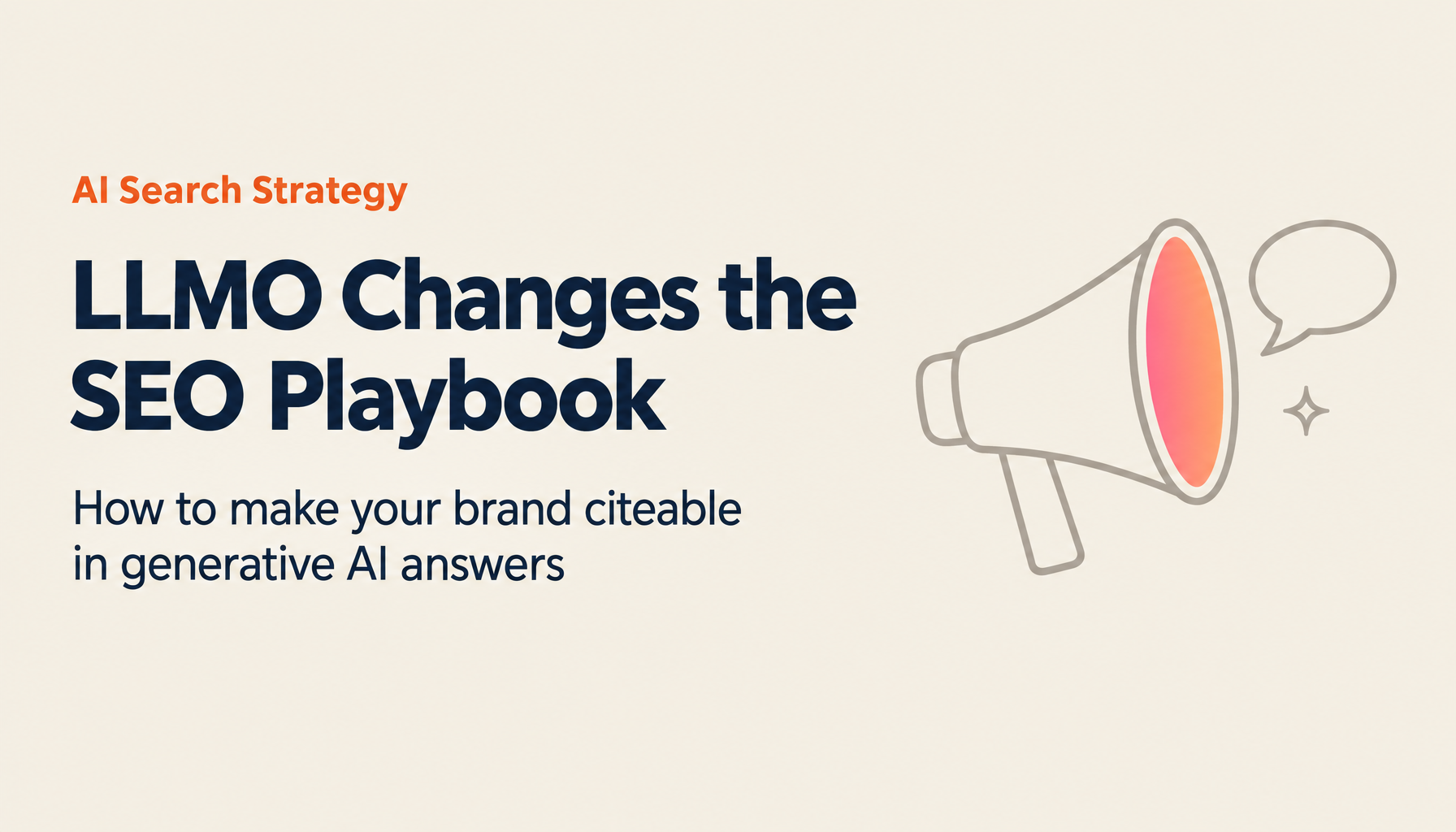
For the past several years, Google SEO and similar traffic acquisition strategies have been considered critical to business success. But with the spread of advanced large language models (LLMs) like ChatGPT, Gemini, and Claude, how people gather and process information — and how that information gets delivered — is changing dramatically. The biggest emerging trend in web marketing is "LLMO (Large Language Model Optimization)." LLMO represents a new strategy that shifts away from the conventional focus on earning clicks through search engine rankings, toward building highly reliable content that AI can easily access and cite.
This article provides a detailed, comprehensive breakdown of LLMO's origins and importance, Google's serious push into AI Overview and AI Mode, and concrete response strategies for web marketing going forward. To stay ahead of the latest AI trends and capture business opportunities, companies must grasp these changes early and act proactively. Reading this article will clarify the full picture of how the traditional SEO model is finally approaching its end — and how to build a new marketing strategy adapted to the AI era.
- What is LLMO? The end of SEO and navigating toward the AI era
- Google's AI Overview and AI Mode — transforming advertising revenue and the search experience
- LLMO response strategies — entity optimization, trust building, and strengthening contextual understanding
- Summary
Looking for AI training and consulting?
Learn about WARP training programs and consulting services in our materials.
What Is LLMO? The End of SEO and Navigating Toward the AI Era
Traditionally, the most important element of web marketing was Google SEO. Websites appearing at the top of search results for users' keyword searches translated directly into traffic and sales. For example, when someone searched "how to use Canva," appearing in the top few results meant visitors would actually access the site and go on to purchase products or find information.
But as AI technology — particularly large language models like ChatGPT — began to spread, the way information is collected, organized, and delivered began to change. Users no longer need to run keyword searches and read through articles themselves. They simply enter a prompt, and AI instantly summarizes the information and generates an answer.
At the root of this is AI's ability to automatically search for related information and generate contextually appropriate responses. While traditional SEO was a technique to get users to click, LLMO is an optimization method designed for AI to accurately and quickly retrieve information. In other words, the shift is from "acquiring clicks" to "earning AI citations."
LLMO represents a new approach that overhauls the traditional SEO mindset and points toward a future where AI search is dominant. Specifically, the manual Google search process — where people search, collect information, and evaluate it themselves — is expected to be replaced by AI that automatically searches and synthesizes information, ushering in the era of "zero-click search." In practice, a user enters a prompt and AI automatically handles every subsequent step — information extraction, organization, and final output. This means website operators now need to focus more than ever on creating content that AI can correctly cite.
The background of LLMO is the vision of a future in which AI's high processing capability instantly and accurately delivers what users need, fundamentally transforming the search experience itself. Content creation previously emphasized keyword density and SEO techniques. Going forward, what matters is content structured so AI can reference it easily — content organized as a recognizable "entity," where expertise, reliability, and originality rooted in real experience clearly come through. This is what will determine success in future web marketing.
To accurately understand the importance of LLMO, the following points must be grasped:
- Traditional SEO aimed to rank at the top of Google search; LLMO is an optimization method for AI to automatically search for and cite information
- Prompt design becomes critically important — how you pose questions to AI greatly affects the quality and accuracy of responses
- As zero-click search expands, what's needed is not click-optimized content but highly credible content that AI can easily cite
LLMO is not merely a new SEO tactic — it signals a paradigm shift across all of web marketing. Traditional keyword stuffing and partial optimization are already losing effectiveness. Companies need to reconsider what information they're sending out holistically — and how clearly organized and valuable that information is for both users and AI. For Canva usage information, for example, rather than just listing how-to steps, publishing first-hand experience, concrete cases, and primary information spanning multiple media becomes indispensable for raising the citation value to AI.
Furthermore, implementing LLMO requires a different perspective than existing SEO approaches — necessitating a strategy shift across the entire company. Marketing staff need to move beyond maintaining search rankings to focusing on how to generate and disseminate AI-optimized content. In the midst of these rapid changes, the "end" of traditional SEO as a concept is an unavoidable trajectory.
This change will also have a significant impact not just on how information is provided, but on the structure of corporate branding strategies and advertising revenue. Traditionally, declining click numbers from Google search was a serious problem for companies. Going forward, how company and site information is cited within AI-generated output, and whether credibility is maintained, becomes the new metric directly tied to business outcomes. In other words, how precisely and compellingly a company communicates its expertise, track record, and originality — and whether it consistently disseminates this across multiple media — is what truly constitutes web marketing strategy going forward.
Google's AI Overview and AI Mode — Transforming Advertising Revenue and the Search Experience
Globally, Google has long enjoyed an overwhelming presence in the search engine market. Google search is the center of a business model heavily dependent on advertising revenue — sponsored ads and click-based systems are the primary promotional tools for companies. But with recent advances in AI technology, Google itself is being forced to make a major transformation of the search experience. The newly introduced "AI Overview" and "AI Mode" represent a major overhaul of the existing keyword search-based system — and carry the potential to ultimately destabilize the advertising revenue-dependent business model that has been Google's foundation.
AI Overview refers to the feature where AI-generated summaries and answers automatically appear in search result pages. This changes the traditional flow — users clicking to a detailed page from a list of search results — to one where they instantly get the information they need from AI summaries alone. Currently, approximately 42.51% of search queries are processed through this system, with direct site click-through rates trending down as a result. Users no longer need to navigate to sites for detailed information — they're relying on what AI presents.
AI Mode, distinct from traditional search mode, operates so that when a user enters a question in prompt form rather than typing search keywords, all answers are generated by AI. For example, if a user prompts "show me how to use Canva," AI automatically searches related web information and presents the most reliable information and specific methods. With search results themselves becoming AI-generated, the motivation to visit individual websites drops dramatically.
For Google, this transformation is also a threat to sponsored advertising — the backbone of its advertising revenue. Traditionally, clicks on ad slots displayed at the top of search results constituted the bulk of advertising revenue. But as AI Overview and AI Mode become widespread, the number of user clicks decreases and the significance of ad display fades. As a result, an enormous impact on the search-related business that comprises 55.9% of Google's revenue is unavoidable.
Furthermore, this new system has the potential to fundamentally transform the user experience itself. Traditional search required users to gather information across multiple pages and extract the most relevant content themselves. With AI Overview and AI Mode, users can instantly and easily obtain what they need — the convenience is immeasurable. For example, if a user wants Tokyo apartment information, where previously they needed to click through to details, AI will now present contextually appropriate information directly — even if advertising exists, click rates are expected to drop sharply.
Additionally, AI Overview tends to be positioned above traditional SEO results and sponsored ads in the display order — a factor that is further forcing a transformation of the traditional business model. Going forward, rather than simply aiming for top rankings through SEO, companies must disseminate information in a format AI can easily adopt — creating content conscious of credibility, expertise, and rich context. This transformation, which redefines how companies communicate their brand value and how information is cited and recognized across the entire market, demands an approach that goes well beyond simple search engine optimization.
In all likelihood, over the next few years, the shift from click-based to AI citation-based traffic will cause a dramatic decline in direct website visits and force a fundamental rethink of traditional advertising models. Companies and marketers will need to urgently establish a digital presence that can be cited by AI — alongside new revenue strategies and multi-channel information dissemination. As a result, Google itself appears to be pivoting rapidly toward accelerating AI technology development and innovation in the search experience to offset declines in advertising gross margins.
LLMO Response Strategies — Entity Optimization, Trust Building, and Strengthening Contextual Understanding
As AI becomes central to search and traditional SEO methods change dramatically, the specific countermeasures companies should take are extremely diverse. Most important is achieving "entity optimization" of content — making it possible for AI to efficiently cite information. An entity is a discrete block of unique information — a person, company, product, service. AI tends to understand such organized information and cite it as credible knowledge for users. If, for example, a company's own track record, real experiences, awards and certifications obtained offline, and information disseminated across multiple media are all recognized as a single entity, it becomes an extremely valuable source for AI.
In this environment, companies need to focus on the following measures. Summarizing the most important responses:
- Disseminating original, high-credibility content
- Emphasizing experience and expertise through communications based on real experience and experiments
- Disseminating information across multiple media (YouTube, social media, books, seminars)
- Presenting qualifications, awards, and company information in an integrated way on official pages
- Structuring content using FAQ and Q&A formats so AI can accurately understand context
First and foremost in content creation, rather than relying on traditional SEO techniques like keyword stuffing, publishing original content based on experience and expertise is urgent. Since AI cannot experience things itself, practical knowledge and real experience built by humans provides the material that backs credibility and expertise. Companies should thoroughly organize and publish on the web information about their recent track record — experimental results or implementation records for specific products, or information that reflects recognition within the industry.
Consistent information dissemination across multiple channels is also important. Integrating not just the website but YouTube videos, social media posts, publications, and even offline achievements like seminars into the digital space strengthens the company's credibility and pull. This helps AI recognize the company's or individual's information comprehensively during citation, resulting in a higher evaluation.
Moreover, optimizing the entity page on the official site provides the foundation for clearly telling AI "who this company is." Specifically, pages containing company overview, background, track record, qualifications, and awards need to be enriched and presented in a clearly organized format. This enables AI to recognize the information as a package and cite it easily — while also making the company's credibility immediately clear to users.
Content structuring is also an important response. Properly structuring headings (H1, H2, H3, etc.) and using related terms and synonyms in a balanced way makes it easier for AI to understand context deeply. Presenting short, clear answers to user questions in FAQ or Q&A format is highly effective for creating an interface that is easy for both AI and users to understand. These information organization efforts ultimately raise the overall credibility, expertise, and authority of the content — differentiating the company from competitors.
As part of entity optimization, having the company's or individual's track record mentioned by third-party trusted sources is also effective. For example, evaluations on external specialist sites and industry media, enriching reviews and testimonials, and partnerships with partner companies — bringing offline achievements actively into the digital space strengthens the consistency and credibility of web information. This leads AI to interpret information not through simple keyword matching but as context and an overall story — resulting in content evaluated as having high citation value.
In this way, companies and marketers need to build new content strategies adapted to the LLMO era rather than relying solely on traditional SEO. As search engines themselves undergo a major transformation with the emergence of AI, companies must organize their own information as a unified entity, bringing credibility and expertise to the forefront. This enables companies to secure an advantageous position in future AI citation and information provision, resulting in the ability to build a sustainable business model.
Summary
This article has explained in detail how traditional SEO is approaching its end in the face of rapidly advancing AI technology, and how LLMO (Large Language Model Optimization) is becoming the new key to web marketing. First, what LLMO is — as a new optimization method compared to SEO, the shift from acquiring clicks to earning AI citations is advancing, with users entering the era of instantly obtaining information through prompt input alone. Google's serious push into AI Overview and AI Mode is expected to dramatically transform the traditional search experience and advertising revenue structure, with major impacts on future advertising businesses and web marketing strategies. And as concrete response measures against these changes, entity optimization, trust building, and enriching contextual understanding are indispensable. Companies need to build high-credibility information sources that AI can easily cite — through original content dissemination and integrated information across multiple media. This enables sustainable marketing strategies that don't depend solely on traditional SEO.
Going forward, as user search behavior shifts to zero-click and AI Mode, companies need to continue making efforts to raise their "citation value" to AI rather than just acquiring clicks. How companies optimize their own information in the new digital ecosystem, and how clearly and compellingly they communicate credibility and expertise to users, will be the decisive factor in future business success.
Marketers, executives, and all business professionals responsible for digital strategy — the time has come to rebuild your information strategy from the new perspective of LLMO rather than adhering to traditional SEO approaches. To grasp the cutting-edge AI technology and the transformation of search engines accompanying it, and to prepare for future marketing strategy, taking concrete measures right now is indispensable.
Reference: https://www.youtube.com/watch?v=eywnCVeh6f0
TIMEWELL AI Implementation Support
TIMEWELL is a professional team supporting business transformation in the age of AI agents.
Services
- ZEROCK: High-security AI agent running on domestic servers
- TIMEWELL Base: AI-native event management platform
- WARP: AI utilization talent development program
In 2026, AI is evolving from something you "use" to something you "work with." Let's think through your AI utilization strategy together.