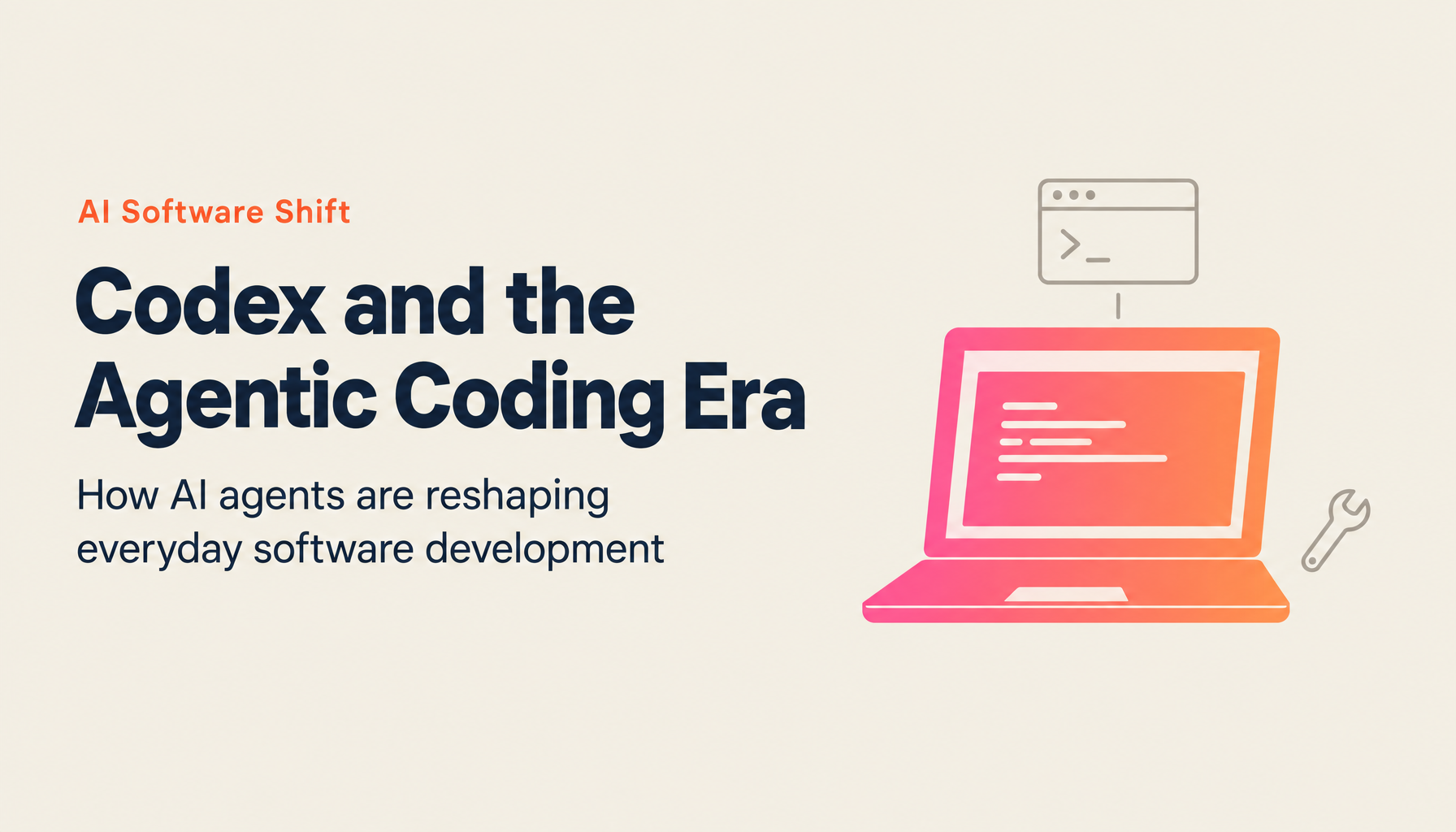
The Age of Agentic Coding: How OpenAI Codex Is Transforming Software Development
Modern software development is changing at an unprecedented pace. With the rapid advancement of AI, the idea of humans and AI agents collaborating on coding work has become a tangible reality. OpenAI's Codex has moved well beyond simple code completion — it's now recognized as an agent capable of autonomously executing entire tasks. OpenAI has invested significant effort in enhancing Codex and its surrounding infrastructure, aiming not for competitive programming benchmarks or simple auto-generation, but for a tool that is immediately useful on real development teams. Internal alpha testing has already produced compelling examples, including one where Codex resolved a bug in the middle of the night — demonstrating its practical, real-world impact.
This article provides a detailed look at the development story behind OpenAI Codex, how it is used internally, and how the future of software development is being reshaped by these capabilities.
Topics covered:
- OpenAI Codex's Evolution and Internal Use Cases
- How Agent Collaboration Is Reshaping Programming
- Market Trends and Future Outlook: Agentic Coding's New Era
- Summary
Struggling with AI adoption?
We have prepared materials covering ZEROCK case studies and implementation methods.
OpenAI Codex's Evolution and Internal Use Cases
OpenAI Codex has evolved far beyond its GPT-3 code generation roots. It is now positioned as a groundbreaking agent capable of executing entire tasks autonomously — not just completing code. Researcher Hansen Wang and Product Lead Alexander Embiricos have spoken passionately about the development journey, noting that Codex was built specifically to fit real-world software development environments rather than just competitive programming tasks. Codex operates with its own isolated container and terminal environment, enabling it to receive a task from a user and autonomously generate a pull request (PR) to resolve it.
During development, a clear challenge emerged: output from earlier models often didn't meet the code style and test coverage standards that professional engineers expect, making it difficult to merge into live projects. In response, the Codex team focused on improving "PR quality" and "reviewability" in real development settings, applying reinforcement learning (RL) and targeted environmental tuning to the model. One memorable internal testing incident: at roughly 1 AM, an agent made multiple attempts to fix a specific animation bug and ultimately delivered the correct solution — a vivid demonstration of Codex's ability to reduce developer burden through rapid iteration.
The Codex agent handles the full cycle: receiving a task, building its environment inside a container, running tests, and presenting output to users. Engineers can see exactly what tests were run and what commands were executed, allowing them to verify correctness quickly. A key internal strategy involves having the agent attempt the same task multiple times and selecting the strongest implementation — directly contributing to higher productivity and fewer errors.
Within the development team, Codex has already enabled engineers to offload the overhead of standard coding tasks and bug fixes, freeing them to focus on strategic decisions and creative design work. This shift — toward more human-AI collaborative workflows — is expected to have a broad ripple effect across software development practices.
The key elements behind Codex's development include:
- Autonomous task execution, end-to-end
- Containerized environments that mirror production for reproducible results
- Quality assurance through reviewable output and automated test execution
- Multi-attempt task strategies that extract the best implementation from several tries
These innovations show that Codex is not just a code generation tool — it's emerging as a genuine development partner. The reproducibility of the agent's learning environment is critical to this: when development and production environments are aligned, user experience is consistent and reliable. Based on internal usage data, the productivity gains, faster bug resolution, and reduced code review overhead are real — and they suggest a coming transformation in how software is built.
Codex is also expected to have a major impact on future UIs and interfaces. Rather than being a layer on top of IDE-based code completion or pair programming, Codex operates autonomously in containerized environments — behaving more like an independent engineer — enabling a new paradigm where multiple tasks are processed in parallel. In this model, users shift their focus from writing code to directing and reviewing work done by the agent.
Within OpenAI, Codex is seen not as a simple task-delegation tool but as a team member that participates across full projects and rapidly submits pull requests. Engineers are shifting their role from "generating code" to "evaluating and overseeing deliverables" — a meaningful upgrade to the development process. Codex's evolution represents not just a technical advancement but a strategic rethinking of how software is built at an organizational level — with direct implications for competitive advantage.
How Agent Collaboration Is Reshaping Programming
In traditional development environments, engineers write, review, and test code manually — one step at a time. AI agents like Codex are fundamentally reorganizing this process. In early internal experiments, engineers assigned tasks to the agent, which instantly generated multiple implementation candidates and automatically presented the most suitable one. This dramatically reduced the overhead engineers previously faced — clearly specifying requirements, verifying test results — and created space for more creative, higher-value work.
Agent collaboration is not simply an extension of "pair programming." Codex goes beyond receiving user instructions — it autonomously recognizes tasks, iterates through options, and searches for optimal solutions with a flexibility that mirrors human thinking. Internally at OpenAI, some users are now submitting multiple pull requests per day, with overall development productivity reported to have jumped significantly. The agent handles everything from task decomposition to execution to self-contained testing — and the engineer simply reviews and approves.
The way agents present their own execution results is itself transforming code review. Agents automatically document the test commands they ran and the command-line output they produced, presenting this to engineers. This makes review work faster and more transparent — what was once a time-consuming process of manually verifying correctness now takes a fraction of the time. Because agent-generated code arrives essentially ready-to-merge, engineers can focus on final review while project progress flows more smoothly.
In this new model, the engineer's role is shifting clearly — away from writing code from scratch and toward strategic decisions: breaking down tasks, reviewing results, and proposing improvements. The ability to evaluate and select the best from multiple agent-generated implementations is becoming an increasingly important skill. And the more attempts the agent makes, the higher the quality of implementation — contributing to a more professional overall development process.
Looking ahead, agents are expected to integrate not just with remote code generation, but seamlessly with IDEs, CLIs, and communication tools like Slack and email. Engineers will be able to assign tasks to agents from any tool and receive results in real time — no longer constrained to specific work environments. Agents running continuously, handling tasks automatically while engineers focus on review and higher-level design, is what the future of programming looks like.
The benefits of agent collaboration also extend beyond engineering — to product management, quality assurance, and customer support. When an agent auto-generates a bug fix PR, it can simultaneously report the intent behind the fix, the scope of impact, and the test results — allowing people across departments to quickly understand the situation and respond appropriately. Detailed documentation of task history and execution results also creates valuable assets for future quality audits and root cause analysis. These organization-wide benefits don't just boost competitiveness — they lay the groundwork for broader process automation and efficiency gains.
The concept of agent collaboration is already beginning to reshape automation thinking across domains well beyond software development. Codex's emergence has put "automatic task decomposition" and "automated result evaluation" in the spotlight — and adoption across the industry is accelerating. As agent collaboration becomes standard, AI is poised to play a complementary role not just in programming, but in data analysis, document creation, and even strategic business decision-making. Organizations will need to rethink their existing processes to take full advantage — and engineers themselves will need to shift toward higher-value work as a result.
Market Trends and Future Outlook: Agentic Coding's New Era
Looking at the broader market, agentic coding approaches like Codex represent far more than a technical breakthrough — they have the potential to trigger a genuine paradigm shift across the software development industry. Where massive teams once built large-scale applications for millions of users, the environment is shifting toward one where individuals and small teams can build flexible, customized software with ease. Internal use cases already show how Codex dramatically cuts development hours and enables multiple projects to run in parallel over short timeframes. This is expected to increase demand for professional software developers while also lowering the barrier for a much wider pool of "vibe coders" to contribute.
Looking forward, agentic coding is expected to move beyond traditional IDE and terminal workflows — integrating seamlessly with Slack and other communication tools, and adopting new visual UIs inspired by formats like TikTok. Imagine a startup founder swiping through short video-format task summaries generated by an agent and giving feedback with a simple "let's go with this change." These new interfaces will deliver user experiences that don't depend on menus or command entry — enabling both asynchronous and real-time work styles simultaneously.
The industry is also converging on a hybrid workflow: agents generate code autonomously, but that code must pass human review before it goes live. The process of developers auditing and evaluating agent output will become increasingly important. The traditional sequence — engineer reviews PR, provides feedback, makes minor adjustments — is being redefined as a new kind of "AI partnership."
Market dynamics show that Codex's evolution is accelerating similar agentic technology research across the industry — not just at OpenAI. Competing products like Claude Code and Jules are also improving usability and accuracy to meet the same market demand. Within this competitive environment, OpenAI's approach — where agents autonomously handle tasks on the user's own computer, enabling smooth cross-tool workflows — is establishing a distinctive advantage.
As development agents mature, the automated generation of documentation and tests alongside code will dramatically improve system-wide transparency and consistency. When that infrastructure is fully in place, the era of on-demand custom software — built by anyone, for niche needs, across all devices — will be within reach. This has the potential to fundamentally change how software is consumed across desktops and smartphones alike.
Codex's technology can also be extended as a productivity tool for product managers, designers, and non-engineers — accelerating AI adoption in functions beyond development. The combination of competitive market pressure and rapid technical advancement will drive the maturation of agentic tools while establishing collaborative programming as a new standard way of working. OpenAI is at the forefront of this change — contributing to the spread and evolution of agentic coding as a driver of digital transformation across economic and cultural sectors.
The task lists visible on screen, agents operating autonomously, and new intuitive UIs designed for this paradigm — all of these have the potential to fundamentally change the software development process. Organizations that move quickly to adopt this shift and break away from traditional development flows will be positioned to create new market value and achieve meaningfully higher operational efficiency. Codex and the broader wave of agentic technology are among the most important indicators of where the market and the technology industry are heading.
Summary
This article has covered OpenAI Codex's evolution and its groundbreaking agentic capabilities — the future of programming enabled by agent collaboration, and the broader impact and outlook for the market. Based on internal success stories, agents that autonomously execute tasks, auto-generate code, run tests, and submit PRs have already shown the potential to dramatically reshape how development work gets done. Engineers can focus on more strategic and creative work — driving organization-wide productivity gains.
Codex's innovation extends beyond the technical — it's a catalyst for change across the development community and the broader market. As agentic technology matures and competition with other products intensifies, further evolution is certain. Organizations that embrace these technologies and rethink traditional development approaches will be best positioned to respond to changing market demands.
Codex represents a revolutionary change in software development — enabling greater efficiency, higher-quality automated code generation, and flexible task delegation and execution. The message is clear: the future belongs to organizations that build their development approach alongside AI, not in spite of it. The advance of agentic coding and its market evolution are worth watching closely — and the sustainable digital transformation they enable is only accelerating.
Reference: https://www.youtube.com/watch?v=TCCHe0PslQw
TIMEWELL's AI Consulting
TIMEWELL is a professional team supporting business transformation in the age of AI agents.
Our Services
- AI Agent Implementation: Business automation using GPT-5.2, Claude Opus 4.5, and Gemini 3
- GEO Strategy Consulting: Content marketing strategy for the AI search era
- DX Promotion & New Business Development: Business model transformation through AI
In 2026, AI is evolving from a tool you use to a colleague you work with. Let's build your AI strategy together.