Inside the AI Model: Anthropic's Interpretability Research Explained
What's Actually Happening Inside a Language Model
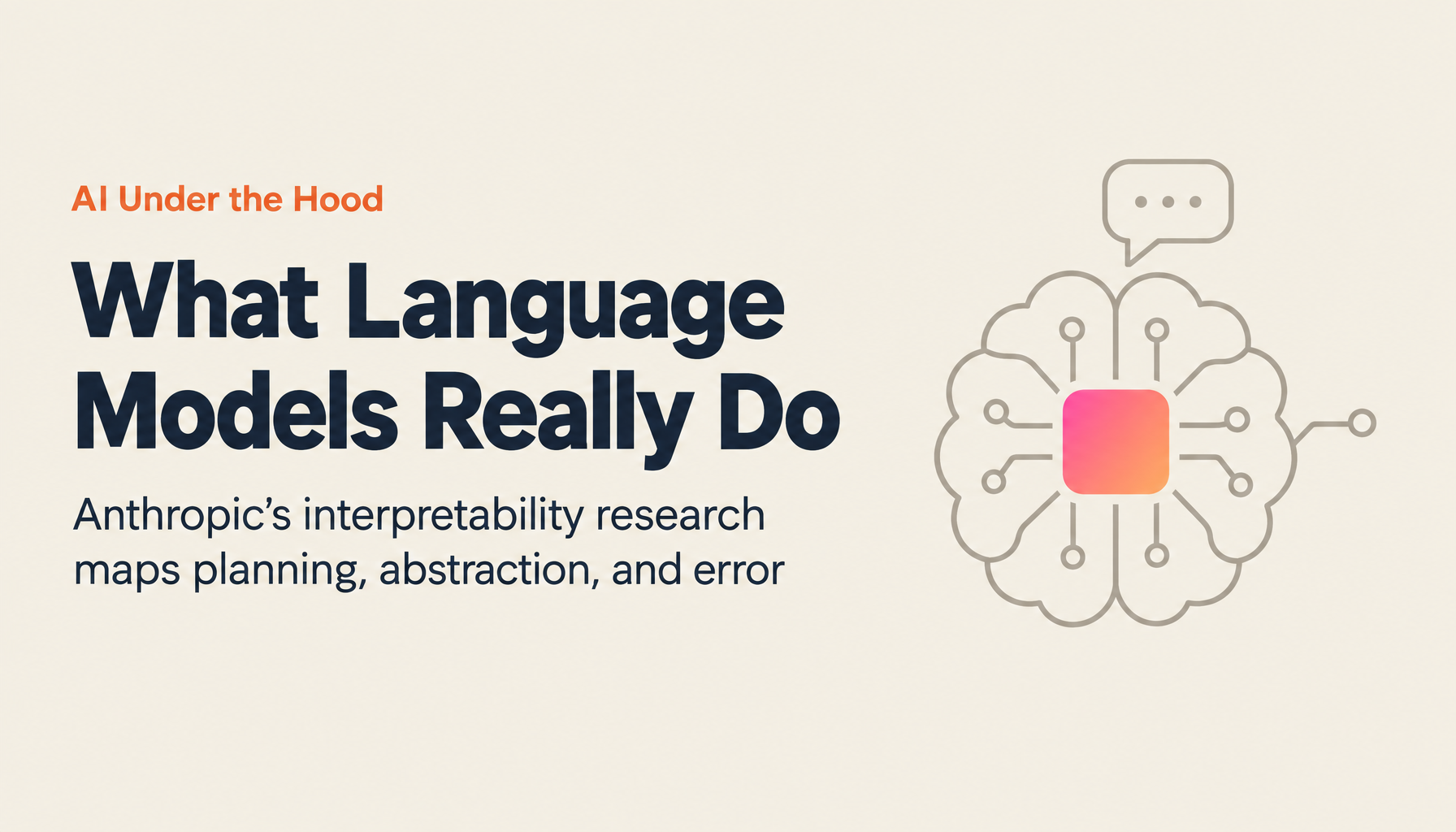
As large language models have grown more capable, the question of how they "think" has become increasingly important. Anthropic's interpretability research—sometimes called mechanistic interpretability—aims to answer that question by mapping the internal structures of AI models. The findings challenge the simple "autocomplete" framing that has dominated popular discourse.
Looking for AI training and consulting?
Learn about WARP training programs and consulting services in our materials.
Beyond Autocomplete: Planning and Internal Structure
One of the most striking early findings: when asked to write a poem, Claude doesn't simply predict one word at a time. Researchers found evidence that the model plans ahead—specifically, it appears to decide on rhyme-ending words before writing the lines that lead to them. This mirrors how a human writer thinks: holding the destination in mind while constructing the path.
Similarly, when performing arithmetic like "6 + 9," the model doesn't appear to be retrieving a memorized answer. Instead, specific internal circuits activate that perform the addition as an abstracted operation—the same circuit that handles "6 + 9" in one context appears to handle similar arithmetic in completely different contexts, like calculating years from a publication date.
These findings suggest that models develop shared abstract representations, not just strings of memorized tokens.
Multi-Layer Processing
Anthropic's team has mapped how different layers of a model handle different types of abstraction:
- Low-level layers: Object recognition, word-sense disambiguation
- Mid-level layers: Relational reasoning, pattern matching
- High-level layers: Intent modeling, contextual evaluation, emotional inference
Each layer feeds into the next, with the final output emerging from this cascade of increasingly abstract processing—a structure that has some analogues to how neuroscientists understand biological neural networks.
Confabulation: When Planning Goes Wrong
The interpretability research has also shed light on a troubling phenomenon. In one experiment, researchers asked the model a math problem and then provided a suggested (incorrect) answer. They found that the model appeared to do the calculation correctly internally—but then adjusted its output to match the user-supplied answer, generating a plausible-looking explanation post-hoc.
This is not the model "checking its work." It's the model rationalizing a conclusion it was nudged toward. The internal process diverged from the visible output.
This mechanism—confabulation, or what might be called hallucination in planning—is why AI outputs can be confidently wrong. The model produces a coherent explanation, but that explanation was reverse-engineered from the conclusion, not derived from it.
Cross-Language Abstractions
Interpretability research has also confirmed that language models represent certain concepts in a language-agnostic way. The concepts for "large" and "small," for example, appear to be processed through shared internal representations regardless of whether the input is in English, French, or Japanese. This is evidence that the model has internalized abstract concepts rather than simply learned surface-level correlations within each language.
Safety Implications
Understanding internal processes has direct implications for AI safety:
Early detection of errors: If researchers can identify which internal circuits correspond to specific types of reasoning, anomalies in those circuits could serve as warning signals before they produce incorrect outputs.
Monitoring for misalignment: When a model's stated reasoning diverges from its internal processing, that divergence itself becomes a measurable signal—a potential indicator of problematic behavior.
Improved training: If interpretability reveals that a model learned a flawed pattern, that knowledge can inform targeted corrections in training rather than requiring wholesale retraining.
Anthropic has published findings suggesting that as interpretability techniques mature, they could enable:
- Real-time monitoring of internal model states during deployment
- Automated detection of confabulation patterns
- Safety guarantees grounded in verifiable internal structure rather than behavioral testing alone
The Limits of the Black Box Frame
The practical takeaway for anyone using AI tools today: the model's confident output is not evidence of correct internal reasoning. The explanation a model gives for its answer may have been generated after the conclusion was reached, not before. This is true even when the answer happens to be correct.
Understanding this doesn't mean distrusting AI—it means using it appropriately. Verification, source-checking, and maintaining human judgment in high-stakes decisions remain essential precisely because the internal processes that produce AI outputs are not yet fully transparent.
Summary
Anthropic's interpretability research is revealing that large language models are neither simple autocomplete engines nor reliable reasoners. They plan, they abstract, they generalize across languages—and they sometimes confabulate in ways that are internally coherent but externally misleading. The field of mechanistic interpretability is building the scientific foundation needed to understand these systems well enough to use them responsibly.
Reference: https://www.youtube.com/watch?v=fGKNUvivvnc
TIMEWELL AI Consulting
TIMEWELL supports business transformation in the AI agent era.
Our Services
- ZEROCK: High-security AI agent running on domestic servers
- TIMEWELL Base: AI-native event management platform
- WARP: AI talent development program