Claude and MCP: How AI Connects to the External World—Anthropic's Next-Generation Protocol Explained
What MCP Actually Does
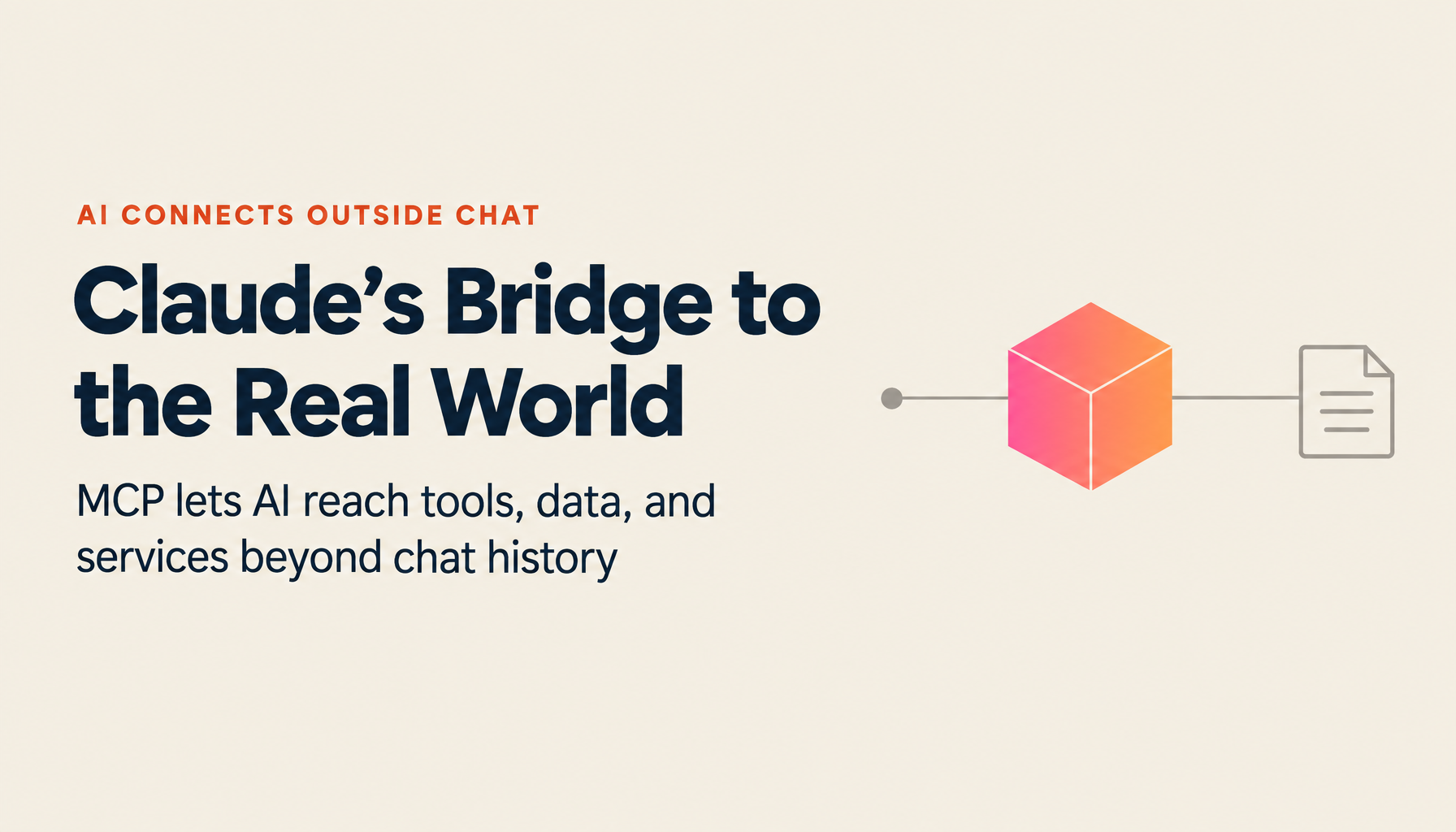
Modern AI is evolving from a chatbot into a genuine interface between people and the systems they work with every day. Model Context Protocol (MCP), developed by Anthropic, is the technical foundation making that possible—a standardized way for Claude and other AI models to access external data sources, tools, and services.
Without MCP, every AI integration required custom development: a bespoke connector for web search, another for Gmail, another for Slack, and so on. MCP replaces that fragmented approach with a single, open protocol. Build an MCP server once, and any MCP-compatible AI can use it.
Looking for AI training and consulting?
Learn about WARP training programs and consulting services in our materials.
The Core Concept: External Context
The fundamental limitation MCP addresses: AI models have traditionally only accessed what's directly in their context window—the conversation history and any documents explicitly uploaded. In practice, real work requires pulling from live systems: current web data, project management tools, cloud storage, internal databases.
MCP gives Claude a standardized way to reach outside its context window and interact with those systems. When a user asks Claude to "check the status of my GitHub PRs" or "summarize what happened in our Slack channel this week," MCP is the mechanism that makes those requests executable rather than hypothetical.
Anthropic engineers Alex, Michael, and John have described MCP in internal discussions as the bridge between Claude's reasoning capabilities and the external world where actual work happens. They noted that Anthropic itself uses Claude with MCP internally—for tasks like automatically generating Slack status updates and progress summaries on projects.
Remote MCP: From Complex Setup to Simple Connection
Early MCP implementations required developers to run MCP servers locally, which created friction. The introduction of remote MCP support changed this: external MCP servers can now be connected through a URL, dramatically lowering the barrier to getting started.
The same web search capability, for example, now works consistently across Claude Code and Claude.ai because both connect to the same MCP server—no duplicate implementation required.
Five Key Enterprise MCP Servers
| Server | What It Enables |
|---|---|
| GitHub | Read/write to repos, manage issues and PRs, code review in context |
| Slack | Read channel history, send messages, update status |
| Google Drive | Read and create documents, search organizational knowledge |
| Playwright (Browser) | Actually operate a web browser—navigate pages, fill forms, capture screenshots |
| Database | Query SQL databases in natural language, analyze data without exporting |
The Playwright MCP server deserves special mention. It enables a feedback loop that wasn't previously possible: Claude can render a webpage, observe how it actually looks in a browser, identify CSS or layout issues, propose fixes, and verify the results—all within a single automated cycle.
Design Principles for MCP Implementation
Anthropic's guidance from internal experience:
Keep tool sets small. When multiple MCP servers with overlapping functionality are connected simultaneously—say, both Linear and Asana for task management—the model can get confused by similar-sounding tool names. Focused, well-scoped tool sets perform better.
Write precise tool descriptions. The description of each MCP tool is part of the model's context. Vague descriptions produce inconsistent behavior. Think of tool descriptions as prompts: specificity matters.
Handle errors gracefully. What happens when an MCP tool fails or returns unexpected data? Robust servers provide the AI with enough information to respond appropriately rather than failing silently.
Provide usage examples. For image generation tools and similar capabilities, including example prompts in the tool description significantly improves output quality.
The Open-Source Ecosystem
Anthropic open-sourced MCP from the beginning, and the ecosystem has grown rapidly. Developers have built MCP servers for GitHub, Asana, Gmail, Slack, and many other services. A central registry provides a curated set of verified servers, making discovery more reliable than searching through individual repositories.
The open-source approach addresses a real problem with proprietary API integrations: when specifications change, integrations break. MCP's standardized protocol provides a stable foundation that survives version changes and makes cross-vendor compatibility tractable.
Practical Use Cases
Smart home integration: John from Anthropic's team runs MCP servers connected to his home security system and appliances. He can ask Claude to check whether the front door is locked before leaving for work—and instruct Claude to lock it if needed.
Knowledge graph management: Another internal experiment uses a knowledge graph MCP server that lets Claude organize and cross-reference information gathered across conversations. When a user mentions they play piano, Claude records that and can later surface relevant connections—like composer recommendations—when appropriate.
Log analysis: Enterprise teams are connecting server log systems to Claude via MCP, enabling natural-language queries like "what caused the spike in errors at 3am?" and automated incident response suggestions.
UI/UX improvement loops: The Playwright MCP server enables development teams to have Claude evaluate actual rendered pages—not just HTML source—and iteratively suggest and verify visual improvements.
Summary
MCP represents a meaningful architectural shift in how AI models integrate with the real world. Rather than building one-off connectors for every tool and service, organizations can invest in well-designed MCP servers that any compatible AI can use. As the open-source ecosystem matures and remote MCP adoption grows, the friction between AI capabilities and actual work systems continues to decrease. For enterprise teams, building good MCP infrastructure now creates durable AI capability that compounds as new models become available.
Reference: https://www.youtube.com/watch?v=aZLr962R6Ag
TIMEWELL AI Consulting
TIMEWELL supports business transformation in the AI agent era.
Our Services
- ZEROCK: High-security AI agent running on domestic servers
- TIMEWELL Base: AI-native event management platform
- WARP: AI talent development program