BitTensor, Crypto, and AI: Distributed Computing, Code Generation, and the Future of Work
Two Converging Waves
In the technology world, two massive forces are reshaping infrastructure and work simultaneously: AI and cryptocurrency. This article examines where they intersect, starting with BitTensor—a project that applies Bitcoin's core mechanism to distributed AI compute—then covering Tether's ongoing regulatory challenges, how AI is transforming software development, and the practical state of remote versus office work.
Looking for AI training and consulting?
Learn about WARP training programs and consulting services in our materials.
BitTensor (Tao): Bitcoin's Model Applied to AI
The Core Idea
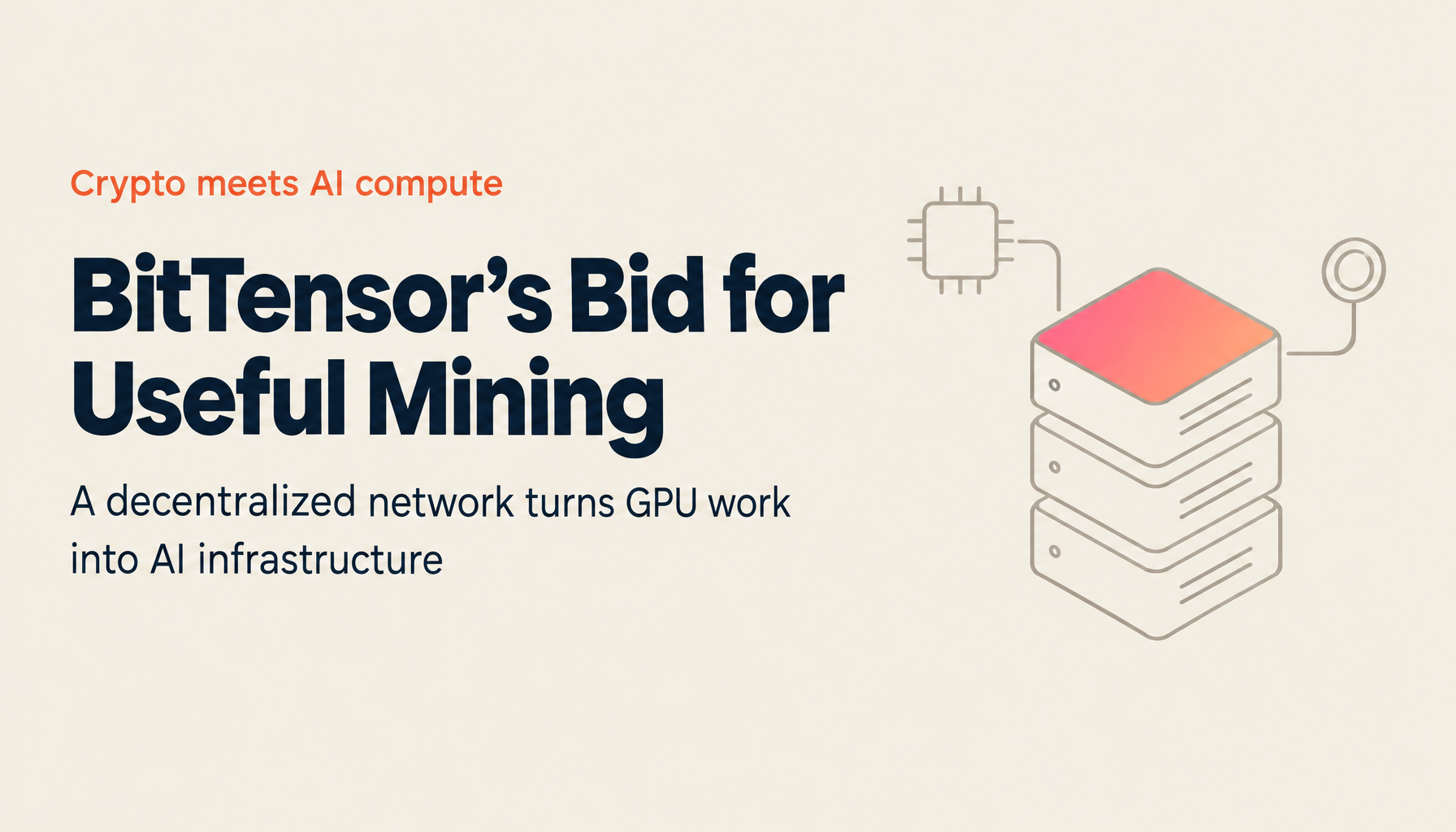
BitTensor is built around a simple but powerful observation: Bitcoin proved that you can build a massive, decentralized network by giving people economic incentives to contribute compute resources. Bitcoin's mining rewards convinced enough participants to provide processing power that the network became more robust than any centralized alternative.
BitTensor's creator, Marc Jeffrey, applies this insight to AI compute. The argument: Bitcoin's proof-of-work consensus mechanism is computationally expensive but produces "busy work"—calculations that secure the network but don't directly produce anything useful. What if the same incentive model directed compute toward AI tasks instead?
BitTensor sets the same maximum supply as Bitcoin (21 million coins, called Tao) to create scarcity and attract participants. But instead of competing in mathematical computations, participants contribute their GPU resources to the network and earn Tao by executing AI-related tasks—model training, inference, and data processing. The compute that maintains the network is also useful compute.
Network Architecture: Subnets
BitTensor isn't a single system—it's a collection of approximately 100 specialized subnets, each with a specific purpose.
Shoots and Targon: Distributed AI compute platforms that let users run AI models (DeepSeek, Mistral Large 2, others) at significantly lower cost than centralized cloud providers—reportedly around 85% cheaper than AWS equivalent. Payment is in Tao, with fiat currency support planned. Shoots is valued at approximately ¥12 billion; Targon at approximately ¥6.3 billion in market terms.
Ready AI: Focused on AI data annotation—generating the labeled training data that AI models require. Scale AI built a large business solving this problem with human annotators. Ready AI aims to automate the process using AI itself. The project involves Gil Elbaz, who previously sold AdWords to Google, suggesting serious backing.
Each subnet operates as a semi-independent economy, potentially with its own tokens. Market evaluation determines how much Tao each subnet receives from network emissions—subnets with higher market valuations (reflecting genuine user adoption) receive proportionally more rewards, creating market-driven quality incentives.
Governance
Launching a new subnet requires staking a quantity of Tao—currently worth approximately $100,000—which is locked temporarily but recoverable. This prevents irresponsible project proliferation while remaining permissionless. The balance between openness and commitment is central to the network's design.
Marc Jeffrey compares BitTensor's potential to Bitcoin and Ethereum. Where Bitcoin established value storage and transfer, and Ethereum established smart contracts and decentralized applications, BitTensor is attempting to establish decentralized AI compute as the third major use case. Barry Silbert (Digital Currency Group founder) has shifted significant attention to BitTensor, establishing an incubation program (Yuma) described as a "BitTensor Y Combinator."
Crypto's Ongoing Challenges: Tether and Regulation
Tether (USDT) remains the dominant stablecoin and the subject of persistent regulatory scrutiny. Its use in illegal transactions—documented in 60 Minutes, US Congressional hearings, and Chainalysis research—is an ongoing concern, though proponents note that cash is used in far larger volumes of illicit activity.
The crypto industry's broader regulatory environment shifted under the Gary Gensler SEC, which pursued aggressive enforcement that some argue pushed projects offshore and underground rather than improving outcomes. The Stablecoin Act under current consideration would impose new requirements on Tether and similar instruments.
Jason Calacanis (This Week in Startups) notes that many early crypto projects—"decentralized Uber," "decentralized Google"—failed to deliver, often because technical feasibility was never rigorously tested. DAO governance with anonymous teams created accountability gaps that enabled fraud. Former President Trump's involvement in NFTs and meme coins alienated many longtime crypto advocates who saw it as opportunistic rather than ideologically consistent.
BitTensor's design attempts to address some of these concerns through transparent market mechanisms, staking requirements that create accountability, and a genuine utility (AI compute) that justifies the incentive structure.
AI and Software Development: Code Generation at Scale
The Numbers
AI-generated code is no longer experimental. Google CEO Sundar Pichai has stated that over 30% of code committed internally is AI-generated. Microsoft CEO Satya Nadella cites 20–30% at Microsoft. Cursor's CEO claims the tool generates approximately 1 billion lines of accepted code per day.
These figures represent a fundamental shift in software production economics.
What Changes
The most significant bottleneck in startup growth over the past two decades has been developer availability—finding and affording enough engineering talent. AI code generation attacks this constraint directly. Projects that required 5 developers may become achievable with 1; teams of 30 may compress to 5 with equivalent output.
This changes the capital requirements for software startups (less needed for engineering headcount), the time-to-market timeline (faster iteration with fewer people), and potentially the total volume of software produced (bottleneck removal typically increases output).
Companies like Lightrun are developing systems where AI-generated code is improved by other AI systems—a more automated development loop. Some forecasts suggest 80–90% of code generation will be AI-handled within a few years.
The Human Relationship Problem in Fundraising
Interestingly, AI's impact on VC outreach has been to increase the value of warm introductions rather than reduce it. As AI tools enable mass generation of cold outreach emails, VCs are flooded with low-quality contact and respond by raising their reliance on trusted referrals.
Charles Hudson (Precursor Ventures) notes that founder success in fundraising depends increasingly on warm intros—connections through shared networks—rather than cold email volume. AI helps build lists and draft messages, but the fundamental trust-building remains human.
Effective cold outreach, when warm intros aren't available: 3–4 sentences, clear introduction, specific value proposition, concrete ask, expression of genuine interest in the investor's prior work, willingness to travel for a meeting. Quality over volume.
Remote Work vs. Office: Where It Actually Stands
The "office comeback" narrative has substance. Many technology companies, including Jason Calacanis's own operation, have moved back to office-primary work.
The stated reasons:
- Speed: in-person communication accelerates all work
- Energy: offices have a pace and intensity that's difficult to replicate remotely
- Focus: sustained remote work correlated with declining concentration and weakened culture
- Mentorship: junior employees develop faster with senior proximity; informal learning and accidental mentorship happen in offices
- Career proximity: access to decision-makers happens more naturally in shared physical space than through scheduled video calls
Co-host Ron Harris describes a personal experience: initially comfortable with remote work, then finding concentration harder to maintain after a few years, and social connections with colleagues fading.
The exception, not the rule: highly productive performers in remote locations may retain that flexibility. But for growth-oriented careers, especially early-career, office presence correlates with faster development.
AI in Business Intelligence: The Data Reality
The Layer Next case study from This Week in Startups illustrates a common AI business problem: the gap between what AI can theoretically do and what it can actually do given a specific customer's data environment.
Layer Next provides a CFO-oriented business intelligence platform. The practical challenge: each customer's data lives in different formats and systems. Making it AI-analyzable requires preprocessing work that's often more labor-intensive than the AI analysis itself.
Recommended approach:
- Define the Ideal Customer Profile narrowly—specific systems (e.g., Salesforce plus specific accounting software)
- Focus initial product on one specific problem type
- Engage early customers deeply ("bearhug strategy")—more customization, more consulting work, but generates the feedback needed to build toward scalable product
The lesson generalizes: AI business solutions face the reality of customer data environments. Success requires understanding those environments in detail, not just applying technology.
Summary
BitTensor represents a genuinely interesting attempt to apply Bitcoin's proven incentive mechanism to AI compute—creating a decentralized alternative to centralized cloud providers for AI workloads. Whether it achieves the scale of Bitcoin or Ethereum remains uncertain, but the underlying demand for cheaper AI compute is real and growing.
Crypto's broader challenges—Tether regulation, governance accountability, the mixed track record of decentralized projects—remain relevant context for evaluating any new project.
AI code generation is already transforming software development economics. The developer shortage that has defined tech hiring for two decades may be the next bottleneck to dissolve.
Remote work, after the pandemic experiment, is being evaluated more soberly. Office presence correlates with mentorship access, career proximity, and organizational speed—particularly for early-career employees.
And AI business solutions continue to run into the unsexy reality of customer data quality and system integration. The companies that solve this infrastructure problem, not just the AI application, will be the durable ones.
Reference: https://www.youtube.com/watch?v=16nd_lIy-lA
TIMEWELL AI Consulting
TIMEWELL supports business transformation in the AI agent era.
Our Services
- ZEROCK: High-security AI agent running on domestic servers
- TIMEWELL Base: AI-native event management platform
- WARP: AI talent development program