This is Hamamoto from TIMEWELL.
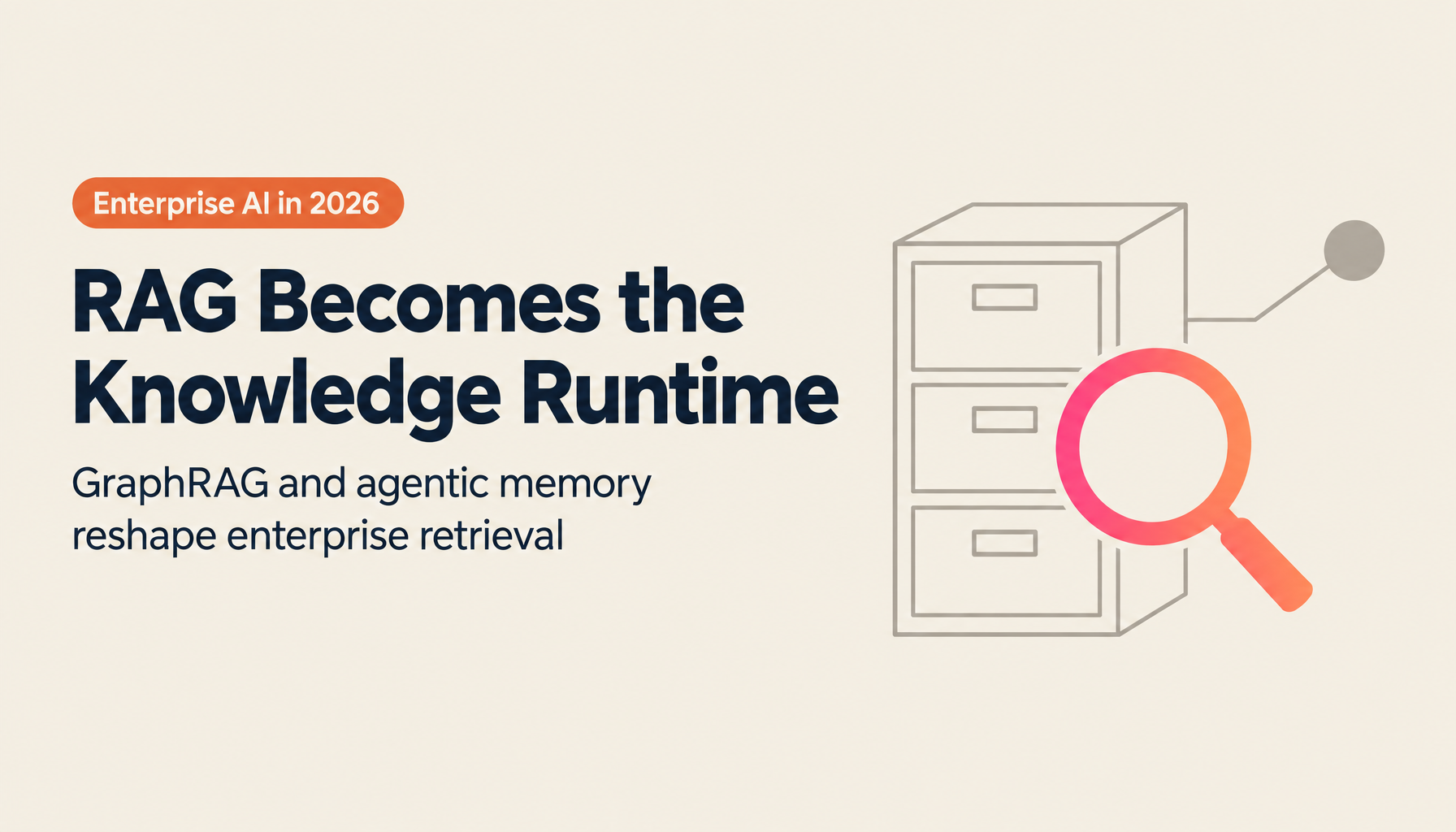
In 2026, RAG (Retrieval-Augmented Generation) has become a core technology in enterprise AI architecture.
The basic RAG pattern—search documents, add context, generate a response—is now outdated. 2026 RAG operates as a "knowledge runtime": an integrated system managing retrieval, verification, reasoning, access control, and audit trails together. GraphRAG reasons about relationships between entities. Agentic Memory maintains long-term context. Azure AI Search's agentic retrieval decomposes complex queries and executes them in parallel.
This article covers the state of RAG technology in 2026 and enterprise implementation best practices.
RAG in 2026: Quick Reference
| Item | Detail |
|---|---|
| Evolution | Knowledge runtime (integrated retrieval + verification + reasoning + audit) |
| GraphRAG | Entity relationship graphs, theme-level responses, Microsoft OSS |
| Agentic Memory | Long-term context retention, essential for agentic AI |
| Azure integration | Agentic retrieval, parallel subquery execution |
| Hybrid search | Vector + keyword + BM25 + metadata + graph |
| Enterprise adoption | Workday, ServiceNow integrating RAG natively |
| Cost | GraphRAG costs 3–5x basic RAG |
What RAG Means in 2026
The Evolution from Basic RAG
RAG enables large language models to reference external knowledge, improving response accuracy and currency.
Early RAG (circa 2023):
Question → Document search → Add to context → LLM response generation
2026 RAG (knowledge runtime):
Question → Query decomposition → Parallel search → Verification → Reasoning → Access control check → Audit log → Response generation
RAG as Knowledge Runtime
Enterprise RAG in 2026 functions as a knowledge runtime, not simply "search and answer."
Knowledge runtime characteristics:
- Retrieval: Hybrid search (vector + keyword + graph)
- Verification: Automatic accuracy and currency confirmation
- Reasoning: Synthesis across multiple sources
- Access control: Information filtering by user permissions
- Audit trail: Recording of response basis and source references
GraphRAG: Next-Generation RAG with Relationship Reasoning
How GraphRAG Works
GraphRAG combines traditional RAG with knowledge graphs.
Limitations of standard RAG:
- Weak on global questions like "What themes appear throughout this entire program?"
- Good at individual fact retrieval but poor at theme-level summarization
- Cannot account for relationships between entities
GraphRAG strengths:
- Builds entity relationship graphs from the entire corpus
- Answers theme-level questions with full traceability
- Enables comparative analysis across multiple sources
GraphRAG Architecture
Document corpus
    ↓
Entity extraction (node creation)
    ↓
Relationship extraction (edge creation)
    ↓
Knowledge graph construction
    ↓
Query time: Graph traversal + vector search
    ↓
Response generation incorporating relationships
GraphRAG limitations:
- Knowledge graph extraction costs 3–5x basic RAG
- Requires domain-specific tuning
- Construction and maintenance require specialized expertise
Microsoft Open Source Release
Microsoft has released GraphRAG as open source, accelerating enterprise adoption.
GraphRAG use cases:
- Cross-document legal analysis
- M&A due diligence
- Regulatory compliance checking
- Research paper theme analysis
Struggling with AI adoption?
We have prepared materials covering ZEROCK case studies and implementation methods.
Agentic Memory: Essential Technology for Agentic AI
Limitations of Static RAG
Traditional RAG is effective for static knowledge retrieval but insufficient for agentic AI workflows.
Problems with static RAG:
- Context lost between sessions
- Cannot learn from feedback
- Cannot maintain state
- Cannot exhibit adaptive behavior
The Emergence of Agentic Memory
In 2026, Agentic Memory has become essential for operating agentic AI systems.
Agentic Memory characteristics:
- Learning from feedback
- State maintenance across sessions
- Long-term context retention
- Adaptive workflows
When to use RAG vs. Agentic Memory:
| Use case | RAG | Agentic Memory |
|---|---|---|
| Static data retrieval | ◎ | △ |
| Real-time adaptation | △ | ◎ |
| Long-term context retention | × | ◎ |
| Feedback learning | × | ◎ |
| Agentic workflows | △ | ◎ |
2026 Implementation Pattern
Agentic AI Architecture (2026)
    │
    ├── RAG layer (static knowledge)
    │   └── Internal documents, FAQ, policies
    │
    ├── Agentic Memory layer (dynamic context)
    │   └── Conversation history, feedback, learned results
    │
    └── Orchestration layer
        └── Selects RAG or Memory based on situation
Azure AI Search Agentic Retrieval
Automatic Complex Query Decomposition
Azure AI Search provides a new search pipeline called agentic retrieval.
How agentic retrieval works:
- LLM analyzes complex user query
- Decomposes into multiple focused subqueries
- Executes subqueries in parallel
- Returns structured responses optimized for chat completion models
Differences from traditional search:
| Item | Traditional search | Agentic retrieval |
|---|---|---|
| Query processing | Single query execution | Decomposed into parallel subqueries |
| Result format | Document list | LLM-optimized structured data |
| Complex queries | Difficult | Automatically decomposed |
Hybrid Search as the Standard
Enterprise RAG in 2026 uses hybrid search as the default.
Hybrid search components:
- Semantic vector search: Meaning-based similarity
- Keyword search: Exact and partial matching
- BM25: Statistical relevance scoring
- Metadata filtering: Date, category, permissions
- Graph traversal: Entity relationship exploration
- Domain-specific rules: Industry-specific logic
Enterprise RAG Implementation Best Practices
Layered Architecture
2026 enterprise AI uses a layered architecture that positions RAG as the knowledge layer.
┌─────────────────────────────────────┐
│         Application layer           │
│    (Chat UI, dashboards)            │
├─────────────────────────────────────┤
│       Orchestration layer           │
│    (Agents, workflows)              │
├─────────────────────────────────────┤
│         Knowledge layer (RAG)       │
│  Accuracy · Currency · Traceability │
├─────────────────────────────────────┤
│           Data layer                │
│    (Documents, DB, APIs)            │
└─────────────────────────────────────┘
Data Quality Is Everything
RAG accuracy is directly tied to data quality.
Data preparation priorities:
- Digitize paper and analog materials
- Build structured databases
- Automate error detection and accuracy maintenance
- Apply and manage metadata
Common failure patterns:
- "Data preparation takes so long we never reach the deployment phase"
- "Staff find it too difficult to use and it becomes a formality"
- "Expectations escalate before accuracy is adequate"
Phased Implementation Approach
Recommended steps:
- Narrow the scope: Start with a specific domain—customer support, quality control
- Build a minimum dataset: Prioritize digitization of paper and existing files
- Pilot highest-impact workflows first: Build success experience
- Create feedback loops: Usage improves data quality in a continuous cycle
Practical Implementation Scenarios
Financial and Insurance Policy Document Search
Input: "What cases are excluded from hospitalization benefits under this insurance policy?"
    ↓
RAG searches multiple policy documents
    ↓
GraphRAG analyzes relationships between relevant clauses
    ↓
Response generated with explicit source attribution
    ↓
"The following conditions result in exclusion:
 1. Intentional self-injury (see Article X)
 2. Hospitalization due to pre-existing conditions (see Article Y)
 ..."
Manufacturing Troubleshooting
On-site report: "Unusual noise on Line 3"
    ↓
RAG searches historical noise incidents
    ↓
Agentic Memory references this week's maintenance log
    ↓
"Analysis of 5 similar historical incidents indicates
 high probability of bearing wear.
 Inspection procedure: ..."
Legal Due Diligence
Input: "Analyze environmental-related risks for the target company"
    ↓
GraphRAG extracts entities from M&A documents
    ↓
Links environmental violations, litigation history, permit status
    ↓
"The following environmental risks have been identified:
 - 2022 Factory A discharge standard violation (fine paid)
 - Ongoing soil contamination investigation at Site B
 ..."
Then vs. Now: RAG Technology Evolution
| Item | Then (2023, basic RAG) | Now (2026, knowledge runtime) |
|---|---|---|
| Architecture | Search → context addition → generation | Integrated search + verification + reasoning + audit |
| Search method | Vector search only | Hybrid (vector + keyword + graph) |
| Graph support | None | GraphRAG entity relationship reasoning |
| Context retention | Within session only | Long-term via Agentic Memory |
| Query processing | Single query | Subquery decomposition, parallel execution |
| Enterprise integration | Limited | Workday, ServiceNow standard support |
| Operational load | High | Reduced through automation tools |
Technology Comparison
RAG vs. Fine-Tuning
| Item | RAG | Fine-Tuning |
|---|---|---|
| Data updates | Real-time possible | Requires retraining |
| Cost | Inference-time only | High training cost |
| Expertise | Search index management | ML expertise required |
| Traceability | Source attribution available | Black box |
| Application domain | Dynamic information | Fixed knowledge/skills |
RAG vs. Long Context Window
| Item | RAG | Long Context |
|---|---|---|
| Cost | Charged for search only | All tokens charged |
| Accuracy | Narrows to relevant information | Potential degradation from information overload |
| Scalability | Handles large-scale data | Context length limitations |
| Operations | Index management required | Simple |
Key Considerations
Benefits
1. Information accuracy and currency
- Suppresses hallucinations by referencing external knowledge sources
- Real-time information updates
- Explicit source attribution ensuring traceability
2. Enterprise readiness
- Integration with access control systems
- Automatic audit trail recording
- Compliance requirement support
3. Cost efficiency
- Lower cost than fine-tuning
- Only relevant information is retrieved and processed
- Phased implementation possible
Honest Limitations
1. Data preparation burden
- High-quality data determines RAG accuracy
- Digitization and structuring requires significant effort
- Ongoing maintenance necessary
2. GraphRAG cost
- 3–5x the cost of basic RAG
- Domain-specific tuning required
- Construction and maintenance require specialized expertise
3. Choosing the right technology
- Static knowledge retrieval: RAG
- Adaptive workflows: Agentic Memory
- Matching technology to use case is critical
Summary
In 2026, RAG has evolved from basic retrieval augmentation into a "knowledge runtime"—the foundational technology layer for enterprise AI.
Key points:
- From "search → append → generate" to integrated search + verification + reasoning + audit
- GraphRAG reasons about entity relationships, handling theme-level questions
- Agentic Memory maintains long-term context, essential for agentic AI operations
- Azure AI Search agentic retrieval automatically decomposes and parallel-executes complex queries
- Hybrid search (vector + keyword + BM25 + graph) is now the standard
- Enterprise platforms including Workday and ServiceNow integrate RAG natively
- GraphRAG costs 3–5x more than basic RAG but enables complex analysis
- Data quality determines RAG accuracy—preparation is not optional
From early RAG in 2023 to now is roughly three years. RAG has matured from "experimental technology" to "standard enterprise AI architecture." Advanced forms like GraphRAG and Agentic Memory have emerged, enabling appropriate technology selection by use case.
For organizations to achieve results with AI, the recommended approach is: prioritize data preparation, pilot RAG in a small domain, build success experience, then expand organization-wide. Companies that are "prepared" will pull ahead—now is the time to build the RAG foundation.