This is Hamamoto from TIMEWELL.
Imagining Jensen Huang's Perspective
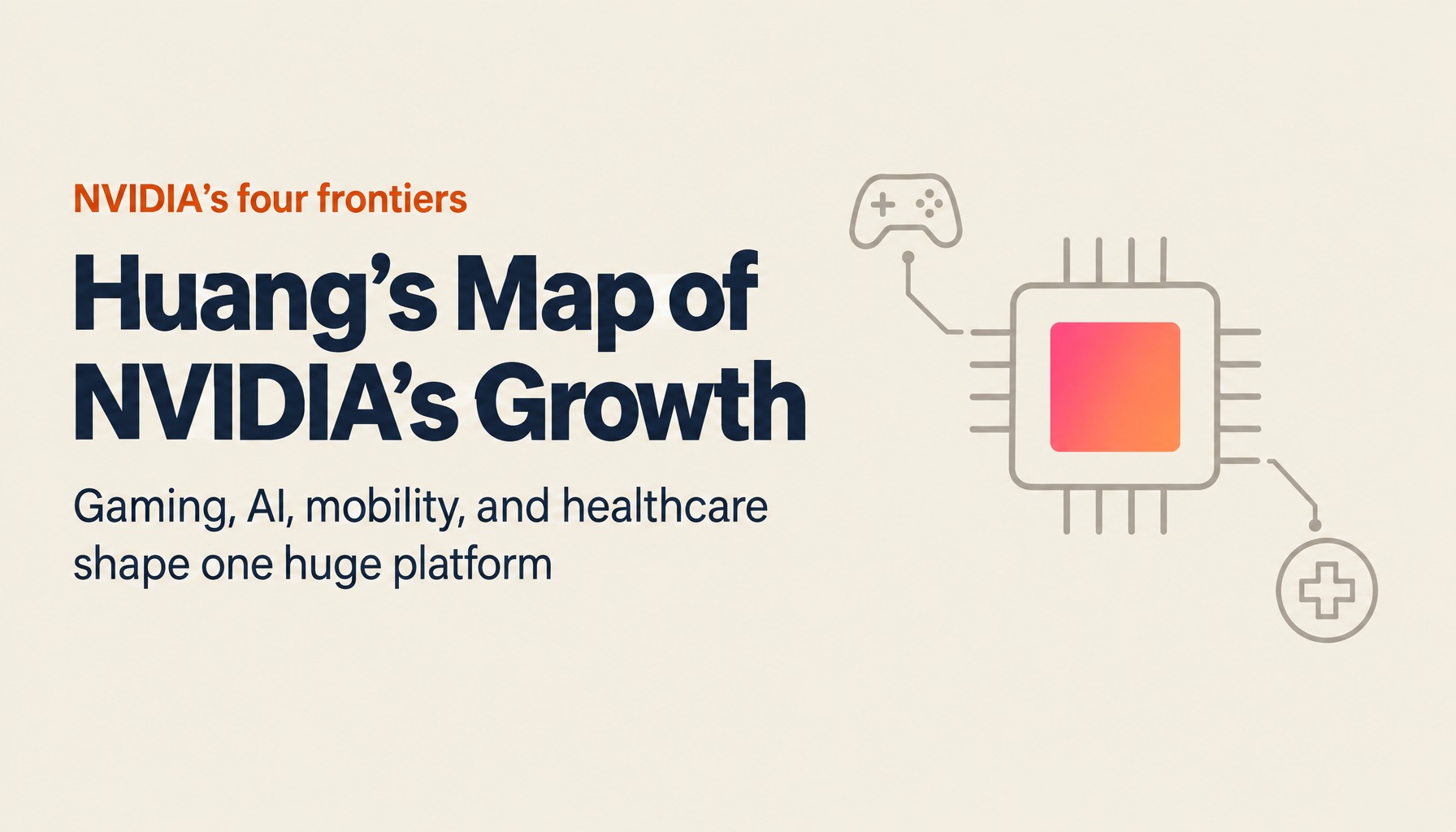
After watching NIO DAY, NVIDIA came up as a natural topic—the company's chips are foundational to autonomous vehicle computing. That got me thinking about how Jensen Huang likely maps NVIDIA's business across its major opportunity spaces.
Huang is Taiwanese-American, a genuine icon of Asian-born tech leadership. He came up at Sun Microsystems, then AMD as a microprocessor designer, and founded NVIDIA at 30. What follows is my own speculative take on how he probably thinks about NVIDIA's four major markets.
Market 1: Graphics and Gaming
This is where NVIDIA built its foundation, and it remains a substantial business. The company's partnership with Epic Games—announced in 2015—was a turning point for Unreal Engine's visual quality. NVIDIA GPUs are the engine behind the rendering capabilities that made modern gaming, virtual production, and real-time 3D environments possible.
Final Fantasy, Fortnite, and major entertainment franchises run on Unreal Engine. The 2020 Tomorrowland online festival and various digital concerts used similar visual infrastructure. My friend's company MOMENT TOKYO ran Japanese DJ online events using Unreal Engine—creating fully designed virtual spaces that simply weren't possible before.
The entertainment industry is not saturated for NVIDIA. Online exhibitions, live commerce (already mainstream in China, arriving in Japan), and virtual events continue expanding.
Looking for AI training and consulting?
Learn about WARP training programs and consulting services in our materials.
Market 2: Cloud Computing and Edge AI
COVID accelerated GPU server demand dramatically in 2020. But the more structurally important trend is the shift from cloud-only architectures to hybrid edge-cloud systems.
The logic is straightforward. For applications involving heavy data—factory vision systems, home security, autonomous vehicles—sending all data to the cloud creates two problems:
- Data volume: Sensor streams can overwhelm network bandwidth
- Latency: Even small delays can be catastrophic in safety-critical contexts
Edge computing compresses or fully processes data locally before any cloud involvement. NVIDIA's high-speed computation is the enabling technology here, and the company's lead in this space is significant enough that competitors have struggled to close the gap.
Cryptocurrency mining also benefits from NVIDIA's processing speed—mining efficiency scales directly with compute capability.
Market 3: Mobility (The Largest Opportunity)
This is the one I find most compelling from a market size perspective. At the time of writing, roughly 2–3 million intelligent vehicles—cars with substantial onboard computing capability—were being produced annually out of approximately 91 million total global vehicle sales. That's roughly 3% penetration.
The remaining 97% represents an eventual addressable market. Vehicle prices are typically 5–10x higher than smartphones, and the compute requirements per vehicle are dramatically higher. The compounding effect of this TAM is extraordinary.
Tesla's model demonstrates where this is going. The Model S was designed from the beginning with sufficient compute architecture to eventually support full self-driving—not as a retrofit but as a software update path. This is design thinking that most traditional automakers hadn't adopted. NVIDIA's GPU hardware is central to this trajectory across multiple manufacturers.
As more intelligent vehicles enter production—across Tesla, NIO, and the broader industry—NVIDIA's automotive computing revenue will grow accordingly.
Market 4: Remote Healthcare
One of the less-discussed NVIDIA opportunity spaces is healthcare. The evolution here has followed a clear progression:
Diagnostic imaging: High-resolution AI image processing has improved diagnostic accuracy across radiology, pathology, and ophthalmology. Stomach cancer detection rates, for example, improved from roughly 60% with human-only review to over 90% with AI-assisted analysis.
Anomaly detection: AI can identify patterns that human physicians systematically miss—particularly in large-volume screening contexts where doctor fatigue is a real factor.
Remote surgery and robotic procedures: High-speed computing enables remote surgical procedures in areas that previously required physical presence. Combined with advances in biotech and robotics, previously inaccessible surgeries are becoming feasible.
This healthcare trajectory will accelerate as biotech innovation compounds with AI capability gains—NVIDIA's compute sits at the center of that intersection.
The Bigger Picture
Jensen Huang is building a company that provides the computational infrastructure for multiple technology revolutions simultaneously: the visual computing revolution (gaming, entertainment), the AI revolution (cloud and edge), the mobility revolution (autonomous vehicles), and the healthcare revolution (medical AI and robotics).
Each of these markets is genuinely large. The combination is extraordinary. NVIDIA is less a chip company than an enabling infrastructure company for the most consequential technology transitions of the next decade.
TIMEWELL AI Consulting
TIMEWELL supports business transformation in the AI agent era.
Our Services
- ZEROCK: High-security AI agent running on domestic servers
- TIMEWELL Base: AI-native event management platform
- WARP: AI talent development program