This is Hamamoto from TIMEWELL
This is Hamamoto from TIMEWELL.
Looking for AI training and consulting?
Learn about WARP training programs and consulting services in our materials.
AI as Co-Pilot
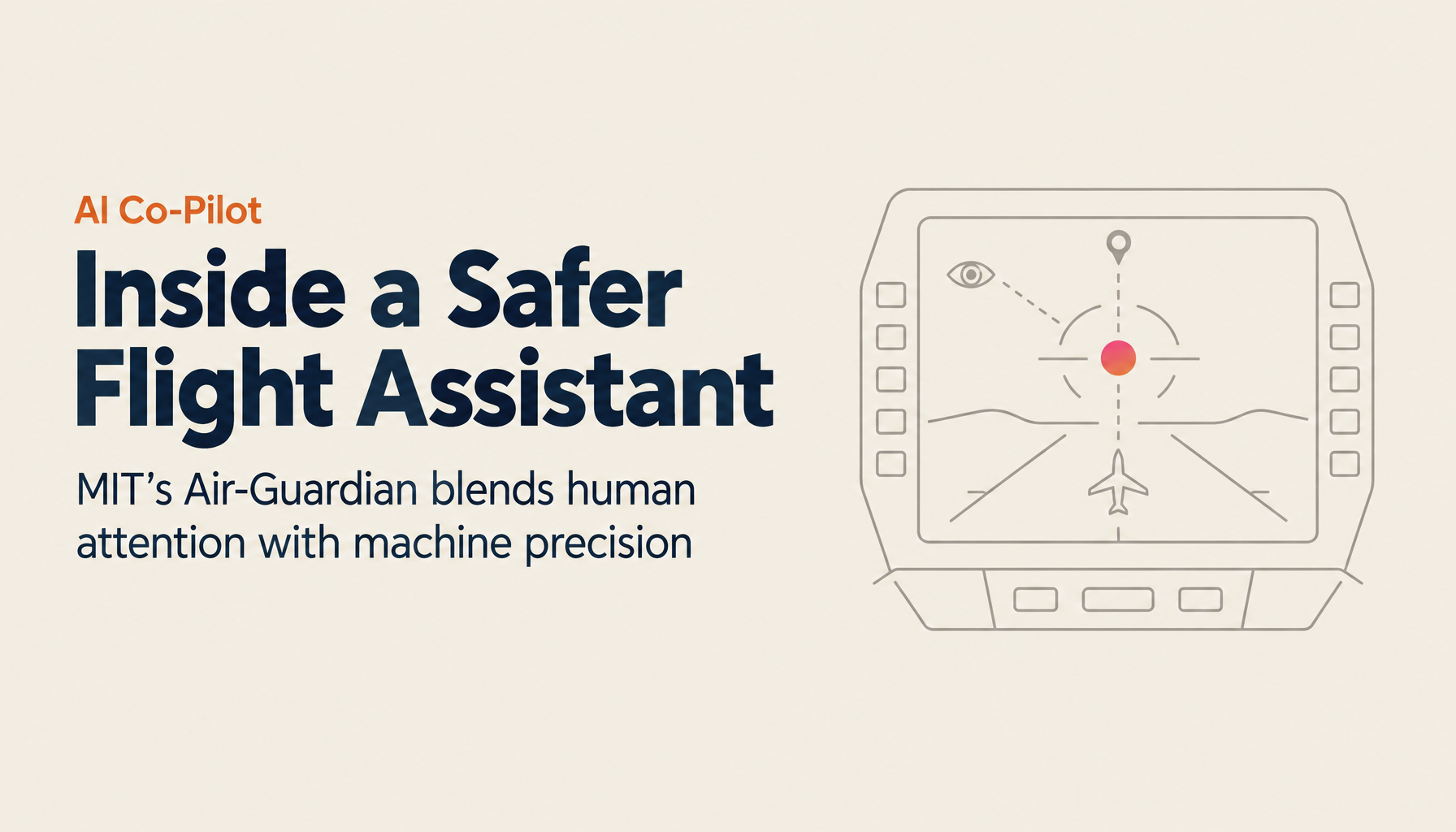
AI as Co-Pilot! A New Aviation Safety Standard
MIT CSAIL develops "Air-Guardian."
Technology: liquid neural networks and VisualBackProp algorithm.
Improved navigation success rate and reduced flight risk.
Rachel Gordon | MIT CSAIL Published: October 3, 2023
[Full Translation]
[Full Translation] "Air-Guardian" is designed to ensure safer skies, combining human intuition with machine precision to build a more symbiotic relationship between pilots and aircraft.
Imagine you are on an airplane, and one human and one computer are piloting the aircraft. Both are operating the controls but always paying attention to different things. When they are paying attention to the same thing, the human pilots. But when the human becomes distracted or misses something, the computer immediately intervenes.
Introducing "Air-Guardian." This is a system developed by researchers at MIT's Computer Science and Artificial Intelligence Laboratory (CSAIL). As modern pilots grapple with an onslaught of information from multiple monitors, particularly in critical moments, "Air-Guardian" functions as an active co-pilot. It is a partnership between human and machine grounded in understanding attention.
So how does it assess attention? For the human, it uses eye-tracking; for the neural system, it relies on what are called "interest maps." These identify where attention is being directed. These maps function as visual guides highlighting key regions in an image, helping to grasp and decode the behavior of complex algorithms. Rather than intervening only during safety violations like traditional autopilot systems, Air-Guardian identifies early signs of potential risk through these attention markers.
The broader implications of this system extend beyond the aviation industry. Similar cooperative control mechanisms could someday be used in cars, drones, and even a wider range of robotics.
"An Exciting Feature of Our Approach Is Its
"An exciting feature of our approach is its differentiability," says Lianhao Yin, a postdoc at MIT CSAIL and lead author of a new paper on Air-Guardian. "Our cooperative layer and overall end-to-end process are trainable. We specifically chose causal continuous-depth neural network models for their dynamic properties in mapping attention. Another unique aspect is adaptability. The Air-Guardian system is not rigid and can adjust based on situational demands, ensuring a balanced partnership between human and machine."
In field tests, both the pilot and the system made decisions based on the same raw images while navigating to intended waypoints. Air-Guardian's success was evaluated based on cumulative reward acquired during flight and the shortest path to waypoints. The Guardian reduced the risk level of flights and increased navigation success rates to the destination.
"This system represents an innovative approach to aviation through human-centered AI," adds Ramin Hasani, inventor of liquid neural networks and MIT CSAIL research affiliate. "By using liquid neural networks, we are providing a dynamic, adaptive approach where AI complements human judgment rather than simply replacing it. This improves safety and collaboration in the skies."
Air-Guardian's True Strength Lies in Its Underlying Technology
Air-Guardian's true strength lies in its underlying technology. It uses an optimization-based cooperative layer employing visual attention from both human and machine, and liquid closed-form continuous-depth neural network models (CfC)—known for their ability to decode cause-and-effect relationships—to analyze incoming images for critical information. Complementing this is the VisualBackProp algorithm, which identifies the system's focus within an image, ensuring a clear understanding of its attention map.
For future large-scale adoption, the human-machine interface will need to be refined. Feedback suggests a bar-like indicator showing when the Guardian system is taking control might be more intuitive.
Air-Guardian Heralds a New Era
Air-Guardian heralds a new era of safer skies, providing a reliable safety net for moments when human attention lapses.
"The Air-Guardian system further advances the goal of reducing operational errors by emphasizing synergy between human expertise and machine learning, using machine learning to complement pilots in challenging scenarios," says Daniela Rus, MIT's Andrew (1956) and Erna Viterbi Professor of Electrical Engineering and Computer Science, Director of CSAIL, and senior author of the paper.
"One of the most interesting results of using visual attention indicators in this work is the potential to allow for earlier intervention by human pilots and greater interpretability," says Stephanie Gil, Assistant Professor of Computer Science at Harvard University, who was not involved in this work. "This is a great example of how AI can be used to work collaboratively with humans, as a way to lower the barrier to achieving trust using natural communication mechanisms between human and AI systems."
This research was partially funded by the US Air Force (USAF) Research Laboratory, the USAF Artificial Intelligence Accelerator, Boeing, and the Office of Naval Research. The results do not necessarily reflect the views of the US government or USAF.
Reference: https://news.mit.edu/2023/ai-co-pilot-enhances-human-precision-safer-aviation-1003?ref=futurepedia
Image Reference: https://news.mit.edu/sit
Image reference: https://news.mit.edu/sites/default/files/styles/newsarticleimagegallery/public/images/202309/MIT-Air-Guardian%20.png?itok=DCAmkkW4
This AI news is produced by the online assistant service "TIMEWELL."
Related Articles
- From full-time to part-time: the reality of working through two maternity leaves and how it changed my perspective on work | TIMEWELL
- Before taking parental leave: the 3 must-do points to ensure you can take leave even during busy season
- Embracing the role of a hands-on certified architect: finding my own path as the 5th generation of Fujita Construction