This is Hamamoto from TIMEWELL.
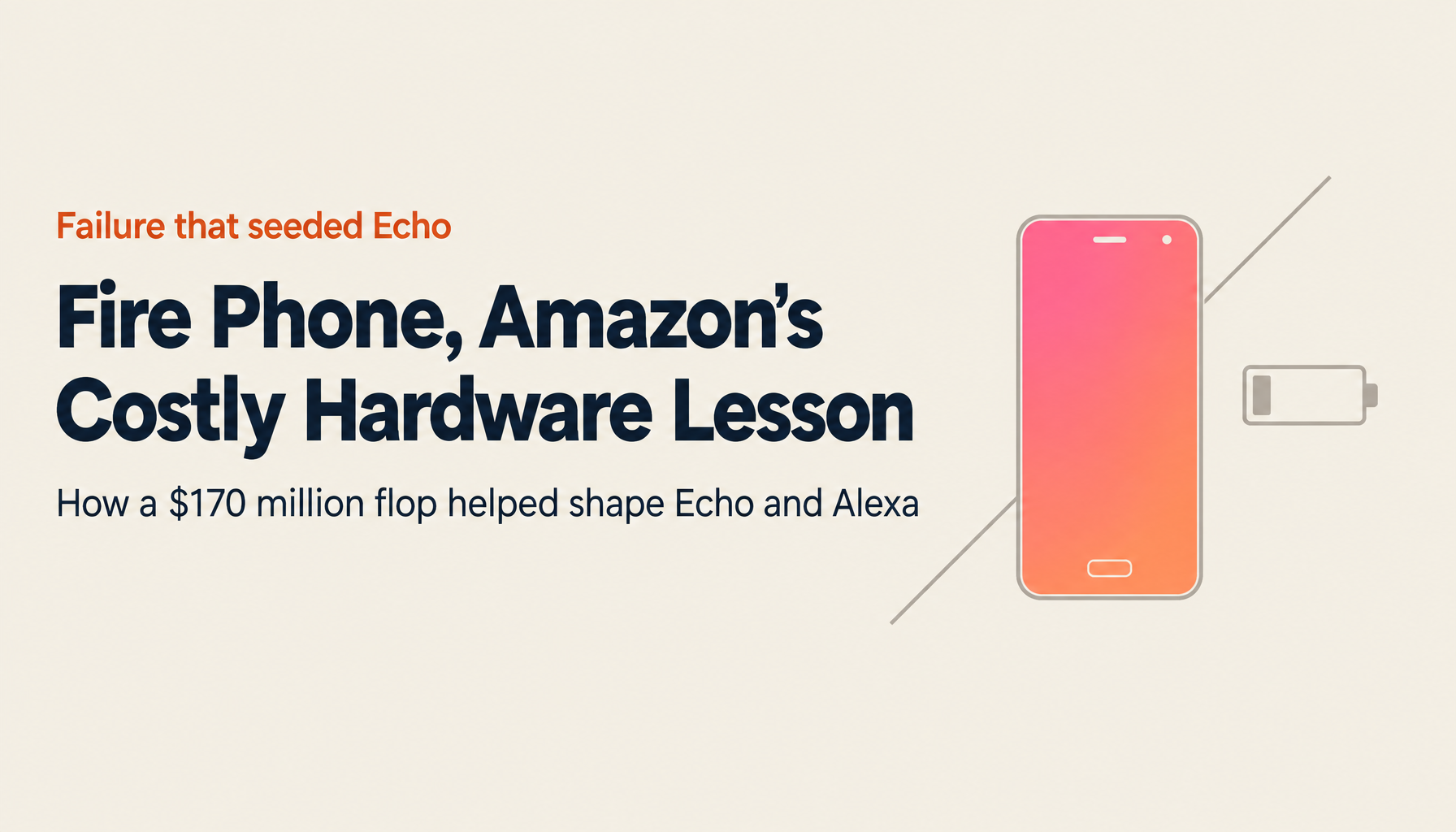
In 2014, Amazon launched the Fire Phone—and recorded $170 million (approximately ¥17 billion) in losses. It was the company's largest hardware failure.
Yet without that failure, the current Echo and Alexa success story might not exist. The Fire Phone development team subsequently led Echo, Fire TV, and Alexa—growing into products that captured 70% of the smart speaker market. At CES in January 2026, Amazon announced Alexa+ browser expansion and a new AI wearable called "Bee," marking a new phase in Amazon's hardware strategy.
This article traces the lessons from Fire Phone's failure and how they transformed into Amazon's success.
Fire Phone vs. 2026 Amazon Ecosystem: Quick Reference
| Item | Fire Phone (2014) | 2026 Amazon Ecosystem |
|---|---|---|
| Products | Fire Phone | Echo, Fire TV, Alexa+, Bee |
| Pricing | iPhone-equivalent premium | Accessible price points |
| Strategy | Vertical integration (single device) | Horizontal expansion (multi-device) |
| Market share | Catastrophic failure | ~70% smart speaker market |
| Result | $170M loss | Smart home market leader |
| 2026 moves | — | Alexa+ browser, Bee announced |
Why Amazon Built the Fire Phone
The Hardware Pivot
In 2007, Amazon entered the hardware market with the Kindle—a major success. As Apple's iPhone and Android rapidly expanded the smartphone market, Amazon began looking for a more direct customer relationship. The answer, they concluded, was a smartphone.
Background factors:
- Confidence from Kindle's success
- Threat from iPhone and Android's market dominance
- Drive to provide direct access to Amazon's services
- Establishment of Lab126 (Amazon's internal hardware division)
Jeff Bezos's Deep Involvement
CEO Jeff Bezos was deeply involved in Fire Phone development—and this involvement was a core problem.
Former team members have described the experience as "building a phone for Bezos, not for customers." Technical innovation was prioritized over practical usability. The result: a device that was technically impressive and practically frustrating.
Fire Phone's Features—and Why They Failed
Dynamic Perspective (3D Display)
Four infrared projectors on the front of the device tracked head movements to create a 3D effect on screen.
What it did: Head movement changed the apparent depth of the home screen, maps, and apps—creating a diorama-like visual effect.
Why it failed: Constant sensor operation drained the battery rapidly. Important information (clock, battery level) wasn't always visible without tilting the phone. Ultimately perceived as a gimmick with no practical benefit.
Firefly (Product Recognition)
A dedicated button activated the camera to recognize products, barcodes, and QR codes, linking directly to Amazon purchases.
Why it failed: Recognition accuracy was inconsistent. Unintended products sometimes appeared. The feature felt like a forced Amazon shopping funnel—useless for customers who wanted to buy elsewhere.
FireOS and the Ecosystem Problem
Fire Phone ran Amazon's modified Android (FireOS), which excluded the Google Play Store.
Critical failure: No Gmail. No Google Maps. No YouTube. No access to the apps people use every day. A smartphone without the core applications its users depend on is not a smartphone—it's a very expensive brick.
Looking for AI training and consulting?
Learn about WARP training programs and consulting services in our materials.
Specs and Pricing
Hardware
| Spec | Fire Phone |
|---|---|
| Display | 4.7" 720×1280 |
| Processor | Snapdragon 800 |
| RAM | 2GB |
| Storage | 32GB / 64GB |
| Rear Camera | 13MP |
| Battery | 2,400mAh |
The specs were solid for 2014. But Dynamic Perspective and Firefly's continuous operation drained the battery dramatically, making daily use impractical.
The Pricing Contradiction
- Launch price: $199 (2-year contract), $649 (no contract)
- iPhone-equivalent pricing
Amazon's established hardware strategy: sell at or near cost, profit from content and services. Fire Phone ignored this—competing with iPhone pricing while delivering a worse experience. Six weeks after launch, the price dropped to $0.99.
The Numbers: $170 Million in Losses
- Inventory write-down: ~$83 million
- Total loss: ~$170 million
- Sales estimate: A small fraction of initial projections
- Production ended: Within one year of launch
The Root Causes
1. The customer wasn't the focus. Amazon's fundamental strength is customer obsession. Fire Phone prioritized CEO curiosity and technical ambition over what customers actually needed.
2. Pricing contradicted Amazon's strategy. Amazon wins through low prices and broad reach. Fire Phone tried to compete vertically—like Apple—without Apple's ecosystem.
3. No ecosystem. Excluding Google Play meant no Gmail, no Maps, no YouTube. For mainstream consumers, these aren't optional features.
Fire Phone Failure → Echo and Alexa Success
The Team Transfer
After the Fire Phone failure, Amazon didn't disband the team. They moved to other projects.
Dave Limp, VP of Amazon Smart Home devices:
"The Fire Phone development was like walking through fire. It was an extremely intense product development process, but we learned a great deal. The Fire Phone team became the seed for many other teams."
"I'd take 20 Fire Phone failures if it means we get another Alexa or Echo 100% of the time."
Applying the Lessons
| Fire Phone Failure | Echo / Alexa Improvement |
|---|---|
| High price point | Accessible pricing (from $99) |
| Single proprietary device | Multi-device ecosystem |
| Gimmick features | Practical voice assistant |
| Google excluded | Open skills development |
| Vertical integration | Horizontal expansion |
The result: Echo captured approximately 70% of the smart speaker market.
2026: Amazon's Current Hardware Strategy
CES 2026 Announcements
Amazon's CES 2026 announcements reflect what was learned from Fire Phone:
Alexa+ Browser Expansion:
- AI assistant independent of any single device
- Accessible via web browser
- Evolved cross-platform strategy
Bee (AI Wearable):
- Technology from a 2025 acquisition
- New AI experience in a new form factor
- Echoes Fire Phone's "hardware ambition"—but with a different approach
Fire TV Updates:
- Deeper AI feature integration
- Expanded Alexa capabilities
What's Different from 2014
- No reliance on a single device
- Works alongside existing ecosystems rather than against them
- Price prioritizes accessibility
- Customer needs come first
Then vs. Now: Fire Phone to Alexa Ecosystem
| Item | Fire Phone (2014) | 2026 Alexa Ecosystem |
|---|---|---|
| Product strategy | Single device | Multi-device (Echo, Fire TV, Bee, etc.) |
| Pricing | Premium (iPhone-equivalent) | Accessible, reach-first |
| Ecosystem | Closed (Google excluded) | Open (skills, integrations) |
| Market result | $170M loss | ~70% smart speaker share |
| AI strategy | Limited (Firefly) | Alexa+ cross-platform |
| Customer focus | Technology-driven (CEO's vision) | Customer-centered (utility-first) |
| Device dependence | Hardware-locked | Browser-accessible |
Innovation Strategy Lessons
1. Never lose the customer focus. No matter how innovative, if customers don't need it, it fails.
2. Build on your competitive strengths. Amazon's advantages are low prices, convenience, and selection. Fire Phone abandoned all three.
3. Ecosystems beat features. A good device in a closed ecosystem loses to a mediocre device in an open one.
4. Learn from failure. Fire Phone's losses made Amazon stronger. Redeploying the team and their knowledge to Echo and Alexa turned $170M in losses into market leadership.
Summary
Amazon Fire Phone is both Amazon's largest failure and the origin of its greatest hardware success.
Key points:
- 2014 launch; $170M in losses
- Dynamic Perspective and Firefly: technically innovative, practically unusable
- iPhone-equivalent pricing contradicted Amazon's low-price strategy
- No Google Play = "basically unusable" in practice
- Fire Phone team led Echo, Alexa, and Fire TV to success
- ~70% smart speaker market share achieved
- 2026 CES: Alexa+ browser expansion, AI wearable Bee announced
- Return to customer-centered thinking drove Amazon's hardware recovery
The Fire Phone lesson—12 years on—is about the importance of learning from failure. Amazon turned $170 million in losses into an investment in Alexa and Echo's success. Customer focus, ecosystem compatibility, and a culture that learns from failure rather than hiding it: these are the lessons every organization building in technology needs.