Hello, this is Ryuta Hamamoto from TIMEWELL. When I talk with Japanese exporters about compliance, Appended Table 2 of the Export Trade Control Order is the piece that most often goes missing. Teams put real effort into classifying products under Appended Table 1, Japan's security list control, and once they get "not controlled," they ship. Appended Table 2 is a different list. It covers CITES-listed leather goods, rough diamonds, hazardous waste, ozone-depleting substances, mercury-added products and, since January 2026, carbon dioxide sent abroad for carbon capture and storage (CCS). If your goods are on it, you need METI's approval to export, even if Appended Table 1 never mentions them.
I rebuilt this article on October 4, 2026, by checking the current e-Gov text of the Order (the version effective June 5, 2026) against every version in force since 2025. The July edition got two things wrong: how the North Korea and Russia rules are structured, and how long administrative sanctions can last. Both are fixed below, and the full item list now shows destinations and practical notes. If your company trades with Japan, or you run a Japanese subsidiary, this is the table your Japanese export team should be checking alongside Appended Table 1.
The 30-second version. Appended Table 2 of Japan's Export Trade Control Order sets out, under Article 48(3) of the Foreign Exchange and Foreign Trade Act (FEFTA), the goods (middle column) and destinations (right column) that need an export approval from Japan's Minister of Economy, Trade and Industry. As of October 4, 2026, 23 rows are live, covering rough diamonds, blood products, nuclear material, fishing vessels, ozone-depleting substances, hazardous waste, mercury, CO2 for CCS, CITES specimens and cultural property. It is a separate track from the Appended Table 1 license, which is about security, so a "not controlled" result under Appended Table 1 leaves Appended Table 2 unanswered. Approvals that turn on destination or counterparty, such as those for North Korea, Russia and Belarus, are set by separate tables, Appended Tables 2-2, 2-3 and 2-4, and by Article 2 of the Order. Exporting without approval can bring up to five years in prison or a fine of up to 10 million yen under FEFTA Article 69-8.
What Appended Table 2 Is, and How an Approval Differs from a License
Japan's Export Trade Control Order (Cabinet Order No. 378 of 1949, "the Order") has two tables with confusingly similar names: Appended Table 1 and Appended Table 2. Japanese practitioners shorten them to "betsu-1" and "betsu-2." The legal basis is different, and so is the interest each one protects. Mix them up and your screening process falls apart. If you want the layout of the whole Order first, start with What is Japan's Export Trade Control Order? A map of Appended Tables 1 and 2.
Appended Table 1 lists goods that need an export license. The basis is Article 48(1) of the Foreign Exchange and Foreign Trade Act (Act No. 228 of 1949, "FEFTA") and Article 1 of the Order. It exists for international peace and security, and it draws lines around weapons and goods that could be diverted to military use by technical specification1. I cover rows 1 to 16 and how to look them up in our guide to Appended Table 1.
Appended Table 2 lists goods that need an export approval. The basis is FEFTA Article 48(3) and Article 2(1)(i) of the Order21. Article 48(3) allows METI to impose an approval requirement where necessary to maintain the balance of international payments, to support the sound development of foreign trade and the national economy, to implement treaties and other international commitments Japan has made in good faith, to contribute to international efforts for peace, or to carry out a Cabinet decision under Article 10(1). In other words, it serves treaty compliance, resource and environmental protection, and sanctions. That is a different job from security list control. If you want the license-versus-approval distinction in more depth, see how Japan's export license and export approval differ.
It also helps to know how the table reads. Each row has a middle column describing the goods and a right column naming the destinations, and an export needs approval when it matches both2. Most rows say "all destinations." Item 34 (frozen short-necked clams, hard clams and mussels), however, applies only to exports to the United States. Item 35-2 (hazardous waste) applies to all destinations except the high seas north of 60 degrees south latitude. Read the destination column every time, not just the item name.
| Point of comparison | Appended Table 1 (export license) | Appended Table 2 (export approval) |
|---|---|---|
| What you need | A METI license | A METI approval |
| FEFTA basis | Article 48(1) | Article 48(3) |
| Basis in the Order | Article 1 | Article 2(1)(i) (consignment processing: Article 2(1)(ii)) |
| Purpose | International peace and security | Treaty compliance, the national economy, balance of payments, international peace, Cabinet decisions |
| Typical goods | Weapons and goods that could be used to develop WMD or conventional weapons | Rough diamonds, CITES specimens, hazardous waste, ozone-depleting substances, mercury, CO2 for CCS, cultural property |
| How you decide | Technical parameters in the METI Ordinance on goods | Item, destination, and definitions in other laws and treaties |
| Penalty for exporting without it | Article 69-7 (up to 7 years; up to 10 years for WMD-related goods) | Article 69-8 (up to 5 years) |
The point to remember is that the two operate independently. A "not controlled" result under Appended Table 1 does not mean Appended Table 2 is cleared. And if goods need an Appended Table 2 approval but also fall under Appended Table 1, you need the license too. If you want a quick read on whether your process covers both, try our free export control readiness check.
Templates for the paperwork. Once Appended Table 2 is checked, you still have to document the Appended Table 1 side. We publish a Japanese-language set of classification and non-applicability certificate forms with a fill-in Q&A (Word), plus Excel sheets such as a catch-all check sheet and a classification log. It reflects the amendments effective February 14, 2026. Download the classification template pack (free; company name and work email required).
Every Live Item in Appended Table 2 (as of October 2026)
As of October 4, 2026, 23 rows of Appended Table 2 are live, meaning not marked "deleted." METI's own list of goods subject to export approval, last updated June 10, 2026, shows the same item numbers3. The statutory wording is long, so I have summarized the goods and added the destination and practical notes. Always confirm the exact scope in the e-Gov text and in the notices and ordinances each item refers to.
| Item | Goods (summary) | Destinations | Nature and notes |
|---|---|---|---|
| 1 | Diamonds (as specified by notice) | All | Kimberley Process. METI's list says "rough diamonds" |
| 19 | Blood products (as specified by notice) | All | METI's list says exports are banned in principle |
| 20 | Nuclear source material and nuclear fuel material, including spent fuel | All | Nuclear |
| 21 | Waste contaminated by nuclear material, material separated from spent fuel and similar (as specified by notice) | All | Radioactive waste |
| 21-2 | Radioisotopes (as specified by notice) | All | Radiation |
| 21-3 | Narcotic and psychotropic precursors and other chemicals used to make narcotics (as specified by ordinance) | All | Drug control. Partial small-value exemption |
| 25 | Vessels with fishing gear, fish processing equipment or storage equipment | All | Fishery resources |
| 30 | Shiitake mushroom spawn | All | Needs consent from the Minister of Agriculture. METI's list says exports are banned in principle |
| 34 | Frozen short-necked clams, hard clams and mussels | United States | Approval needed only for U.S.-bound exports |
| 35 | Substances in Annexes A, B, C and E of the Montreal Protocol | All | Ozone layer |
| 35-2 | (1) Specified hazardous wastes under Japan's Basel Act (2) Waste under the Waste Management Act | All except the high seas north of 60°S | For (2), a confirmation under the Waste Management Act comes first |
| 35-3 | Rotterdam Convention Annex III chemicals, ingredients of pesticides refused or cancelled, specified poisons, substances banned under the Industrial Safety and Health Act, Class I Specified Chemical Substances under the Chemical Substances Control Law, and more | All | Chemical safety. Grows when the referenced laws add substances |
| 35-4 | Mercury under the Minamata Convention, mercury-added products and products using them as parts | All | Mercury |
| 35-5 | CO2-containing gas exported for disposal (sub-seabed storage) under the London Protocol | All | Added January 19, 2026 |
| 36 | CITES Appendix I and II animals and plants, their parts, eggs, seeds, taxidermy, processed products and other derivatives (as specified by notice) | All | Biodiversity |
| 37 | Specimens, organs and processed products of species protected under Japan's Act on Conservation of Endangered Species | All | Domestic protection |
| 38 | Mist nets | All | Biodiversity |
| 39 | Counterfeit, altered or imitation currency, postage stamps and revenue stamps | All | Public order |
| 40 | Books, drawings and other goods that advocate or incite rebellion | All | Public order |
| 41 | Books, drawings, sculptures and other goods likely to harm public morals | All | Public morals |
| 43 | National treasures, important cultural properties, important tangible folk cultural properties, special natural monuments, natural monuments and important art objects | All | A license or confirmation under another law comes first |
| 44 | Goods infringing patents, trademarks, copyrights and similar rights in the destination country, or goods misleading as to origin (as designated) | All | METI's list says only goods misleading as to origin are currently covered |
| 45 | Goods subject to identification procedures under the Customs Act (suspected IP infringement) | All | Linked to customs procedures |
The first thing newcomers notice is the gaps. Rows 2 to 18, 22 to 24, 26 to 29, 31 to 33 and 42, 28 rows in all, simply read "deleted"2. When an item drops out, Japan keeps the number and marks it deleted, and new items are slotted in with sub-numbers like 35-5, so existing numbers never shift. The most recent deletion was Item 33, juvenile eels, removed on December 1, 2025. I trace that change in our list of 2025 to 2026 amendments to the Order. Plenty of older explainers still list items that have since been deleted, so before you export, confirm against the current e-Gov text and METI's list that the item is still there and which number it falls under.
Some items also involve more than METI. Shiitake spawn under Item 30 needs the consent of the Minister of Agriculture, Forestry and Fisheries before METI approves (Article 2(2) of the Order). For Item 35-2(2) and Item 43, a license or confirmation under another law, such as the Waste Management Act or the Act on Protection of Cultural Properties, must already be in hand (Article 2(3))2. A team that assumes "file with METI and we're done" tends to stall at the step before.
Replace siloed classification work with AI.
METI's FY2024 data shows 52% of foreign exchange law violations stem from classification errors. Download the TRAFEED product catalog covering features and rollout.
Approvals Set by Destination and Counterparty: Appended Tables 2-2, 2-3 and 2-4
Everything so far turns on what you ship. Article 2(1) of the Order also contains items (i)-2 through (i)-8, which require approval based on where the goods go and who you deal with2. Those items refer to three separate tables: Appended Table 2-2, Appended Table 2-3 and Appended Table 2-4. Watch the naming. Item 2 of Appended Table 2 is a deleted row; Appended Table 2-2 is a table in its own right.
North Korea falls under item (i)-2. Appended Table 2-2 has 36 categories, including frozen beef, caviar, alcoholic beverages, tobacco, perfume, leather handbags and wallets, fur products, pearls and precious stones, laptop computers, passenger cars, watches and works of art. A supplementary provision of the Order, however, rewrites item (i)-2 until April 13, 2027 to cover goods bound for North Korea in general. The only goods it leaves out are those that already need approval under Appended Table 2 itself, so in effect every export to North Korea needs approval. METI explains that imposing this approval requirement is how Japan bans those exports24. The Cabinet decided on April 8, 2025 to extend the measure for two years, from April 14, 2025 to April 13, 20274.
Russia and Belarus fall under items (i)-3 and (i)-4, which require approval to export goods listed in Appended Table 2-3. That table covers the goods in rows 1 to 15 of Appended Table 1 plus general-purpose goods specified by ministerial ordinance. The ordinance is the Ministerial Ordinance Specifying Goods under Appended Table 2-3 of the Export Trade Control Order (METI Ordinance No. 15 of 2022), last amended in a version effective January 23, 2025, according to e-Gov5. Items (i)-6 and (i)-7 go further: any export to Russia or Belarus needs approval when it involves a direct or indirect transaction with a person designated by public notice, whatever the goods. Item (i)-5 covers exports to the areas of Ukraine's Donetsk and Luhansk regions specified by notice, again regardless of the goods.
Third countries fall under item (i)-8. Appended Table 2-4 lists ten countries: the United Arab Emirates, Armenia, China, India, Kazakhstan, Kyrgyzstan, Syria, Thailand, Turkey and Uzbekistan2. This is often misread, so let me be precise. Exports to these countries do not all require approval. Approval is needed only when Appended Table 2-3 goods are exported in a direct or indirect transaction with a person designated by public notice. A designation is a regulatory classification under Japanese law, not a judgment about the country or the company. On October 2, 2026, Japan's Ministry of Foreign Affairs, Ministry of Finance and METI announced that four entities in countries other than Russia and Belarus had been added to the export ban, and that a ban on exports of goods that would strengthen Russia's industrial base would be introduced. The announcement does not list the goods or the effective date6.
What makes this area hard is that the scope moves through notices and ordinances. A transaction that needed no approval yesterday can need one today after a notice is amended. Checking the item table once is not enough; each transaction has to be matched against the counterparty and the current notices. METI's page on Russia-related sanctions warns that e-Gov may not yet show the latest law even after a new measure takes effect7. For screening procedures across sanctions lists, see our guide to sanctions lists.
Common Item-Based Cases: Diamonds, CITES, Waste, Chemicals and CCS
The list makes more sense with real cases. Each of these trips up companies that assume export control does not apply because they "don't sell weapons."
Rough diamonds and CITES
Rough diamonds fall under Item 1, and exporting them takes a Kimberley Process certificate as well as the approval8. The Kimberley Process is a certification scheme that keeps diamonds mined in conflict zones and used to fund armed groups out of legitimate trade. It applies to rough stones whether they are headed for jewelry, polishing or industrial use.
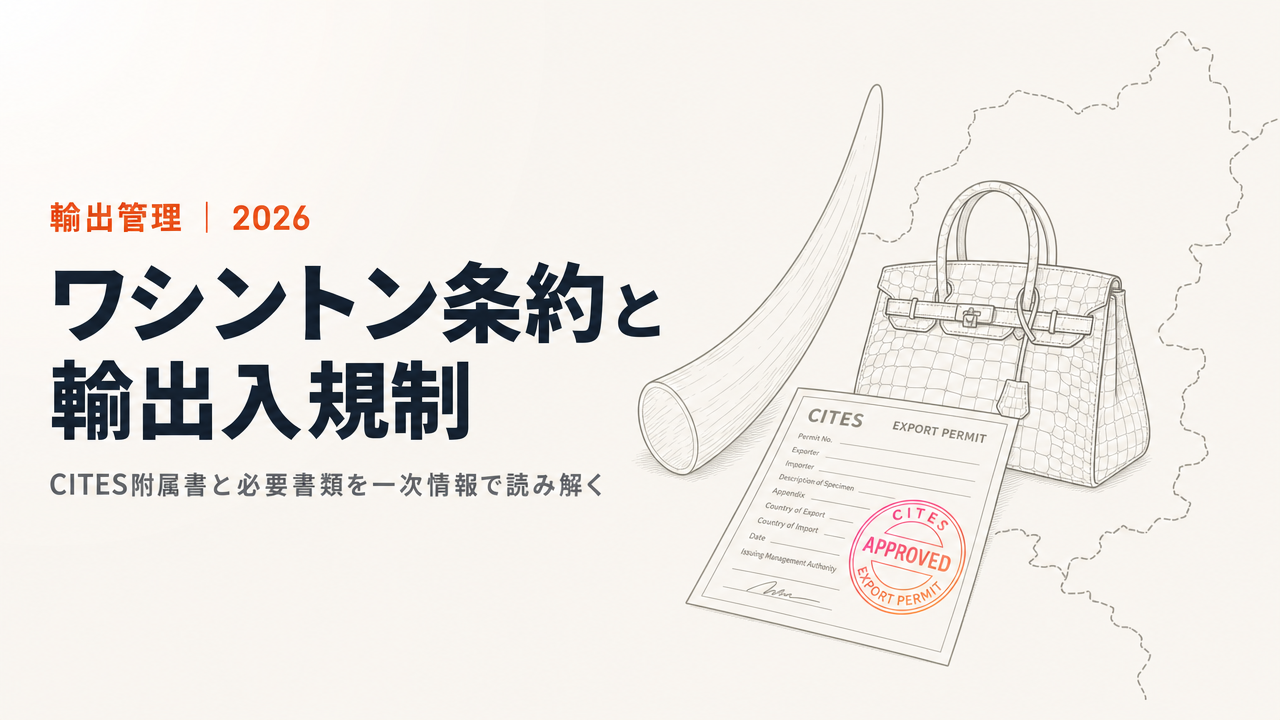
CITES is Item 36. It covers animals and plants of species listed in CITES Appendix I or II, along with their parts, eggs, seeds, taxidermy, processed products and other derivatives, to the extent designated by METI notice29. CITES itself works in three tiers: Appendix I species are in principle barred from commercial trade, Appendix II species need an export permit from the exporting country, and Appendix III species need an export permit or a certificate of origin1011. A leather handbag or belt, an ivory product, or an accessory made from reptile skin can fall under Item 36 depending on the species. Shipping your own leather goods to an overseas customer can be enough.
The appendices change at every Conference of the Parties. The amendments adopted at CoP20, held in Samarkand, Uzbekistan from November 24 to December 5, 2025, took effect on March 5, 2026, with some species delayed until June 5, 202712. Item 36 refers to the appendices but leaves the Japanese scope to METI notice, so check how the species you use is treated in the current notice. Species protected under Japan's domestic Act on Conservation of Endangered Species (Act No. 75 of 1992) are covered separately in Item 37. For how the convention works, see our CITES export and import guide.
Hazardous waste and consignment processing
Hazardous waste is Item 35-2. Part (1) covers specified hazardous wastes under Japan's act implementing the Basel Convention (Act No. 108 of 1992). Part (2) covers waste under the Waste Management Act, and for part (2) an export confirmation under that act must come before the approval2. More companies now ship used circuit boards, metal scrap and spent batteries abroad as resources, and depending on the hazard assessment, an approval may be needed. It is the classic case of recycling turning into a violation, and Japan Customs' list of other export-related laws covers it too13.
Consignment processing is a little different, because its basis is Article 2(1)(ii) of the Order rather than the item table2. Where a Japanese company contracts with someone abroad to process goods, and the processing is a type designated by METI, the raw materials need approval when they are exported. The typical case is sending leather, fur and leather goods to an overseas factory to be made into shoes, bags or clothing and then brought back to Japan14. The approval sits with the party exporting the raw materials, not the party importing the finished goods, and that reversal is where first-timers usually stumble.
Chemicals: items that grow without the Order changing
For chemical makers and traders, the items that matter most are 21-3, 35, 35-3 and 35-4: narcotic precursors, ozone-depleting substances, Rotterdam Convention chemicals and Class I Specified Chemical Substances, and mercury. Each one borrows its definition from another law or treaty2. When the referenced law adds a substance, Appended Table 2 grows while the text of the Order stays exactly the same. I think this is the biggest trap in the whole table.
It is happening in 2026. Item 35-3(6) refers to Class I Specified Chemical Substances under Japan's Chemical Substances Control Law. Cabinet Order No. 416 of 2025 added PFHxS-related substances to that class effective June 17, 2026. Cabinet Order No. 171 of 2026, promulgated on May 22, 2026, adds long-chain perfluoroalkyl carboxylic acids (LC-PFCAs) and their salts, LC-PFCA-related substances, chlorpyrifos and medium-chain chlorinated paraffins (MCCPs) effective November 22, 20261516. All of these were added for elimination under the Stockholm Convention, and under the Chemical Substances Control Law their manufacture and import are prohibited in principle. On the export side, Item 35-3 makes them subject to approval.
CISTEC, Japan's export control information center, makes the same point in its parameter sheet for Appended Table 2 chemicals: Appended Table 1 is normally amended once a year, while Appended Table 2 is often amended several times a year17. Anyone answering customer questions about Appended Table 2 status for chemicals needs to track amendments to the Chemical Substances Control Law, the Agricultural Chemicals Regulation Act and the Poisonous and Deleterious Substances Control Act, not just the Order.
CO2 exported for CCS (Item 35-5)
On January 19, 2026, Cabinet Order No. 382 of 2025 added Item 35-52. It covers CO2-containing gas exported for disposal under Annex 1 of the London Protocol (the 1996 Protocol to the 1972 Convention on the Prevention of Marine Pollution by Dumping of Wastes and Other Matter), which in practice means storage in geological formations under the seabed. METI's list describes it as "CO2-containing gas for CCS purposes"3.
METI's Export Notice 2026 No. 1, "Export approval for gas containing carbon dioxide" (issued January 13, 2026, effective January 19), sets out the procedure. Only an applicant who holds an export confirmation for CO2-containing gas, issued under guidelines of the Agency for Natural Resources and Energy, can apply. METI approves only where Japan and the importing country have an agreement or arrangement that confirms and allocates permitting responsibility in line with the London Protocol and other applicable international law, and the export matches it. The application goes to the Trade Licensing Division of METI's Trade and Economic Security Bureau, with a statement of reasons, a copy of the export contract and a copy of the confirmation18. If you work on overseas CCS projects in power, steel, chemicals or engineering, it is worth deciding now who in the company owns this as an Appended Table 2 matter.
When Approval Is Not Needed, the Procedure, and the Penalties
Assume the exemptions are narrower than under Appended Table 1. Article 4(3) of the Order disapplies Article 2 for goods temporarily landed in Japan, for goods in Appended Table 5 (free relief goods, free commercial samples and promotional items worth 2 million yen or less in total, and so on), and for personal effects in Appended Table 6. Each exemption comes with exceptions, though. The free-sample exemption, for example, does not apply to diamonds, CITES specimens, mercury or certain chemicals. Items 37 to 41 and 43 to 45 get no exemption at all2.
The small-value exemption is limited too. Article 4(4) and Appended Table 7 cover only three categories: certain Item 21-3 chemicals such as acetone and ethyl ether (up to 300,000 yen in total), Item 19 blood products (up to 50,000 yen), and Items 30 and 34 (up to 30,000 yen)2. The "it's a small shipment, so we're fine" reasoning that sometimes works under Appended Table 1 rarely holds for Appended Table 2.
The application procedure is set by the Export Trade Control Regulations (MITI Ordinance No. 64 of 1949)19, and the details for each item come from METI notices, including the general operating notice on the Order and item-specific export notices. An approval is valid for six months from the date it is granted, unless METI sets a different period or extends it where it finds a particular need (Article 8 of the Order)2. If the transaction changes, you may need a new approval, so read the conditions on the approval document.
Now the penalties. Some people treat an approval as the lighter cousin of a license. That is a risky assumption. Exporting Appended Table 2 goods without approval can bring up to five years of imprisonment, a fine of up to 10 million yen, or both, under FEFTA Article 69-8(1)(iv). If five times the value of the goods exceeds 10 million yen, the fine can reach five times the value. A company faces a fine of up to 500 million yen under Article 72, or five times the value if that is higher1.
Administrative sanctions sit on top of that. Under FEFTA Article 53(2), METI can ban a violator from exporting and importing for up to one year. For breaches of export or import approval requirements that form part of countermeasures decided by the Cabinet under Article 10(1), the ban can run up to three years1. Japan's measures on North Korea are such countermeasures4. Among the cases METI has published, an unapproved export of motorcycles to Russia led to a one-year ban, and an unapproved import of North Korean clams led to a three-year ban. I go through the penalty tiers and cases in our guide to FEFTA penalties. For a company that earns its living from exports, losing the right to trade is close to a business shutdown.
What Changed Since the First Edition (July 2026)
This article first appeared on July 19, 2026. In the two and a half months since, the text of Appended Table 2 has not changed. But the first edition missed some developments and got two explanations wrong. Here is a side-by-side view.
| Topic | First edition (July 19, 2026) | Now (checked October 4, 2026) |
|---|---|---|
| Current e-Gov version | Effective June 5, 2026 | Same. The Appended Table 2 family has not changed since the version effective January 19, 20262 |
| Item 35-5 | "CO2 for ocean disposal" | CO2-containing gas exported for CCS (sub-seabed storage), added January 19, 2026. Applicants need an export confirmation from the Agency for Natural Resources and Energy18 |
| Item 33 | Listed only as a deleted number | Juvenile eels were deleted on December 1, 2025 |
| North Korea | "Sits in Appended Table 2, item 2" | Appended Table 2-2 is a 36-row table of mainly luxury goods. Until April 13, 2027, a supplementary provision extends approval to all goods for North Korea, which bans those exports4 |
| Russia and third countries | Mentioned Appended Tables 2-3 and 2-4 only | Appended Table 2-4 lists ten countries and applies only to transactions with designated persons. Four third-country entities were added on October 2, 20266 |
| Length of administrative sanctions | Up to three years for approval violations | Up to one year as a rule; up to three years for breaches of Cabinet-decided countermeasures (FEFTA Article 53(2))1 |
| Chemical designations | Not covered | PFHxS-related substances on June 17, 2026, and LC-PFCAs and three other groups on November 22, 2026, become Class I Specified Chemical Substances, widening Item 35-315 |
| CITES | Not covered | CoP20 amendments to the appendices took effect March 5, 2026 (some on June 5, 2027)12 |
| Exemptions and validity | Not covered | The small-value exemption covers only three categories in Appended Table 7. Approvals are valid for six months as a rule2 |
The two errors are worth spelling out. The first edition said North Korea controls "sit in Appended Table 2, item 2." In fact item 2 is a deleted row, Appended Table 2-2 is a separate table of mainly luxury goods, and today's blanket approval requirement comes from a supplementary provision. The first edition also said approval violations carry up to three years of administrative sanctions across the board, when the statute sets one year as the default. I found both by rereading the primary text.
Looking back, the pattern is clear to me. The table itself is quiet, but everything around it keeps moving. The only change to the text in 2026 was the new Item 35-5, yet chemical designations, the CITES appendices and Russia-related notices all moved through other channels. Appended Table 1 can be tracked largely around its annual amendment. Appended Table 2 cannot.
Set the Order of Checks, and Don't Stop at Appended Table 1
Here is the order I recommend running every time. First, is the item on the Appended Table 1 list? Second, if not, does a catch-all control apply based on end use or end user? Third, is the item in Appended Table 2, including the destination column? Fourth, does the destination or counterparty trigger the North Korea, Russia or Belarus measures or a designation by notice? Fifth, does the shipment touch another law, such as CITES, the Act on Protection of Cultural Properties, the Waste Management Act or the Customs Act? Stop after the first step and you miss the other four. For how list controls and catch-all controls fit together, see our guide to list and catch-all controls.
Running all of that by hand, and keeping up with every amendment, is a heavy load. So let me be clear about what our product, TRAFEED, does and does not do. TRAFEED is an AI agent for export control. Working from parts lists and product specifications, it drafts the Japan export classification against Appended Table 1 of the Order and the appended table of the Foreign Exchange Order (for technology), and keeps the evidence on file. It also screens counterparties against lists such as METI's End User List and the U.S. Consolidated Screening List. It does not decide whether an Appended Table 2 approval is needed, so the third check above stays with your team, using this list and METI's guidance. Your export control officer makes the final call, and nothing here is legal advice. Details are on the TRAFEED product page.
If you want somewhere to start on Monday:
- Take stock of what you ship against the 23 rows above, destination column included
- If you handle chemicals, give someone the job of tracking amendments to the Chemical Substances Control Law and the other laws Appended Table 2 refers to
- Build a step that matches transactions involving North Korea, Russia, Belarus and the ten countries in Appended Table 2-4 against current designations
- Tell sales and logistics that the exemptions here are much narrower than under Appended Table 1
Appended Table 2 can catch ordinary leather goods, used materials and chemicals, nothing that looks like a weapon or advanced technology. It is easy to overlook, and the penalty for overlooking it is up to five years. If you are not sure whether your case needs approval, or you want help setting up the process, reach out through our export control consultation (TRAFEED) and we will work through your situation with you.
References and Primary Sources
Footnotes
-
e-Gov Law Search, Foreign Exchange and Foreign Trade Act (Act No. 228 of 1949), Articles 10, 48, 53, 69-7, 69-8 and 72 (version effective August 12, 2026; we confirmed these provisions are unchanged by the amendment scheduled for January 4, 2027, on October 4, 2026): https://laws.e-gov.go.jp/law/324AC0000000228/ ↩ ↩2 ↩3 ↩4 ↩5
-
e-Gov Law Search, Export Trade Control Order (Cabinet Order No. 378 of 1949). Articles 2, 4 and 8, Supplementary Provision paragraph 3, Appended Tables 2 to 2-4, 5 and 7 of the current version effective June 5, 2026 (as amended by Cabinet Order No. 194 of 2026), compared by us with each version under the revision history (Cabinet Orders No. 177, 376 and 382 of 2025) (checked October 4, 2026): https://laws.e-gov.go.jp/law/324CO0000000378/ ↩ ↩2 ↩3 ↩4 ↩5 ↩6 ↩7 ↩8 ↩9 ↩10 ↩11 ↩12 ↩13 ↩14 ↩15 ↩16 ↩17
-
METI, List of Goods Subject to Export Approval (last updated June 10, 2026): https://www.meti.go.jp/policy/external_economy/trade_control/04_kamotsu/01_export/export_kamotsu.html ↩ ↩2
-
METI, Countermeasures concerning North Korea under the Foreign Exchange and Foreign Trade Act (Cabinet decision of April 8, 2025; measures in effect April 14, 2025 to April 13, 2027): https://www.meti.go.jp/press/2025/04/20250408002/20250408002.html ↩ ↩2 ↩3 ↩4
-
e-Gov Law Search, Ministerial Ordinance Specifying Goods under Appended Table 2-3 of the Export Trade Control Order (METI Ordinance No. 15 of 2022; last amended by METI Ordinance No. 1 of 2025, effective January 23, 2025): https://laws.e-gov.go.jp/law/504M60000400015 ↩
-
Ministry of Foreign Affairs, Ministry of Finance and METI, Measures under the Foreign Exchange and Foreign Trade Act concerning the situation in Ukraine (October 2, 2026): https://www.meti.go.jp/policy/external_economy/trade_control/01_seido/04_seisai/downloadCrimea/20261002press_russia.pdf ↩ ↩2
-
METI, Sanctions concerning Russia and others: https://www.meti.go.jp/policy/external_economy/trade_control/01_seido/04_seisai/crimea.html ↩
-
METI, Export of Rough Diamonds (Kimberley Process): https://www.meti.go.jp/policy/external_economy/trade_control/02_exandim/05_diamond/kimberley_ex.html ↩
-
METI, About the Washington Convention: https://www.meti.go.jp/policy/external_economy/trade_control/02_exandim/06_washington/cites_about.html ↩
-
Japan Customs, Washington Convention: https://www.customs.go.jp/tetsuzuki/washington/topcontents_jr.htm ↩
-
JETRO, Import and Export Regulations under the Washington Convention: Japan (Trade and Investment Q&A): https://www.jetro.go.jp/world/qa/04A-010911.html ↩
-
U.S. Fish and Wildlife Service, CITES CoP20 Amendments to Appendices I and II (Public Bulletin PB 26-001, January 13, 2026): https://www.fws.gov/sites/default/files/documents/2026-01/ole-public-bulletin-cites-cop20-amendments-to-appendices-i-and-ii-pb-26-001-01_13_2026.pdf ↩ ↩2
-
Japan Customs, List of Other Laws and Regulations Related to Export: https://www.customs.go.jp/yusyutu/2021_1/data/export.htm ↩
-
METI, Consignment Processing Trade (leather, fur, leather goods, etc.): https://www.meti.go.jp/policy/external_economy/trade_control/02_export/16_itaku/index.html ↩
-
e-Gov Law Search, Order for Enforcement of the Act on the Evaluation of Chemical Substances and Regulation of Their Manufacture, etc., revision history (Cabinet Order No. 416 of 2025, effective June 17, 2026; Cabinet Order No. 171 of 2026, effective November 22, 2026) and comparison of Article 1 (checked October 4, 2026): https://laws.e-gov.go.jp/law/349CO0000000202 ↩ ↩2
-
METI, Cabinet decision on the Cabinet Order amending the Order for Enforcement of the Chemical Substances Control Law (May 19, 2026): https://www.meti.go.jp/press/2026/05/20260519001/20260519001.html ↩
-
CISTEC, Parameter Sheet: Export Trade Control Order Appended Table 2, Chemicals (October 2025 edition, reflecting ordinances effective October 22, 2025; in Japanese): https://cistec.or.jp/publication/20251022-betsu2_mushou.pdf ↩
-
METI, Export Notice 2026 No. 1, "Export approval for gas containing carbon dioxide" (issued January 13, 2026; effective January 19, 2026; in Japanese): https://www.meti.go.jp/policy/external_economy/trade_control/boekikanri/download/export/2026/20260113_01_ex.pdf ↩ ↩2
-
Export Trade Control Regulations (MITI Ordinance No. 64 of 1949; Japanese Law Index, National Diet Library): https://hourei.ndl.go.jp/simple/detail?lawId=0000041858¤t=-1 ↩