Hello, this is Hamamoto from TIMEWELL.
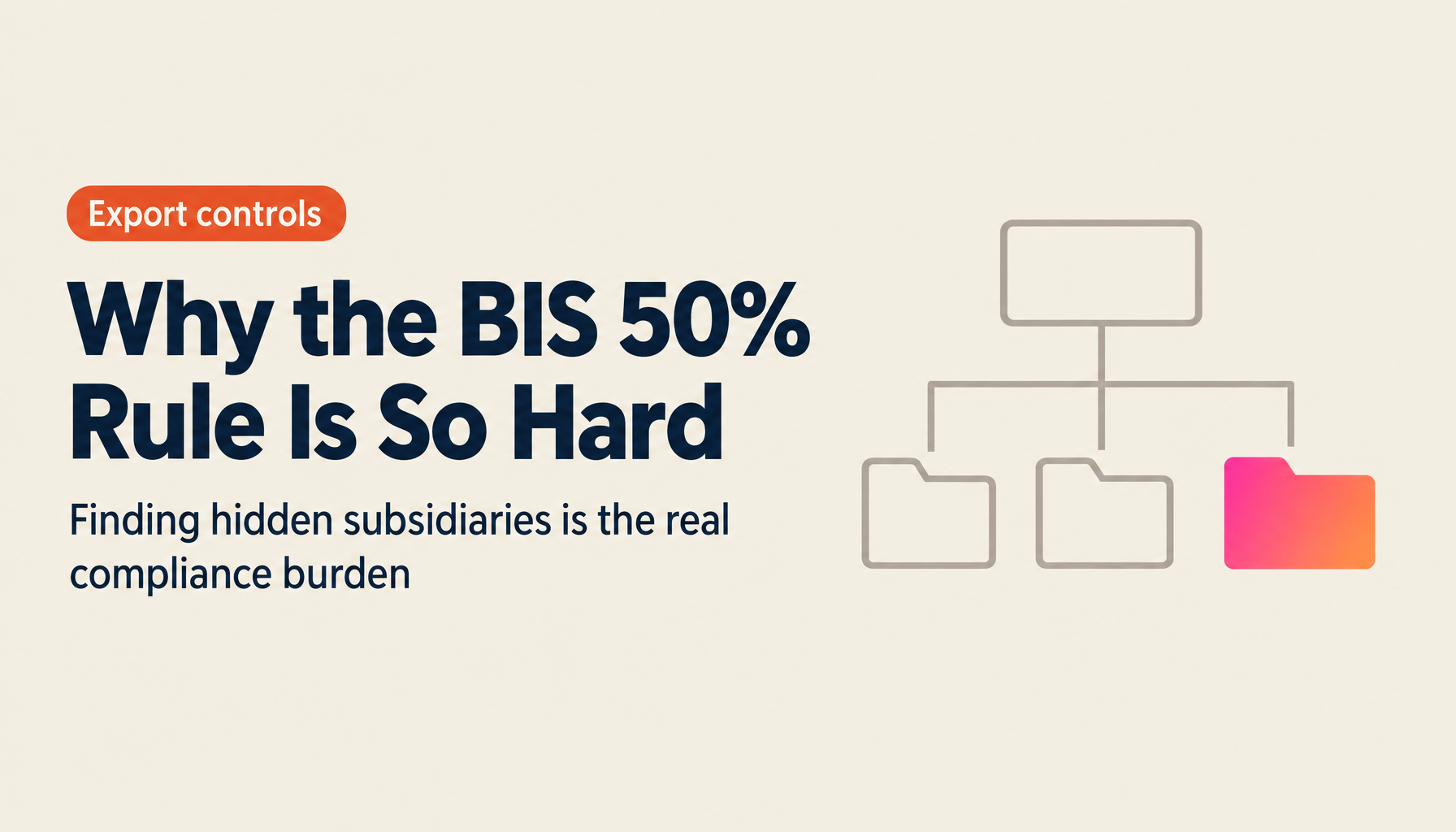
Talking with export-control officers, there's one regulation whose name I've heard more than any other over the past year. The BIS "50% Rule," officially the Affiliates Rule. It sweeps the subsidiaries of listed companies into scope even when their names aren't on any list. Written down it's a single line, but trying to comply with it in practice is startlingly hard work—especially when the counterparty is a Chinese company.
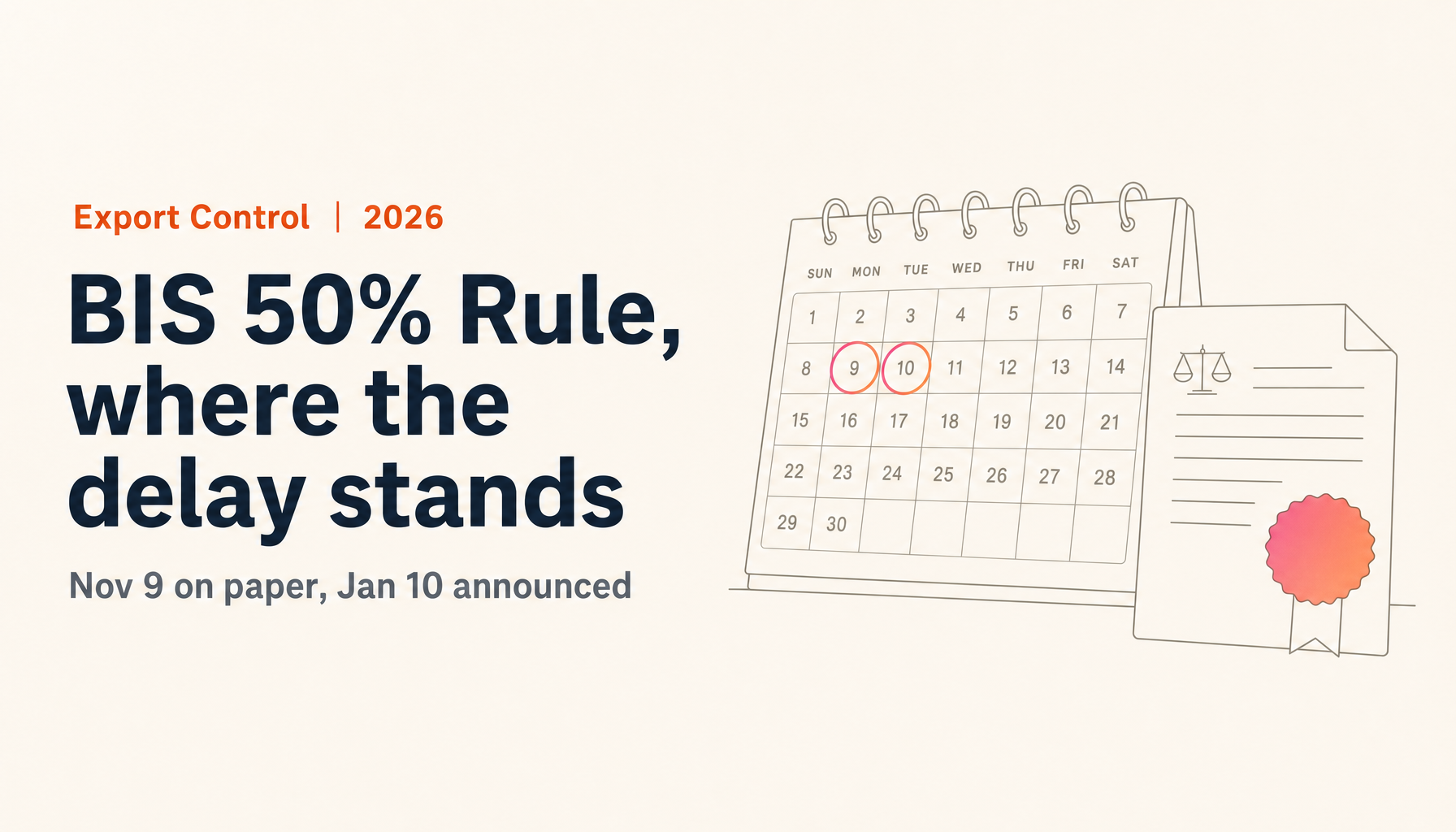
And there's a slightly awkward wrinkle. Right now, it's paused. Following the late-October 2025 US-China deal, the rule was suspended worldwide starting November 10, 2025, and the stay in the Federal Register ends November 9, 2026. In September 2026 the two governments announced an extension to January 10, 2027, but as of October 3 BIS had not published it (the latest status is in where the BIS 50% Rule delay stands). Either way, this is not a permanent withdrawal. So right now is the calm before the storm. In this piece, I'll walk through why compliance with the BIS 50% Rule is this hard, why China-related information is especially difficult to obtain, and how we think about making capital relationships visible. If you're wondering whether your company is affected, size it up first with our export-control readiness check and read on.
The screening procedure behind the ownership question: Tracing who owns whom only works if the screening step around it is written down. This fill-in procedure covers the five sanctions-list systems (US OFAC, US BIS, the EU, the UK, the UN) plus Japan's Foreign End User List, including the 50% and ownership-control tests, where each official source lives and how often it updates, and the Red Flags to record. Filled in, it becomes the written procedure you can hand to auditors or to a counterparty. Listing is a regulatory designation, not a judgment of the company. → Download the Five Sanctions-List Systems Screening Procedure(Free. Your company name and work email are required.)
What the BIS 50% Rule actually is
Start with the mechanism itself. The detailed workings are in our complete guide to the BIS Affiliates Rule; here are the essentials.
On September 29, 2025, BIS put into effect an interim final rule titled "Expansion of End-User Controls To Cover Affiliates of Certain Listed Entities"1. Any affiliate that is directly or indirectly owned, in the aggregate, 50% or more by companies on the Entity List, the Military End-User (MEU) List, or certain SDN List parties automatically becomes subject to the same controls, even without being individually listed2. BIS's under secretary explained the aim as closing "loopholes" that let parties evade listing2.
If you know the similarly named OFAC 50% Rule, you might think they're the same. But there's a decisive difference. Under OFAC's rule, you only aggregate holdings within the same sanctions program. The BIS 50% Rule, however, aggregates holdings across separate lists—the Entity List, the MEU List, and certain SDN parties3. If an Entity List company holds 30% and an MEU List company holds 30%, that's 60% aggregate and it's in scope. And when there are multiple owners, the most restrictive status among them flows down to the subsidiary4. A single strict owner with even a small stake mixed in can sharply raise the weight of the controls.
As noted, the Federal Register stays this rule from November 10, 2025 through November 9, 2026, and absent further rulemaking it resumes on November 105. The suspension is part of the US-China deal: in exchange for the US halting the rule worldwide, China halted its rare-earth and other export controls6. The two governments announced in September 2026 that the deal would run to January 10, 20277, but that is a two-month extension, and as of October 3 the US Federal Register step had not happened. Flip that around: when the deal's deadline arrives or the deal collapses, the controls come back. It is no reason at all to stop preparing.
Replace siloed classification work with AI.
METI's FY2024 data shows 52% of foreign exchange law violations stem from classification errors. Download the TRAFEED product catalog covering features and rollout.
Why compliance is "hard"
The trouble with the BIS 50% Rule is that the logic of conventional screening doesn't work.
Traditional sanctions-list screening was, in essence, a "reject the listed name" mechanism. You match the Entity List against the name of the counterparty you're about to deal with, and if they match, you stop. But the targets of the 50% Rule aren't on any list to begin with. They are the unnamed subsidiaries of listed parents. A name-matching mechanism, in principle, cannot detect them. BIS itself states that its official screening list is no longer an exhaustive listing8.
On top of that, companies are required to trace ownership themselves. BIS created a new "Red Flag 29": if you know, or have reason to know, that a counterparty has a listed owner, you must determine the ownership percentage or obtain a license8. Leave it alone, and it can be treated as evidence that you "knew," raising the penalties. In other words, an affirmative duty was imposed to actively seek out targets you cannot see.
Consider how hard this is in practice. Evaluating cross-list aggregation isn't a matter of looking at one company's shareholders. You have to check, exhaustively, how multiple listed companies combine their stakes, multiplying through layers of indirect ownership. The paths to verify explode as the layers deepen. And the lists move daily. The Entity List saw additions nearly every month in 2025 alone, and when listings change, whole clusters of their 50% subsidiaries turn over. An ownership map you built once goes stale in no time9.
For a sense of scale: the Entity List itself is on the order of 2,000 entries, but its 50% subsidiaries are said to swell to tens of thousands. Chasing that "invisible" population—more than ten times the size of the list itself—while matching it against a daily-changing list, is, to put it mildly, not realistic to do by hand.
Why China-related information is this hard to obtain
And this difficulty peaks with China. The reason is that Chinese corporate ownership structures are, by design, hard to see from the outside.
A November 2025 report by the US think tank ITIF analyzes, concretely, the techniques Chinese companies use to obscure their ties to the home country10. Organizing the patterns it lists, a few types emerge. One is a structure where state capital is layered and dispersed: local governments, state-owned financial institutions, and affiliates of the state asset-supervision commission each hold a few percent, so that overall the entity sits under state influence while a simple shareholder list reveals no substantive control. Another is staged acquisition of foreign companies while deliberately keeping the historic local brand name: after the acquisition completes, the name and logo remain unchanged, with no mention of Chinese capital on the website. ITIF also notes an instance of Chinese authorities instructing overseas-expanding firms to "dilute the home-country color"10.
More troublesome still is the VIE arrangement. It's a multi-layer structure that transfers control by contract rather than shares, designed to evade foreign-investment rules. Following the shareholder register alone won't get you to the actual controller. Add to that, under Military-Civil Fusion, firms that present themselves as civilian makers while also supplying the military, and grasping relationships becomes harder yet10.
The technical barriers can't be ignored either. Chinese corporate registry and beneficial-owner information is mostly in simplified Chinese, a hurdle for foreign firms in both language and access. China introduced a system requiring existing entities to file beneficial-owner information by November 2025, but that is authority-side data, not something you can obtain exhaustively from outside11. Then there's name variance: for the same company, simplified Chinese, pinyin, and English renderings don't line up, so entity resolution is anything but straightforward. When these compound, tracing "who owns 50% of whom" from the outside becomes harder than you'd imagine.
How TRAFEED approaches this
So how do we handle these invisible capital relationships? What TRAFEED provides is not mere list matching, but a "chain analysis" capability12.
The idea is simple. Track not just the counterparty itself but the parties beyond it, comprehensively. Before you start dealing with an overseas business, it automatically analyzes the target's relationship chain, examining shareholder structure, affiliated companies, and past sanctions history across multiple data sources to surface risks that don't appear on the surface. It automatically traces the chain of capital relationships and matches it against sanctions and watch lists. It's precisely the idea of taking on, as a system, the "trace the invisible subsidiaries" work the 50% Rule demands.
The other thing we focus on is presenting the grounds. TRAFEED doesn't just judge a risk level on a four-point scale; it shows why that judgment was reached, attaching even the URLs of the sources it referenced as evidence. The aim is a state where you can explain yourself directly even when questioned in an audit—a design meant to avoid ending at "the AI decided." It also tracks each country's regulatory revisions, reflecting changes in major jurisdictions including China, which makes it easier to avoid leaving a judgment's premises outdated. TRAFEED's core judgment logic is patented, and its accuracy has been validated in joint proof-of-concept work with Okayama University.
Let me be honest: there is no magic tool anywhere in the world that can see through Chinese corporate ownership 100%. As long as the data itself is opaque, limits remain. That is exactly why what matters is holding, as a system, a flow that gathers clues across multiple sources, keeps a record of the paths traced and the grounds, and leaves the final judgment to a human. The final classification and risk assessment should rest with your company's export-control officer. What TRAFEED handles is the vast, painstaking matching and visualization that lead up to that judgment.
What to do before the stay ends
Finally, I want to think about how to use the time that is left. The period while the BIS 50% Rule is paused is a valuable grace window to get your preparations in order. It's worth sharing across the organization that the suspension is only a temporary freeze: on paper it ends November 9, 2026, and even if the extension is published, the new deadline is around January 10, 2027. And the similarly named OFAC 50% Rule remains in effect right now, for sanctions purposes5. This is by no means a case of "it's paused, so do nothing."
What to start on now is mapping the capital relationships between your major counterparties and listed companies. Will you scramble to re-examine tens of thousands of companies on the day it revives, or will you start running a system that makes capital relationships visible now, while you can? That gap will tell from the day the stay ends. Export control shifts from a structure that panics with every change to one that runs on the assumption that things will change. Preparing for the BIS 50% Rule is a touchstone for exactly that. If you're unsure how far you can handle it in-house, reach out through an individual consultation. And if you'd like to first sort out the very concept of beneficial ownership, see our explainer on the basics of beneficial owners as well.
References
If you are reviewing export-control operations or classification workflows, download the TRAFEED product catalog (PDF) or contact us.
Footnotes
-
BIS, "Expansion of End-User Controls To Cover Affiliates of Certain Listed Entities" (published in the Federal Register September 30, 2025; effective September 29, 2025). https://www.federalregister.gov/documents/2025/09/30/2025-19001/expansion-of-end-user-controls-to-cover-affiliates-of-certain-listed-entities ↩
-
BIS press release, "Department of Commerce Expands Entity List to Cover Affiliates of Listed Entities." On automatically subjecting 50%-or-more-owned subsidiaries of Entity List/MEU List parties, and the aim of closing "loopholes." Application to certain SDN List parties is confirmed by multiple major law firms. https://www.bis.gov/press-release/department-commerce-expands-entity-list-cover-affiliates-listed-entities ↩ ↩2
-
The difference from the OFAC 50% Rule (aggregation across separate lists). Moody's KYC commentary. https://www.moodys.com/web/en/us/kyc/resources/insights/differences-between-the-bis-50-rule-and-the-ofac-50-rule.html ↩
-
The most restrictive owner's status flows down when multiple listed companies aggregate to 50% or more. Morrison Foerster commentary (October 1, 2025). https://www.mofo.com/resources/insights/251001-bis-adopts-50-percent-affiliates-rule-implications ↩
-
BIS, "One Year Suspension of Expansion of End-User Controls for Affiliates of Certain Listed Entities" (published in the Federal Register November 12, 2025). Suspension runs November 10, 2025 to November 9, 2026, with automatic resumption on November 10, 2026 absent further rulemaking. No extension had been published as of October 3, 2026. The OFAC 50% Rule has been continuously in effect since 2014. https://www.federalregister.gov/documents/2025/11/12/2025-19846/one-year-suspension-of-expansion-of-end-user-controls-for-affiliates-of-certain-listed-entities ↩ ↩2
-
White House Fact Sheet (November 1, 2025). Reciprocal measures of the US suspending the Affiliates Rule worldwide and China halting its rare-earth and other export controls. https://www.whitehouse.gov/fact-sheets/2025/11/fact-sheet-president-donald-j-trump-strikes-deal-on-economic-and-trade-relations-with-china/ ↩
-
MOFCOM, "商务部美大司负责人解读第八轮中美经贸磋商成果" (September 28, 2026; extension of the Kuala Lumpur joint arrangement to January 10, 2027, Chinese). https://www.mofcom.gov.cn/syxwfb/art/2026/art_d9ea01824fc44fd8a29f7dc3f8ca9c72.html . On the US side, Treasury Secretary Bessent's remarks as reported by NBC News (September 23, 2026). https://www.nbcnews.com/business/economy/us-china-extend-trade-truce-trump-rcna599525 ↩
-
BIS's statement that its official screening list (CSL) is "no longer an exhaustive listing," and the new Red Flag 29 (duty to determine ownership when you know or have reason to know). Morrison Foerster commentary. https://www.mofo.com/resources/insights/251001-bis-adopts-50-percent-affiliates-rule-implications ↩ ↩2
-
Frequent updates to the Entity List (monthly additions in 2025). KPMG and others. https://kpmg.com/us/en/taxnewsflash/news/2025/03/us-bis-adds-entities-entity-list.html ↩
-
Eli Clemens, "How Some Chinese Companies Obscure Ties to China and What Policymakers Should Do About It," ITIF (November 3, 2025). Analyzes patterns such as layered state-capital mixing, staged acquisitions preserving local brands, instructions to dilute home-country color, and concealment of Military-Civil Fusion. https://itif.org/publications/2025/11/03/some-chinese-companies-obscure-ties-to-china-what-policymakers-should-do-about-it/ ↩ ↩2 ↩3
-
China's beneficial-owner information filing system (existing entities required to file by November 1, 2025). Morgan Lewis commentary. https://www.morganlewis.com/pubs/2024/12/chinas-new-beneficial-owner-information-filing-requirements-what-foreign-investors-need-to-know ↩
-
TRAFEED's chain analysis (automatic tracing of the capital-relationship chain, cross-source investigation of multiple data sources, matching against sanctions and watch lists), evidence-based judgment with source URLs attached, and same-day reflection of each country's regulations. Core logic is patented (Japanese Patent No. 7862062), with accuracy validated in joint proof-of-concept work with Okayama University. TRAFEED official (https://timewell.jp/en/trafeed ). ↩