Hello, this is Hamamoto from TIMEWELL.
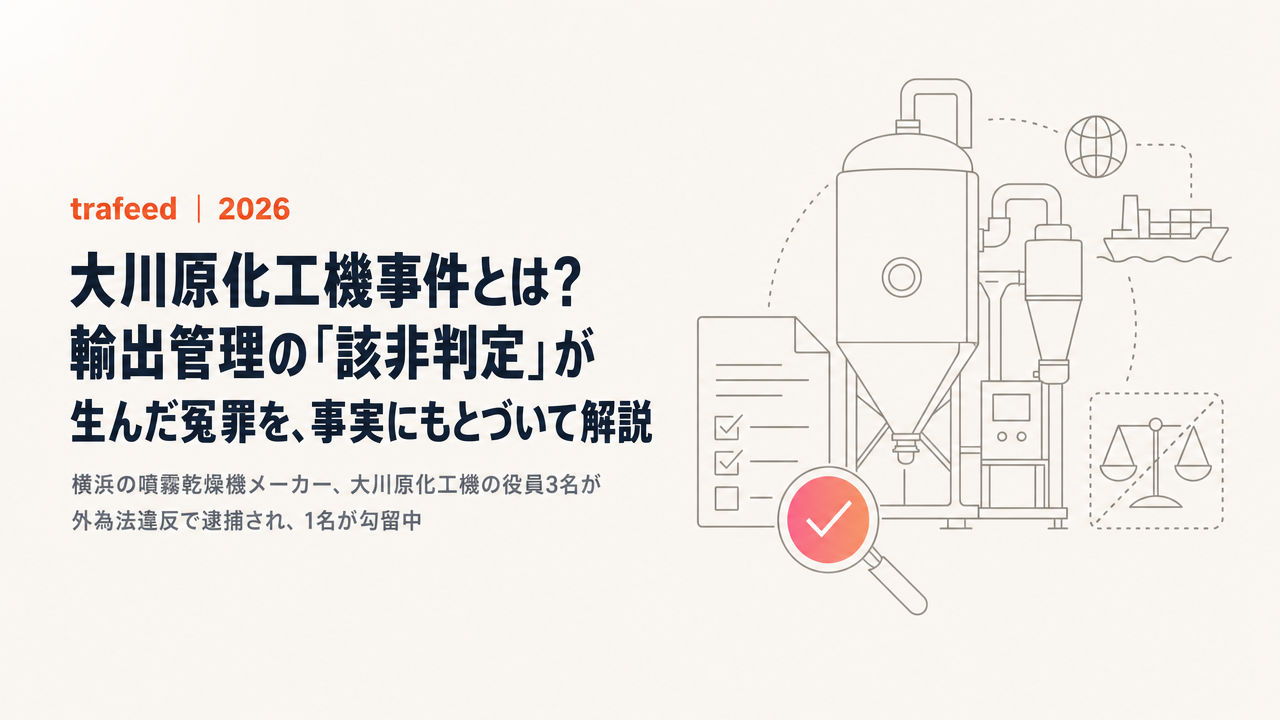
If you work in export control, you will hear the name of this case sooner or later. The Ohkawara Kakohki case. Three executives of a mid-sized Yokohama manufacturer were arrested, one of them died while in detention, and courts later acknowledged that "the arrest and the prosecution were illegal." It was an event that drove home how export control—usually a quiet, unglamorous practice—can hold sway over a person's life.
A man died in this case. I will write, as much as I can, only the facts, grounded in the finalized court rulings and primary materials. On that basis, I want to think about how this case connects to the practice of export control, and to "classification" in particular. Not to consume it sensationally, but to ask what we can learn so that the same thing never happens again.
What happened
Ohkawara Kakohki is a maker of spray dryers based in Tsuzuki-ku, Yokohama, with around 90 employees. A spray dryer is a device that instantly dries liquid into fine powder. It makes powdered milk, instant coffee, pharmaceutical base powders—utterly ordinary industrial machinery. The company is reported to hold a high domestic share.
On March 11, 2020, the Public Security Bureau of the Tokyo Metropolitan Police arrested three of its executives on suspicion of violating FEFTA1. The allegation was that they had exported to China, without the economy minister's license, spray dryers that could be diverted to the manufacture of biological weapons. They were indicted on March 31. The three were company president Masaaki Ohkawara, director Junji Shimada, and adviser Shizuo Aijima2.
The three were detained for a long time. Among them, Aijima was diagnosed with advanced stomach cancer in October 2020, while in detention. His defense repeatedly sought bail, but all seven requests were denied (his family later said there were eight). Without adequate opportunity for treatment, Aijima died on February 7, 2021, at the age of 72—without ever learning that the charges against him would be dropped2.
That withdrawal came about half a year after Aijima's death. On July 30, 2021, the Tokyo District Public Prosecutors Office dropped the prosecution just before the first hearing3. This was not an acquittal. It was the prosecution's own side withdrawing the case, on the ground that "doubt had arisen as to whether the goods fell under the export controls." When I think of the weight the company and its three executives were made to bear from arrest to indictment to withdrawal, words become hard to choose.
Replace siloed classification work with AI.
METI's FY2024 data shows 52% of foreign exchange law violations stem from classification errors. Download the TRAFEED product catalog covering features and rollout.
The dispute turned on the reading of a single word, "disinfect"
Why did this happen? At the heart of it is what export-control practitioners call "classification." Classification is the work of judging whether the goods or technology you intend to export fall under the regulatory lists in the law. Get it wrong in one direction and you export a controlled item without a license, a violation; get it wrong the other way and you treat a non-controlled item as controlled. It is the entrance to export control, and the point that demands the most care. I've touched on the thinking behind this judgment in a separate article on the "clearly" guideline as well.
In the Ohkawara Kakohki case, the question was whether the spray dryers "fell under" that regulatory list. The basis lies in FEFTA Article 48(1), the appended tables of the Export Trade Control Order, and a ministerial ordinance. That ordinance lists three conditions for a controlled spray dryer: the water evaporation rate must fall within a set range; it must be able to make powder with a mean particle size of 10 micrometers or less; and it must be "capable of sterilizing or disinfecting the interior in situ"4. Meet all three, and it becomes controlled.
The fight was over the third condition. What does "capable of disinfecting the interior in situ" mean? Investigators reasoned that heating the interior with the machine's heater to a high temperature kills bacteria such as E. coli O157, so this heat-based sterilization is included in the requirement. They pointed to experiments showing the interior reached over 110 degrees Celsius5.
The company and its defense read it entirely differently. This regulation is, after all, a domestic implementation of the Australia Group—an international framework to prevent the proliferation of biological and chemical weapons. In that international standard, "disinfection" means destroying the infectious capability of microorganisms inside the device using disinfecting chemical agents; physical methods like heating are not included. And "in situ" means the machine is equipped with a structure to clean and disinfect its interior with chemical solution without disassembly. Their exported machines had no such structure, so they were not controlled in the first place4.
Put into words, it is a slight difference in interpretation. Yet how you read this one clause decides whether an ordinary civilian dryer becomes a "weapons-divertible controlled item" or stays just a machine. The difficulty and the danger of classification are concentrated right here.
Where it was called a wrongful prosecution
This case is called a wrongful prosecution not merely because interpretations diverged, but because the investigation itself had problems grave enough for a court to declare it illegal.
The Tokyo High Court found that the arrest "clearly and objectively lacked reasonable grounds" and was illegal under the State Redress Act6. The reasons were many. There were spots inside the device where the temperature does not readily rise, as employees and Aijima and others had pointed out, yet investigators did not perform the obvious additional step of actually measuring the lowest-temperature location. When the defense later ran experiments, the spots where powder accumulates rose only to around 35 degrees, far short of the temperature needed for sterilization. Moreover, investigators pressed ahead with the arrest even after METI's responsible division pointed out problems with their reading of the requirement. Testimony from several police officers revealed that there had been caution within the investigating side itself that "the arrest is not appropriate"6.
What especially stunned the public was the testimony of a serving police officer. In June 2023, in the courtroom of the state-liability suit, a police inspector from the Metropolitan Police Public Security Bureau who had been involved in the investigation answered the plaintiff's question—"wasn't this a fabrication?"—with "well, it's a fabrication," and, asked about the necessity of the arrest and detention, said "it wasn't necessary"7. A person who had run the investigation testified this way himself, in court. The weight of that is hard to put into words.
In the next year's appeal, the background of the investigation came further into the light. As to why METI, which had initially been negative toward the investigators' interpretation, came to accept it partway through, the judgment treated as established that there had been pressure from a Public Security Bureau official on the upper ranks of METI8. You can sense how, within the dynamics of organizations, a single regulatory interpretation was moved. This goes to the very roots of the export-control system.
How the trials ended
The criminal case closed, as noted, with the July 2021 withdrawal of the prosecution. No one was convicted.
Meanwhile, the company, the executives, and Aijima's bereaved family sued the national government and the Tokyo Metropolitan Government for state redress. On December 27, 2023, the Tokyo District Court found the police officers' arrest and interrogation and the prosecutors' detention request and indictment all illegal, and ordered the national and metropolitan governments to pay about 162 million yen9. On May 28, 2025, the Tokyo High Court upheld this, went further than the first instance in assessing the investigators' interpretive stance as "lacking rationality," and raised the damages to about 166 million yen10. Neither the national nor the metropolitan government appealed, and the judgment became final in June 202511.
After the judgment became final, the authorities moved to review it. In August 2025, the National Police Agency, the Metropolitan Police, and the Supreme Public Prosecutors Office each published verification reports. The Metropolitan Police acknowledged problems such as an absence of investigative command and treated 19 people, including retirees, as disciplined or subject to discipline. The Supreme Prosecutors acknowledged problems including failing to interpret the relevant laws and ordinance accurately and an insufficient investigation, but declined to discipline the prosecutor in charge12. That same month, the Metropolitan Police deputy superintendent-general and others visited Aijima's family and apologized for the illegal investigation and arrest and for having damaged his opportunity for treatment. The family is reported to have said, "We accept the apology, but we cannot forgive"12.
Aijima's family has also brought a separate suit against the national government, contesting the legality of the judges' decisions on detention and denial of bail, and that case is still ongoing as of this writing. Right after the High Court ruling, METI announced a policy of clarifying the content of the regulation, including amending the ordinance, in light of how ambiguous its wording had been13. It followed through: an ordinance amendment promulgated on November 14, 2025 and effective November 15 replaced the word rendered in this article as "disinfect" (sakkin in Japanese) with shōdoku, and limited the method to the use of chemical agents14.
How this case connects to export-control work, and what comes next
The heaviest thing I take from this case is the fact that classification trips up even the pros. And here, "the pros" are not only company staff. The investigators, and at one point even METI, were found by the court to have misread the regulatory requirement. Export-control classification is that subtle, that open to interpretation, an area where you cannot reach an answer without setting the statutory text and the international framework side by side.
If so, what a company needs to protect itself is not just the "correctness" of the judgment. It is keeping a record—one anyone can later follow—of why you reached that judgment, on which clause and which international standard, and on what information. Ohkawara Kakohki had substantial grounds for believing its machines were not controlled. Even so, the judgment noted that the wording of the regulation was ambiguous, the notice had not been disseminated, and there was no entry even in the matrix table METI had published13. The very information underlying the judgment had not reached the company adequately.
Here lies the meaning of steadily shoring up export-control work. Reflect the latest interpretations of the law and the movements of the international framework; keep a record of the grounds for your judgment; rely not on individual assumptions; and build a state where you can explain yourself consistently even when questioned in an audit. That is both to prevent genuine violations and to be ready, if suspicion is ever turned on you, to show that "this is how we thought, and on this basis we judged." It is a quiet but reliable breakwater for keeping such risk from ever coming near your company in the first place. For what actual violation cases leading to penalties or prosecution have looked like, see our export control violation case studies, arranged by era. That article, too, treats this case not as a violation but as one in which a legitimate manufacturer was caught up in a dispute over how the regulatory wording should be read.
Our export-control AI agent, TRAFEED, was built with a strong focus on this "keeping the grounds" part. It doesn't merely judge a risk level; it shows why that judgment was reached, attaching even the URLs of the sources it referenced as evidence. Because it tracks and reflects each country's regulatory revisions, it makes it easier to avoid a situation where the premises of a judgment are left outdated. Of course, the AI does not make the final classification on your behalf. The last judgment should rest with your company's export-control officer. What TRAFEED handles is the gathering and organizing of the information that supports that judgment, and the visualization of its grounds. As this case teaches, judgment trips up even the pros. That is exactly why it is worth holding, as a system, both the judgment itself and the record that can explain it. If you're weighing how to shore up your own export control, reach out through an individual consultation. And if you'd like to check where you stand first, starting with our export-control readiness check is a fine place to begin.
The Ohkawara Kakohki case showed, in the most painful form, that export control is not a mere clerical procedure but a heavy practice tied directly to the fates of people and companies. What we should take from it, before any words blaming the authorities, is a quiet resolve to keep our own classifications explainable.
References
If you are reviewing export-control operations or classification workflows, download the TRAFEED product catalog (PDF) or contact us.
Footnotes
-
Japan Federation of Bar Associations, "Relief from Wrongful Convictions (Ohkawara Kakohki Case)." The March 11, 2020 arrest and the outline of the FEFTA charge. https://www.nichibenren.or.jp/activity/criminal/visualisation/falseaccusation/case4.html ↩
-
The three arrested executives (President Masaaki Ohkawara, Director Junji Shimada, Adviser Shizuo Aijima); Aijima's stomach-cancer diagnosis in detention, denial of bail, and death on February 7, 2021. Jiji Press (May 28, 2025) and other reporting. https://www.jiji.com/jc/article?k=2025052800620&g=soc ↩ ↩2
-
On July 30, 2021, the Tokyo District Public Prosecutors dropped the prosecution just before the first hearing; the Tokyo District Court dismissed the case on procedural grounds. CALL4 case commentary. https://www.call4.jp/column/?p=4423 ↩
-
The three spray-dryer criteria under Article 2-2 of the ministerial ordinance (water evaporation rate; mean particle size of 10 micrometers or less; "capable of sterilizing or disinfecting the interior in situ"), and the interpretation of "disinfect" and "in situ" based on the Australia Group agreement. CISTEC, "Commentary on the Legal Interpretation Portion of the Tokyo High Court Judgment" (August 8, 2025). https://www.cistec.or.jp/service/houtaikei_saikochiku_data/20250808.pdf ↩ ↩2
-
The investigators' interpretation (that heat-based sterilization is included) and the internal-temperature experiments cited as its basis. Same CISTEC commentary and reporting. ↩
-
The Tokyo High Court's finding that the arrest "clearly and objectively lacked reasonable grounds" and was illegal under the State Redress Act (failure to measure the lowest-temperature location, disregard of METI's points, internal caution within the investigation, etc.). CISTEC commentary PDF (illegality-finding portion of the judgment). https://www.cistec.or.jp/service/houtaikei_saikochiku_data/20250808.pdf ↩ ↩2
-
On June 30, 2023, in the state-liability trial, a Metropolitan Police Public Security Bureau inspector involved in the investigation testified, "well, it's a fabrication," and "it wasn't necessary" (of the arrest and detention). Gentosha plus (courtroom report by Daishi Ishihara). https://www.gentosha.jp/article/28480/ ↩
-
Investigator testimony at the appeal and the judgment's finding regarding pressure from a Public Security Bureau official on METI's upper ranks. Tokyo Shimbun. https://www.tokyo-np.co.jp/article/359445 ↩
-
Tokyo District Court judgment of December 27, 2023, finding the arrest, interrogation, detention request, and indictment illegal and ordering the national and metropolitan governments to pay about 162 million yen. Jiji Press, Nikkei, and others. ↩
-
Tokyo High Court judgment of May 28, 2025 (Presiding Judge Akiyoshi Ota), upholding the first instance and raising damages to about 166 million yen. Jiji Press (May 28, 2025). https://www.jiji.com/jc/article?k=2025052800620&g=soc ↩
-
The national and metropolitan governments did not appeal, and the judgment became final in June 2025. CISTEC commentary PDF and reporting. ↩
-
The August 7, 2025 publication of verification reports by the National Police Agency, Metropolitan Police, and Supreme Prosecutors (the Metropolitan Police treated 19 people as disciplined or subject to discipline; the Supreme Prosecutors declined to discipline the prosecutor in charge), and the August 25 apology to the bereaved family. Nikkei. https://www.nikkei.com/article/DGXZQOUD213UR0R20C25A8000000/ ↩ ↩2
-
The judgment's findings on the ambiguity of the regulatory wording and notice (inadequate dissemination to makers, absence from the matrix table) and METI's June 4, 2025 policy of clarifying the regulation, including amending the ordinance. CISTEC commentary PDF. https://www.cistec.or.jp/service/houtaikei_saikochiku_data/20250808.pdf ↩ ↩2
-
METI, "Overview of the amendments to the Export Trade Control Order and related regulations" (November 2025, promulgated November 14, 2025; in Japanese). The spray dryer criterion changed from sakkin to shōdoku, limited to methods using chemical agents (effective November 15, 2025). https://www.meti.go.jp/press/2025/11/20251114001/20251114001.html ↩

![A Beginner's Dictionary of Japanese Export Control Jargon: "Betsu-ichi," "Toku-ippan," "White Country," and 30 Other Terms Your Colleagues Keep Using [2026 Edition]](/images/columns/export-control-jargon-glossary/cover.en.png)