Hello, this is Hamamoto from TIMEWELL.
In the first part, I traced where economic security stands for manufacturers, as the 2026 Monozukuri White Paper portrays it. The heart of risk analysis is the supply chain, and companies' worries are shifting outward toward "how do we grasp what our partners are doing"—yet many firms are stuck at information gathering.
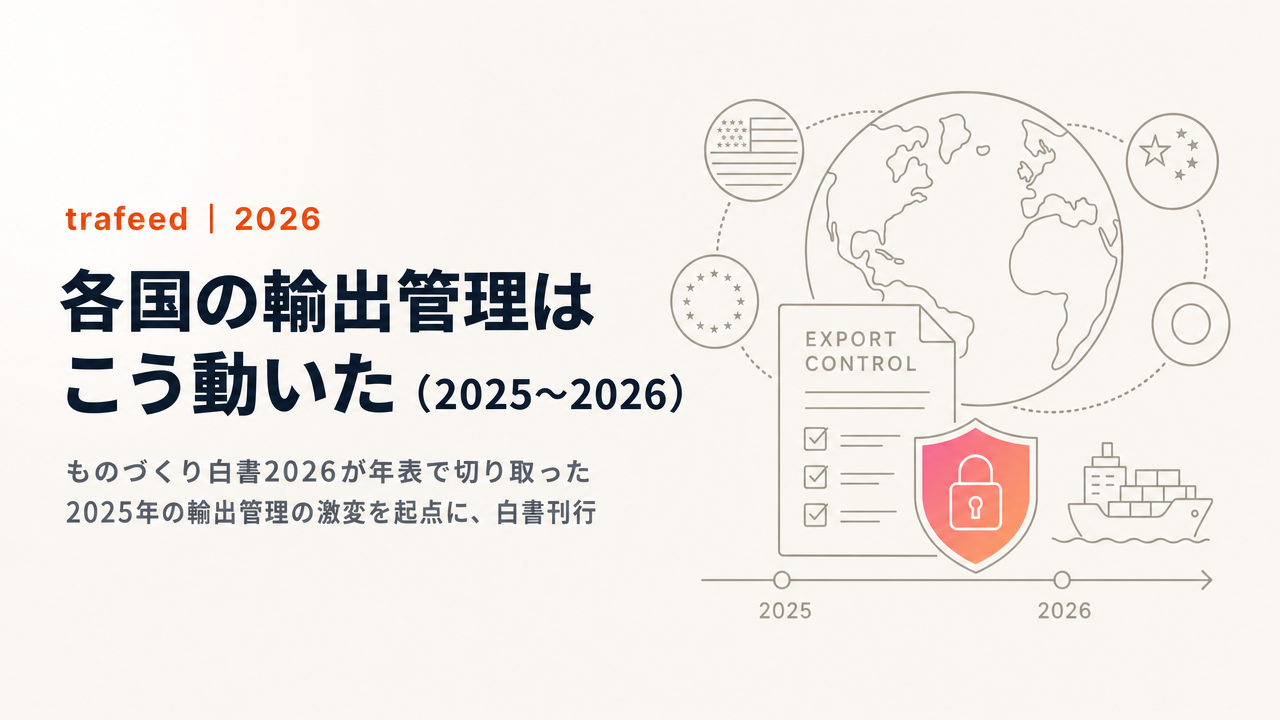
What generates those "partner movements" is the export-control regulation of each country. In Section 4, the White Paper compiles what happened around the world in 2025 into a single timeline. Reading it, I felt a slight chill down my spine. That many regulatory changes, compressed into a single year. And after the White Paper went to print, the situation moved further still in 2026. This time I'll take the White Paper's timeline as a starting point and redraw the map as of July 2026, working from primary sources in the originating countries. If you're worried whether your own goods or partners might get caught, sizing it up first with our export-control readiness check will keep this from feeling like someone else's problem.
The White Paper's timeline of 2025, when every country moved at once
Start with the White Paper's timeline itself. Laid out chronologically, 2025 comes across as an extraordinary year.
In January, the US tightened export controls on AI-use semiconductors and the like bound for China and published a final rule banning the import and sale of connected vehicles involving China and Russia. That same month, a presidential memorandum on "America First trade policy" appeared, and the exchange of additional tariffs on China began. In February, China strengthened export controls on rare metals, bringing five items such as tungsten and indium under licensing, while in the EU the AI Act's prohibited-practices provisions took effect. By April, China tightened rare-earth export controls further, and the US imposed reciprocal tariffs and a 25% tariff on automobiles. The EU rolled out projects to develop critical raw materials outside its borders, and Japan decided on support of up to roughly 800 billion yen for domestic semiconductor makers1.
Tariffs, export controls, industrial support. The US, China, the EU, and Japan all made their moves within the same quarters, as if by prior arrangement. The White Paper analyzes the backdrop as intensifying competition among nations over advanced-industry sectors2. The tug-of-war to grip the "pressure points" of the economy—semiconductors and rare earths—erupted in the form of export controls.
Looking at this timeline, it makes complete sense that manufacturing managers name "grasping partners' movements" as their biggest challenge. Quite apart from any effort of their own, a supplier's home country suddenly changes the rules. The timeline drives that reality home, with dates attached.
Replace siloed classification work with AI.
METI's FY2024 data shows 52% of foreign exchange law violations stem from classification errors. Download the TRAFEED product catalog covering features and rollout.
What bites hardest is the regulation that never stopped
Here is where the story goes beyond the White Paper. Read only the timeline and you conclude "regulations tightened in 2025" and leave it there. But in practice, what is scariest is the regulation still moving at this very moment.
Leading the pack is the licensing regime for seven heavy rare earths that China introduced on April 4, 2025. Under Announcement No. 18 of 2025 from the Ministry of Commerce and the General Administration of Customs, seven elements—samarium, gadolinium, terbium, dysprosium, lutetium, scandium, and yttrium—along with their metals and oxides and the permanent magnets containing them, became subject to per-shipment Chinese government licensing3. Terbium and dysprosium are indispensable to the neodymium magnets that hold their magnetic force even at high temperatures. In other words, nearly every manufacturer that handles motors or actuators falls within the reach of this rule.
What matters is that this April measure is not covered by the US-China truce described below. As of July 2026, it is fully in force. For Japanese manufacturers, the regulation biting hardest in real terms is not the October rules that made big news, but this quietly continuing April licensing regime—that is how I see it.
There is another set of controls in motion, aimed at Japan by name. Under Announcement No. 1 of 2026 on January 6, China strengthened export controls on dual-use items bound for Japan, and in February it placed Japanese companies on export-control and watch lists4. These, too, sit outside the US-China truce, remaining as measures targeting Japan. I'll leave the details to the article on China's Announcement No. 1 of 2026 on Japan-bound dual-use items, but the point to hold here is that "the US and China shook hands, so we're safe" is entirely false. The regulations that bite Japan live outside the handshake.
The cliff called November 10, 2026
So what was this US-China "truce" that filled the headlines? This is the biggest issue of the second half of 2026, so let me lay it out carefully.
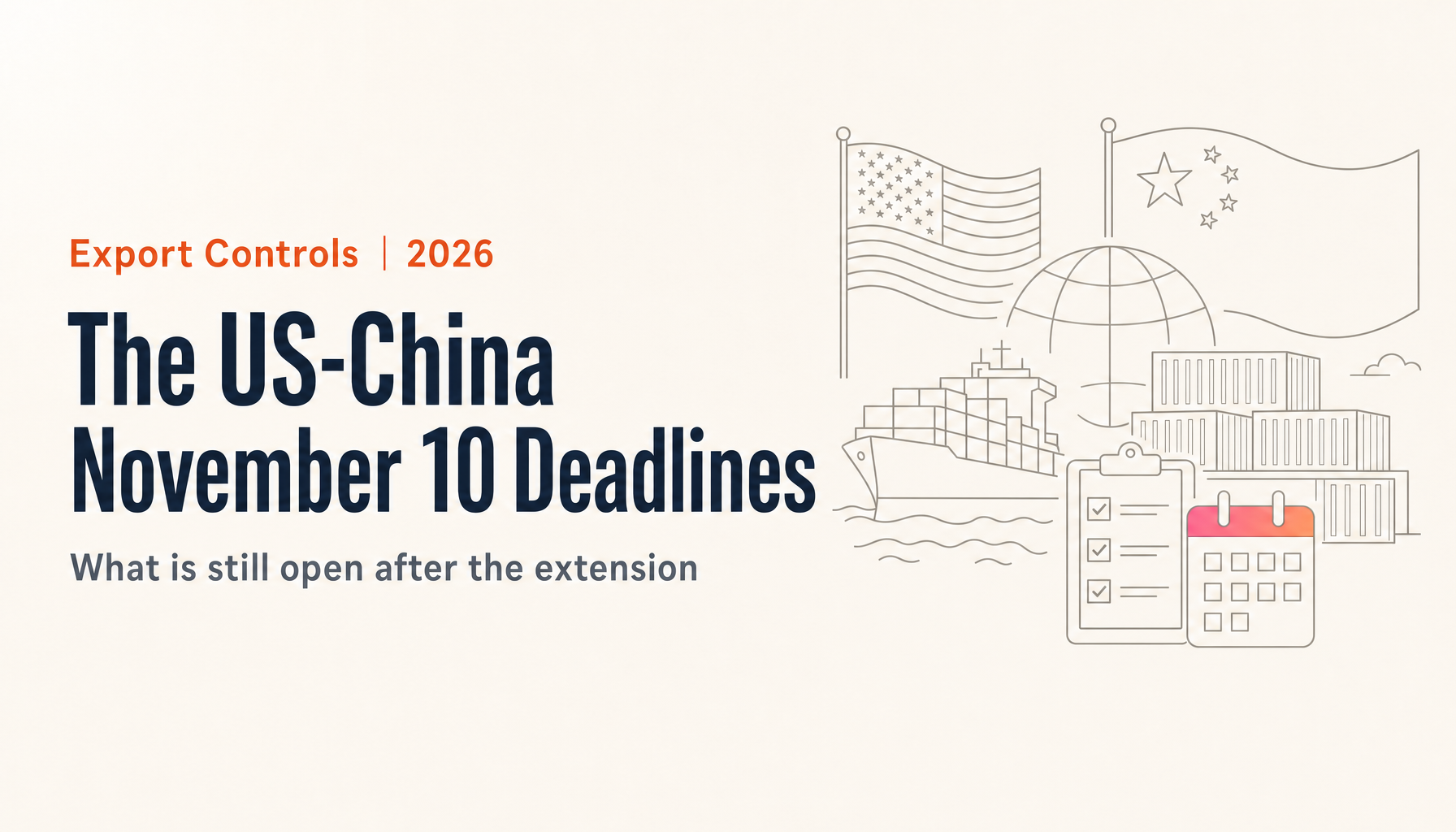
The trigger was the US-China summit held in South Korea on October 30, 2025. There, the two countries agreed to a one-year truce5. In response, China suspended its just-announced October 9 rare-earth expansion via Announcement No. 70 on November 7. The suspension runs until November 10, 20266. On the US side, the so-called "50% rule"—which automatically subjects subsidiaries owned by listed entities to controls—was likewise stayed, through November 9, 2026 on the Federal Register7.
That 50% rule had itself been a powerful measure introduced only in late September 2025. A subsidiary more than half-owned by a controlled entity is automatically subject to the same controls, even if its own name isn't on the list. Freezing it immediately after introduction shows how fierce the US-China maneuvering is.
And what I most want to flag is Announcement No. 61, China's October 9 extraterritorial rule. It requires Chinese government licensing even to export to a third country any foreign product that "contains Chinese-origin rare earths at 0.1% or more by value" or is "made with Chinese rare-earth technology"8. China brought to rare earths the very logic by which US export controls reach around the world. This too is now suspended under No. 70, but only frozen.
In short, November 10, 2026 is a cliff. Unless extended, the suspensions of the Chinese expansion and the US 50% rule both lapse automatically around that day. In September 2026 the US and China announced an extension to January 10, 2027, but as of October 3 BIS had not published the US extension, and it buys only two months (see our BIS 50% rule guide). If the deal holds, the calm continues; if it breaks down, the controls could snap back all at once. For an export-control officer, this autumn is no season to spend at ease. Suspension is not withdrawal. That single point is worth sharing across the organization.
Japan's and the EU's "defense" and "offense"
While the major powers trade regulatory blows, Japan and the EU have not sat on their hands either.
Japan first shored up its defenses. METI promulgated a revision of the complementary export control—the catch-all regulation—on April 9, 2025, effective October 9. It strengthened the conventional-weapons catch-all and changed the regime so that higher-concern items such as machine tools, integrated circuits, radar, and navigation radio equipment are designated as "specified items" by HS code, requiring firms to manage them9. This is a tightening aligned with US controls on China, aimed at preventing unintended technology outflow routed through Japan. For how this revision changed the classification approach, see the explainer on the "clearly" guideline.
On offense, Japan and the US built a critical-minerals framework. On October 28, 2025, in Tokyo, they signed the "Japan-US Framework for Securing the Supply of Critical Minerals and Rare Earths through Mining and Processing"10. It counters Chinese rare-earth pressure by securing everything from mining to processing across the two countries, and ministerial meetings and action plans have continued into 2026.
The EU is more structural still. Under its Critical Raw Materials Act, it designated 60 strategic projects in March 2025—47 within the EU and 13 outside—accelerating permits for mining, refining, and recycling11. Designing the break from Chinese dependence as industrial policy rather than one-off regulation is what gives it its edge. Alongside that, August 2, 2026 is the EU AI Act's (Regulation (EU) 2024/1689) general date of application. This is widely misread, so it is worth pinning to the articles. What starts applying that day is the transparency obligations (Article 50) and the European Commission's power to impose fines on general-purpose AI (GPAI) model providers (Article 101), among others—the substantive obligations for high-risk AI come later. Under the amending Regulation (EU) 2026/1744 (adopted July 8, 2026; published in the Official Journal on July 24, 2026; in force from July 27, 2026), Annex III high-risk AI (Article 6(2)) applies from December 2, 2027, and Annex I high-risk AI embedded in products (Article 6(1)) from August 2, 2028. The penalty provisions themselves (Articles 99 and 100) have applied since August 2, 202512. It's a move that makes export control and AI regulation feel contiguous.
Defensive catch-all, offensive minerals framework. Japan is working on both wheels, but digesting these on the ground still falls to each company's export-control officer. Even when the state builds the systems, running the daily classifications and partner checks remains the company's job.
How will manufacturers answer the White Paper's homework?
As we saw in the first part, many manufacturers are stalled at the information-gathering stage. Line up the regulatory moves above and the reason is plain. Tracking China's announcement numbers, checking updates to the US entity list, matching them against the HS codes of Japan's catch-all specified items, and on top of that preparing for the November cliff. Doing all of this by hand, on the side of one's main job, is no longer realistic. The volume and speed of information have outrun the officer's capacity.
That is exactly why you need a mechanism that turns gathered information into judgments. Rather than watching the news and sighing "what a time to be alive," you match, mechanically, whether your goods or technology fall under which rule and whether the partner you're about to deal with sits on any country's list, and you speed up the first response. Our export-control AI agent, TRAFEED, was built precisely to take on that matching. It reflects each country's regulations and visualizes the risk level of goods and partners in seconds. Whether it's a regulation "that never stopped," like the seven-heavy-rare-earths licensing, or one "beyond the cliff" that could revive in November, it helps officers avoid overlooking them. The final classification should rest with your company's export-control officer, but by shouldering the information processing that leads up to it, it can help you climb out of the "information-gathering valley" the White Paper pointed to.
The 2025 timeline will only grow longer next year. Regulations may increase, but they rarely shrink. If so, the shift is from a structure that panics every time a rule changes to one that runs on the assumption that rules will change. The answer to the homework the 2026 Monozukuri White Paper handed manufacturers may lie right about there. If you want to know where your own company stands first, reach out through an individual consultation. And if you'd like to grasp the full picture of China's rare-earth controls as a map, see our rare-earth regulation map as well.
References
If you are reviewing export-control operations or classification workflows, download the TRAFEED product catalog (PDF) or contact us.
Footnotes
-
METI, MHLW, and MEXT, 2026 White Paper on Monozukuri (Manufacturing Industries), Part 1, Chapter 4, Section 4 "Responding to an increasingly uncertain external environment," timeline, citing JETRO Business Briefs, the Ministry of Foreign Affairs, and METI announcements. ↩
-
Same White Paper, text on the backdrop to strengthened trade measures and export controls. ↩
-
China Ministry of Commerce and General Administration of Customs, Announcement No. 18 of 2025 (April 4, 2025), export-control measures on seven heavy rare earths and related items. MOFCOM (English): https://english.mofcom.gov.cn/Policies/AnnouncementsOrders/art/2025/art_0dd87cbee7b045bf93fabe6ab2faceee.html ↩
-
China Ministry of Commerce, Announcement No. 1 of 2026 (January 6, 2026, strengthened dual-use export controls toward Japan), and Announcements No. 11 and No. 12 of 2026 (February 24, 2026, listing Japanese firms). MOFCOM: https://www.mofcom.gov.cn/zwgk/zcfb/art/2026/art_8990fedae8fa462eb02cc9bae5034e91.html ↩
-
US-China summit (October 30, 2025, South Korea), one-year truce agreement. Per reporting (The Washington Post and others). ↩
-
China Ministry of Commerce and General Administration of Customs, Announcement No. 70 of 2025 (November 7, 2025), suspending the October 9, 2025 expanded controls (Nos. 55, 56, 57, 58, 61, 62) until November 10, 2026. MOFCOM: https://www.mofcom.gov.cn/zwgk/zcfb/art/2025/art_b1ec77dd3f0d4762952904df7cdaadec.html ↩
-
US Bureau of Industry and Security (BIS), "Expansion of End-User Controls To Cover Affiliates of Certain Listed Entities" (published in the Federal Register September 30, 2025; effective September 29, 2025). Stayed worldwide through November 9, 2026 under the US-China agreement (90 FR 50857, November 12, 2025). Federal Register: https://www.federalregister.gov/documents/2025/09/30/2025-19001/expansion-of-end-user-controls-to-cover-affiliates-of-certain-listed-entities ↩
-
China Ministry of Commerce and General Administration of Customs, Announcement No. 61 of 2025 (October 9, 2025, extraterritorial measures on rare-earth-related items). MOFCOM: https://www.mofcom.gov.cn/zwgk/zcfb/art/2025/art_7fc9bff0fb4546ecb02f66ee77d0e5f6.html (suspended until November 10, 2026 by Announcement No. 70 of 2025). ↩
-
METI, "Revision of the Complementary Export Control (Catch-all Regulation)" (promulgated April 9, 2025; effective October 9, 2025). Machine tools, integrated circuits, radar, and others designated as "specified items" by HS code. METI: https://www.meti.go.jp/policy/anpo/apply-01/20251009_catchminaoshi/20251009catchall.html ↩
-
Ministry of Foreign Affairs of Japan, "Japan-US Framework for Securing the Supply of Critical Minerals and Rare Earths through Mining and Processing" (signed October 28, 2025, Tokyo). MOFA (provisional translation): https://www.mofa.go.jp/mofaj/files/100926027.pdf ↩
-
European Commission, Critical Raw Materials Act (CRMA) strategic projects. 47 within the EU designated in March 2025 and 13 outside in June (60 total). European Commission: https://single-market-economy.ec.europa.eu/sectors/raw-materials/areas-specific-interest/critical-raw-materials/strategic-projects-under-crma/selected-projects_en ↩
-
Staged application under Article 113 of the AI Act (Regulation (EU) 2024/1689), as amended by Regulation (EU) 2026/1744. The general date of application is August 2, 2026, from which Chapter IV (Article 50, transparency obligations), Chapter III Section 5 (Articles 40-49: harmonised standards, conformity assessment, CE marking, registration) and Article 101 (the Commission's power to fine GPAI model providers) apply, among others. High-risk AI applies from December 2, 2027 for Annex III systems (Article 6(2)) and from August 2, 2028 for Annex I systems (Article 6(1)). The prohibited practices (Article 5) have applied since February 2, 2025, and the GPAI chapter and the penalty provisions (Articles 99 and 100) since August 2, 2025. Regulation (EU) 2026/1744 was adopted on July 8, 2026, published as OJ L 2026/1744 on July 24, 2026, and entered into force on July 27, 2026. ↩