TIMEWELL
Solutions
Free ConsultationContact Us
TIMEWELL

Unleashing organizational potential with AI

ISO/IEC 27001 (ISMS) certification mark (SGS / ISMS-AC)

ISO/IEC 27001:2022 certified Certificate No. JP26/00000255 Scope: Planning, development and operation of SaaS products utilizing AI technology

Services

  • ZEROCK
  • TRAFEED
  • TIMEWELL BASE
  • WARP
  • WARP 1Day
  • WARP NEXT Corporate
  • WARP BASIC
  • WARP ENTRE
  • Alumni Salon
  • WARP for Schools
  • Alumni Ventures
  • FDE
  • AI Consulting
  • EMC GLOBAL

Company

  • About Us
  • Team
  • Why TIMEWELL
  • News
  • Contact
  • Free Consultation

Content

  • Insights
  • Knowledge Base
  • Case Studies
  • Whitepapers
  • Events
  • Solutions
  • AI Readiness Check
  • ROI Calculator

Legal

  • Privacy Policy
  • Manual Creator Extension
  • WARP Terms of Service
  • WARP NEXT School Rules
  • Legal Notice
  • Security
  • Anti-Social Policy
  • ZEROCK Terms of Service
  • TIMEWELL BASE Terms of Service

Newsletter

Get the latest AI and DX insights delivered weekly

Your email will only be used for newsletter delivery.

© 2026 株式会社TIMEWELL All rights reserved.

Contact Us
HomeColumnsTagsFEFTA
Tag

FEFTA

Articles about "FEFTA"

32 articles

32 articles (showing 12)

From COCOM to the Wassenaar Arrangement. A Beginner's History of Export Control Regimes
TRAFEED

From COCOM to the Wassenaar Arrangement. A Beginner's History of Export Control Regimes

How export control moved from COCOM (1949 to 1994) to the Wassenaar Arrangement, how four regimes divide the work, and how Japan reflects them in law each year.

2026-11-06Ryuta Hamamoto
Japan's Export Control Public Comment: Every Change in the Comparison Tables, Explained
TRAFEED

Japan's Export Control Public Comment: Every Change in the Comparison Tables, Explained

A plain-English walk through the public comment that opened in Japan on October 19, 2026 (deadline November 18), compared with the rules in force since February 14, 2026. It reads the old-and-new comparison tables for cabinet orders, ministerial ordinances, notices and circulars, and sorts out the changes to controlled goods, controlled technology and procedures. These are still drafts.

2026-11-06Ryuta Hamamoto
Inform Notices Explained, and How to Use Pre-Consultation with METI
TRAFEED

Inform Notices Explained, and How to Use Pre-Consultation with METI

A beginner's guide to Japan's inform requirement, where METI tells an exporter to apply for a license. Legal basis, seven steps after a notice, and how pre-consultation works.

2026-11-06Ryuta Hamamoto
Red Tape in Export Controls, and Where the Burden Falls in Japan and the US
TRAFEED

Red Tape in Export Controls, and Where the Burden Falls in Japan and the US

A beginner's guide to the red-tape debate in export controls. Where license waits pile up in Japan, how the US argues it, and what exporters can do.

2026-11-06Ryuta Hamamoto
Japan's FEFTA Revisions Explained: From the February 2026 Changes to the October Draft
TRAFEED

Japan's FEFTA Revisions Explained: From the February 2026 Changes to the October Draft

Japan's export rules are about to change again, and the public comment period is open. This guide walks through what took effect on February 14, 2026, what moved between then and October, and what the draft published on October 19 would change, based on the original METI documents and with every term explained.

2026-10-28Ryuta Hamamoto
Cyberattacks Are an Export Control Problem Too: Tech Leaks and Fake IT Workers
TRAFEED

Cyberattacks Are an Export Control Problem Too: Tech Leaks and Fake IT Workers

When drawings and technical documents are stolen in a cyberattack, it is not only an IT problem. Working from primary sources in Japan, including METI's guidance documents, government alerts on North Korean IT workers and the design policy for the new SCS supply chain security ratings, this article maps four routes technology leaves a company, ten checks to run in-house, and how to prepare when a customer asks for TICS or an SCS 4-star rating.

2026-10-04Ryuta Hamamoto
The Asahi Kasei Arrest: Which Law Was Broken, and Where Export Controls Fit
TRAFEED

The Asahi Kasei Arrest: Which Law Was Broken, and Where Export Controls Fit

On September 17, 2026, Aichi police arrested a former Asahi Kasei employee on suspicion of disclosing trade secrets on a latent curing agent used in semiconductor packaging to a Chinese company. Working from Asahi Kasei's own statement and Japanese press reports, this article lays out the timeline, explains which part of Japan's Unfair Competition Prevention Act the arrest rests on, why the Foreign Exchange and Foreign Trade Act and the Economic Security Promotion Act do not appear, and what to check in your own company today. Updated to include the reported indictment of October 27, 2026.

2026-09-18Ryuta Hamamoto
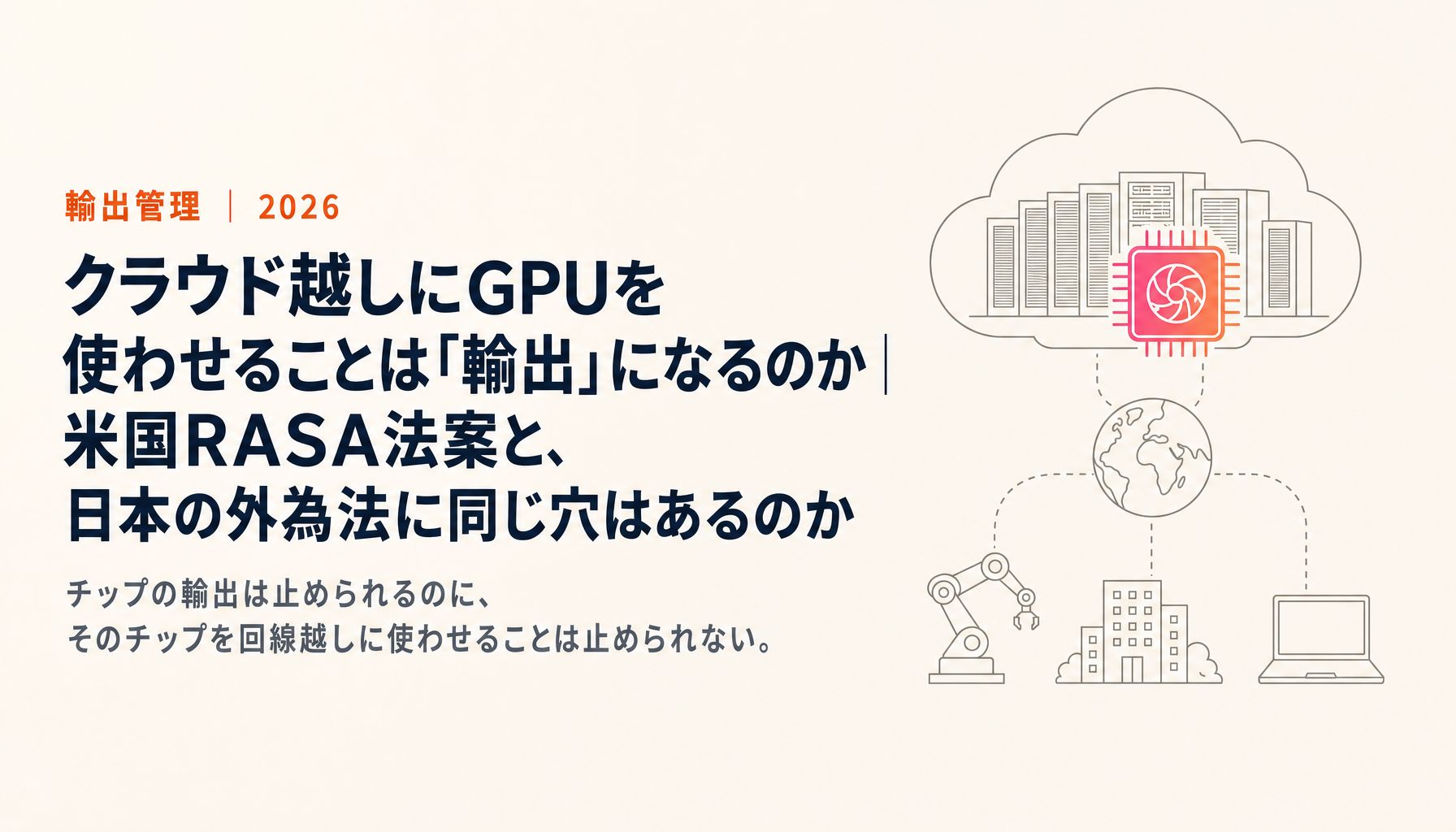
Does letting someone use a GPU over the network count as an export? The RASA bill, and whether Japan has the same gap
TRAFEED

Does letting someone use a GPU over the network count as an export? The RASA bill, and whether Japan has the same gap

You can stop the chip from leaving the country, but you cannot stop someone from using it over a network connection. This piece traces where that difference comes from, working from the text of the EAR, BIS's own advisory opinions, and the Japanese Foreign Exchange and Foreign Trade Act. It covers what the RASA bill actually says, whether Japan has the same gap, and what to check in practice.

2026-08-21Ryuta Hamamoto
"Is Your Technical Information Leaking?" Speaking at JX LIVE! 2026, Part One: Economic Security and Export Control in the Age of AI
TRAFEED

"Is Your Technical Information Leaking?" Speaking at JX LIVE! 2026, Part One: Economic Security and Export Control in the Age of AI

On 28 July 2026 I spoke at JX LIVE! 2026, the Japan Association of New Economy's conference at TOKYO NODE in Toranomon Hills.

2026-08-01Ryuta Hamamoto
What Are Catch-All Controls? A Plain Guide to Japan's Supplementary Export Controls for Beginners
TRAFEED

What Are Catch-All Controls? A Plain Guide to Japan's Supplementary Export Controls for Beginners

A beginner-friendly explanation of catch-all controls, formally Japan's supplementary export controls.

2026-07-25Ryuta Hamamoto
What Are List Controls? A Plain Guide to Japan's Appended Table 1 and Export Classification
TRAFEED

What Are List Controls? A Plain Guide to Japan's Appended Table 1 and Export Classification

List controls enumerate goods and technology with weapons-relevant performance in the law by specification and require a licence regardless of destination. This guide explains Appended Table 1, the Foreign Exchange Order table and the goods ordinance, how to classify, how it differs from catch-all controls, and the 2025 to 2026 revisions.

2026-07-25Ryuta Hamamoto
What Are Dual-Use Items? A Plain Guide to Classification, Catch-All Controls and Why "We Only Make Commercial Products" Does Not Hold
TRAFEED

What Are Dual-Use Items? A Plain Guide to Classification, Catch-All Controls and Why "We Only Make Commercial Products" Does Not Hold

A plain guide to dual-use items in Japanese export control, covering why commercial products are regulated, the four regimes, list and catch-all controls, classification, deemed export, and the penalty for exporting without a license, checked against the statutes as of November 2026.

2026-07-24Ryuta Hamamoto

Related Tags

TRAFEED(31)Export Control(13)export control(10)Economic Security(8)Beginner Guide(8)Glossary(4)catch-all controls(3)compliance(3)COCOM(2)Public Comment(2)Export Trade Control Order(2)Export Classification(2)Technology Leakage(2)deemed export(2)list controls(2)
View all tags