Hello, this is Ryuta Hamamoto from TIMEWELL.
When people start studying export control, the first word they tend to trip over is "list controls." The name reads as if there were a catalogue of dangerous articles somewhere, and unless you handle one of those unusual items, none of it concerns you. Then you open the actual provisions, and what you find written there is the machining accuracy of a machine tool, the performance of a semiconductor, the heat resistance of a material. The more ordinary the products your company makes, the more that gap tends to surprise you.
List controls are the entrance to the whole edifice of export control, and at the same time the heaviest part of the day-to-day work. Get this wrong and the terms that come later, catch-all controls and classification, never quite land; they float somewhere above your head. This piece sets out what list controls are, where in which law they are written, and who does the deciding, laid out so that someone meeting the subject for the first time can read it end to end. I unpack the jargon as it appears.
List controls draw the line by performance
List controls are one category within the broader system of security export control. Security export control refers to the state checking, at the point of export, that goods or technology which could feed the development of weapons or weapons of mass destruction do not reach a party of concern. List controls sit at the centre of that system.
The mechanism itself is, if anything, straightforward once you say it out loud. Goods and technology whose performance lends itself to the development, manufacture or use of weapons are enumerated in advance, in the law, with concrete figures and specifications. When you export or provide anything matching those entries, a prior licence from the Minister of Economy, Trade and Industry is required in principle. The work of checking whether your own product matches the list is called classification. I will give classification its own section shortly.
The property to hold on to here is that list controls apply regardless of destination. Destination means the country or region you are exporting to. Unlike catch-all controls, whose application changes with the counterparty country, a listed item requires the procedure even when the destination is a friendly, advanced economy. The line is drawn on the performance of the object itself, so the line does not move with where the object is going. This is the foundation for understanding both the legal structure I turn to next and the difference from catch-all controls I take up later.
If you want a first feel for whether your own products are likely to be caught, try our free export control self-check. Within a few minutes it will give you a sense of which questions you need to answer.
Replace siloed classification work with AI.
METI's FY2024 data shows 52% of foreign exchange law violations stem from classification errors. Download the TRAFEED product catalog covering features and rollout.
From FEFTA to Appended Table 1: a structure of four layers
To know where list controls are actually written, it helps to see Japan's export control law as four layers. Hold this structure in mind and you stop getting lost when you go looking for a provision.
At the top sits the enabling statute. Its formal name is the Foreign Exchange and Foreign Trade Act; in daily use we shorten it to FEFTA. The broad framework of export control and the penalties live in this statute. FEFTA itself, however, does not say which performance thresholds are caught. That content is technical, granular and frequently amended, so the concrete substance is delegated to cabinet orders and ministerial ordinances below the statute.
The second layer is the cabinet orders. For goods, the Export Trade Control Order governs; for the provision of technology, the Foreign Exchange Order governs. Providing technology means handing designs, know-how or programs to another party, and in legal terms this is called the provision of services. Appended Table 1 of the Export Trade Control Order, together with the table under the Foreign Exchange Order, is the itemised list of what list controls cover. When people say the "list" in list controls, you can safely take it to mean Appended Table 1 and the Foreign Exchange Order table.
The third layer is the ministerial ordinance issued by the Ministry of Economy, Trade and Industry. It carries the long name of the ordinance specifying goods or technology under Appended Table 1 of the Export Trade Control Order and the table of the Foreign Exchange Order, and in practice it is called the goods ordinance. Where Appended Table 1 gives the broad category, say "machine tools," it is this goods ordinance that draws the fine numerical line, specifying which machining accuracy and above is caught. On top of that come the interpretive notices that explain how all this operates, forming a fourth layer that supports the actual work. When you classify, you read back and forth across these four layers, from Appended Table 1 to the goods ordinance to the notices1.
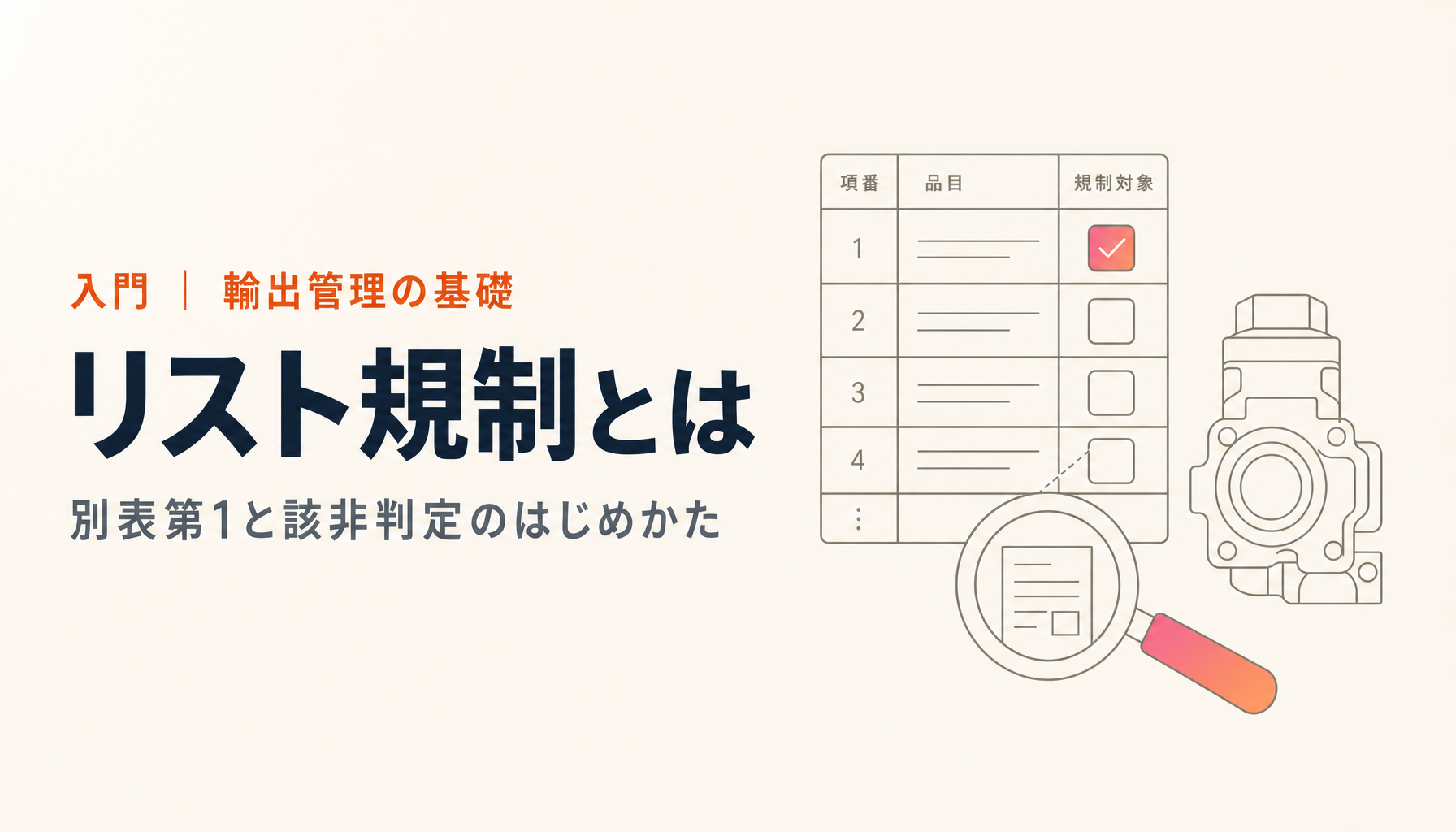
So what is enumerated in that topmost list, Appended Table 1 of the Export Trade Control Order? It is organised by item number. Items 1 through 15 are the subject of list controls, and item 16 is the subject of catch-all controls. This ordering of the item numbers is not something Japan decided on its own; it reflects what has been agreed in international frameworks. What each item covers, and how to find the item number for your own product, is set out in Appended Table 1 of the Export Trade Control Order: items 1 to 16 and how to look them up.
Japan participates in four international arrangements on export control. These are known as the multilateral export control regimes, where participating countries move in step and negotiate which performance thresholds in which fields to control. The four are the Nuclear Suppliers Group (NSG), which handles the nuclear field; the Australia Group (AG), which handles the chemical and biological weapons field; the Missile Technology Control Regime (MTCR), which handles missiles and other delivery systems; and the Wassenaar Arrangement (WA), which broadly handles conventional arms and their related dual-use goods. National lists share a similar structure because, traced back, they rest on these same agreements.
The correspondence between the item numbers in Appended Table 1 and these four regimes lays out as follows.
| Item number | Broad subject | Corresponding regime |
|---|---|---|
| Item 1 | Weapons themselves | (weapons themselves, not a regime match) |
| Item 2 | Nuclear-related | NSG |
| Item 3 | Chemical weapons related | AG |
| Item 3-2 | Biological weapons related | AG |
| Item 4 | Missile-related | MTCR |
| Items 5 to 15 | Dual-use goods tied to conventional arms (advanced materials, materials processing, electronics, computers, telecommunications, sensors and lasers, navigation, and so on) | WA |
What the table should make you notice is that item 1 alone is different in character. Item 1 covers weapons themselves, and it is distinguished from dual-use items, which can serve civilian or military purposes. Items 2 through 15 are the domain that covers so-called dual-use goods, those whose use is not settled in one direction. I set out the idea of dual-use itself in more detail in what dual-use items are, and reading the two together gives you a rounder picture. One thing to keep in mind: the fact that something appears on the list indicates a regulatory classification only. It is not a judgement on the merit of the goods or the counterparty involved. This neutral stance is a premise you should not let go of, right to the end, when discussing export control.
Classification is the exporter's own responsibility, recorded on a parameter sheet
By now the where of it is coming into view. The next question is who, exactly, decides whether your own product matches the list. This is perhaps where newcomers are most surprised. The one who decides is not the state. It is the exporter.
On its own website, the Ministry of Economy, Trade and Industry states plainly that it does not perform classification2. In other words, there is no arrangement whereby you carry your product to the ministry, ask "does mine fall under the list?", and are told the answer. What the ministry provides are tools such as matrix tables that lay out, item number by item number, the Export Trade Control Order, the goods ordinance and the interpretive notices. Using them to classify is the responsibility of the exporting side. This principle of self-responsibility is an unavoidable, and quite heavy, point in understanding list controls.
In practice, to organise and record this determination item by item, a form called a parameter sheet or item-by-item comparison table is widely used. It lists the requirements set by the provisions down the left, records how your product's figures and specifications stand against each of them on the right, and works through the requirements one at a time to conclude controlled or not controlled. The best-known versions of these forms are those provided by the Center for Information on Security Trade Control (CISTEC). It is worth remembering that "parameter sheet" is not a term that appears in the law; it is simply the established name for a form that has settled into practice3.
The determination you produce does not end as an internal document. Customers frequently ask "is this product not controlled?" and request a non-applicability certificate. When customs asks you to show your basis, this parameter sheet becomes the explanatory material. Classification is a work product that carries external accountability. Continuing this comparison for every product and every model number, and reviewing it each time there is a design change or a list revision, is the most laborious part of the day-to-day work of list controls. The reason we are building an export control AI agent called TRAFEED is precisely that maintaining this painstaking comparison by hand alone has stopped being realistic. An AI agent is software that, following a procedure given to it in advance, moves on its own from reading the materials to drafting a determination. That said, the final classification belongs to each company's export control officer; what the AI takes on is doing the comparison of provisions against specifications without gaps and at speed, and leaving the reasoning on the record.
How list controls and catch-all controls differ
Once you understand list controls, the thing to hold alongside them, always as a pair, is catch-all controls. Japan's export control is a two-storey structure built from these two, and looking at only one of them invites a classic failure.
The ground floor is list controls. As we have seen, the subject is items matching the performance and specification thresholds enumerated in items 1 to 15 of Appended Table 1 of the Export Trade Control Order, and a licence is required regardless of destination. The axis of judgement is, throughout, the performance of goods or technology.
The upper floor is catch-all controls. Also called complementary export controls, they are set out in item 16 of Appended Table 1 and the Foreign Exchange Order table. Even for an item that does not match the list, a licence becomes necessary where its use may go toward the development of weapons of mass destruction or conventional weapons, where the end user is involved in such development, or where you receive an individual notification from the ministry requiring a licence application. This notification is called an inform. One of the materials for judging whether an end user raises concern is the End User List published by the ministry. It is a list of foreign entities and others flagged as raising concern about involvement in the development of weapons of mass destruction and the like, and as of the September 2025 revision it is reported to carry roughly 835 entities4. Here too I want to stress: listing is a regulatory classification that typologically indicates an end user requiring verification, and it does not mean a judgement that the entity has committed any wrongdoing.
Set the two side by side. List controls take the specifications of the object as their basis and apply uniformly across all regions; catch-all controls take end use, end user and destination as their basis, and are geographically limited. The governing items differ too: items 1 to 15 for list controls, item 16 for catch-all. Note that where you obtain an individual licence because an item falls under list controls, you do not need to reassess the catch-all controls. For a side-by-side comparison that also covers how each destination is treated, see list controls vs catch-all controls, compared in a table.
The failure that arises easily here is the judgement that "I checked the list, it was not controlled, so I can export freely." Being outside the list only clears the ground floor; the upper floor, the catch-all, remains. If the counterparty's background is unclear, if the explanation of use is vague, if there are signs of re-export through a third country, that is where you need to stop. I explain the substance of catch-all controls, and in particular the three requirements that trigger the need for a licence, in the three requirements of catch-all controls, which I hope you will read as the next step after list controls.
The 2025 revisions came thick and fast, and the list keeps moving
The last thing I want to convey about list controls is a fact: this system is not fixed. It moves almost every year. When agreements at the multilateral regimes are updated, that flows into Japan's Appended Table 1. In recent years, additions and reviews have continued in fields where technical progress ties directly to security, such as equipment involved in manufacturing advanced semiconductors. A basis you built last year is not guaranteed to hold this year.
2025 too saw several revisions overlap. First, a review of export controls on machine tools took effect on 28 May 2025. Next, a review of the complementary catch-all controls was promulgated on 9 April 2025 and took effect on 9 October of the same year. In that review, the framing of what is covered was reorganised: exports even to Group A countries, meaning the countries such as those in Europe and North America whose procedures had been simplified on the basis that they operate export control rigorously and had until then been outside the catch-all, can now fall within scope where the inform requirement is met. Further, the End User List was revised on 29 September 2025, and a cabinet order partially amending the Export Trade Control Order was issued on 14 November of the same year5.
Looking at that run of revisions, it becomes clear that the day-to-day work of list controls is not a case of "set it up properly once and you are done." A design change can raise a specification and turn a product from outside to inside the list, and a revision of the list itself can do the same. A company with a large catalogue has to keep tracking two separate movements, design change and list revision, across each of thousands of model numbers. Running that with a team of one or two dedicated people is, frankly, quite punishing in reality.
What we are working on with TRAFEED is exactly a way to keep pace with this moving target, basis and all. On our own research, TRAFEED is the world's first AI agent in the field of security export control in Japan (as of March 2026, internal study), and it holds Patent No. 7862062. It is built on a knowledge graph of more than 200 million records, including papers, patents and researcher information. A knowledge graph is a database that links information such as people, technologies and organisations together like a map, and its strength is following relationships that a simple word match cannot see. In joint validation with Okayama University using roughly 30,000 past screening records, we confirmed AI classification accuracy of 95% or higher (internal study). Support for item-by-item comparison tables such as parameter sheets is an area we will keep strengthening. To repeat, the final classification belongs to each company's export control officer, and the AI is positioned as a tool that supports that judgement.
Summary
Boiled right down, the story of list controls comes to a handful of points.
- List controls are a mechanism that enumerates, by specification, goods and technology whose performance lends itself to conversion into weapons, and requires a licence in principle for exporting anything that matches. It applies uniformly regardless of destination
- The legal structure is built from four layers. On the foundation of the FEFTA statute, goods are set by Appended Table 1 of the Export Trade Control Order, technology by the Foreign Exchange Order table, and the concrete specifications by the goods ordinance
- In Appended Table 1, items 1 to 15 are list controls and item 16 is catch-all. Items 2 to 15 reflect the agreements of the four multilateral regimes (NSG, AG, MTCR, WA)
- Classification is the exporter's own responsibility, not the ministry's. On a parameter sheet or item-by-item comparison table, you check the requirements against your product's specifications one at a time and record the result
- List controls draw the line by performance; catch-all controls draw it by end use and end user. Even outside the list, do not relax; you have to check the upper floor, the catch-all
- 2025 too saw a run of revisions, including the machine tools review and the catch-all review. Because the list keeps moving, classification is work you have to keep maintaining
Because the provisions are hard to read, list controls tend to get shunned as "a tiresome procedure best left to the experts." But at heart, I think of it as the practice of being able to explain, in your own words, what performance your products have, where they go, and what they might be used for. Whether you do it reluctantly as regulatory compliance, or take it on as the work of knowing the outline of your own products, the tasks are the same, but whether the programme lasts turns on that difference.
If you cannot tell whether your products fall under list controls, or where to begin, talk to our TRAFEED team.
Footnotes
-
On the legal structure of export control (the relationship between FEFTA, the Export Trade Control Order, the Foreign Exchange Order and the goods ordinance), see the Center for Information on Security Trade Control (CISTEC), "Overview of Security Trade Control" (https://www.cistec.or.jp/export/yukan_kiso/anpo_gaiyou/index.html ), and the Japan External Trade Organization (JETRO), "Quick Guide to Security Trade Control," January 2024 edition (https://www.jetro.go.jp/ext_images/world/security_trade_control/pdf/guide/202401_v2.pdf ). ↩
-
That the Ministry of Economy, Trade and Industry does not perform classification is stated on METI, "Security Trade Control" (https://www.meti.go.jp/policy/anpo/ ). The body of that page is access-controlled, so its content was confirmed through the CISTEC and JETRO explanations. ↩
-
On parameter sheets and item-by-item comparison tables, see JETRO, "Trade and Investment Consultation Q&A" 04A-001028 (https://www.jetro.go.jp/world/qa/04A-001028.html ). The forms are provided by CISTEC. ↩
-
The positioning of catch-all controls and the End User List draws on JETRO, "Trade and Investment Consultation Q&A" 04A-020118 (https://www.jetro.go.jp/world/qa/04A-020118.html ), and the JETRO "Quick Guide," January 2024 edition. The number of listed entities (roughly 835) is an approximate figure based on secondary sources; the precise count and scope should be confirmed against the original End User List published by METI (revised 29 September 2025). ↩
-
The 2025 revisions (the machine tools review effective 28 May 2025, the complementary export control review promulgated 9 April 2025 and effective 9 October 2025, the End User List revision of 29 September 2025, and the cabinet order partially amending the Export Trade Control Order of 14 November 2025) are per the "What's New" section of METI, "Security Trade Control" (https://www.meti.go.jp/policy/anpo/ ). For a comparison with the EU system, see the fundamental structure of the EU Dual-Use Regulation. ↩