Hello, this is Ryuta Hamamoto from TIMEWELL. When people start learning Japanese export control, the first wall is almost always the same question: what is the difference between list controls and catch-all controls? Here is the answer in one table up front.
| Dimension | List controls | Catch-all controls (complementary export controls) |
|---|---|---|
| What is checked | The item and its specifications (classification) | End use and end user, plus inform notices from the METI Minister |
| Scope | Rows 1–15 of Appended Table 1 of the Export Order and of the Foreign Exchange Order's Appended Table | Row 16: nearly all other goods and technology, excluding food, lumber, and the like |
| Destinations | All destinations | Mainly outside Group A. Since October 9, 2025, Group A shipments also need a license if an inform notice is received |
| When a license is required | Always, if the item is controlled | When the exporter learns of a weapons-development risk, or receives a notice |
| License types available | Individual licenses, plus bulk (comprehensive) licenses where eligible | Individual licenses only |
In one sentence: list controls bind the item; catch-all controls bind the use and the counterparty. Both live inside Appended Table 1 of the Export Trade Control Order, split between rows 1–15 and row 16. In my view, the weak point is the seam between the two: what happens to an item that came back "non-controlled" under list controls. That item drops into row 16 and stays inside the catch-all net. Non-listed items can still need a license, and that is what this piece is really about.
On October 9, 2025, Japan's review of complementary export controls took effect, and Group A (the former "White Countries") stopped being entirely outside catch-all. Plenty of explanations that rank well in search still say catch-all never applies to Group A. I checked every comparison point against the statutes and METI's published materials as of October 4, 2026, then ran five example transactions through both regimes.
US readers often map this onto a familiar EAR pattern: CCL classification first, then end-use and end-user rules for everything else. The mapping is useful, not exact. Japan has its own Appended Table 1 structure, its own Group A destination list, METI's End User List, and an inform-notice mechanism. If you run a Japan subsidiary, ship under Japanese export declarations, or buy from Japanese manufacturers who must license under the Foreign Exchange and Foreign Trade Act (FEFTA), you need the Japanese vocabulary, not only ECCNs. If you want a quick outside check on how your process handles both steps, our free export-control readiness check takes about three minutes.
Rows 1–15 and row 16: one table, two regimes
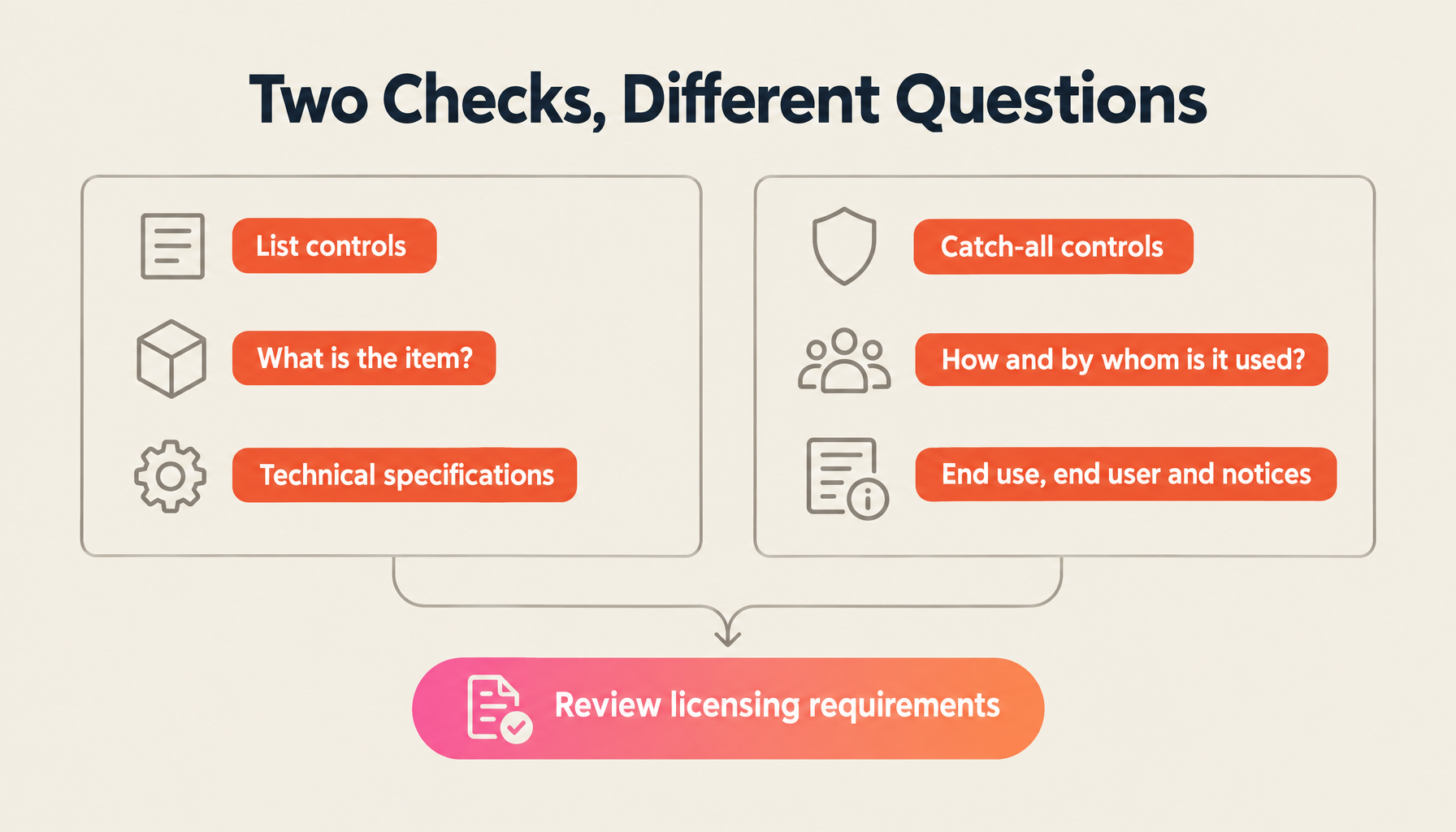
Japan's security export controls run on FEFTA. Exports of goods fall under Article 48, transfers of technology under Article 25. The lists that say what is regulated are Appended Table 1 of the Export Trade Control Order (for goods) and the Appended Table of the Foreign Exchange Order (for technology). Both run from row 1 to row 16. Rows 1–15 are list-control territory; row 16 is catch-all territory.1
| Row | Regime | Contents |
|---|---|---|
| Rows 1–15 | List controls | Weapons, nuclear, chemical and biological weapons-related items, missiles, advanced materials, materials processing, electronics, computers, telecommunications, sensors, navigation, marine, propulsion, and more, enumerated item by item |
| Row 16(1) | Catch-all (specified items) | Machine tools; radar, navigation radio, and wireless remote-control equipment; integrated circuits; aircraft, spacecraft, and their parts; navigation equipment; and inspection equipment, where the HS codes in Article 14-2 of the Goods and Technologies Ordinance apply |
| Row 16(2) | Catch-all (other) | Goods in Customs Tariff Act chapters 25–40, 54–59, 63, 68–93, and 95, other than specified items and list-controlled items |
Why two regimes? Because a parameter list on its own cannot stop just-below-threshold engineering. Picture machines specified just under the list threshold, shipped in volume and routed into weapons production. A list that only reads specifications cannot stop that transaction. Catch-all closes the gap by reaching non-listed items when the use or the counterparty raises a weapons-development concern. The formal Japanese name, complementary export controls, says it well: catch-all complements list controls. It does not replace them.1
METI states plainly that exporters must check "from the perspectives of both list controls and catch-all controls."1 So the practical sequence has two steps. First, classify against rows 1–15; if the item is controlled, you need a license for every destination. If it is not, it falls into row 16 and you run catch-all: end use, end user, and inform status.
A non-controlled list result is not "unregulated." It means "go to step two." Issuing a certificate of non-applicability to a customer can feel like the end of the job, but the catch-all step has not even started. Honestly, I think this second step is the most easily overlooked gap in Japanese export compliance. For the full row-by-row map, see What Is Appended Table 1? Items 1–16 Explained.
Item versus use and counterparty
The two regimes run on completely different evidence. List controls can be settled from the product spec sheet. Catch-all cannot be settled without the contract and what you know about the customer. That is also why the two checks often end up with different teams.
How list controls work
List controls require a license from the Minister of Economy, Trade and Industry for exports or transfers to every country and region when the goods or technology sit in rows 1–15. The destination column for rows 1–15 reads "all regions" in every row.2 A friendly destination does not remove the license requirement. That is the sharpest contrast with catch-all.
Classification works by narrowing the candidate rows from the product category, then comparing the actual specifications against the thresholds in the Goods and Technologies Ordinance. The result goes into a parameter sheet or a classification certificate. The step-by-step method is in Japan Export Classification: The 5 Steps, and the basics of list controls are in What Are List Controls?
Classification records and the catch-all records that follow are easier to defend when they share one format. We publish a free set of Word and Excel templates covering classification and non-applicability certificate forms, a parameter worksheet, a catch-all verification sheet, and a classification log. Download the Classification Certificate and Parameter Sheet Guide + Templates (2026 edition) and use it to keep step one and step two in a single trail.
One exception shows where the two regimes meet: the small-value exception in Article 4(1)(v) of the Export Order. Goods in rows 5–13 and 15 with a total value of JPY 1 million or less (JPY 50,000 for certain goods listed in Appended Table 3-3) can ship without a license to destinations other than Iran, Iraq, and North Korea. The exception only works, though, when the catch-all conditions set for that destination are not met.2 Even an exception to list controls sends you back to the catch-all check.
How catch-all controls work
Catch-all covers goods and technology outside list control, which means row 16. The net is wide, hence the name. There are two streams, one for weapons of mass destruction and one for conventional weapons; the WMD catch-all dates back to April 2002.3
Not everything in the net needs a license. Two triggers matter. The first is the objective requirement: after checking end use and end user, the exporter learns there is a risk of use in developing, manufacturing, using, or storing WMD, or in developing, manufacturing, or using conventional weapons. The second is the inform requirement: a written notice from the METI Minister stating that a license application should be filed. Meeting either one means a license is required.1 The memory aid I use: objective requirements fire on what the exporter can see, the inform requirement on what the government can see.
For end-user checks, the reference point is METI's End User List. It was revised on September 29, 2025, and now lists 835 entities (87 more than before) in 15 countries and regions. METI is explicit that it "is not an embargo list." Even for a listed entity, no license application is needed when it is clear the item will not be used for weapons development.3 A listing means METI has not been able to dismiss concerns. It is reference information, not a verdict on the organization. How to judge "clearly" is covered in The "Clearly Evident" (Akiraka) Guideline, and the plain-language basics are in What Are Catch-All Controls?
Everyday civilian goods are not automatically out of scope
"We don't make weapons, so this has nothing to do with us" is the most expensive instinct in export control. CISTEC, Japan's specialist center for security trade control, gives concrete examples.4 Carbon fiber in tennis rackets and fishing rods can serve as missile structural material, which is why high-spec carbon fiber sits in list row 5. Triethanolamine, used in shampoo, can be a chemical-weapons precursor. A freeze dryer built for instant coffee could be diverted into biological production equipment.
The lesson is not that every consumer product is controlled. Civilian materials can still cross list thresholds, and general-purpose goods below those thresholds still sit in row 16. "What you make" never answers the question. "What you sell, to whom, and for what purpose" does, and that is the real difference between the two regimes.
Destinations: Group A is no longer fully outside catch-all
List controls are simple: every destination. Catch-all varies with the destination, and Japan sorts destinations into three groups. Group A is the 27 countries in Appended Table 3 of the Export Order, including the United States, the United Kingdom, Germany, France, South Korea, Australia, and Canada. The UN arms-embargoed group is the 10 countries and regions in Appended Table 3-2: Afghanistan, the Central African Republic, the Democratic Republic of the Congo, Iraq, Lebanon, Libya, North Korea, Somalia, South Sudan, and Sudan. Everything else is a "general country."2
That last label confuses people. "General country" does not mean "country of concern." Taiwan, Singapore, India, Thailand, Vietnam, Mexico, and China are all general countries. The label only means the destination is not in Group A.
| Destination | List controls | Row 16(1) specified items | Row 16(2) other |
|---|---|---|---|
| Group A (27 countries) | License required | License required only if an inform notice is received because of diversion risk | Same as left |
| General countries | License required | Objective and inform requirements, for both WMD and conventional weapons | WMD: objective and inform requirements. Conventional weapons: inform requirement only |
| UN arms-embargoed (10) | License required | Objective and inform requirements, for both WMD and conventional weapons | Same as left |
The legal basis is in the Export Order itself. Row 16's destination column reads "all regions (excluding the regions listed in Appended Table 3)," so Group A starts outside row 16. Article 1(3), however, requires anyone exporting row 16 goods to Group A to obtain a license under FEFTA Article 48(2), and Article 4(2) waives that license unless an inform notice has been received. The fact that conventional-weapons objective requirements do not apply to row 16(2) shipments to general countries comes from the drafting of Article 4(1)(iv).2 METI describes the Group A inform requirement as applying "only where there is a risk of diversion to countries of concern."1
Two things to take from the table. Only the list-controls column says "license required" in every row, because item-based control does not care who the buyer is. And Group A is no longer entirely outside catch-all. Exporters are not asked to run objective end-use and end-user checks on Group A shipments, but once a notice arrives, the shipment cannot move without a license. For the amendment history and the HS code list behind specified items, see Japan's Catch-All Amendments, Explained; for the destination groups themselves, see Japan's Country Groups A, B, C, and D.
Replace siloed classification work with AI.
METI's FY2024 data shows 52% of foreign exchange law violations stem from classification errors. Download the TRAFEED product catalog covering features and rollout.
Five cases: which regime actually applies
Comparison tables only go so far, so here are five common transactions. They are illustrations, not real deals, and whether a given item is controlled depends on the actual numbers in the Goods and Technologies Ordinance. Read each one as "assuming the item is (or is not) controlled."
Case 1: high-spec carbon fiber to a US customer
If the carbon fiber meets the row 5 thresholds, it is list-controlled, and a license is required even though the United States is in Group A. List controls have no "friendly country" carve-out. If the same carbon fiber falls short of the thresholds, it drops into row 16, and because the destination is Group A, no license is needed unless an inform notice arrives. One specification flips the answer.
Case 2: general-purpose plastic parts to a plant in Thailand
Plastic parts fall in Customs Tariff Act chapter 39 and are not specified items, so they are row 16(2). Thailand is a general country, so the WMD objective and inform requirements apply, and for conventional weapons only the inform requirement applies. If the contract and specs show no weapons-development use, the customer is not on the End User List, and no notice has arrived, no license is needed. METI still asks exporters to "keep a record of how they reached that decision in line with their internal rules."1 A "no license" answer still leaves a paper trail.
Case 3: a specified-item machine tool to a general-country customer
A machine tool below the list thresholds is a row 16(1) specified item if its HS code appears in Article 14-2 of the Goods and Technologies Ordinance. For specified items going to general countries, conventional-weapons objective requirements apply as well. If the contract documents show the customer's plant will use it to make conventional-weapons parts, a license application is required. Before October 9, 2025, this shipment would only have needed the WMD check and confirmation that no inform notice had been received.
Case 4: electronic components to a distributor in Germany, and then a notice arrives
Non-listed electronic components headed to Germany, a Group A country, do not trigger objective requirements. Now suppose METI sends an inform notice citing a risk of diversion to a country of concern. A license under Article 1(3) of the Export Order is now required.2 METI says exports covered by a notice are licensed only once the concern has been resolved.1 This is exactly where "Group A means no catch-all" breaks down.
Case 5: a small-value list-controlled sample to a general country
Say a part controlled under one of rows 5–13 (and not listed in Appended Table 3-3) ships to Singapore with a total value of JPY 800,000. The small-value exception can remove the list-control license requirement. For general countries, though, the exception only applies if the WMD objective requirement and both inform requirements are not met.2 Even here, the catch-all check cannot be skipped.
Put the five side by side and the pattern is clear. List controls are a single yes-or-no on the item. Catch-all depends on a combination of destination, row 16 split, end use, end user, and notice status. Working through that combination by hand for every order is honestly a lot of work.
Penalties, license types, and technology transfers
Three questions come up often enough in practice to deserve their own section.
Penalties do not split along list versus catch-all lines
People tend to assume catch-all violations carry lighter penalties. For destinations outside Group A, they do not. Article 1(1) of the Export Order defines the scope of the FEFTA Article 48(1) license as exports of "goods in the middle column of Appended Table 1 to the regions in its right-hand column." Row 16's right-hand column is every region except Group A, so once a row 16 item headed to a general or UN arms-embargoed destination meets a trigger, it needs the same Article 48(1) license as a list-controlled item.2
An unlicensed export in either case falls under FEFTA Article 69-7(1): imprisonment of up to seven years, a fine of up to JPY 20 million, or both, with the fine ceiling rising to five times the value of the goods when that is higher. Under Article 72, a company can face a fine of up to JPY 700 million (or five times the value, if higher). Certain goods designated by Cabinet Order as especially likely to be used for nuclear weapons and similar programs fall under the heavier Article 69-7(2). A breach of the Group A inform requirement under Article 48(2) falls under Article 69-8: up to five years or JPY 10 million, and up to JPY 500 million for a company. Unlicensed exports under Article 48(1) can also lead to an administrative export ban of up to three years under Article 53.5 None of this is legal advice; it is a map of where the provisions sit.
License types: catch-all means individual licenses
List-controlled items can use bulk (comprehensive) licenses for certain destination and item combinations once the exporter meets the requirements, including filing an internal compliance program with METI. Bulk licenses cannot be used for catch-all.6 A catch-all license is needed precisely because a specific concern is on the table, so each transaction is reviewed individually. The license types are compared in Individual vs Comprehensive Export Licenses.
For hard calls, exporters can consult METI's Security Export Licensing Division before applying. For catch-all consultations, METI asks for four things: documents showing the commercial flow, logistics, contract terms, and end use; catalogs or specifications; materials on the end user's business; and the objective-requirements confirmation sheet.1 Read the other way, that list is a good template for what your own file should hold.
Technology transfers follow the same two-tier structure
Everything above applies to technology as well. Under FEFTA Article 25, technology in rows 1–15 of the Foreign Exchange Order's Appended Table is list-controlled, and row 16 is catch-all.15 Emailing drawings, giving technical training at an overseas plant, or carrying technical files out on a USB drive can all count as a technology transfer or a related export of a storage medium.
Transfers inside Japan can be covered too. Besides transfers to non-residents in Japan, a revised circular published in November 2021 clarified that, from May 1, 2022, transfers to residents who fall under "specified categories" of strong influence from a foreign government or foreign company are also within deemed-export control.7 Companies that hire foreign nationals or run joint research need both regimes on the technology side as well. See Service Transactions and the Foreign Exchange Order Appended Table and Deemed Exports and the "Specified Categories".
If you buy from Japanese suppliers
Most US readers meet this topic from the buying side, so a few practical notes. A Japanese supplier's classification answer (controlled or non-controlled under Appended Table 1, often shown on a certificate of non-applicability) is a Japanese classification, not an ECCN, and the two do not map one-to-one. If you need an ECCN for your own EAR compliance, ask for it separately.
Because the United States is in Group A, your Japanese supplier does not have to run objective end-use and end-user checks on a shipment to you, but list-controlled items still need a METI license, and a Group A inform notice can still stop a shipment. Build that lead time into sourcing plans for sensitive parts. If you are a US company buying through, or reselling into, general countries such as Taiwan, Singapore, or Mexico, expect the supplier to ask for end-use and end-user information; that is the catch-all check working as designed, not a sign that anyone suspects you.
Separately, US rules keep moving. The BIS Affiliates Rule (the 50% rule extending certain Entity List restrictions to majority-owned affiliates) is suspended, and the suspension rule (90 FR 50857) runs through November 9, 2026 in the Federal Register. The US and China have announced an extension to January 10, 2027: China's Ministry of Commerce stated it on its official site on September 28, and the US Treasury Secretary's September 23 remarks are known through press reports. As of October 3, BIS had not published an extension rule in the Federal Register.89 Current status and the ownership math are in What Is the BIS 50% Rule?
What changed since the first edition
This piece first went up on January 23, 2026, and was revised in July and August. The division of labor between the two regimes has not changed, but several things around it have. Here is the previous version next to the current position.
| Item | Previous version (August 2026) | Now (checked October 4, 2026) |
|---|---|---|
| Catch-all framework | Reflected the October 9, 2025 review | No change. METI's review page was last updated April 15, 2026, and METI revised its security trade control Q&A on April 241011 |
| METI End User List | September 29, 2025 revision, 835 entities | Still the latest: 835 entities in 15 countries and regions, applied from October 9, 2025. METI says it is not an embargo list311 |
| List-control side | Not covered | The FY2025 routine amendment (Cabinet Order No. 376 of 2025, promulgated November 14, 2025) took effect February 14, 2026. METI says list items are, in principle, amended every year212 |
| FEFTA penalties | Not covered | After the partial entry into force of FEFTA amendments on June 5, 2026, the unlicensed-export penalty sits in Article 69-7. Article 48, which sets the license requirement, did not change5 |
| METI guidance | Not covered | METI posted the third edition of its introductory Security Trade Control Guidance on March 31, 202611 |
| BIS 50% rule | Said the rule was "scheduled to return on November 10, 2026" | Suspension rule (90 FR 50857) runs through November 9, 2026. Extension to January 10, 2027 announced (China's MOFCOM on September 28; US Treasury Secretary's September 23 remarks via press reports). No BIS extension rule in the Federal Register as of October 389 |
The last row corrects the previous version. The Federal Register deadline, the announced extension, and the state of BIS rulemaking are three separate things, and none of them yet supports a firm date. On the Japanese side, list amendments will keep coming every year. When the next amendment is promulgated, list your controlled items and the items you judged non-controlled near the amended rows before it takes effect. The non-controlled ones should already be going through catch-all, so review those records too.
Post-amendment checklist
Use this alongside METI's procedure flow chart and objective-requirements confirmation sheet.10
Classification (list controls, rows 1–15)
Compare the product against the Goods and Technologies Ordinance thresholds and document the rationale in a parameter sheet. In METI's analysis of FY2024 FEFTA violation cases, 52% traced to classification and 36% to gaps in the control framework.13 The breakdown is in 52% of FY2024 FEFTA Violations Trace Back to Classification.Row 16 split
A non-controlled list result is not the end. Separate specified items (row 16(1)) from other row 16 goods (row 16(2)) by HS code. That decides whether conventional-weapons objective requirements apply to general-country shipments.1Destination group
Group A, general country, or UN arms-embargoed. Make sure your team knows that Group A shipments need a license once an inform notice arrives.1End-use check (objective requirement)
Look through contracts, specifications, and customer communications for anything indicating weapons-development use. A non-listed item can still open a license question here.End-user check (objective requirement)
Screen for weapons-program involvement and against METI's End User List.3 Even for a listed entity, the "clearly evident" route may apply when use and terms show no weapons development, but that judgment means working through the guideline. Practical notes: Customer Due Diligence (End-User Screening) in Practice.Inform status and record retention
Confirm no inform notice has been received. Even when the conclusion is "no license application needed," keep the trail.1 The catch-all verification sheet in the 2026 templates works if you have no form.
Steps 2 through 6 change with every order. TRAFEED is our AI first-pass analyst for that work: it supports Japanese export classification against rows 1–15, runs the catch-all end-use and end-user checks, and screens counterparties against METI's End User List and the US Consolidated Screening List, keeping the evidence on file. For Japanese classification specifically, a joint validation with Okayama University on roughly 30,000 past review records found accuracy of 95% or higher (company research, as of March 2026). It holds Japan Patent No. 7862062 and is used by more than 20 organizations. Your export control officer makes the final call.
Summary
| Dimension | List controls | Catch-all controls |
|---|---|---|
| What is checked | Item and specifications | End use, end user, and inform notices |
| Scope | Rows 1–15 | Row 16 (specified items in 16(1), everything else in 16(2)) |
| Destinations | All destinations | Mainly outside Group A; Group A only when an inform notice is received (since October 9, 2025) |
| When a license is required | Always, if controlled | When a risk becomes known, or a notice arrives |
| License types | Individual, or bulk where eligible | Individual only |
- List controls bind the item; catch-all binds use and counterparty, split between rows 1–15 and row 16 for both goods and technology
- A non-controlled list result still requires the catch-all check, and so does using the small-value exception
- Group A shipments need a license once an inform notice citing diversion risk arrives (since October 9, 2025)
- An unlicensed row 16 export outside Group A falls under the same FEFTA Article 69-7 as a list-controlled one
- Work in order: classify, split row 16, group the destination, check end use, check end user, confirm notices, keep records
If I could add one habit to every export team, it would be this: keep a list of everything you have classified as non-controlled, and link each item to the transactions where it passed the catch-all check. A list classification stays tied to the product until the rules change. A catch-all answer changes with every deal. In the end, the difference between the two regimes is also a difference in what you record.
Always confirm details against METI's Security Trade Control pages. This piece reflects the position as of October 4, 2026, and is not legal advice. If you want to map your products and counterparties onto the two regimes, talk to us about TRAFEED. Materials are in our resource library.
References
- METI, Complementary Export Controls (Catch-All Controls)
- METI, Review of Complementary Export Controls (effective October 9, 2025)
- METI, Catch-all procedure flow chart (from October 9, 2025)
- METI, Objective-requirements confirmation sheet
- METI, Revision of the End User List (September 29, 2025)
- e-Gov, Export Trade Control Order (Japanese)
- e-Gov, Foreign Exchange and Foreign Trade Act (Japanese)
- CISTEC, The Basics of Export Control
- METI, Security Trade Control
- Federal Register, suspension rule 90 FR 50857 (November 12, 2025)
Related articles
- What Are Catch-All Controls? A Plain Guide
- Japan's Catch-All Export Control Amendments, Explained
- The "Clearly Evident" (Akiraka) Guideline for Catch-All Controls
- What Is Appended Table 1 of Japan's Export Trade Control Order?
- Japan Export Classification (Gaihi Hantei): The 5 Steps
- What Are List Controls?
- Japan's Certificate of Non-Applicability Explained
- Customer Due Diligence (End-User Screening) in Practice
- Individual vs Comprehensive Export Licenses
- What Is the BIS 50% Rule? Stay Deadline, Extension Deal, and Ownership Math
Footnotes
-
METI, "Complementary Export Controls (Catch-All Controls)" (last updated December 23, 2025; accessed October 4, 2026). https://www.meti.go.jp/policy/anpo/catchall.html ↩ ↩2 ↩3 ↩4 ↩5 ↩6 ↩7 ↩8 ↩9 ↩10 ↩11 ↩12
-
e-Gov, Export Trade Control Order, Article 1(1) and (3), Article 4(1)(iii)–(v) and (2), Appended Table 1 row 16, Appended Tables 3, 3-2, 3-3, and 4, and supplementary provisions of Cabinet Orders No. 175 and No. 376 of 2025 (version in force from June 5, 2026; checked October 4, 2026). https://laws.e-gov.go.jp/document?lawid=324CO0000000378 ↩ ↩2 ↩3 ↩4 ↩5 ↩6 ↩7 ↩8
-
METI, press release on the revision of the End User List (September 29, 2025; accessed October 4, 2026). 835 entities in 15 countries and regions, applied from October 9, 2025. https://www.meti.go.jp/press/2025/09/20250929006/20250929006.html ↩ ↩2 ↩3 ↩4
-
CISTEC, "The Basics of Export Control: The Importance of Security Export Control" (accessed October 4, 2026). https://www.cistec.or.jp/export/yukan_kiso/anpo_jyuuyousei.html ↩
-
e-Gov, Foreign Exchange and Foreign Trade Act, Articles 25, 48, 53, 69-7, 69-8, and 72 (text in force as of October 4, 2026). https://laws.e-gov.go.jp/document?lawid=324AC0000000228 ↩ ↩2 ↩3
-
JETRO, Security Trade Control Quick Guide (Japanese), p. 11, "Whether a bulk license applies" (January 2024): bulk licenses "cannot be applied to catch-all controls." https://www.jetro.go.jp/ext_images/world/security_trade_control/pdf/guide/202401_v2.pdf ↩
-
Keidanren Times, "Clarification of deemed-export control" (December 2, 2021): revised circular published November 18, 2021, applied from May 1, 2022. https://www.keidanren.or.jp/journal/times/2021/1202_06.html ↩
-
Federal Register, "One Year Suspension of Expansion of End-User Controls for Affiliates of Certain Listed Entities," 90 FR 50857 (published November 12, 2025; FR Doc. 2025-19846). Suspension ends November 9, 2026 absent an extension. https://www.federalregister.gov/documents/2025/11/12/2025-19846/ ↩ ↩2
-
Ministry of Commerce of the People's Republic of China, Americas and Oceania Department explainer on the eighth round of China-US economic and trade consultations (September 28, 2026), item 8. https://www.mofcom.gov.cn/syxwfb/art/2026/art_d9ea01824fc44fd8a29f7dc3f8ca9c72.html ↩ ↩2
-
METI, "Review of Complementary Export Controls (effective October 9, 2025)" (last updated April 15, 2026; accessed October 4, 2026). https://www.meti.go.jp/policy/anpo/apply-01/20251009_catchminaoshi/20251009catchall.html ↩ ↩2
-
METI, Security Trade Control, news listing (last updated July 30, 2026; accessed October 4, 2026). https://www.meti.go.jp/policy/anpo/ ↩ ↩2 ↩3
-
METI, "Classification and the goods and technology matrix tables" (last updated February 18, 2026): list items are "in principle amended every year." https://www.meti.go.jp/policy/anpo/matrix_intro.html ↩
-
METI, "Analysis of FEFTA Violation Cases (Security Trade Control), FY2024" (December 2025). https://www.meti.go.jp/policy/anpo/gaitameho_document/ihanjireigaitamehou6.pdf ↩
![Japan's Catch-All Export Control Amendments, Explained: The October 9, 2025 Overhaul and Its Impact on the Use, End-User, and Inform Requirements [2026 Update]](/images/columns/catchall-three-requirements-guide/cover.en.png)