Hello, this is Ryuta Hamamoto from TIMEWELL.
When I talk with people who handle export control, one scene comes up every time. Someone from sales asks, in a casual tone, "This product, we want to ship it to a new partner in Asia next week, it's fine to export, right?" You open the spec sheet and it is a wall of numbers: frequency, precision, heat resistance. Whether any of them crosses a threshold listed in the rules, you check one by one, staring back and forth at the legal text. Before you know it, the whole afternoon is gone. I suspect that particular research hell is familiar to a lot of readers.
And the work does not end once you have looked it up. Is the partner really someone you can trust? Is there a parent company or a shareholder in the picture that gives you pause? You search names, chase corporate registrations, and dig into overseas information. You keep a written record of the basis for your judgment in case of an audit. And all the while, each country's rules keep changing. The feeling that a day disappears just keeping up is no exaggeration at all.
Why do export control officers end up carrying this much? Let me first lay out the structure of it, based on government primary sources. Then I will talk about how far "AI-driven export control," an approach that is spreading little by little, can lighten that burden, caveats included so we do not overtrust it. If you first want to know where your own export control stands, start with our free export control self-check.
An export control officer's day dissolves into "looking things up"
Seen from outside, export control might look like a procedure of stamping documents. Inside, though, it is a steady chain of investigation. I want to draw that concretely.
The first thing in your way is classification. Classification means checking whether the goods or technology you intend to export are "controlled" under the lists set out in law, or "not controlled." To decide, you read the product's spec sheet and drawings, and sometimes technical information at the level of an academic paper, then match the figures written there against the thresholds set in the rules, one at a time. Above so many hertz and it is controlled; below so many microns of precision and it is controlled. There are mountains of such fine conditions, field by field. Because a single number crossing a threshold flips the conclusion, you cannot let your guard down.
Next comes partner screening. You match the partner's company name against various lists and check whether it corresponds to an entity of concern. What makes it awkward is that it does not stop at the company name on the surface. Who is the parent company? Is there a shareholder of concern? Where do the goods ultimately end up? Trace the connections and you sometimes find a party that warrants attention hidden in an unexpected place. Chasing this by hand can easily take several hours per case.
And you must not forget the records and the paperwork. Why did you judge it not controlled? Which threshold in which article did you compare it against? If you do not keep the basis for the judgment, you cannot explain it in a later audit. I often hear that the work of writing up the basis takes more time than the judgment itself. Look it up, confirm it, write it down, keep it. This whole flow repeats with every case.
Why the burden gets this heavy
Hearing all this, you might think, "I understand the officer has it hard, but isn't this a problem with the system?" Exactly so, and the burden has structural reasons. Let me lay them out in three.
The first is the way the system is built, so that classification is the exporter's own responsibility. Japan's Ministry of Economy, Trade and Industry does not carry out classification on a company's behalf. The responsibility for determining what falls under the rules rests with the exporting side. In other words, you have to hold the expertise in-house and keep judging under your own power. That the burden of this self-management is structurally large is where it all starts1.
The second is that the rules keep changing at high frequency. Export control rules are revised often, in step with the international situation. Looking at Japan alone, an expansion of the supplementary export controls (the catch-all controls) took effect in October 2025, and the Foreign End User List, which gathers overseas entities warranting attention, was expanded to 835 entities in a September 2025 revision. Further, a cabinet order revision added equipment incorporating FPGAs to the controlled items, taking effect in February 20262. That is Japan's movement alone; bring the United States, Europe and China into view and the speed of change rises further still. Keeping up by hand with revisions across many countries and languages is already reaching beyond the limits of any one person's effort.
The third is that because this step depends on human effort and knowledge, mistakes arise easily. This is not impression but something government data shows plainly. According to the fiscal 2024 analysis published by Japan's Ministry of Economy, Trade and Industry, about 52% of violations of the Foreign Exchange and Foreign Trade Act (in the security trade area) stemmed from shortcomings related to classification3. In earlier years too, it has been reported repeatedly that many violations are classification related, and human factors such as forgetting to classify at all, or assuming something was not subject to the rules, occupy the top places. Classification, the very starting point of export control work, is the largest breeding ground for violations. I have organised the detailed breakdown by year in a separate piece on the METI violation-analysis data.
That burden weighs most heavily on the organisations least able to assign a dedicated person. JETRO (the Japan External Trade Organization) too states clearly that at many small and mid-sized companies, limits on relevant knowledge and management resources mean the internal system for export control is not well developed4. When one officer holds all the knowledge, the know-how is severed the moment that person leaves through transfer or resignation. Single-person dependency and the risk that comes with a change of officer are like a shadow that follows this work around. The overall flow of a classification is diagrammed in government material as follows.
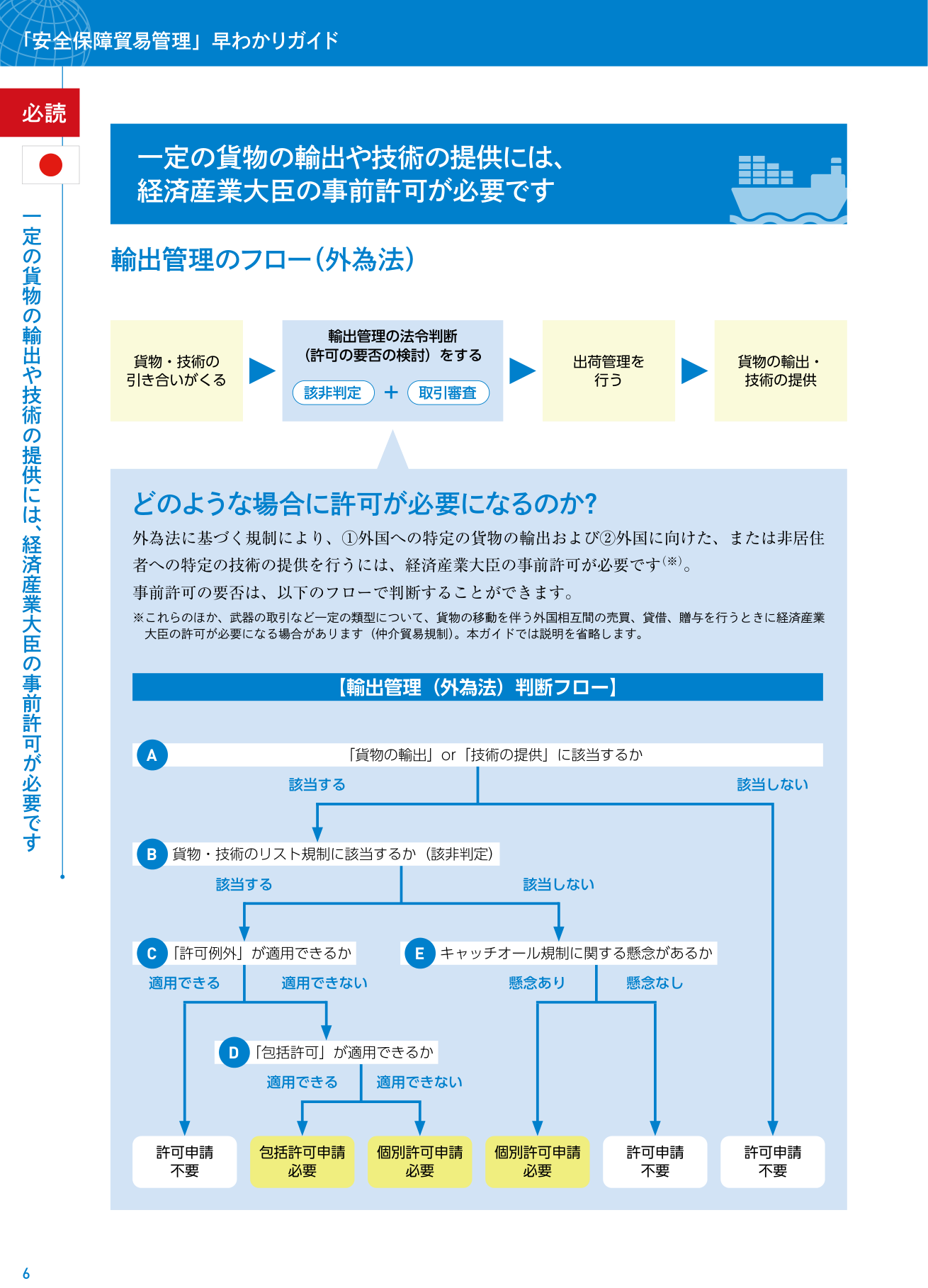
Source: JETRO, "A Quick Guide to Security Trade Control" (January 2024 edition) One thing to add here. When an entity is placed on a regulatory list such as the Foreign End User List, that is a regulatory category, not a judgment that the company has done something wrong. Rather than singling out a listed company as dangerous, the neutral stance of a practitioner is simply to confirm, in line with the system, which transactions require attention.
Replace siloed classification work with AI.
METI's FY2024 data shows 52% of foreign exchange law violations stem from classification errors. Download the TRAFEED product catalog covering features and rollout.
AI-driven export control as an option
So far we have looked at the structure of the burden. It depends on human effort and knowledge, it is chased by change, and it is chased by record-keeping. If so, the natural idea that surfaces is to have AI take on the groundwork and organising, and let people concentrate on the final judgment. This is AI-driven export control, which is now spreading.
The important thing is that this is not about throwing the judgment over to AI. AI gathers the material for judgment quickly and accurately and lays the issues out in front of a person. The person checks them and reaches a conclusion under their own responsibility. That division of roles is the foundation. Let me organise, task by task, what AI can concretely do, following the four burdens of export control.
In supporting classification, AI reads spec sheets, design documents and technical literature, and matches the figures written there against the thresholds in the rules. Because it shows the basis, down to which article and which criterion it judged against and how, the officer is freed from the labour of hunting through legal text from scratch. In particular, reading specifications out of drawings and design data is where mistakes tend to occur, and I touch on that burden in more detail in a piece on the export control risks in drawings.
In partner screening, AI does more than match company names; it analyses the chain of relationships including parent companies and shareholders, and makes visible where the goods ultimately arrive and which networks of relationships warrant attention. Its strength is surfacing hidden related parties that a person cannot chase to the end. On the thinking behind partner vetting itself, please also see the piece on end-user screening and customer due diligence.
In paperwork, it automatically generates reports with the basis and reasoning for a judgment attached. That keeps you in a state where, if an audit asks you to explain, you can immediately show why you reached the conclusion. And in keeping up with each country's rules, it researches across multilingual literature and regulatory lists and reflects revisions quickly. This is an area where AI can take on much of the burden of a person chasing official gazettes around the world.
TRAFEED, which we develop, is an export control AI agent aimed at these four tasks. It references a large-scale knowledge graph of papers, patents, researcher information and more, looks across the rules of Japan, the United States, Europe and China, and connects everything from supporting classification through analysing the chain of relationships to generating evidence-backed reports in a single flow. Beyond classifying goods, it also handles deemed export checks for when technology is provided to international students or researchers, an issue I have organised in a piece on the risks of deemed export. Alongside that, for the thinking on dual-use (usable for both civilian and military purposes) items, the piece on what dual-use items are is a useful reference.
How much easier does it get, in numbers
Talk of efficiency, spoken on feeling alone, tends toward exaggeration. Let me put both government data and the figures we publish side by side, with the reservations made clear.
As a starting point worth pinning down, there is the size of the burden to be reduced. As noted above, about 52% of Foreign Exchange and Foreign Trade Act violations stemmed from classification-related shortcomings (METI's fiscal 2024 analysis)3. Turned around, this means that if AI can raise the accuracy of classification and reduce the misses, there is a chance of reaching a substantial part of the violation risk. That is at the root of what makes it meaningful to move export control to an AI-driven form.
On that basis, let me pass on TRAFEED's figures. For classification accuracy, we reached 95.5% in a joint proof of concept with Okayama University (our own figure)5. By combining a consensus of multiple AI models with a deterministic rule engine, we take a design that structurally suppresses the phenomenon of AI generating false information. For the logic involved in judging the level of concern, we have obtained a patent (Japanese Patent No. 7862062)6.
There are figures on processing time too. TRAFEED makes the level of concern of an export transaction visible in roughly five seconds, and automatically generates everything from a round of investigation to an evidence-backed report in about ten minutes at the fastest. On that basis, a judgment that used to take two to three hours per case becomes five seconds, and we state that this can cut work time by up to 99.7%5. That said, this reduction rate is an estimate for a model case we publish, not a figure verified by an independent third party. The actual effect changes with the product handled and the complexity of the case. The numbers are best received as one rough guide.
Let me also touch on how widely it has spread. TRAFEED has been adopted, or adoption has been decided, at more than 20 organisations, including manufacturers, trading companies, research universities and independent administrative agencies. We believe it is the world's first AI agent in the field of Japan's security export control, though that too is an expression carried with the reservation that it is our own finding as of March 20266. Because this is a new field, we avoid flat assertions and always deliver the fact and the reservation as a set.
Caveats, so we do not overtrust it
I have talked about efficiency this far, but as long as you are using AI, there are things to watch for. If anything, precisely because export control is work that carries heavy responsibility, I believe this is where you must not slip.
First, the final judgment must always be made by a person. The principle in the system, that classification is the exporter's own responsibility, does not change just because you use AI. AI is an aide that handles the groundwork and the organising; the conclusion of controlled or not, and whether to proceed with a transaction, are for the export control officer to check and decide. The reason TRAFEED assumes Human-in-the-loop (a design that keeps a person inside the loop of judgment) is to hold this very line. Please avoid the way of using it where you swallow AI's output whole and turn it straight into a document.
Second, attention to information security. The spec sheets and partner information handled in export control are a mass of sensitive information that must not leak out. Where is the data you feed the AI processed, and how is it stored? Casually throwing important design data into an outside service without confirming this is dangerous. When you consider adopting a tool, be sure to check the handling of data and the mechanism for managing it.
Third, the habit of checking whether AI's conclusion comes with a basis. An AI that returns only the conclusion "not controlled" looks convenient but is in fact perilous. Being able to trace back to the primary sources, down to which threshold in which article it compared against, is the condition for export control that can withstand an audit. Efficiency, and keeping yourself in a state where you can explain. These two must be made to hold together. More than the number coming out fast, being able to have a person verify that number carries the value in practice.
The first step, and the export control officer of the future
This ran long, so let me organise the key points.
- An export control officer's burden concentrates into four things: the research of classification, partner screening, paperwork, and keeping up with each country's rules
- That burden has structural reasons: that classification is the exporter's own responsibility, that the rules are revised at high frequency, and that it depends on human effort and knowledge so mistakes arise easily
- Government data too shows that about 52% of Foreign Exchange and Foreign Trade Act violations stemmed from classification-related shortcomings (METI's fiscal 2024 analysis)
- AI-driven export control is an approach in which AI takes on the groundwork and organising and people concentrate on the final judgment. TRAFEED reached 95.5% classification accuracy in a joint proof of concept (our own figure)
- Figures such as the reduction rate are estimates for a model case, and it is the firm premise that the export control officer makes the final call
Export control has, in part, been held up until now by "the effort of an individual who holds the knowledge." Yet with the rules changing this fast and the information handled this much larger, relying on that effort alone is nearing its limit. Make AI the partner for the groundwork and the record-keeping, and pour your own energy into judgment and explanation. The officers who can carry out that reshuffling of roles, I think, are the ones who will carry export control forward. Turn single-person dependency into a system, and you also build toward an arrangement where the know-how is not severed even when the officer changes.
Even so, there is no need to change everything at once. It is enough to start from knowing what state your own export control is in right now. As a first move, check where you stand with our free export control self-check, and then, if you are unsure how to proceed concretely, please talk to the TRAFEED team. Matched to the reality of your own products and transactions, we will help you organise where you can bring AI in so that it works without strain. Let us start from turning the time that used to dissolve into research into time that raises the quality of judgment.
References and primary sources
Footnotes
-
Japan's Ministry of Economy, Trade and Industry, "Security Trade Control Guidance" and the Q&A on classification (stating that classification is a procedure the exporter itself is responsible for, and that METI does not carry out classification). https://www.meti.go.jp/policy/anpo/guidance.html ↩
-
Japan's Ministry of Economy, Trade and Industry, press release, "On the cabinet order partially amending Appended Table 1 of the Export Trade Control Order and the Appended Table of the Foreign Exchange Order" (promulgated 14 November 2025, effective 14 February 2026, adding equipment incorporating FPGAs to Item 7 of Appended Table 1, among other changes). https://www.meti.go.jp/press/2025/11/20251114001/20251114001.html ↩
-
Japan's Ministry of Economy, Trade and Industry, Trade and Economic Security Bureau, Office of Security Trade Inspection, "On the analysis of violation cases under the Foreign Exchange and Foreign Trade Act (security trade area) (fiscal 2024)" (December 2025). https://www.meti.go.jp/policy/anpo/gaitameho_document/ihanjireigaitamehou6.pdf ↩ ↩2
-
JETRO (the Japan External Trade Organization), "A Quick Guide to Security Trade Control: Taking on Export Control in the Age of Economic Security" (January 2024 edition). https://www.jetro.go.jp/ext_images/world/security_trade_control/pdf/guide/202401_v2.pdf ↩
-
AIsmiley product introduction, "Export control AI 'TRAFEED'" (95.5% classification accuracy in a joint proof of concept with Okayama University, the level of concern made visible in five seconds, an estimate for a model case shortening the conventional two-to-three-hour judgment, and other figures; all figures published by our company). https://aismiley.co.jp/product/timewell_trafeed/ ↩ ↩2
-
TIMEWELL Inc. press release (PR TIMES; reference to a large-scale knowledge graph, obtaining Japanese Patent No. 7862062, adoption decided at more than 20 organisations, the world's first AI agent [as of March 2026, our own finding], and other points). https://prtimes.jp/main/html/rd/p/000000130.000119271.html ↩ ↩2