Hello, this is Ryuta Hamamoto from TIMEWELL.
When people talk about economic security and AI, the conversation usually runs inside a single frame: how do we defend ourselves through regulation. Which chip stopped shipping. Which item just landed on a list. Whether our own products are caught. That defensive work matters, of course. But following the moves of various countries over the past year or so, the thing I keep coming back to is this: fortifying the defence alone will not hold an advantage in this field.
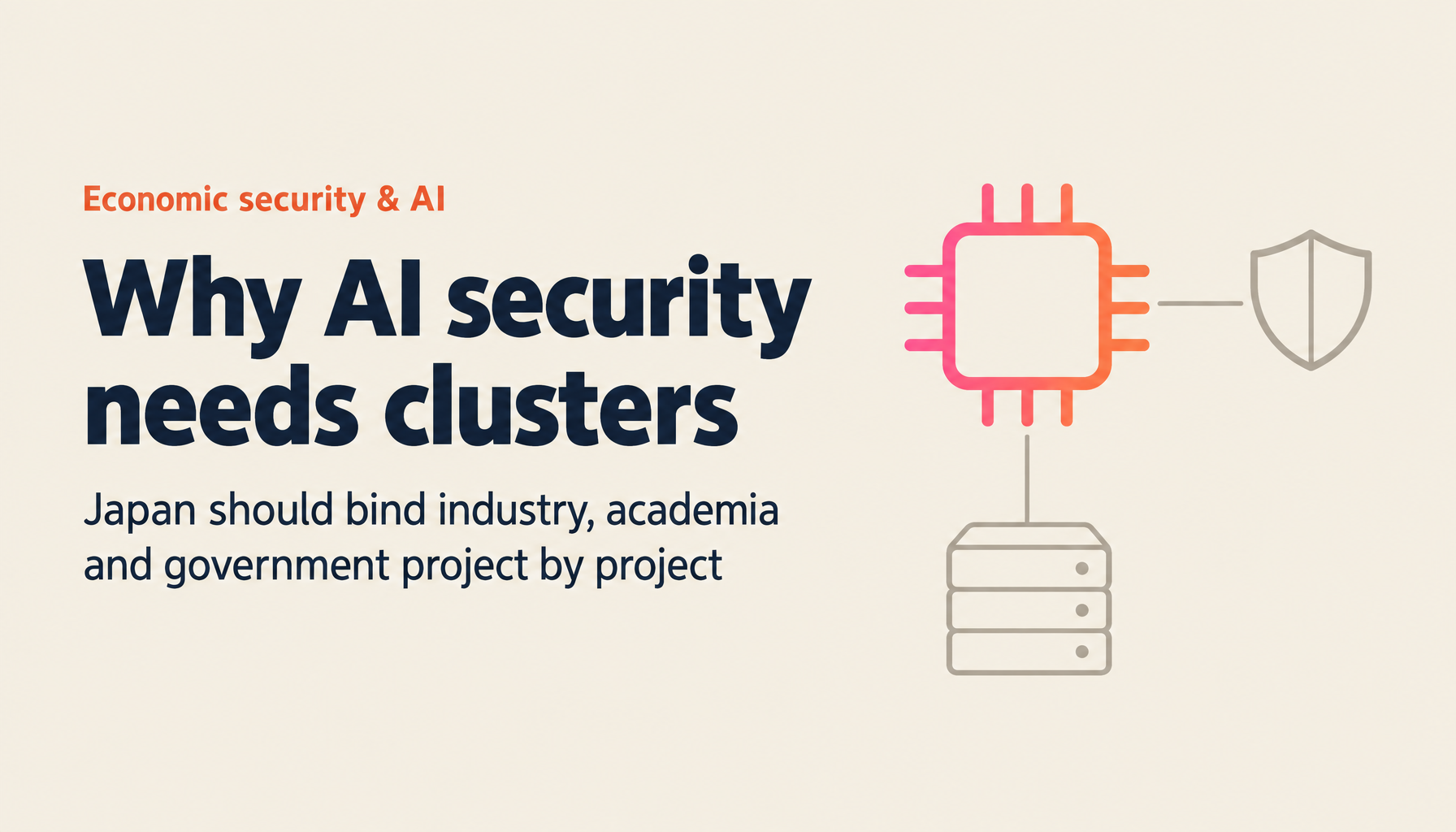
This piece is not an explainer on export control. I am writing it as my own proposal. The conclusion first: in this space where security, export control and physical AI overlap, individual companies handling their own compliance in isolation runs into a ceiling, and Japan should build what I will call a cluster-type ecosystem, where industry, academia and government bind together project by project. By cluster I mean a body of companies, universities, research institutions and government offices that share a purpose and gather case by case to divide the roles between them. Let me set out why I think this, starting from where the sense of urgency comes from.
Two events that showed containment alone cannot hold
First, why raise the alarm at this particular moment, grounded in facts. AI capability, pushed to its root, is governed by the amount of compute available. And that compute connects directly to advanced semiconductors, goods that states manage as strategic assets. This is exactly why the United States has treated AI as a national-security matter and fenced off advanced chips through export controls. In 2022, NVIDIA's high-performance GPUs could no longer be exported to China, and when a lower-spec China version appeared, the US in October 2023 added a new metric measuring performance density and widened the controls to catch even that lower-spec part.1 It was an attempt to carry the idea that "AI power is compute, and compute is advanced semiconductors" through to its logical end in the form of regulation.
Then two events came along that shook the premise behind this containment. One was the rescission of the AI Diffusion Rule in May 2025. This was an interim rule that sought to manage advanced-AI semiconductors by sorting countries into three tiers. It was published in the Federal Register dated 15 January 2025, with compliance due to begin on 15 May that year. But many friendly countries found themselves demoted to the middle tier, which generated diplomatic friction, and the burden on domestic firms was judged too heavy, so the Bureau of Industry and Security at the Department of Commerce rescinded it just before it took effect.2 The harder they tried to draw a precise line, the more they damaged relations with allies and their own competitiveness. A fundamental difficulty of regulatory design showed through.
The other was the so-called DeepSeek shock, also in January 2025. When the Chinese startup DeepSeek released a high-performance reasoning model, US semiconductor-related stocks fell sharply, and reports described a leading chip firm's shares dropping roughly 17% in a single day, said to be one of the largest single-day losses of market value in US equity history. The claim that development costs were extremely low comes from the company itself and has not yet been independently verified, but at the very least it was shown in visible form that a low-cost model approaching the frontier can emerge even while export controls continue. Set these two side by side and a reality surfaces: blocking the entrance through regulation is not enough to keep a technological advantage secure. Defence is necessary, yet defence alone falls short.
If you have not yet gauged how your own products or technology relate to controls like these, start with our free export control self-check. In a few minutes you will get a sense of which questions you need to work through.
The "offensive model" the US showed was a consortium
The party that moved fastest to act on the limits of defence was, ironically, the United States itself, the very country that had led the regulation. In July 2025 the US administration published "America's AI Action Plan", a package of more than 90 measures, and at the same time signed Executive Order 14320, "Promoting the Export of the American AI Technology Stack".3 As the name says, this is an executive order for pushing a full set of AI technology out through exports.
What I want to draw attention to is the mechanism. The "American AI Exports Program", newly established by the Department of Commerce under this executive order, seeks to deliver to allied countries a single bundled package running from hardware such as chips and servers, through data centres and cloud, data preparation, AI models and security, to application software for particular uses. And at its core sat an industry-led consortium: a method of publicly soliciting proposals from alliances of companies. Not a single firm, but several companies bound together to propose one package, and if selected, the government adds export-licence review, introductions to financing and diplomatic support. Documents on this solicitation appeared in the Federal Register in October 2025 and again in April 2026.
I take this development seriously precisely because the very idea I want to argue for here, the cluster-type ecosystem, is being implemented as national strategy. Rather than only stopping the outflow of other countries' technology through defensive regulation, they bundle their own technology and turn it into an offensive export. And they place the actor not in government but in an industry alliance, with government supporting from behind. This design, running defence and offence as two wheels of the same axle, is a precedent Japan should learn from. If you want to see the timeline of how the US-China back-and-forth over semiconductor and AI regulation has moved, I have organised it in the US-China AI and semiconductor regulation calendar (2024-2028), which is worth reading alongside this for the full picture.
Replace siloed classification work with AI.
METI's FY2024 data shows 52% of foreign exchange law violations stem from classification errors. Download the TRAFEED product catalog covering features and rollout.
China's rules point to another front
China, for its part, is taking its own path through regulation of the models themselves. For generative AI, the "Interim Measures for the Management of Generative AI Services" took effect on 15 August 2023, imposing obligations such as ensuring the legality of training data, reviewing the content of outputs, verifying users by real name, and filing on algorithms and safety.4 It was a comprehensive generative-AI regulation early by world standards, and a distinctive feature is that it also applies to services provided into China from abroad. Then in March 2025 the "Measures for Labelling AI-Generated and Synthetic Content" were promulgated and took effect from September that year. This regime requires text and images made by AI to be marked in two ways: an explicit label visible to users, and an invisible mark embedded in the file's information.
Where Japan and the US build their controls mainly around the flow of hardware and the export side, China lays state management from the software side, through the provision of models and the labelling of outputs. This shows well that there is more than one front in AI regulation. Watch only the semiconductors at the entrance and you miss the other fronts, models, services, disclosure of the origin of generated content. The space where economic security and AI intersect is that multilayered. The details of China's rules around AI models and semiconductors are gathered in China's AI model and semiconductor export controls (2026 edition), which you can refer to as well.
One thing I want to make clear here. A country imposing regulation, or a company or technology falling within a regulated category, is a separate matter from any value judgment that the country or company is at fault. Regulation is a classification within a system; it does not decide the rights and wrongs of the parties involved. What I am concerned with in this article is how Japan should set its posture while each country widens its net under a different design philosophy, not condemning any particular country or company. I want to put that up front. How controls like these actually bear on day-to-day work is covered in the overall picture of AI export regulation (2026).
Japan has the foundation. What is left is how to bind it
So is Japan without means? Far from it. If anything, the institutional foundation has been laid fairly well over the past few years. The Economic Security Promotion Act, enacted in 2022, has four pillars: securing the stable supply of critical goods, ensuring the stable provision of core infrastructure services, supporting the development of advanced critical technologies, and keeping certain patent applications non-public.5 Strengthen supply chains, nurture critical technologies, protect sensitive inventions. The point of this law is that it holds both defence and development as a matter of institutional design.
On the development side, the "Key and Advanced Technology R&D through Cross Community Promotion Program", known as the K Program, is in motion. Grounded in the Economic Security Promotion Act and related law, it is led across ministry lines by the Cabinet Office, MEXT and METI, with JST and NEDO, public bodies that support research, managing the funds as endowments. Combining the first round in September 2022 and the second in August 2023, it aims for a scale of around 500 billion yen, and roughly 50 critical technologies have been identified so far. Frontier fields such as AI and quantum are among the targets. On top of this, a security-clearance system, under which the government confirms the trustworthiness of people who handle sensitive non-public information important to security, took effect in May 2025, putting in place a precondition for industry, academia and government to step into international joint research. On AI itself, the "AI Promotion Act", which sets no penalties and instead backs research, development and use, came fully into force in 2025, with an AI Strategy Headquarters established in the Cabinet.
In other words, the funding framework, the mechanism for protecting information, and the law for promoting AI are all present as components. What I feel is missing is the cross-cutting thread that binds these together case by case. Themes run in the K Program, the export-control regime turns on its own, and the AI Promotion Act moves separately again. Each extends vertically, yet the place that ties security, export control and the actual implementation of AI horizontally into one project is still weak. What the US pulled off with its industry-led consortium was exactly this: placing that horizontal thread at the centre of national strategy. Precisely because Japan has the foundation, there is a lot of room to design the binding.
As one of the technical pieces to be bound in, we are developing an export-control AI agent called TRAFEED. Export control is the work of continuously reconciling item data, the regulatory text of each country and information on counterparties, and the rules update on separate schedules country by country. It has become unrealistic to keep that reconciliation running on human effort alone, which is why I believe it needs AI support. In joint validation with Okayama University using roughly 30,000 past screening records, we confirmed AI classification accuracy of 95% or higher (internal study). That said, the final classification, the ultimate call on whether a company's product is caught by a control, belongs to each company's export-control officer. What AI takes on is reconciling provisions against specifications without gaps and at speed, and leaving the basis for the decision on the record.
Physical AI lays bare the weak point of supply chains
There is one more thing we will not be able to avoid from here: physical AI. This is an industry term proposed by NVIDIA in early 2025, referring to AI that perceives the physical world, reasons about it, and actually acts. Use in robots, autonomous driving and manufacturing sites is anticipated, and it should be noted that it is not a formal legal category. It is a vendor-originated concept. Even so, the direction, that AI is moving beyond information processing inside a screen into a stage of driving physical machines, is one many people have begun to share.
Physical AI matters for economic security because, involving physical form, its dependence on hardware and materials intensifies all at once. The motors, sensors and drive systems of robots cannot do without rare earths and critical minerals. And this supply chain has already shown many times over that it is vulnerable to geopolitical tremors. From 2023 onward China progressively tightened export management of materials such as gallium and germanium, and in April 2025 it widened controls to cover seven medium and heavy rare-earth items such as dysprosium and terbium, along with related magnets. Reports have also described moves entering 2026 to strengthen management of dual-use items directed toward Japan. In short, the further AI ventures into the physical world, the more the weak point at its feet, the supply of materials, becomes AI's own weak point.
Here is where my reason for proposing a cluster-type ecosystem comes together. In the age of physical AI, the power to build models is not enough on its own. Securing materials, making supply chains resilient, driving machines safely, and at the same time keeping constant watch on whether their import and export touch each country's regulations. These are not tasks a single company can complete. Material makers, parts makers, AI developers, university researchers and export-control specialists have to bind together project by project, or none of it turns. On dual use, the idea of technology usable for both civilian and military ends, I explain the basics in what are dual-use items; physical AI is exactly a field where this dual-use character runs strong. That is precisely why a place to bind things together is needed.
Proposal: uniting offence and defence through project-based communities
On the facts to this point, let me state my proposal clearly. In the space where security, export control and physical AI overlap, Japan should deliberately increase project-based clusters in which industry, academia and government gather case by case. There is no need to copy the US industry-led consortium wholesale. Japan has its own institutional base: the development framework of the K Program, the assurance of trust in security clearance, and the backing of the AI Promotion Act. What is missing is the operating pattern that ties these horizontally on top of a single case.
To sketch a concrete picture: choose one field of physical AI, and design a single cluster that runs from securing materials, through model development and the safety of the actual machine, to conformity with export control. Material makers take on making the supply chain resilient, universities the foundational technology, AI firms the implementation, and the export-control party takes on the classification and counterparty checks needed when the results are rolled out overseas. Government backs it with funding and institutions, and sensitive information is protected by security clearance. Defensive compliance and offensive technology export run inside the same project. Rather than confining defence to the lonely work of one officer, you redesign it as part of the offence. That is what I put into the word cluster.
Why is this an important piece for national security too. What the DeepSeek shock showed was the reality that containment alone cannot hold an advantage. What the US consortium showed was an answer: bind together and go on the offensive. If Japan takes both lessons, it needs to break out of a passive stance of quietly working through compliance and shift its position to that of an actor that protects technology while binding it and sending it outward. And for that cluster to function, it is a precondition that the defensive practice of export control keeps running without slowing the pace of the project. An AI-based export-control foundation like TRAFEED is, in my view, a technical piece that supports that precondition. What we are aiming for is to make compliance not a reason to stop, but a base for continuing the offence.
Let me add, for completeness, that the point that TRAFEED is the world's first AI agent in the field of Japan's security export control is based on our own research as of March 2026, and it is registered under Patent No. 7862062. Adoption has spread to more than 20 organisations, and it is built on a knowledge graph of over 200 million records, including 90 million papers, 100 million patents and 300,000 researchers, that is, a database that maps the connections between pieces of information like a map. What the figures mean is simply that it can reconcile that many provisions and pieces of technical information, but as I keep saying, the design is one where the final call is made by a person.
Summary
In the space where economic security and AI overlap, what I want to say comes down to these few points.
- Because AI power connects to compute and compute to advanced semiconductors, AI has become a central theme of economic security. But the rescission of the AI Diffusion Rule and the DeepSeek shock showed that containment alone cannot hold an advantage
- With Executive Order 14320 and the American AI Exports Program, the US turned toward "offensive export", built around an industry-led consortium. A design running defence and offence as two wheels of one axle is a precedent Japan should learn from
- China lays regulation on a different front, through the provision of models and the labelling of outputs. There is more than one front, and the field of economic security and AI is becoming multilayered
- Japan has the foundation: the four pillars of the Economic Security Promotion Act, the K Program, security clearance and the AI Promotion Act. What is missing is the way of binding these horizontally case by case
- The age of physical AI deepens dependence on materials and supply chains. That is exactly why a cluster-type ecosystem is needed, binding everything from materials through implementation to export control on a project basis
Listing on a regulatory register is a classification within a system; it does not decide the rights and wrongs of the parties involved. I did not write this article to criticise any country or company, but toward a single question: how Japan should set its posture. Redesign the defensive practice of compliance as part of an offensive ecosystem. If you want to take that first step from the practical work at your feet, export control, please talk to our TRAFEED team. As a technical piece of the cluster, we will tell you what we can do.
Footnotes
-
On the strengthening of US export controls on advanced semiconductors toward China (2022 to 2023), see neutral commentary such as that from the Japan External Trade Organization (JETRO). Primary sources are the US Bureau of Industry and Security (BIS) and the Federal Register. ↩
-
Rescission of the AI Diffusion Rule. JETRO Business News (May 2025) https://www.jetro.go.jp/biznews/2025/05/9f653beb6ac301ac.html / Primary sources: BIS and the Federal Register (interim final rule dated 15 January 2025; rescission announced 13 May 2025). ↩
-
Executive Order 14320, "Promoting the Export of the American AI Technology Stack", The White House (July 2025) https://www.whitehouse.gov/presidential-actions/2025/07/promoting-the-export-of-the-american-ai-technology-stack/ / The solicitation for the American AI Exports Program is in the Federal Register https://www.federalregister.gov/documents/2025/10/28/2025-19674/american-ai-exports-program ↩
-
China's "Interim Measures for the Management of Generative AI Services" (took effect 15 August 2023). See neutral commentary such as Science Portal China from the Japan Science and Technology Agency (JST) https://spc.jst.go.jp/news/230703/topic_2_04.html / Primary source: the original text published by the Cyberspace Administration of China (CAC). The "Measures for Labelling AI-Generated and Synthetic Content" were promulgated in March 2025 and took effect in September that year. ↩
-
Japan's Economic Security Promotion Act (enacted 2022) and the Key and Advanced Technology R&D through Cross Community Promotion Program (K Program). Cabinet Office https://www.cao.go.jp/keizai_anzen_hosho/suishinhou/suishinhou.html / https://www8.cao.go.jp/cstp/anzen_anshin/kprogram.html / For the AI Promotion Act see the Cabinet Office https://www8.cao.go.jp/cstp/ai/ai_act/ai_act.html Confirm budget scale, the number of critical technologies and effective dates against the latest values in each primary source. ↩