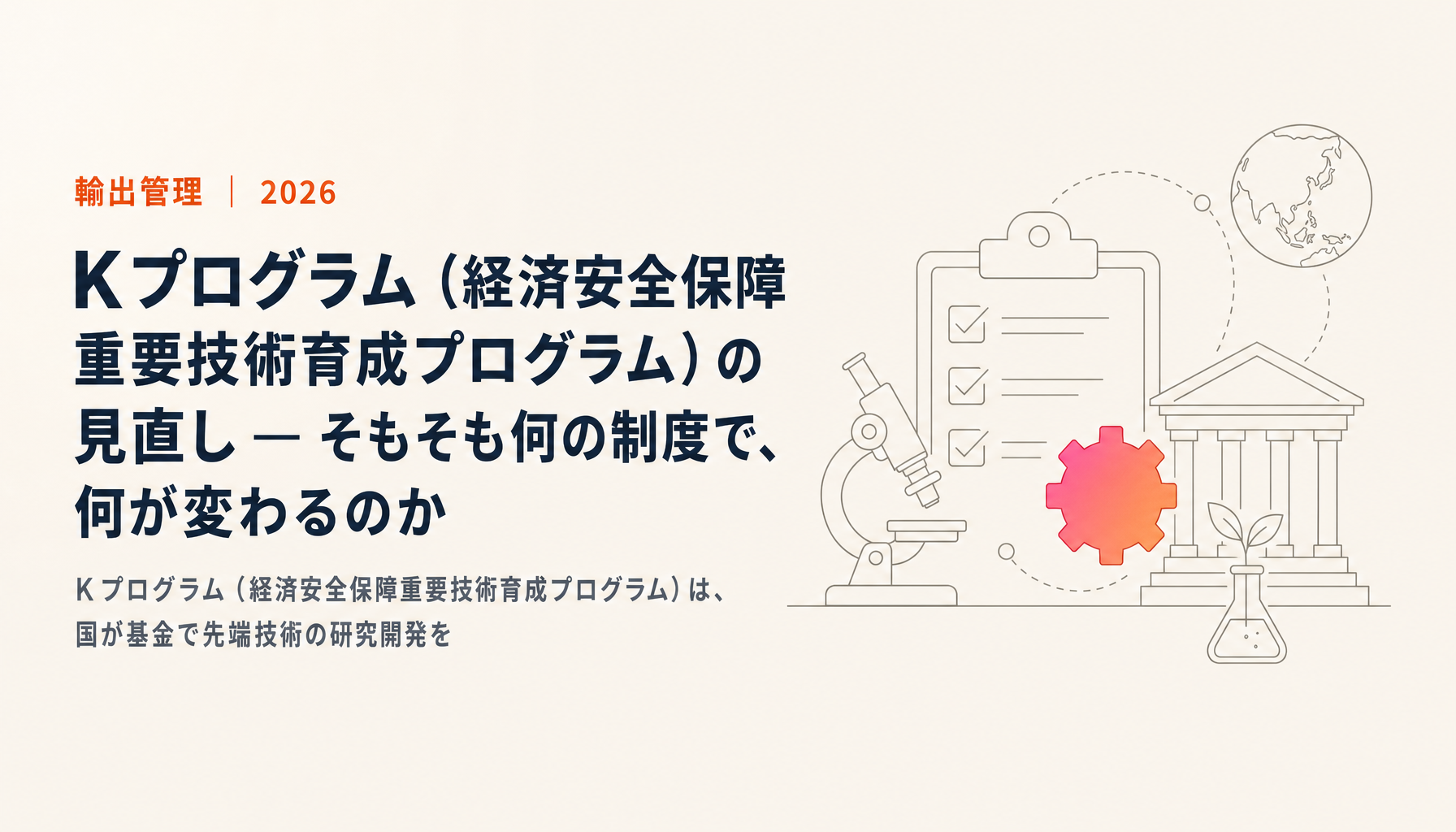
This is Ryuta Hamamoto from TIMEWELL. Japanese government documents on the K Program moved in quick succession through 2026: the 7th Science, Technology and Innovation Basic Plan in March, an amendment to the enabling statute in June, and both the Integrated Innovation Strategy 2026 and the Basic Policy on Economic and Fiscal Management and Reform 2026 in July. Each of those cabinet decisions contains the words "successor programme" or "institutional design."
The trouble is that you stumble at the first step. What is the K Program in the first place? Why does the state paying for private-sector technology development count as "security"? Without that, the sentence "work on the institutional design of a successor programme will be made concrete" tells you nothing about whether any of this touches your organisation.
So this article assumes no prior knowledge. The first half explains the programme itself; the second half sets out what is moving in 2026, using only what I could confirm in primary government sources. Where I could not confirm something, I say so. This is policy in mid-flight, and blurring that line would leave readers reasoning from false premises.
What the K Program actually is
The programme's formal Japanese name translates as the Program for Development of Critical Technologies for Economic Security. Its English name is the Key and Advanced Technology R&D through Cross Community Collaboration Program, which is where the initial "K" comes from.1
The Cabinet Office describes the purpose as promoting research and development, and the use of its results, for advanced critical technologies that are indispensable if Japan is to continue securing a firm position in the international community over the medium to long term, recognising the multivalent nature of science and technology, and covering public applications as well as civilian ones.1
That is a long sentence, so let me unpack it. "Advanced critical technologies" means technologies that are not yet in practical use but are expected to matter. "The multivalent nature of science and technology" refers to a single technology having several possible uses. Underwater positioning technology, for instance, serves seabed resource surveys, marine infrastructure inspection and safe ship navigation alike. And "covering public applications as well as civilian ones" means developing with an eye not only to commercial use but also to how government might use the technology for public purposes.
In short: the K Program is a scheme in which the state funds the development of frontier technologies that have more than one use.
Why funding technology counts as security
This is the first hurdle for most readers. "Security" suggests defence and diplomacy, but the law behind the K Program reasons differently.
The enabling statute is the Economic Security Promotion Act, formally the Act on the Promotion of Ensuring Security by Integrated Implementation of Economic Measures (Act No. 43 of 2022).2 Article 61 defines "specified critical technologies," and the thinking is concentrated there.
Article 61 covers advanced technologies that may become important for maintaining the lives of the people and economic activity in the future, and that risk giving rise to a situation harming the security of the state and its people in any of three cases. The statute packs these into two clauses; the Basic Guideline sets them out as categories 1 to 3.23
- Where the technology is improperly used by an external party
- Where information used in its research and development is improperly used by an external party
- Where goods or services using the technology are depended on externally and cannot be used stably
The third is the most intuitive. If a component or capability comes from a single overseas source and that source stops, domestic industry and daily life stop with it. Hence the interest in being able to make it at home. The first two are the mirror image: technology or information a country holds leaving in ways it did not intend.
So the statute treats protecting technology and growing it as a pair. The 7th Basic Plan puts the two side by side as "protection" and "promotion."4 The K Program is the promotion side. On the protection side sit export control and research security, and the two live back to back within the same legal framework.
Note also the phrasing "improperly used by an external party." This is a statute that defines categories of risk, not one that names particular countries or companies.
Who decides, and who disburses
The programme is run across ministries under the Economic Security Promotion Council and the Integrated Innovation Strategy Promotion Council, led by the Cabinet Office, MEXT and METI.1
The decision chain is set out in the Basic Guideline. Which critical technologies the K Program should support is indicated case by case in an "R&D Vision," decided by the Economic Security Promotion Council and the Integrated Innovation Strategy Promotion Council, following deliberation by the Program Council, which is made up of academic experts and relevant ministries, and deliberation on economic security at the National Security Council.3 In practice each Vision has been decided at a joint meeting of the two councils: the first on September 16, 2022, the second on August 28, 2023, and a partial amendment to the second on March 7, 2025.13
The money flows like this. The Critical Technology Development Fund for Economic Security was established at JST (the Japan Science and Technology Agency) and NEDO (the New Energy and Industrial Technology Development Organization),3 and Cabinet Office Notification No. 103 of October 18, 2022 designated both as "designated funds" under Article 63, paragraph 1 of the Act.5 JST and NEDO run the public calls, and selected universities and companies carry out the work.
On scale, a government paper submitted to the Cabinet Secretariat's expert panel in December 2024 states that the programme supports research, development and commercialisation of advanced critical technologies with a total of 500 billion yen.6 The expert panel's recommendation of January 30, 2026 records the same figure and adds that, since the regime began operating in September 2022, the K Program has covered 51 technologies and selected 121 proposals.7 As for the budget years, the draft amendment to the Basic Guideline refers to the supplementary budgets for FY2021 and FY2022. The current text mentions only FY2021; FY2022 is what the draft adds.8
You can see what is actually running on the Cabinet Office page. Counting the tables as of August 1, 2026, there are 24 R&D concepts under the second R&D Vision and 19 under the first, 43 in total.1 The area labels are marine, space and aviation, cross-domain and cyberspace, and bio, with the first-Vision table combining the last two. Each concept is assigned to JST or NEDO as the implementing agency. Most recently, four R&D concepts were revised on April 17, 2026: advanced cyber defence capability and analysis enhancement; technology for disinformation analysis; high-efficiency, high-quality laser processing technology; and advanced materials technology for aircraft engines.1
If you want the fundamentals in more depth, see my separate article on the K Program. This piece focuses on the review.
What happens after selection: the designated fund council
What makes the K Program different from an ordinary research grant is what follows selection. Going in without knowing this leads to surprises.
For specified critical technology R&D carried out through a designated fund, establishing a "designated fund council" is mandatory under Article 63, paragraph 4. The Basic Guideline states that the person representing the R&D is deemed to have consented to the council's establishment by responding to the public call.3 Applying is itself the consent. The Guideline adds that the call must make clear that the R&D is funded by a designated fund and that a council will be established.3
The council is composed of relevant ministries, funding agencies such as JST and NEDO, and the researchers carrying out the work, meaning universities and private companies. It exists to provide hands-on support in a setting where information sharing subject to confidentiality obligations is possible.9 Unless the council's rules provide otherwise, its secretariat function is performed by the Cabinet Office and administrative bodies under the minister with jurisdiction over the designated fund, with the funding agency providing administrative support.3
A good number of these councils are already running. The Cabinet Office page listing council activity showed councils No. 1 through No. 42, with no gaps, as of August 1, 2026.10 The same recommendation put the figure at 34 as of December 31, 2025,7 so eight were added over the following seven months.
For the avoidance of doubt: the council requirement and the information-management rules apply uniformly to R&D carried out through a designated fund. An institution being covered by a council says nothing about whether its research is problematic. Selection is the outcome of a competitive review.
Support periods and evaluation: where "interim evaluation" comes from
The 2026 cabinet decisions repeatedly say "in light of the results of the interim evaluation and the like." That phrase traces back to the evaluation machinery set out in the Operation and Evaluation Guideline for the K Program (September 16, 2022, Cabinet Secretariat and Cabinet Office).11
| Item | Content |
|---|---|
| Method | A stage-gate approach, dividing technology stages and setting gates (progress past each gate depends on the assessment at that point) |
| Support period | Up to 10 years from the start of R&D |
| Self-evaluation | Annual self-evaluation by the principal investigator |
| External evaluation | External evaluation by the funding agency, in principle in the third year from the start of R&D and in the year the R&D ends; projects continuing beyond five years receive at least one further evaluation before completion |
| Use of results | Evaluation results feed into budget allocation, including acceleration, deceleration and termination |
| Vision review | The Program Council considers, around five years from the start of research, draft proposals to continue, amend or end an R&D Vision, and reports to the joint meeting |
The 7th Basic Plan likewise describes the K Program as carrying out R&D on a basic period of about five years, while looking ahead to social implementation over a medium-to-long horizon of about ten years.4 With the first R&D Vision decided in September 2022, the earliest cohort is now approaching its fifth year. The 2026 policy sits on top of that evaluation cycle.
That said, I could not find any published document showing when, by whom, or in what form the "results of the interim evaluation of this programme" referred to in the cabinet decisions were or will be compiled. The evaluation cycle as a mechanism is published, as above; the results themselves have simply not reached the point of publication. That is as far as the record goes as of August 1, 2026.
Where the 2026 review came from
The review was not decided at a single meeting. Its shape emerged because three cabinet decisions in a row pointed the same way.
| Date | Document | What it says about the K Program |
|---|---|---|
| March 27, 2026 | 7th Science, Technology and Innovation Basic Plan (cabinet decision) | "While steadily promoting this programme, the state of a successor programme will be considered in light of the critical technology areas from an economic security perspective and the thinking behind them, the results of the interim evaluation of this programme, and the like."4 |
| June 17, 2026 | Amendment to the Economic Security Promotion Act (Act No. 38 of 2026) promulgated | Widens the range of funds under which a designated fund council can be established9 |
| July 3, 2026 | Expert panel, sectoral study meeting (public-private technology cooperation), 7th meeting | Secretariat explains the draft amendment to the Basic Guideline12 |
| July 14, 2026 | Integrated Innovation Strategy 2026 (cabinet decision)13 | "While promoting the K Program, work will proceed to make concrete, in light of the results of the interim evaluation and the like, the institutional design of a successor programme, from the perspective of building a technological foundation supporting national security through R&D on advanced technologies important for economic security. [Cabinet Office, MEXT, METI]"14 |
| July 21, 2026 | Basic Policy on Economic and Fiscal Management and Reform 2026 (cabinet decision) | "In order to promote R&D on specified critical technologies, institutional design toward strengthening the Program for Development of Critical Technologies for Economic Security will proceed, along with the promotion of international joint research."15 |
| July 24, 2026 | Expert panel, 17th meeting | Deliberates drafts covering the overarching Basic Policy and five Basic Guidelines (documents 3 to 8); the specified critical technology guideline is document 716 |
The thing to read here is the verb. The 7th Basic Plan, the first cabinet decision to write "successor," said the state of a successor programme "will be considered."4 Four months later the Integrated Innovation Strategy 2026 turned that into work proceeding "to make concrete" the institutional design of a successor programme, in light of interim evaluation results.14 From consideration to concretisation, one notch along. The Strategy places that sentence in two locations, once in the section on strategic prioritisation of technology areas and again in the section on strengthening technological capability with an emphasis on economic security. Its opening pillar on the organic linkage of science and technology with national security likewise says the institutional design of a K Program successor will be made concrete.14 In other words it is in the skeleton of the document. I cover the Strategy as a whole in a separate article.
A week later the Basic Policy 2026 added the words "toward strengthening" and the clause "along with the promotion of international joint research."15 The second of those connects directly to the export control point later in this article. Other themes in the Basic Policy 2026 are covered here.
One qualifier is worth holding onto. The 7th Basic Plan opens its sentence with "while steadily promoting this programme," and the Integrated Innovation Strategy 2026 with "while promoting the K Program."414 The Basic Policy 2026 carries no such clause, but what it does call for is institutional design "toward strengthening."15 On all three, the framing is not termination or contraction. It is designing the next thing while running the current one.
Replace siloed classification work with AI.
METI's FY2024 data shows 52% of foreign exchange law violations stem from classification errors. Download the TRAFEED product catalog covering features and rollout.
The statute has already changed: Act No. 38 of 2026
Alongside the policy documents, the enabling statute itself was amended. Formally, the Act Partially Amending the Act on the Promotion of Ensuring Security by Integrated Implementation of Economic Measures and the Japan Bank for International Cooperation Act (Act No. 38 of 2026) was promulgated on June 17, 2026; Cabinet Office material shortens the title to the Act Partially Amending the Economic Security Promotion Act and the JBIC Act.159
The amendment has five pillars and enters into force in stages.9
| Pillar | Content | Entry into force |
|---|---|---|
| 1. Stable supply of critical materials | Support for services indispensable to supply; duty of effort and requests for cooperation on stable supply | Within 6 months of promulgation |
| 2. Stable provision of core infrastructure services | Addition of the medical sector; operational improvements | Medical sector within 18 months; operational improvements within 6 months (part one month after promulgation) |
| 3. Development support for advanced critical technologies | Widening the range of funds under which a designated fund council can be established | One month after promulgation |
| 4. Promotion of important overseas business (new) | A new scheme to support overseas business important for economic security; amendment of the JBIC Act | Within 1 year of promulgation |
| 5. Comprehensive economic security think tank and public-private council (new) | Cabinet Secretariat as command tower; research functions added to the Research Institute of Economy, Trade and Industry (RIETI); a new public-private council | Within 6 months of promulgation |
The K Program review runs across pillars 3 and 5. My article on the 2026 amendment covers the statute as a whole.
Pillar 3 in detail. According to the Cabinet Office's outline of the bill, two expansions were made to the funds under which a designated fund council can be established.9
First, the range of institutions. The existing statute listed five bodies capable of allocating R&D funds: JST, NEDO, AMED (the Japan Agency for Medical Research and Development), JSPS (the Japan Society for the Promotion of Science) and NARO (the National Agriculture and Food Research Organization). The amendment extends coverage from funds established by those five to funds established by national research and development agencies and other corporations established under special legislation.
Second, the character of the fund. Under the existing statute the fund had to have specified critical technology R&D as its purpose. The amendment adds funds that carry out specified critical technology R&D as part of their activity.
The second point is the one that bites in practice. Previously a fund had to be, in effect, a K Program fund to fall under the council framework. After the amendment, a fund created for another purpose can fall within scope if specified critical technology R&D sits inside it. The current text of Article 63, paragraph 1 on e-Gov (the version in force from July 17, 2026) reflects this widened wording.2
The Basic Guideline itself is being rewritten
When the statute changes, the documents beneath it follow. The institutional foundation of the K Program is the Basic Guideline on the Promotion of Research and Development of Specified Critical Technologies and the Appropriate Use of the Results Thereof (cabinet decision of September 30, 2022). A draft partial amendment was submitted as document 7 to the 17th meeting of the Expert Panel on Economic Security Legislation on July 24, 2026.163 The Basic Guideline is established under Article 60, paragraph 1 of the Act, and paragraph 3 requires the Prime Minister to draft it and seek a cabinet decision, a procedure applied to amendments as well by paragraph 6.2 A change here therefore moves the foundation the K Program stands on.
The substance of the draft was set out three weeks earlier, in the secretariat material for the 7th sectoral study meeting on public-private technology cooperation of July 3, 2026. There are three main changes.8
One: widening the scope of eligible funds. The item covers the funds under which a designated fund council can be established, tracking the amendment to Article 63. The secretariat material gives the reason as the importance of diverse research actors being able to undertake R&D using designated fund councils, under fund-holding institutions suited to the character of the work.8
Two: critical technology areas from an economic security perspective. The heading of Chapter 1, Section 3(2) of the Basic Guideline changes from "technology areas in which research studies are conducted" to "critical technology areas from an economic security perspective," and the referenced areas are replaced with 13 areas.8 That is the biggest single change, so it gets its own section below.
Three: deletion of the text on research studies. The amendment inserts new Articles 3-3 and 3-4 covering comprehensive economic security research, and deletes the existing Article 64, which covered technology-specific research; the corresponding text in the Basic Guideline is removed accordingly.8 A caution is needed here. In the current statutory text on e-Gov (the version in force from July 17, 2026), the heading of Chapter 4 still reads "Development support for specified critical technologies (Articles 60 to 64)," and the body of Article 64 is still there.2 Article 1, item 3 of the amending act's supplementary provisions puts both the insertion of three articles after Article 3 and the amendment to Article 64 into force on "a date fixed by cabinet order, within six months of promulgation."2 That cabinet order date itself could not be confirmed as of August 1, 2026. Saying that Article 64 "is already gone" would not be accurate today.
From 20 areas to 13
Both versions share a premise: designating individual technologies in advance is inappropriate, so it is important to consider broadly the areas within which specified critical technologies may fall.8 What changes is what the list of areas is there for.
In the current Basic Guideline the 20 areas sit under "technology areas in which research studies are conducted," the areas the Prime Minister refers to when commissioning research studies. A note in the secretariat material records that they originated as the scope of a broad survey under the Cabinet Office's FY2021-22 commissioned project on building a think tank function for safety and security.8 The list runs: biotechnology; medical and public health technology (including genomics); artificial intelligence and machine learning; advanced computing; microprocessors and semiconductors; data science, analysis, storage and operation; advanced engineering and manufacturing; robotics; quantum information science; advanced surveillance, positioning and sensor technology; brain-computer interfaces; advanced energy and energy storage; advanced information and communications networks; cybersecurity; space; marine; transport; hypersonics; chemical, biological, radiological and nuclear (CBRN); and advanced materials science.8 It is a list of component technologies.
Under the draft, the item itself becomes "critical technology areas from an economic security perspective," and 13 areas take its place, this time as the areas to be referred to as ones in which specified critical technologies may fall.38 The secretariat explained the swap at the July 3 meeting: the current text set out 20 areas provisionally as the scope for research studies, but the amendment creates a framework for comprehensive research and deletes the article on technology-specific research studies. Since the need to identify which specified critical technologies to support remains, 13 areas were set out as the new reference point.12
The draft refers to these 13 areas.8
| # | Critical technology areas from an economic security perspective (draft) |
|---|---|
| 1 | Marine and shipbuilding |
| 2 | Aviation |
| 3 | Digital and cybersecurity (including next-generation information infrastructure technology) |
| 4 | Resource and energy security, and green transformation |
| 5 | Advanced medicine, bio, healthcare and food tech |
| 6 | Manufacturing and materials (critical minerals, parts and materials) |
| 7 | Mobility, transport and port logistics |
| 8 | Defence industry and disaster prevention |
| 9 | AI and advanced robotics |
| 10 | Quantum |
| 11 | Semiconductors and communications |
| 12 | Fusion energy |
| 13 | Space |
Set side by side, the character has shifted. Where the 20 were named component technologies, the 13 are cut along industry and application lines: "marine and shipbuilding," "mobility, transport and port logistics." For working out where your own organisation sits, the 13 are easier to map onto.
The provenance is traceable in primary sources too. The base is the annex titled Recommendation on Critical Technology Areas from an Economic Security Perspective, attached to the Recommendation Toward Further Promotion of Economic Security compiled by the Expert Panel on Economic Security Legislation on January 30, 2026. That annex listed 12 areas.7 The July draft adds one to make 13. The secretariat material explains that the 13 areas were organised in light of that January recommendation and the 7th Science, Technology and Innovation Basic Plan adopted on March 27, and notes: "Main change from the January recommendation: defence industry and disaster prevention added in light of the 7th Science, Technology and Innovation Basic Plan."8 Two names also shifted: item 3 gained "(including next-generation information infrastructure technology)," and item 5 moved from January's "drug discovery, medicine, healthcare, bio and food tech" to "advanced medicine, bio, healthcare and food tech."87
This list is not a mere reference table, either. The January annex records that, for technology-leak prevention measures applied to R&D programmes aimed at social implementation, and for those applied under the procedure manual to R&D programmes premised on publication of results, the programmes to be covered are to be considered in light of the Basic Guideline's "technology areas in which research studies are conducted." It then states that defining critical technology areas from an economic security perspective is appropriate precisely to serve that selection of covered programmes, and the wider question of which technologies to nurture.7 Swapping the list out is not a question confined to the K Program.
On item 8, defence industry and disaster prevention, a member at the July 3 meeting remarked that the inclusion of defence might mean single-use technologies were in scope, though the set as a whole read as strongly dual-use.12 The secretariat's answer is on the record: the areas as presented are drawn broadly to indicate where specified critical technologies may fall, the point being that they may fall within the defence industry area too. The position that R&D on defence equipment itself is not conducted under the Economic Security Promotion Act is unchanged.12 Adding the area and extending the K Program's remit to equipment development are, on the published record, two different things.
What was discussed at the study meeting (as individual members' views)
The 7th sectoral study meeting on public-private technology cooperation ran online from 15:00 to 15:45 on July 3, 2026. Forty-five minutes. The secretariat (the Cabinet Secretariat's preparatory office for economic security legislation and the Cabinet Office's Director-General for Economic Security) explained the draft amendment to the Basic Guideline, then the floor opened.12
A few of the recorded comments are worth quoting. All of them are individual members' views as recorded in the published summary. None is a government position or a settled assessment.
One member said they understood the aim of widening the scope of designated funds to be a review of how R&D support has been provided through the K Program to date.12 That is the clearest appearance of the word "review" I could find in published material. Another argued that, in reviewing how the state funds R&D, the operation should be considered only after examining how other countries, the United States in particular, fund research, and which funding agencies pursue which missions.12 Several US funding agencies are named in that comment; I mention them here only as points of comparison for thinking about institutional design.
A third member said that, before widening the scope of designated funds, there should be a review of how the R&D conducted so far has actually been operated, particularly at the funding agencies. The same member expressly added that the intention was not to suggest current operations are inappropriate, but that any expansion should be based on the results of such a review.12 It is not a comment to be read as criticism of JST or NEDO as implementing agencies.
On technology areas, several members objected strongly to the disappearance of "advanced computing" from the draft, and the meeting's summary points include the line that advanced computing must not be dropped from the critical technology areas.8 The secretariat's answer is also on the record: the 13 areas were developed in light of the critical technology areas set out in the 7th Basic Plan and are considered to cover advanced computing without gaps, specifically within the digital and cybersecurity area, the AI and advanced robotics area, and the semiconductors and communications area.12
That exchange matters for how to read the new list. A name disappearing does not mean the subject has dropped out of scope; the cut has moved to industry and application lines, so component technology names no longer appear on the surface. Work out where your technology sits on that basis.
What has not been published
This is policy in progress, so more is unknown than known. To avoid misreadings, here is what I could not confirm in published material as of August 1, 2026.
- The successor programme's name, budget, start year and call timing. The treatment of the fund is open too: whether the existing Critical Technology Development Fund carries over or a new one is created. The cabinet decisions go no further than saying institutional design will be made concrete.414
- Who conducts the "interim evaluation," when, and what it contains. The evaluation machinery itself is published,11 but the results referred to in the cabinet decisions have not reached publication.
- Recent Program Council activity. The document establishing the Council was partially amended on July 6, 2026,17 but the Cabinet Office list of meetings runs only to the 11th (September 17, 2025); no 12th meeting is published.1 On the July 6 amendment, note that the seven expert members did not change: they are the same as the attendees recorded for the 11th meeting,18 and the identifiable differences are updates to titles. The reading that new members were added in July is not supported by the published record.
- The conclusion on integrating the "Institute for Critical Technology Strategy" (provisional name) with the comprehensive economic security think tank function. The Integrated Innovation Strategy 2026 says the Institute will begin operating during FY2026, that work will proceed on securing personnel and preparing the environment toward building the comprehensive think tank function during FY2026, and that consideration of how the two should be integrated will proceed in light of the expert panel's recommendation.14 The 7th Basic Plan is at the same stage, aiming to build a body that handles the function in a unified way.4 No conclusion has been reached.
- Whether NEDO has FY2026 calls open. JST's position could be confirmed, as set out below; NEDO's K Program call status could not be retrieved by the method used here. I cannot write that calls have stopped at both.
What changes for companies
Taking the above together, here is the picture by position. What is stated as fact stops at published institutional changes; on anything touching the content of the successor programme, I say it is not visible.
| Position | Confirmed change | What you can do now |
|---|---|---|
| Considering applying (company or university) | JST's K Program call page states that future calls will be published once decided and that there are currently no open calls.19 The scope of funds under which a designated fund council can be established has already widened9 | Since the timing of resumed calls is unpublished, build the internal footing an application presupposes first: security management measures, research security, export control. Understand up front that applying is treated as consent3 |
| Already selected | Work continues. Four R&D concepts were revised on April 17, 20261 | Check on the Cabinet Office page whether the R&D concept tied to your project is among those revised. External evaluation is in principle in year three and the final year,11 so work the dates backwards |
| Supplier to, or joint research partner of, a selected institution | A designated fund council is mandatory, and proper management of information is particularly required3 | Where a counterparty is involved in designated fund R&D, align on information handling and the treatment of technology transfers at the contracting stage |
| Companies whose technology may fall in the 13 areas | The referenced technology areas move from 20 to 13 under the draft8 | The 13 are cut along industry and application lines. Read your position on the basis of the secretariat's explanation that a missing component-technology name does not mean exclusion12 |
One point does not fit in the table. The widening of eligible fund-holding institutions reaches into places that assumed the K Program had nothing to do with them: a public fund created for another purpose can now fall under the designated fund council framework if specified critical technology R&D sits inside part of it.9 What applicants for public funding should check is covered in economic security requirements for research grant applicants.
The point that gets missed: selection brings export control obligations with it
This, I think, is the least-discussed part of the K Program. Treat the programme as a research funding question and it disappears; read the Basic Guideline and export control practice is written into it explicitly.
Chapter 1, Section 2 of the Basic Guideline recounts that the government has required research institutions to build systems for proper compliance with security export control under the Foreign Exchange and Foreign Trade Act (Act No. 228 of 1949), to strengthen trade secret protection under the Unfair Competition Prevention Act (Act No. 47 of 1993), and to secure research integrity and research security. It then states that, given their nature, the handling of specified critical technologies and the conduct of their R&D require particularly full care on these points.3
Chapter 3, Section 3(d) goes further. Because a designated fund council is mandatory for the K Program and proper management of information is especially required, it states that the principal investigator and the main co-investigators must be persons capable of taking sufficient security management measures, and continues that the institutions to which they belong are expected to properly address the steps required under law for security export control and trade secret protection, as well as those required for research integrity, research security and security management.3 The obligation attaches to the institution, not just to the individual researcher.
Meanwhile the Basic Policy 2026 calls for promoting international joint research,15 and the Basic Guideline treats "strategic international research cooperation" as a standalone item at Chapter 3, Section 3(e), stating that international research cooperation is to be pursued strategically toward effective R&D, bearing in mind the importance of expanding and deepening cooperation with allies and like-minded countries under an international order based on fundamental values and rules.3
Promotion and control arrive together, in other words. The further international joint research goes, the more concretely these judgments come up.
- Whether technical information provided in joint research is caught by list controls under the Export Trade Control Order Appended Table 1 and the Foreign Exchange Order Appended Table (in Japanese practice this determination of "applicable or not" is called gaihi hantei, classification)
- Whether providing technology to foreign nationals in Japan, or to researchers who participate while remaining affiliated with an overseas institution, falls within deemed export
- Checks on overseas partners and collaborators, and retention of those records
- Export procedures where equipment or prototypes go abroad
These four are management questions rather than research questions, so the research group cannot close them alone. The wider picture of research security is in research integrity and research security in practice, the university perspective in export control and deemed export at universities, and classification practice in the basics of non-applicability certificates and building an internal compliance programme.
TRAFEED, our own service, supports classification and counterparty checks with AI and keeps a record of who decided what and when. What the Basic Guideline asks for is that the institution address these matters properly. A judgment that exists only in one person's head is hard to square with that. Keeping it in a ledger puts the regulator's requirement and your internal practice in the same place.
What to watch next
Four places will tell you where this goes.
The cabinet decision on the Basic Guideline. The draft was put to the 17th expert panel meeting on July 24, 2026.16 Amending the Basic Guideline requires a cabinet decision under Article 60, paragraph 3, applied to amendments by paragraph 6, so the 13 areas take formal effect at that decision.2
The remaining entry-into-force dates. The amendment to Article 63 (pillar 3, the widening of designated funds) took effect on July 17, 2026, one month after promulgation.2 Pillar 5, the comprehensive think tank and public-private council, is set within six months of promulgation,9 and the amendment to Article 64 is likewise waiting on a cabinet order date within six months.2
The Program Council and the JST and NEDO call pages. The Council's published record stops at the 11th meeting (September 17, 2025),1 yet this is the body that considers whether to continue, amend or end an R&D Vision.11 On calls, JST states that future calls will be published once decided,19 and NEDO maintains its own page listing R&D concepts, calls and selected project summaries.20
The phrase "ES-X." The expert panel's outline recommendation of January 16, 2026 and its recommendation of January 30 both say it is important that, during the 7th Basic Plan period (FY2026 to FY2030), the work be developed through "economic security transformation" (ES-X), with relevant ministries and other diverse actors reframing the R&D they themselves conduct from an economic security perspective.721 Page 66 of the Integrated Innovation Strategy 2026 also carries "support for accelerating economic security transformation (ES-X)" alongside the K Program successor item.14 The successor debate travels with this concept.
In summary
- The K Program funds, through a state fund, the development of frontier technologies that serve both civilian and public applications. Its enabling statute is the Economic Security Promotion Act, whose Article 61 defines "specified critical technologies" through three risk categories: improper use of the technology, improper use of R&D information, and external dependence
- The fund sits at JST and NEDO and was designated under Article 63, paragraph 1 by Cabinet Office Notification No. 103. As of August 1, 2026 the Cabinet Office page lists 43 R&D concepts, and designated fund councils are published through No. 42. A council is mandatory for designated fund R&D, and responding to a public call is treated as consent to its establishment
- The 2026 review took shape in sequence: the 7th Basic Plan (March 27) wrote that the state of a successor programme would be considered; the Integrated Innovation Strategy 2026 (July 14) moved that to making the institutional design concrete in light of interim evaluation results; and the Basic Policy 2026 (July 21) added "toward strengthening" and international joint research
- The statute has already been amended (Act No. 38 of 2026, promulgated June 17, 2026), widening eligible funds from five institutions to national research and development agencies and other corporations established under special legislation, and to funds that conduct specified critical technology R&D as part of their activity
- The draft amendment to the cabinet-decided Basic Guideline went to the expert panel on July 24, 2026, replacing the item that lists 20 technology areas for research studies with 13 "critical technology areas from an economic security perspective" in which specified critical technologies may fall. The 13 are cut along industry and application lines, with defence industry and disaster prevention added in light of the 7th Basic Plan
- The successor programme's name, budget, start year and call timing, and the content of the "interim evaluation results," were not published as of August 1, 2026. The 7th Basic Plan and the Integrated Innovation Strategy 2026 both lead with a clause about promoting the current programme, and the Basic Policy 2026 asks for design "toward strengthening" it. All three are written as an update to institutional design, not a termination
- Selection brings export control and research security obligations with it. The Basic Guideline requires that the principal investigator and main co-investigators be capable of taking sufficient security management measures, and places the obligations for security export control, trade secret protection, research integrity and research security on the institutions they belong to
The K Program is not a scheme you can build a footing for once a call opens. Applying is treated as consent to join a council, and information management and export control practice sit on the other side of that. If I had to name one thing to do while the successor's shape is still unsettled, it would be that footing. The window is open now. It will not be once a call is announced and the dates start moving.
Related articles
- What is the K Program?
- The 2026 amendment to the Economic Security Promotion Act
- The Economic Security Promotion Act in full
- Integrated Innovation Strategy 2026
- Basic Policy 2026
- Research integrity and research security in practice
- Economic security requirements for research grant applicants
- Export control and deemed export at universities
- Deemed export: the specified categories in five minutes
References
- Cabinet Office, Science, Technology and Innovation, "Program for Development of Critical Technologies for Economic Security"
- e-Gov Law Search, "Act on the Promotion of Ensuring Security by Integrated Implementation of Economic Measures"
- Cabinet Office, "7th Science, Technology and Innovation Basic Plan" (cabinet decision of March 27, 2026)
- Cabinet Office, "Integrated Innovation Strategy 2026" (cabinet decision of July 14, 2026)
- Cabinet Office, "Basic Policy on Economic and Fiscal Management and Reform 2026" (cabinet decision of July 21, 2026)
- Cabinet Office, outline of the bill partially amending the Economic Security Promotion Act and the Japan Bank for International Cooperation Act
- Expert Panel on Economic Security Legislation, 17th meeting agenda and materials
- Expert Panel on Economic Security Legislation, sectoral study meeting on public-private technology cooperation, 7th meeting materials and summary record
- Cabinet Secretariat and Cabinet Office, "Operation and Evaluation Guideline for the Program for Development of Critical Technologies for Economic Security" (September 16, 2022)
- JST and NEDO K Program pages
Footnotes
-
Cabinet Office, Science, Technology and Innovation, "Program for Development of Critical Technologies for Economic Security" (list of R&D concepts, joint meetings and Program Council meetings; retrieved August 1, 2026) https://www8.cao.go.jp/cstp/anzen_anshin/kprogram.html ↩ ↩2 ↩3 ↩4 ↩5 ↩6 ↩7 ↩8 ↩9
-
e-Gov Law Search, "Act on the Promotion of Ensuring Security by Integrated Implementation of Economic Measures" (Act No. 43 of 2022), Chapter 4, Articles 61, 63 and 64, and Article 1 of the supplementary provisions of Act No. 38 of 2026 (version in force from July 17, 2026) https://laws.e-gov.go.jp/law/504AC0000000043 ↩ ↩2 ↩3 ↩4 ↩5 ↩6 ↩7 ↩8 ↩9
-
Expert Panel on Economic Security Legislation, 17th meeting, document 7, draft partial amendment to the "Basic Guideline on the Promotion of Research and Development of Specified Critical Technologies and the Appropriate Use of the Results Thereof": Chapter 1 Sections 2 and 3; Chapter 2 Section 8; Chapter 3 Sections 1 and 2; Chapter 3 Section 3(d) and (e) https://www.cas.go.jp/jp/seisaku/keizai_anzen_hosyohousei/r8_dai17/shiryo7.pdf ↩ ↩2 ↩3 ↩4 ↩5 ↩6 ↩7 ↩8 ↩9 ↩10 ↩11 ↩12 ↩13 ↩14
-
Cabinet Office, "7th Science, Technology and Innovation Basic Plan" (cabinet decision of March 27, 2026), pp. 40 and 46-47 https://www8.cao.go.jp/cstp/kihonkeikaku/7honbun.pdf ↩ ↩2 ↩3 ↩4 ↩5 ↩6 ↩7
-
Cabinet Office Notification No. 103 (October 18, 2022), designating, under Article 63, paragraph 1 of the Act on the Promotion of Ensuring Security by Integrated Implementation of Economic Measures, the fund established at JST and the fund established at NEDO as designated funds https://www.cao.go.jp/keizai_anzen_hosho/suishinhou/technology/doc/103_kokuji.pdf ↩
-
Expert Panel on Economic Security Legislation, 11th meeting, document 8, "Status of Efforts on Specified Critical Technologies" (December 2024) https://www.cas.go.jp/jp/seisaku/keizai_anzen_hosyohousei/r6_dai11/siryou8.pdf ↩
-
Expert Panel on Economic Security Legislation, 15th meeting, "Recommendation Toward Further Promotion of Economic Security" and its annex "Recommendation on Critical Technology Areas from an Economic Security Perspective" (January 30, 2026) https://www.cas.go.jp/jp/seisaku/keizai_anzen_hosyohousei/r8_dai15/teigen.pdf ↩ ↩2 ↩3 ↩4 ↩5 ↩6
-
Expert Panel on Economic Security Legislation, sectoral study meeting on public-private technology cooperation, 7th meeting, summary points and materials (document 1-7, July 3, 2026; three main changes, the 13 areas, and comparison with the current 20 areas) https://www.cas.go.jp/jp/seisaku/keizai_anzen_hosyohousei/r8_dai17/shiryo1-7.pdf ↩ ↩2 ↩3 ↩4 ↩5 ↩6 ↩7 ↩8 ↩9 ↩10 ↩11 ↩12 ↩13 ↩14
-
Cabinet Office, "Outline of the Bill Partially Amending the Economic Security Promotion Act and the Japan Bank for International Cooperation Act" (five pillars, staged entry into force, detail on development support for advanced critical technologies, and the composition of designated fund councils) https://www.cao.go.jp/keizai_anzen_hosho/suishinhou/doc/houangaiyo.pdf ↩ ↩2 ↩3 ↩4 ↩5 ↩6 ↩7 ↩8
-
Cabinet Office, Economic Security, "Designated Fund Councils for Specified Critical Technology R&D: council activity" (councils No. 1 to No. 42 as retrieved on August 1, 2026) https://www.cao.go.jp/keizai_anzen_hosho/suishinhou/technology/kyogikai.html ↩
-
Cabinet Secretariat and Cabinet Office, "Operation and Evaluation Guideline for the Program for Development of Critical Technologies for Economic Security" (September 16, 2022) https://www8.cao.go.jp/cstp/anzen_anshin/unyo-hyouka.pdf ↩ ↩2 ↩3 ↩4
-
Expert Panel on Economic Security Legislation, sectoral study meeting on public-private technology cooperation, 7th meeting, summary record (document 1-8, July 3, 2026) https://www.cas.go.jp/jp/seisaku/keizai_anzen_hosyohousei/r8_dai17/shiryo1-8.pdf ↩ ↩2 ↩3 ↩4 ↩5 ↩6 ↩7 ↩8 ↩9 ↩10
-
Cabinet Office, "Integrated Innovation Strategy" index page (cabinet decision date and links to the full text and summary of the 2026 Strategy) https://www8.cao.go.jp/cstp/tougosenryaku/2026.html ↩
-
Cabinet Office, "Integrated Innovation Strategy 2026" (full text; cabinet decision of July 14, 2026), pp. 5, 24-25 and 66 https://www8.cao.go.jp/cstp/tougosenryaku/togo2026_zentai.pdf ↩ ↩2 ↩3 ↩4 ↩5 ↩6 ↩7
-
Cabinet Office, "Basic Policy on Economic and Fiscal Management and Reform 2026" (cabinet decision of July 21, 2026), p. 19, "(2) Strengthening Economic Security," and footnotes 86 and 88 https://www5.cao.go.jp/keizai-shimon/kaigi/cabinet/honebuto/2026/2026_basicpolicies_ja.pdf ↩ ↩2 ↩3 ↩4 ↩5
-
Expert Panel on Economic Security Legislation, 17th meeting agenda (July 24, 2026; document 7 is the draft amendment to the specified critical technology Basic Guideline) https://www.cas.go.jp/jp/seisaku/keizai_anzen_hosyohousei/r8_dai17/gijishidai.pdf ↩ ↩2 ↩3
-
Cabinet Office, "Convening of the Program Council for the Program for Development of Critical Technologies for Economic Security" (Prime Minister's decision of June 17, 2022; partially amended July 6, 2026) https://www8.cao.go.jp/cstp/anzen_anshin/20260706_pc.pdf ↩
-
Cabinet Office, Program Council for the Program for Development of Critical Technologies for Economic Security, summary record of the 11th meeting (September 17, 2025) https://www8.cao.go.jp/cstp/anzen_anshin/program/11kai/giji.pdf ↩
-
Japan Science and Technology Agency (JST), "K Program call information" (retrieved August 1, 2026) https://www.jst.go.jp/k-program/koubo/ ↩ ↩2
-
New Energy and Industrial Technology Development Organization (NEDO), "Program for Development of Critical Technologies for Economic Security" https://www.nedo.go.jp/activities/k-program.html ↩
-
Expert Panel on Economic Security Legislation, 14th meeting, "Outline Recommendation on Amending the Economic Security Promotion Act (Research and Development of Specified Critical Technologies)" (January 16, 2026) https://www.cas.go.jp/jp/seisaku/keizai_anzen_hosyohousei/r8_dai14/teigenkosshi_4.pdf ↩