What Is the K Program? A Company's Guide to Japan's 500-Billion-Yen State-Led Push to Grow Frontier Technology
Hello, this is Ryuta Hamamoto from TIMEWELL.
Over the past year, I have heard more and more people say something like, "It looks as though our research theme is about to be selected for a K Program public call." Yet when I ask, "So what changes once you are selected?" many of them come up short. Some have told me they applied thinking it was a kind of subsidy, only to be taken aback when a confidentiality pledge and a requirement to build a technology-leakage-prevention framework came attached.
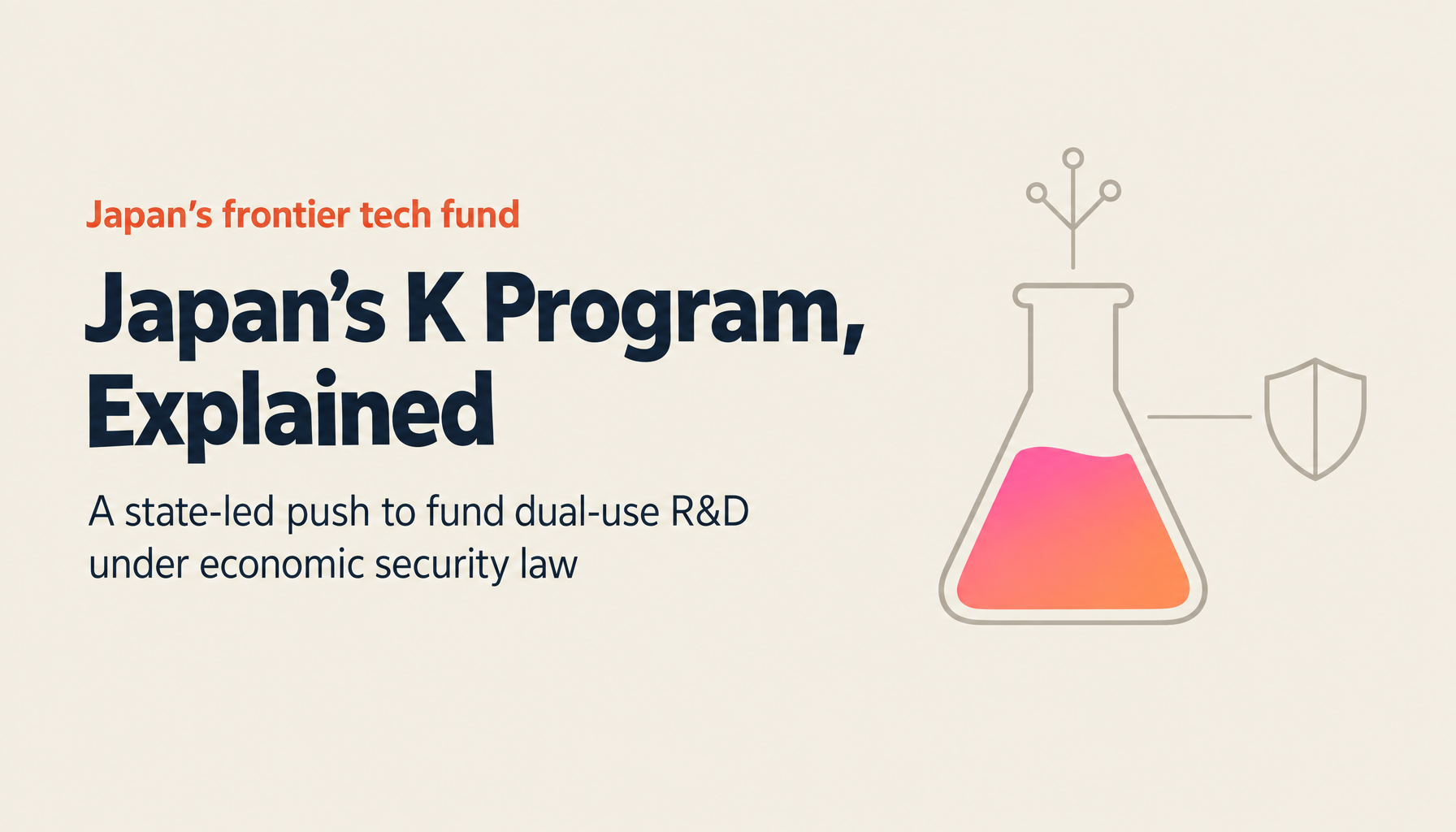
Let me explain it in one sentence first. The K Program (Key and Advanced Technology R&D Through Cross-Community Collaboration Program) is Japan's scheme for the state to nurture frontier dual-use technologies through a fund on the scale of 500 billion yen. These are technologies usable for both civilian and public purposes, such as AI, quantum, semiconductors, unmanned systems, space, ocean, and biotechnology. It is not simply research money. It is a national strategy built on a law called the Economic Security Promotion Act, and the support comes bundled with confidentiality obligations and information-management discipline. Who is running it, on what, for how much, and under which law? I will lay it out from a practical standpoint for companies and universities, working from primary government sources throughout.
If you are wondering whether your own technology could fall within the scope of export control, taking the export-control readiness check to get a rough sense of where you stand before reading on will help you read the export-control section in the second half as something that concerns you directly.
What the K Program Is: A Designated Fund Rooted in Law
The formal name of the K Program is the "Key and Advanced Technology R&D Through Cross-Community Collaboration Program." The "K" comes from Keizai Anzen Hosho, the Japanese for economic security. The vessel that holds the money behind the program is the "Critical Technology Development Fund," which is designated as a "designated fund" under Article 63, paragraph 1 of the Economic Security Promotion Act (formally, the Act on the Promotion of Ensuring Security by Taking Economic Measures in an Integrated Manner, Act No. 43 of 2022) [1] [10].
The Act was enacted on May 11, 2022, and promulgated on May 18 [10]. The provisions of Chapter 4, which set out support for advanced-technology development, came into force on August 1, 2022, as part of the Act's phased entry into force. The key concept here is "specified critical technologies." Article 61 of the Act defines these as "advanced technologies that could become important for maintaining the lives of the people and economic activity in the future, and among which those that could give rise to a situation harming the security of the state and its people if the technology were improperly used externally" [10]. In other words, the Act squarely targets so-called dual-use technologies, those that can be repurposed for both civilian and military or public uses.
The basis for the figure is clear as well. On December 6, 2021, Prime Minister Fumio Kishida declared in his policy speech at the 207th session of the Diet that "the state will establish a fund aiming for the scale of 500 billion yen, to underpin research and development investment in fields indispensable to the world's future, such as artificial intelligence, quantum, life sciences, space, and the ocean" [11]. This "scale of 500 billion yen" is a target the government set, built up starting from the first supplementary budget for FY2021 and onward. The cumulative amount actually raised through each year's supplementary budgets has to be checked individually against published materials, but the design philosophy of the program is consistent on one point: this is not a one-off subsidy, but a fund meant to nurture technology patiently over the long haul.
Why This Scheme Was Created
A naive question arises: why should the state go out of its way to nurture specific technologies with tax money? Should this not be left to the market?
Reading the foundational operating document, "Basic Approach to the Operation of the Key and Advanced Technology R&D Through Cross-Community Collaboration Program" (Prime Minister's decision of June 17, 2022), conveys the government's sense of urgency [3]. Behind it lie the intensifying contest for technological supremacy among nations, the risk of sensitive technology leaking, and the existence of frontier fields where private investment alone is hard to gather. Technologies tied directly to security are hard to value on short-term returns, and market forces alone do not channel enough capital to them. Yet leaving them alone risks being overtaken by other countries, or having the technologies you did grow leak out unintentionally. The K Program starts from the point where this "market failure" overlaps with a "security imperative," and the state moves to nurture the technologies itself.
Another point not to overlook is that the scheme is designed to play a "new, complementary role" relative to existing measures [3]. Rather than replacing the R&D budgets that MEXT and METI have long held, it is positioned as an additional layer that backs technologies of particular importance from a security standpoint, quickly and flexibly. The time horizon is also distinctive: while social implementation is envisioned over the medium to long term (around ten years), the actual span from research and development to technology demonstration is designed to run on roughly a five-year basis [3].
Replace siloed classification work with AI.
METI's FY2024 data shows 52% of foreign exchange law violations stem from classification errors. Download the TRAFEED product catalog covering features and rollout.
Who Runs It: A Whole-of-Government Structure
One reason the K Program is hard to grasp is the sheer number of ministries and agencies involved. To organize it, the core is the Council for Science, Technology and Innovation (CSTI) secretariat in the Cabinet Office, joined as one body by the Cabinet Secretariat, MEXT, and METI in a whole-of-government structure [1]. Putting the decision-making flow in a table makes it clearer.
| Stage | Who | Role |
|---|---|---|
| Vision decision | Economic Security Promotion Council / Council for Integrated Innovation Strategy | Decide the "R&D Vision" that sets the support targets |
| Security deliberation | National Security Council (NSC) | Deliberate on the Vision from an economic-security standpoint |
| Operational decisions | Program Council | Discuss individual operating policies and technology selection in practical terms |
| Public-private dialogue | Designated Fund Council (Article 62 of the Act) | Exchange views as industry, academia, and government, with the state providing hands-on support |
| Fund management / public calls | JST / NEDO | Manage the fund and handle calls, selection, progress management, and evaluation |
The "Program Council for the Key and Advanced Technology R&D Through Cross-Community Collaboration Program," which is the linchpin of operations, is jointly chaired by the Minister of State for Economic Security and the Minister of State for Science and Technology Policy, and is composed of experts and relevant ministries [7]. The experts include Setsuko Aoki, Heigo Sato, Kazunari Hatakeyama, Ichiro Hara, and Yoichiro Matsumoto, with the chair chosen by mutual selection among the experts. The Council was established by the Prime Minister's decision of June 17, 2022, and partial revisions to its composition have followed on April 24, 2023, June 13, 2024, September 9, 2025, and July 6, 2026 [7]. You can see that the scheme is not left fixed but is continually adjusted to fit the situation.
The organizations that actually face researchers and companies on the ground are the Japan Science and Technology Agency (JST) and the New Energy and Industrial Technology Development Organization (NEDO), both positioned as research-promotion institutions [8] [9]. Roughly speaking, JST (under MEXT) handles research concepts leaning toward basic and applied work at universities and national research and development institutions, while NEDO (under METI) handles research concepts leaning toward industrialization and implementation. Each sets up its own fund and takes on everything from public calls and selection through management, evaluation, and information control.
What Gets Supported: Five Domains and Around 51 Technologies
The support targets are set out concretely in a document called the "R&D Vision." This is the heart of the scheme, so it is worth tracing how it has evolved. The First Vision was decided on September 16, 2022, selecting 27 technologies [4]. The Second Vision followed on August 28, 2023, adding 23 technologies [5]. Then, in the partial revision of the Second Vision on March 7, 2025, one more was added: a technology relating to the effective use of fertilizer components, fertilizer conservation, and fertilizer production using synthetic biology and data science. This was an expansion mindful of food security [6]. As a result, roughly 51 technologies in total are organized as support targets.
These technologies are broadly classified into five domains. To grasp the big picture, here is an overview.
| Domain | Examples of main technologies |
|---|---|
| Ocean | Transport and recovery of AUVs (autonomous underwater vehicles), high-precision navigation in non-GPS environments using quantum and other technologies, underwater wireless communication, next-generation data-sharing systems |
| Space and aviation | Optical communication between low-Earth-orbit satellites, autonomously operating satellite constellations, small high-sensitivity multi-wavelength infrared sensors, high-altitude unmanned-aircraft remote sensing, on-orbit satellite refueling, advanced materials for aircraft engines |
| Cyberspace | AI security, verification of malicious functions in firmware, software, and hardware, hybrid-cloud platforms, advanced cyber defense and analysis, cryptographic technologies, disinformation analysis |
| Cross-domain | Next-generation batteries, metal additive manufacturing, higher-performance and rare-metal-saving heat-resistant superalloys, heavy-rare-earth-free magnets, next-generation semiconductor materials, manufacturing, and micro-fabrication, materials for power and high-frequency devices, superconducting foundations |
| Biotechnology | Biomolecule sequencers, multi-gas sensing, manufacturing of hemostatic agents, brain-tech using brain waves, synthetic biology and fertilizer |
Looking over the lineup, you can see that emerging, cutting-edge technologies such as AI, quantum, unmanned systems (drones), advanced sensors, and advanced energy are explicitly set out as their own categories in the Vision [4] [5]. Semiconductor materials, next-generation batteries, cryptography, and heat-resistant superalloys map directly onto the U.S.-China technology competition and supply-chain stories you often hear about in the news. Turn that around and you find that the K Program's target technologies overlap directly with the areas that concern export controls in country after country. I will dig into that later in the export-control section. For the thinking behind the relevant technology lists, reading them together with The Basics of List Controls and Catch-All Controls and Semiconductors and Economic Security makes the picture three-dimensional.
What Changes Once You Are Selected: Support and Discipline Come as a Set
This is the "point that takes people aback" I mentioned at the outset. The K Program is not a scheme where the state hands over money and is done. Selected companies and universities take on a degree of discipline in exchange for the support.
At the center of that is the "council." Article 62 of the Economic Security Promotion Act positions the council as a forum where the state, researchers, and companies exchange views carefully as one public-private body on the research and development of specified critical technologies [10]. These are called Designated Fund Councils, and roughly up to the 42nd had been established as of April 2025 [2]. In a council, the state provides "hands-on support" not only with funding but also with regulatory response and coordination with relevant agencies. For researchers, it is a reassuring arrangement.
On the other hand, a confidentiality obligation is imposed on the council. Article 64 of the Act requires confidentiality of council members and sets penalties for breach [10]. Information arising during the research and development process is handled according to arrangements made by each council in light of its nature and the state of the technology's progress, and necessary safety-management measures, that is, technology-leakage safeguards and information management, are put in place. This is easy to misunderstand: the confidentiality obligation is less about constraining academic freedom than a foundation that lets sensitive technology be nurtured with peace of mind. Even so, in practice you need to promptly build a framework after selection to manage who can access which information and to control any removal of information outside the organization. Support and discipline come as a set. This is the one point I think it is best to internalize from the very start.
From Public Call to Post-Selection: How You Get Involved in Practice
So how do you actually get involved in the K Program, and where is the entry point? The answer is the public call. JST and NEDO carry out calls and selection on an ongoing basis. JST, for example, ran a second FY2025 call for research and development topics, with a deadline set at noon on November 3, 2025 [8]. Examples of selected research and development span an extremely wide range of fields: composite-material bonding, next-generation batteries, gas sensing, superconducting foundations, heat-resistant superalloys, underwater optical wireless, on-orbit satellite refueling, brain-tech, AI security, autonomous and distributed control of small unmanned aircraft, high-functionality cryptography, and supply-chain security [8] [9]. If your organization's research theme overlaps with any of the five domains, the call information is worth checking regularly.
The practical work required after selection breaks down into two main parts. One is the confidentiality-obligation and information-management framework covered in the previous section. The other, and one that is surprisingly easy to overlook, is the connection to export control. Many of the technologies the K Program nurtures overlap with the list controls set out by the Foreign Exchange and Foreign Trade Act (FEFTA). If your research involves exchanging data with overseas joint researchers, or teaching technology to foreign researchers or international students, the net of export control comes down over it. This is precisely why it is best to keep an export-control perspective from the moment your selection is decided. For the basics of classification and deemed exports, we explain them carefully in The Basics of Economic Security and Export Control and A Practical Guide to Deemed-Export Risk, so use them as a starting point for building your framework.
The Pitfall When You Take the Results Out: The Gateway of Export Control
Of all the points that come up in K Program consultations, this is the one I feel is most important. When you try to take frontier technology grown with public money outside the country for overseas expansion or international joint research, the gateway of export control stands in your way.
Concretely, there are three scenarios. First, joint research with overseas universities or companies, where you provide technical information or samples abroad. Second, providing technology to foreign researchers or international students, which is what is known as a "deemed export." In the 2022 revision of FEFTA operations, providing technology even to a resident who falls under a "specified category" of being under the strong influence of a foreign government came to require a license. Third, overseas demonstration and the overseas rollout of results themselves. The K Program's target technologies, including AI, quantum, semiconductor manufacturing, unmanned systems, sensors, and cryptography, all tend to overlap with the list-controlled items and technologies in Appended Table 1 of the Export Trade Control Order and the appended tables of the Foreign Exchange Order. In these scenarios, classification (determining whether goods or technology fall under list controls) and screening of counterparties and host researchers become essential. We have organized METI's thinking on classification in A Guide to METI's Classification Guidelines, and list-matching of counterparties in The Complete Guide to Sanctions Lists and Restricted-Party Lists.
Frankly, running this classification and screening by hand alone has become quite hard given the volume of information today. Regulatory lists are updated frequently, counterparty names vary in spelling across languages, and tracing capital relationships often leads to a different listed party. We at TIMEWELL developed our export-control AI agent TRAFEED precisely to solve this problem. A classification AI built to conform to METI's FEFTA standards rapidly determines whether a technology or result falls under list controls, and automatically cross-checks joint-research partners, suppliers, and host researchers against various sanctions and restricted-party lists. Because the basis for each determination and the matching records can be retained in an auditable form, you can run the confidentiality-obligation and technology-leakage-prevention framework of the council and the export-control compliance of the results-utilization phase as one seamless operation. We have confirmed the AI's classification accuracy at 95% or higher based on joint demonstrations, but the premise is always that your company's export-control officer makes the final classification decision; the tool is positioned to make that judgment faster and more accurate.
From Then to Now: The Scheme's Path and What Comes Next
The K Program, which began in 2022, has steadily gained heft over these few years. The R&D Vision grew from the First Vision's 27 technologies, added 23 in the Second Vision, and added one more in the partial revision of March 2025, expanding the support targets to roughly 51 technologies [4] [5] [6]. The Designated Fund Councils, the forum for public-private dialogue, had built up to roughly the 42nd as of April 2025 [2], and the Program Council that runs operations had a partial revision of its composition on July 6, 2026 [7]. The scheme keeps updating itself like a living thing.
And now the government is preparing its next move. Under the direction set out in the Integrated Innovation Strategy and elsewhere, the plan is to flesh out the design of a successor scheme to the K Program and to begin operating a "Critical Technology Strategy Research Institute" (tentative name) during FY2026, building a comprehensive economic-security think-tank function. Securing research security and promoting cybersecurity measures at universities and other institutions are also raised as issues. Because these are still at the stage of scheme design and planned start of operation, please confirm the details against the latest government materials as of the time you read this. On preparations by research institutions, The Basics of Research Integrity and Research Security is a useful reference.
As a supplementary note, the K Program's targets move in step with amendments to law and the broadening of economic-security policy. Behind the addition of fertilizer to the biotechnology domain is the fact that fertilizer was designated as a specified critical material under the stable-supply system for critical materials in the Economic Security Promotion Act. The legal framework for economic security continues to be amended, including the security clearance system, so the latest developments need to be tracked continuously.
Conclusion: Prepare With an Eye on What Comes After Selection
The K Program is not a mere research subsidy but a mechanism, as a national strategy, for nurturing frontier dual-use technologies. Here are the key points.
- The legal basis is Chapter 4 of the Economic Security Promotion Act (Act No. 43 of 2022), especially Articles 61 through 64. The fund is a designated fund under Article 63 of the same Act.
- The scale is the government target of 500 billion yen. The starting point was Prime Minister Kishida's policy speech of December 6, 2021.
- Jurisdiction has the Cabinet Office (CSTI) at the core, with the Cabinet Secretariat, MEXT, and METI driving it across government. Fund management and public calls are handled by JST and NEDO.
- The support targets span five domains, ocean, space and aviation, cyber, cross-domain, and biotechnology, totaling roughly 51 technologies.
- Selected companies are subject, as a set, to the council's confidentiality obligation (Article 62; and Article 64, with penalties) together with technology-leakage safeguards and information management.
- When taking results overseas, classification and counterparty screening under FEFTA become essential.
One last thing. The most common worry I hear on the ground is post-selection anxiety: "We've been selected, so how do we now run technology-leakage safeguards and export control?" The two cannot be separated. If you think through building the confidentiality and information-management framework and systematizing export control for the results-utilization phase on the same blueprint, you will not be caught scrambling later.
If you are considering applying to the K Program, or have already been selected and are wrestling with building your framework, please start with the TRAFEED product page. In a 30-minute online consultation (book here), we will hear about your research theme and the outline of your overseas collaboration, then make concrete proposals on how to systematize classification, counterparty screening, and technology management.
I hope this article helps you see through to the practical work that lies beyond selection.
References
- [1] Cabinet Office, Council for Science, Technology and Innovation secretariat, "Key and Advanced Technology R&D Through Cross-Community Collaboration Program (K Program)" https://www8.cao.go.jp/cstp/anzen_anshin/kprogram.html
- [2] Cabinet Office, "Economic Security Promotion Act (Overview of the Four Systems; Support for the Development of Advanced Critical Technologies)" https://www.cao.go.jp/keizai_anzen_hosho/index.html
- [3] Cabinet Office, "Basic Approach to the Operation of the Key and Advanced Technology R&D Through Cross-Community Collaboration Program" (Prime Minister's decision of June 17, 2022) https://www8.cao.go.jp/cstp/anzen_anshin/20220617_kihonteki.pdf
- [4] Cabinet Office, "R&D Vision (First Vision)" (decided September 16, 2022) https://www8.cao.go.jp/cstp/anzen_anshin/2_vision.pdf
- [5] Cabinet Office, "R&D Vision (Second Vision)" (decided August 28, 2023) https://www8.cao.go.jp/cstp/anzen_anshin/2_vision2-kaitei.pdf
- [6] Cabinet Office, "Overview of the Partial Revision of the R&D Vision (Second Vision)" (March 7, 2025; list of support-target technologies) https://www8.cao.go.jp/cstp/anzen_anshin/1_kaitei-gaiyou.pdf
- [7] Cabinet Office, "On Convening the Program Council" (members; partial revision of July 6, 2026) https://www8.cao.go.jp/cstp/anzen_anshin/20260706_pc.pdf
- [8] Japan Science and Technology Agency (JST), "Key and Advanced Technology R&D Through Cross-Community Collaboration Program (K Program)" https://www.jst.go.jp/k-program/
- [9] New Energy and Industrial Technology Development Organization (NEDO), "Key and Advanced Technology R&D Through Cross-Community Collaboration Program (K Program)" https://www.nedo.go.jp/activities/k-program.html
- [10] e-Gov Law Search, "Act on the Promotion of Ensuring Security by Taking Economic Measures in an Integrated Manner (Act No. 43 of 2022)" https://laws.e-gov.go.jp/law/504AC0000000043
- [11] Prime Minister's Office of Japan, "Policy Speech by Prime Minister Kishida" (207th session of the Diet, December 6, 2021) https://www.kantei.go.jp/
Related Articles
- The Basics of Economic Security and Export Control
- A Guide to METI's Classification Guidelines
- A Practical Guide to Deemed-Export Risk
- The Complete Guide to Sanctions Lists and Restricted-Party Lists
- The Basics of List Controls and Catch-All Controls
- Semiconductors and Economic Security
- What Are Research Integrity and Research Security?
- Dual-Use Technology and the Risk of Military Diversion