Hello, this is Ryuta Hamamoto from TIMEWELL.
Let me answer the most common search question first. The SDN List is the U.S. Treasury's list of individuals, entities, vessels, and aircraft designated by the Office of Foreign Assets Control (OFAC). Their property in U.S. jurisdiction is blocked, and U.S. persons are generally prohibited from dealing with them. To check a name, you use OFAC's free Sanctions List Search and lower the matching threshold so spelling variants show up. When I counted the CSV that OFAC published on October 2, 2026, it held 19,488 entries.12
The lists did not sit still in 2026. OFAC spent the spring rolling over a temporary Russia oil general license and added designations tied to tolls for passage through the Strait of Hormuz. The United Kingdom closed the OFSI consolidated list on January 28 and moved to a single UK Sanctions List. The EU adopted its 20th Russia package in April and its 21st in July. In Japan, the Ministry of Finance updated its asset-freeze list on October 2 and added service restrictions on 35 specific vessels. Watching one list and calling the job done is no longer a serious control. If you want a quick read on where your own process has gaps, our export compliance check is a reasonable place to start.
Four points to keep in mind before the detail:
- The SDN List is OFAC's financial sanctions list. Its core effects are asset blocking and a ban on dealings by U.S. persons
- For a one-off check, use OFAC's Sanctions List Search. To search several U.S. lists at once, use the Consolidated Screening List (CSL) on trade.gov, which covers 13 lists
- Companies with U.S. and Japanese exposure need five streams screened against the same counterparty at the same time: the United States (OFAC and BIS), the EU, the UK, the UN, and Japan (METI's End User List and the Ministry of Finance asset-freeze list)
- A listing is a regulatory designation under each country's law. It is not a moral judgment about the listed company
What is the SDN List? Definition and how to search it
SDN stands for Specially Designated Nationals and Blocked Persons. OFAC designates parties under presidential executive orders and sanctions statutes, and the SDN List is the core of U.S. financial sanctions. It is not only people and companies. In the October 2, 2026 file, my count came to 7,570 individuals, 1,539 vessels, 342 aircraft, and roughly 10,000 entities and other entries.2 Property and interests in property of listed parties that are in the United States or in the possession of U.S. persons are blocked. U.S. persons, meaning U.S. citizens, permanent residents, entities organized under U.S. law, and anyone in the United States, are generally prohibited from dealing with them. Some entries, many of them Iran-related, carry the note "Subject to Secondary Sanctions." Significant dealings with those parties can expose non-U.S. companies to sanctions too.
What people often miss is that OFAC also runs a separate family of non-SDN lists, distributed together as the Consolidated Sanctions List.3 There are six. The SSI List restricts only certain transactions, such as new financing, with listed firms in specific Russian sectors. The FSE List names foreign persons OFAC has found to have engaged in sanctions-evading transactions. The CAPTA List covers foreign financial institutions whose correspondent or payable-through accounts in the United States are prohibited or restricted. The NS-MBS List covers menu-based sanctions. The NS-CMIC List covers Chinese companies whose publicly traded securities U.S. persons may not purchase. The NS-PLC List covers certain members of the Palestinian Legislative Council. A name that appears only on a non-SDN list triggers a narrower prohibition, not a full block, so the same "hit" can call for a very different response.
Here is the search routine I recommend:
- Open Sanctions List Search, enter the counterparty's English legal name in the Name field, and set List to "All" so you cover both SDN and non-SDN lists.4
- Lower the Minimum Name Score from its default of 100. OFAC's FAQs explain that 100 returns only exact matches, while 50 returns names that are about 50% similar.5
- If candidates appear, compare the sanctions program, address, date of birth, and registration numbers with what you know about your counterparty.
- If the match is strong, hold the shipment or payment and escalate under your internal procedure to your export control officer, your bank, and counsel.
- Record the date and time, the name you entered, the score setting, and the result.
On step 2, my own preference is to start around 80 to 85 and raise the threshold only when the candidate list gets unmanageable. OFAC lays out a six-step process for evaluating a potential match, including the requirement for U.S. persons to report blocked property or rejected transactions within 10 business days.6 Note that OFAC states plainly that the tool "is not a substitute for undertaking appropriate due diligence."4 When you want several U.S. lists in one place, the CSL on trade.gov searches 13 lists from Commerce, State, and Treasury and updates automatically every day at 5:00 a.m. Eastern.7 If you want the SDN, Entity List, and MEU List compared side by side, see Entity List vs. MEU List vs. SDN List.
One reading rule before going further. A listing on the SDN List, or on any other country's list, is a legal designation. It does not mean the company has been found to have committed wrongdoing, and legitimate commercial businesses are sometimes caught in broad categories. Treat a hit as a legal and transactional fact to work through, not as a verdict on the counterparty.
Turn this screening flow into a written procedure: A fill-in procedure sheet for the U.S. (OFAC and BIS), EU, UK, and UN lists plus Japan's End User List. It covers which official source to check, how often, and against what, and includes the 50% and ownership-control tests and Red Flags as fields. → Download the Five Sanctions-List Systems Screening Procedure (2026) (Free. Company name and work email required.)
Why multi-list screening became a board issue
Ten years ago, deep sanctions screening was mostly a job for major banks, some trading houses, and defense-adjacent firms. Russia's full-scale invasion of Ukraine in 2022, and the G7 and EU sanctions packages that followed, pulled ordinary dual-use goods into the perimeter: semiconductors, CNC machine tools, bearings, EV battery materials, drone components, industrial software, and financial services.
Payment rails matter as much as packing lists. Dollar transfers touch U.S. financial infrastructure. Euro transfers touch the EU. Sterling and the insurance market touch the UK. One hit can freeze the deal even when the commercial contract is clean. Add OFAC secondary sanctions, EU anti-circumvention clauses, the UK regime, and Japan's own statute, and a yen contract between two Japanese companies can still trip foreign lists depending on counterparty, destination, and end use. Shipping made this visible in 2026. Once the U.S. warned about sanctions risk around Hormuz passage tolls, Japanese ship operators and cargo owners could not treat it as someone else's problem (I covered the background in the Strait of Hormuz closure update).
The structural pain is that there is no single master list. On the U.S. side alone you have the SDN List, the non-SDN lists, the Entity List, the Denied Persons List, the Unverified List, the Military End-User List, and the Defense Department's Section 1260H list, each with a different legal job. The EU has stacked 21 Russia packages. The UK changed the structure of its list in January 2026. Japan runs its own End User List and catch-all controls. Manual tracking does not scale, so screening design has become a management question rather than a junior checklist.
Replace siloed classification work with AI.
METI's FY2024 data shows 52% of foreign exchange law violations stem from classification errors. Download the TRAFEED product catalog covering features and rollout.
Latest update dates for each list (checked October 4, 2026)
Your screening record should show which version of which list you checked. So here are the official sources and their most recent updates, as I confirmed them on each agency's site and in the distributed files on October 4, 2026.
| List | Agency | Where to check | Last update (as of Oct 4, 2026) |
|---|---|---|---|
| SDN and non-SDN lists | U.S. Treasury, OFAC | Sanctions List Search, Recent Actions | October 2, 2026 (counterterrorism designations)8 |
| Consolidated Screening List | U.S. Commerce (trade.gov) | CSL search and API | Updated automatically every day at 5:00 a.m. ET7 |
| Entity List | U.S. Commerce, BIS | Supplement No. 4 to EAR Part 744, Federal Register | August 24, 2026 (one removal and address revisions; last additions on October 9, 2025)9 |
| Unverified List | U.S. Commerce, BIS | Supplement No. 6 to EAR Part 744, Federal Register | Most recent revision rule April 25, 202510 |
| End User List | Japan, METI | METI security export control pages | Revised September 29, 2025 (835 entities, effective October 9, 2025)11 |
| Asset-freeze list | Japan, Ministry of Finance | Economic sanctions and target list page | As of October 2, 202612 |
| EU financial sanctions list | European Commission | Financial Sanctions Files, EU Sanctions Map | File generated September 22, 2026 (6,241 entries)13 |
| UK Sanctions List | UK government | gov.uk | October 2, 2026 (Russia regime changes)14 |
| UN Security Council Consolidated List | UN Security Council | Consolidated list XML and PDF | File generated October 2, 2026 (1,011 entries)15 |
What changed between April and October 2026
Several facts this article relied on in its first version of April 24, 2026 have moved. The table puts the original statement next to the current status.
| Item | Then (April 24, 2026) | Now (October 4, 2026) |
|---|---|---|
| OFAC temporary Russia oil license | GL 134B issued April 17 (expiring May 16) | GL 134C issued May 18, extending the window to June 171617 |
| Hormuz passage tolls | Not covered | FAQ 1249 (April 28, updated May 29) says toll payments are not authorized for U.S. persons18 |
| Entity List additions | Covered the September 2025 addition of 32 entities | Last additions on October 9, 2025. No addition rules in 2026 as of October 3199 |
| BIS 50% rule | Not covered beyond a link to our quick check | Suspended under the Federal Register text through November 9, 2026. The U.S. and China announced an extension to January 10, 2027, but no BIS extension rule had been published as of October 32021 |
| EU Russia sanctions | 20th package proposed February 6 | 20th package adopted April 23, 21st adopted July 2322 |
| UK | Moved to the UK Sanctions List on January 28 | Single list maintained, updated through October 214 |
| UN Consolidated List | About 1,000 entries (as of April 15) | 1,011 entries (736 individuals, 275 entities)15 |
| Japan End User List | 835 entities | Unchanged (the September 29, 2025 version is current) |
| Japan Ministry of Finance list | Not covered | Service restrictions on 35 specific vessels added in the October 2 list12 |
The pattern is clear. U.S. financial sanctions, the EU, and Japan's Ministry of Finance moved over the past six months, while the U.S. export control Entity List saw no additions in 2026. The timing overlaps with ongoing U.S.-China trade talks. Even so, the BIS 50% rule deadline and the next EU package could move things quickly this autumn. The riskiest habit is assuming last quarter's screening still holds without checking the update dates.
OFAC's SDN List: the financial core
The practical force of the SDN List comes from its link to dollar clearing. Trade finance still routes heavily through correspondent banks that clear in New York, so a transfer involving an SDN party often has nowhere to go. Japanese megabanks and regional banks are no exception. Letting an SDN-linked payment through creates U.S. regulatory exposure, so banks bounce transfers when identification or corporate registration looks off. A perfect export contract with no collectible payment is not a deal.
OFAC stayed busy in 2026. On Russia, it issued a series of general licenses (the GL 134 series) starting in March that temporarily allowed the delivery and sale of Russian-origin crude oil and petroleum products already loaded on vessels. It replaced the license with GL 134B on April 17 and GL 134C on May 18, which ran until June 17.1617 On Iran, FAQ 1249, published April 28, states that toll payments to the Government of Iran or the IRGC for safe passage through the Strait of Hormuz are not authorized for U.S. persons, including U.S. financial institutions.18 The most recent actions show the same churn: counterterrorism designations on October 2, Iran-related designations on October 1, and removals under the Belarus, counter narcotics, and Libya programs on September 30.8 Entries enter and exit, so your process has to catch both.
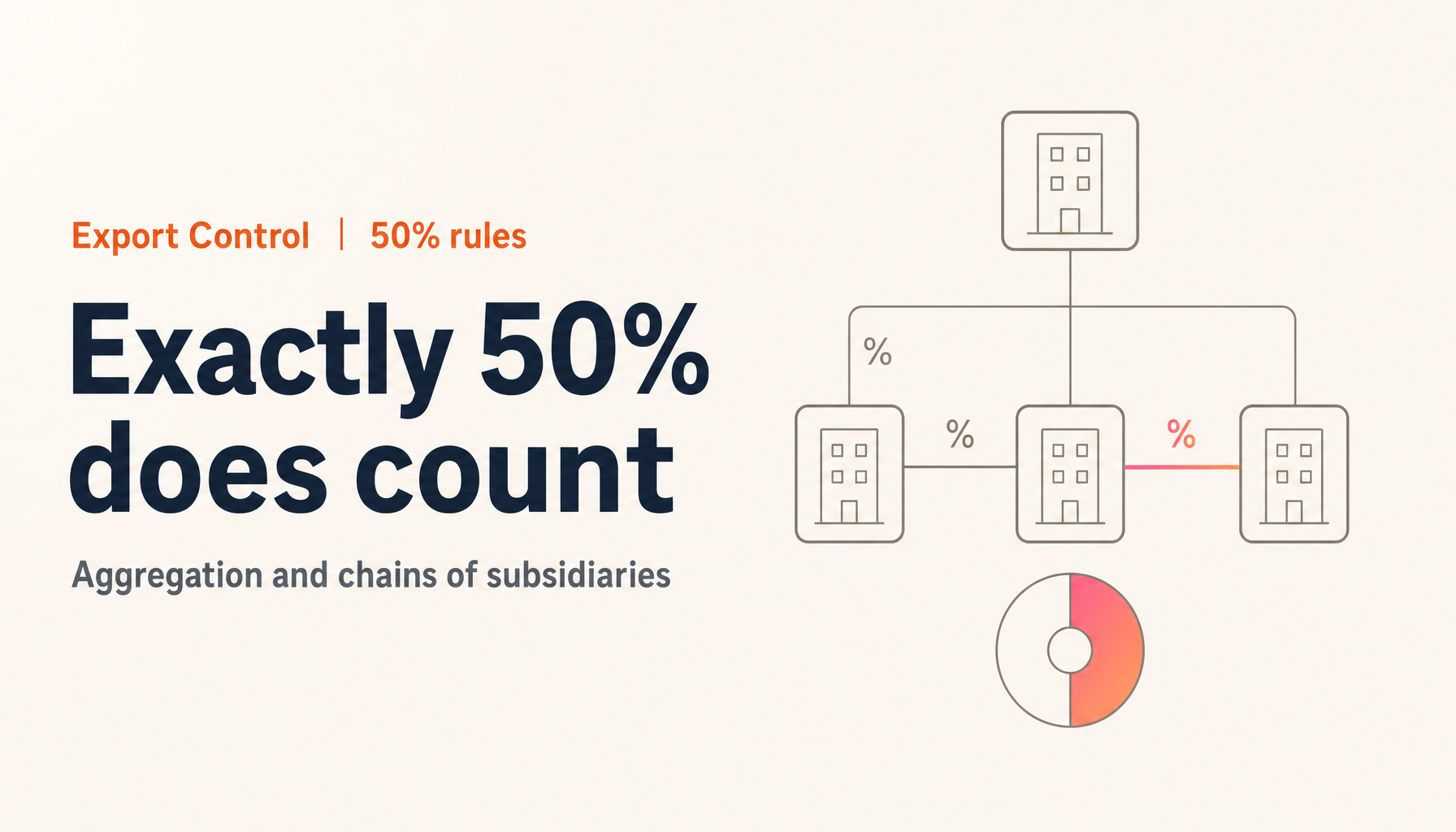
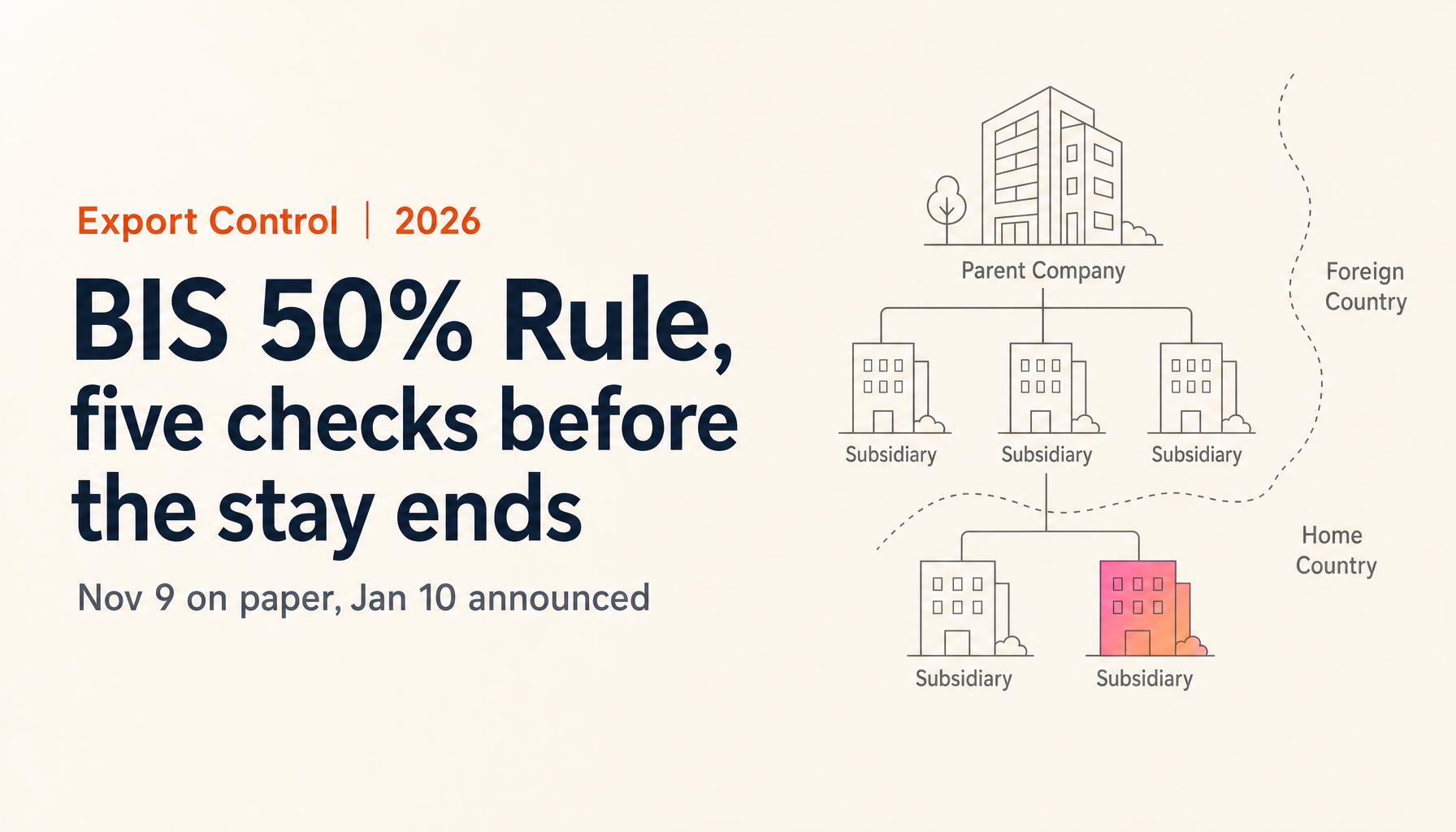
The rule people forget is the 50% rule. Under guidance revised on August 13, 2014, an entity owned 50% or more in the aggregate, directly or indirectly, by one or more blocked persons is itself treated as blocked, even if its name is not on the list.23 The key word is aggregate. If blocked person A owns 25% and blocked person B owns another 25%, the company is at 50% and is blocked. Name-only screening misses this by design, so you need shareholder and beneficial-owner data.
The penalties are worth knowing in concrete terms. Civil penalties for violations of sanctions under the International Emergency Economic Powers Act (IEEPA) can reach the greater of $377,700 per violation or twice the value of the transaction, the inflation-adjusted figure published in the Federal Register on January 15, 2025.24 Willful violations can also be prosecuted criminally. Non-U.S. companies are less often penalized directly under U.S. law, but secondary-sanctions designations and bank de-risking hit the business all the same. In practice, someone needs to read OFAC's Recent Actions daily against counterparties, affiliates, and end users.
BIS lists: Entity List, MEU, Denied Persons, Unverified
Goods and technology flows under the Export Administration Regulations (EAR) are policed by the Commerce Department's Bureau of Industry and Security (BIS). The best-known list is the Entity List, which names foreign parties that the U.S. government has determined raise national security or foreign policy concerns and imposes license requirements on exports, reexports, and in-country transfers of items subject to the EAR. Many entries carry a policy of denial, which in commercial terms often works like an embargo for EAR items.
The largest recent action was announced by BIS on December 2, 2024 and published in the Federal Register on December 5 (89 FR 96830): 140 entities added at once, centered on semiconductor manufacturing equipment.19 The listed addresses included not only China but also Japan, South Korea, and Singapore. That action changed licensing treatment under the EAR. It was not a finding that each company had done something wrong, and it swept legitimate commercial businesses into a broad regulatory category. In screening work, that means careful reconciliation of names, locations, and parent-subsidiary links. The rule of September 16, 2025 added 32 entities, 23 of them in China, and the rule of October 9, 2025 added 26 entities in China, Turkey, and the UAE (29 entries including three addresses). Then the additions stopped. The 2026 Federal Register has no Entity List addition rules at all. The only Entity List actions were on August 24, 2026: one removal and the deletion of two addresses for a Hong Kong entity (as of October 3).9
Three adjacent BIS lists belong on the same dashboard. The Military End-User (MEU) List names parties in China, Russia, and other countries that BIS has determined to be military end users, and it requires licenses for certain items. The Denied Persons List (DPL) covers parties that received denial orders stripping their export privileges after EAR violations, and each order is published in the Federal Register. As a rule, you cannot deal in items subject to the EAR with a DPL party. The Unverified List (UVL) covers parties for which BIS could not complete an end-use check. Continuing business usually requires a UVL statement from the end user, and License Exceptions are restricted. The most recent UVL revision rule was published April 25, 2025.10
How these lists relate is often misstated, including in my own first version. In an October 2022 rule (87 FR 61971), BIS added a criterion allowing a party to move to the Entity List when a sustained lack of cooperation by the host government prevents an end-use check of a UVL party.25 So an unresolved UVL entry can lead to the Entity List. The DPL is different. A party lands there through an administrative order tied to its own violation, not by being "promoted" from the Entity List. The April version described the three as a strict hierarchy, and I have corrected that here. Whatever the list, getting off it is slow, so prevention and clean records are the realistic defense.
The other topic everyone is watching this autumn is the BIS 50% rule (Affiliates Rule). It extends the same restrictions to companies owned 50% or more by Entity List and certain other listed parties. It took effect on September 29, 2025 and was then suspended by a separate rule (90 FR 50857), which keeps it suspended through November 9, 2026 under the Federal Register text.20 The U.S. and China have announced an extension to January 10, 2027. China's Ministry of Commerce stated it on its official site on September 28, while the U.S. side rests on a September 23 remark by the Treasury Secretary as reported in the press.21 As of October 3, BIS had not published an extension rule. Planning around November 9 is the safer assumption. The calculation method and preparation steps are in What Is the BIS 50% Rule?, and you can try ownership aggregation with our free BIS 50% rule check (no sign-up). Final legal calls still belong to your compliance officer and the latest official text.
EU, UK, and UN lists: read the scheme, not only the name match
EU sanctions are built regulation by regulation. Each Council Regulation has annexes that name individuals and entities, and the asset-freeze designations are pulled together in the EU's consolidated financial sanctions list, available through the European Commission's Financial Sanctions Files and the EU Sanctions Map. The public file generated on September 22, 2026 contained 6,241 entries by my count.13 On Russia, the 12th package in December 2023 made the "No Russia" contract clause mandatory, and the 14th package in June 2024 added a best-efforts duty to keep third-country subsidiaries from undermining the measures. After the 19th package on October 23, 2025, the EU adopted the 20th on April 23, 2026 and the 21st on July 23, 2026.22 I walked through the entities added to the export ban in the 21st package, and China's response the next day, in the EU's 21st sanctions package. Enforcement still varies across 27 member states, so the same facts can lead to different procedures and penalties in Germany, France, or the Netherlands.
The United Kingdom stopped updating the OFSI Consolidated List of Asset Freeze Targets on January 28, 2026 and made the UK Sanctions List the only source for all UK sanctions designations.14 That implemented the single-list policy the government set out in 2025. For screening systems it was a real change. Any connector that pulled the OFSI list has to switch to UK Sanctions List data and identifiers, or designations made after January 28 simply never reach your screening. The UK Sanctions List was updated again on October 2 with changes under the Russia regime. For the enforcement side, see UK OTSI powers and 2026 enforcement.
The UN Security Council Consolidated List still needs a parallel check. The XML generated on October 2, 2026 held 736 individuals and 275 entities, 1,011 entries in total. The newest listing was dated July 22 and the newest amendment September 28.15 By committee, ISIL (Da'esh) and Al-Qaida entries are the largest group at 336, followed by North Korea (155), the Taliban (140), and Iran (121). A hit or no-hit answer is not enough. You need the underlying resolution, because a Japanese company's response under Japanese law depends on which resolution applies. Where governments disagree, for example on Iran sanctions, is set out in our summary of security and sanctions positions at the UN General Assembly's 2026 debate, drawn from the speech texts.
Japan's End User List and the Ministry of Finance asset-freeze list
If your counterparty or your supply chain touches Japan, two more sources matter. Japan's regime rests on two pillars: asset-freeze measures under the Foreign Exchange and Foreign Trade Act, which implement UN resolutions and coordinate with the U.S. and EU, and catch-all export controls. The information tool for catch-all is METI's End User List. It identifies foreign organizations for which concerns about weapons of mass destruction development, or now conventional weapons development, have not been dispelled. METI describes the list as reference information and says explicitly that it is not an embargo list.11 Even so, if the end user of your goods is listed, you must apply for an export license unless it is clear the goods will not be used for those purposes.
The current version was issued on September 29, 2025 and took effect on October 9, 2025. It lists 835 organizations in 15 countries and regions, 87 more than before, and for the first time includes organizations that need checks related to conventional weapons development and transaction patterns.11 As of October 4, 2026, there has been no newer revision. The hard part in operations is spelling and identity. Chinese organization names have multiple accepted English spellings, and Cyrillic and Arabic transliterations vary by institution. Without the end user's exact English legal name and registration identifiers in your master data, false negatives are guaranteed.
One caution that U.S. teams sourcing from Japan should understand: absence from the End User List is not clearance. If the end use or the customer raises diversion concerns, Japan's catch-all rules can still require a license. The list signals likely concern when a party is on it. It does not clear a party whose name is missing. The logic is explained in What Are Catch-All Controls?
The second pillar is the Ministry of Finance's list of parties subject to asset-freeze and related measures. It lists individuals and organizations whose remittances and capital transactions are restricted, program by program. As of October 2, 2026, it covers 1,179 Russian individuals and organizations and 78 organizations and 43 individuals involved in Iran's nuclear activities (measures in place since September 2025), among others.12 On October 2, it also added the IMO numbers of 35 vessels subject to new restrictions on service transactions. The list is also distributed in Excel and CSV, so you can match it against your master data automatically. The End User List answers an export licensing question, while the Ministry of Finance list answers a money and services question, so you need both.
How to run multi-list screening without burning the team
A company that wants gap-resistant screening needs these streams on the same counterparty at the same time:
- The U.S. Consolidated Screening List, which covers 13 lists, including the SDN List and the EAR lists
- The EU consolidated financial sanctions list
- The UK Sanctions List
- The UN Security Council Consolidated List
- Japan's End User List and the Ministry of Finance asset-freeze list
Adjacent sources that are not sanctions lists in the strict sense still show up in daily work: the Defense Department's Section 1260H list (its latest update was noticed in the Federal Register on June 10, 2026),26 Canada's SEMA list, Australia's DFAT list, and company-specific watch lists. Updating all of that by hand with one or two people in a mid-market compliance team is not a serious plan.
Spelling variation and ownership depth make the job harder. The same Chinese company can arrive as an English legal name, simplified Chinese, pinyin, a parent name, a brand name, and an office name. Russian names jump between Cyrillic and several Latin systems, and Middle Eastern names combine Arabic script with multiple English spellings. On top of that sit OFAC's 50% rule, the EU ownership and control tests, and the BIS 50% rule. Complex logistics then multiply the parties to screen: importer, destination, end user, forwarder, customs broker, settlement bank. One listed party anywhere can stop the chain.
TRAFEED, TIMEWELL's export control AI agent, is built to run that cross-list work as a first pass. Enter the counterparty, destination, and cargo context, and it screens against the U.S. Consolidated Screening List, OFAC's SDN List, and EU, UK, UN, and Japanese lists, showing a concern level in about five seconds. It also checks ownership under the BIS 50% rule (flagging cases where ownership percentages are unknown for review), drafts the Japan export classification, and keeps the evidence on file in one place. The U.S. consolidated list and other countries' sanctions lists are ingested automatically, and the screen shows the update date of each list used, so your team can later explain which version it checked. Your export control officer makes the final call, and nothing here is legal advice. The feature overview is in the TRAFEED product catalog (PDF).
Three principles for a screening framework that survives audit
First, stop relying on a single list. SDN-only, Entity List-only, or End User List-only designs always leave a hole somewhere: money, goods, or catch-all. Make screening the same counterparty against the CSL, the EU list, the UK Sanctions List, the UN list, and Japan's two lists the default, not the special case.
Second, automate update tracking. OFAC moves almost daily. EU annexes change with each package. The UK restructured its list in January 2026, and Japan's Ministry of Finance added vessel restrictions in October. A framework that freezes when the designated analyst is on vacation will not survive questions from management or regulators. Ingest, change detection, and hit notification belong on tooling.
Third, retain the rationale. When customs, a regulator, or your bank asks what you knew at shipment or payment time, "we ran a tool" is not an answer. You need to show when you screened, which list versions you used, which settings produced the hit, and who approved the outcome.
Lists will keep moving. Some, like the U.S. Entity List in 2026, go quiet for a while, but financial sanctions, the EU, and Japan keep adding entries. Building the framework now is cheaper than reconstructing years of weak screening after a hit. If you want help designing party screening for U.S. and Japanese exposure together, contact us.
References
Related Articles
- Entity List vs. MEU List vs. SDN List
- What Is the BIS 50% Rule? Stay Deadline, Extension Deal, and Ownership Math
- Customer Due Diligence in Export Control: Screening Against the Foreign End User List and the Entity List
- The EU's 21st Russia Sanctions Package and China's Announcement the Next Day
- China's Dual-Use Export Control List and Watch List
Footnotes
-
U.S. Department of the Treasury, OFAC, "Sanctions List Service" (distribution of the SDN List and the non-SDN Consolidated Sanctions List; search tool). https://ofac.treasury.gov/sanctions-list-service ↩
-
OFAC, "Specially Designated Nationals List," SDN.CSV published October 2, 2026, retrieved October 4, 2026 and counted by TIMEWELL (7,570 individuals, 1,539 vessels, 342 aircraft, 10,037 other entries). https://sanctionslist.ofac.treas.gov/Home/SdnList ↩ ↩2
-
OFAC, "Other OFAC Sanctions Lists" (the six non-SDN lists in the Consolidated Sanctions List). https://ofac.treasury.gov/other-ofac-sanctions-lists ↩
-
OFAC, "Sanctions List Search" (search fields, fuzzy matching, and disclaimer). https://sanctionssearch.ofac.treas.gov/ ↩ ↩2
-
OFAC, FAQs 246 to 249 (fuzzy logic and the Minimum Name Score in Sanctions List Search). https://ofac.treasury.gov/faqs/topic/1636 ↩
-
OFAC, FAQ 5 (six steps for evaluating a potential match and reporting within 10 business days). https://ofac.treasury.gov/faqs/5 ↩
-
International Trade Administration, "Consolidated Screening List" (13 lists from Commerce, State, and Treasury; automatic daily update at 5:00 a.m.). https://www.trade.gov/consolidated-screening-list ↩ ↩2
-
OFAC, "Recent Actions" (actions of October 2, October 1, and September 30, 2026, checked October 4, 2026). https://ofac.treasury.gov/recent-actions ↩ ↩2
-
Federal Register, "Removal From the Entity List," 91 FR 54657, https://www.federalregister.gov/documents/2026/08/24/2026-17230/removal-from-the-entity-list ; "Revisions to the Entity List," 91 FR 54658, https://www.federalregister.gov/documents/2026/08/24/2026-17231/revisions-to-the-entity-list (both August 24, 2026; BIS rules from January 1 to October 3, 2026 checked through the Federal Register API, with no Entity List addition rules found) ↩ ↩2 ↩3
-
Federal Register, "Revisions to the Unverified List," 90 FR 17339 (April 25, 2025). https://www.federalregister.gov/documents/2025/04/25/2025-07185/revisions-to-the-unverified-list ↩ ↩2
-
METI, press release on the revision of the End User List (September 29, 2025; 835 organizations; effective October 9, 2025; in Japanese). https://www.meti.go.jp/press/2025/09/20250929006/20250929006.html ↩ ↩2 ↩3
-
Ministry of Finance, Japan, "Economic sanctions measures and list of targets" (asset-freeze measures under the Foreign Exchange and Foreign Trade Act, as of October 2, 2026; in Japanese). https://www.mof.go.jp/policy/international_policy/gaitame_kawase/gaitame/economic_sanctions/list.html ↩ ↩2 ↩3
-
European Commission, Financial Sanctions Files, public XML (generationDate September 22, 2026; retrieved October 4, 2026 and counted by TIMEWELL). https://webgate.ec.europa.eu/fsd/fsf ↩ ↩2
-
GOV.UK, "UK sanctions list" (OFSI Consolidated List closed January 28, 2026; UK Sanctions List is the only source; last updated October 2, 2026). https://www.gov.uk/government/publications/the-uk-sanctions-list ↩ ↩2 ↩3
-
United Nations Security Council, "Consolidated United Nations Security Council Sanctions List," XML (dateGenerated October 2, 2026; retrieved October 4, 2026 and counted by TIMEWELL). https://scsanctions.un.org/resources/xml/en/consolidated.xml ↩ ↩2 ↩3
-
OFAC, "Issuance of Russia-related General License" (GL 134B, April 17, 2026). https://ofac.treasury.gov/recent-actions/20260417_33 ↩ ↩2
-
OFAC, "Cuba Designations and Designations Updates; Issuance of Russia-related General License" (GL 134C, May 18, 2026). https://ofac.treasury.gov/recent-actions/20260518_33 ↩ ↩2
-
OFAC, FAQ 1249, "Are 'toll' payments to Iran for safe passage through the Strait of Hormuz authorized?" (released April 28, 2026; updated May 29, 2026). https://ofac.treasury.gov/faqs/1249 ↩ ↩2
-
Federal Register, "Additions and Modifications to the Entity List; Removals From the Validated End-User (VEU) Program," 89 FR 96830 (December 5, 2024; 140 entities), https://www.federalregister.gov/documents/2024/12/05/2024-28267/additions-and-modifications-to-the-entity-list-removals-from-the-validated-end-user-veu-program ; "Additions and Revisions to the Entity List," 90 FR 44496 (September 16, 2025; 32 entities), https://www.federalregister.gov/documents/2025/09/16/2025-17893/additions-and-revisions-to-the-entity-list ; "Additions to the Entity List," 90 FR 48193 (October 9, 2025; 26 entities and 3 addresses), https://www.federalregister.gov/documents/2025/10/09/2025-19508/additions-to-the-entity-list ↩ ↩2
-
Federal Register, "One Year Suspension of Expansion of End-User Controls for Affiliates of Certain Listed Entities," 90 FR 50857 (November 12, 2025; FR Doc 2025-19846). https://www.federalregister.gov/documents/2025/11/12/2025-19846/one-year-suspension-of-expansion-of-end-user-controls-for-affiliates-of-certain-listed-entities ↩ ↩2
-
Ministry of Commerce of the People's Republic of China, briefing by the head of the Department of American and Oceanian Affairs on the eighth round of China-U.S. economic and trade talks (September 28, 2026; in Chinese). https://www.mofcom.gov.cn/syxwfb/art/2026/art_d9ea01824fc44fd8a29f7dc3f8ca9c72.html ↩ ↩2
-
European Commission (DG FISMA), "Sanctions adopted following Russia's military aggression against Ukraine" (19th package October 23, 2025; 20th package April 23, 2026; 21st package July 23, 2026), https://finance.ec.europa.eu/eu-and-world/sanctions-restrictive-measures/sanctions-adopted-following-russias-military-aggression-against-ukraine_en ; EUR-Lex, "Council Regulation (EU) 2026/1848," https://eur-lex.europa.eu/legal-content/EN/TXT/HTML/?uri=OJ:L_202601848 ↩ ↩2
-
OFAC, "Entities Owned by Blocked Persons (50% Rule)" (guidance revised August 13, 2014). https://ofac.treasury.gov/faqs/topic/1521 ↩
-
Federal Register, "Inflation Adjustment of Civil Monetary Penalties," 90 FR 3687 (January 15, 2025; IEEPA maximum raised to $377,700). https://www.govinfo.gov/content/pkg/FR-2025-01-15/html/2025-00786.htm ↩
-
Federal Register, "Revisions to the Unverified List; Clarifications to Activities and Criteria That May Lead to Additions to the Entity List," 87 FR 61971 (October 13, 2022). https://www.federalregister.gov/documents/2022/10/13/2022-21714/revisions-to-the-unverified-list-clarifications-to-activities-and-criteria-that-may-lead-to ↩
-
Federal Register, "Notice of Availability of Designation of Chinese Military Companies," 91 FR 35189 (June 10, 2026). https://www.federalregister.gov/documents/2026/06/10/2026-11571/notice-of-availability-of-designation-of-chinese-military-companies ↩