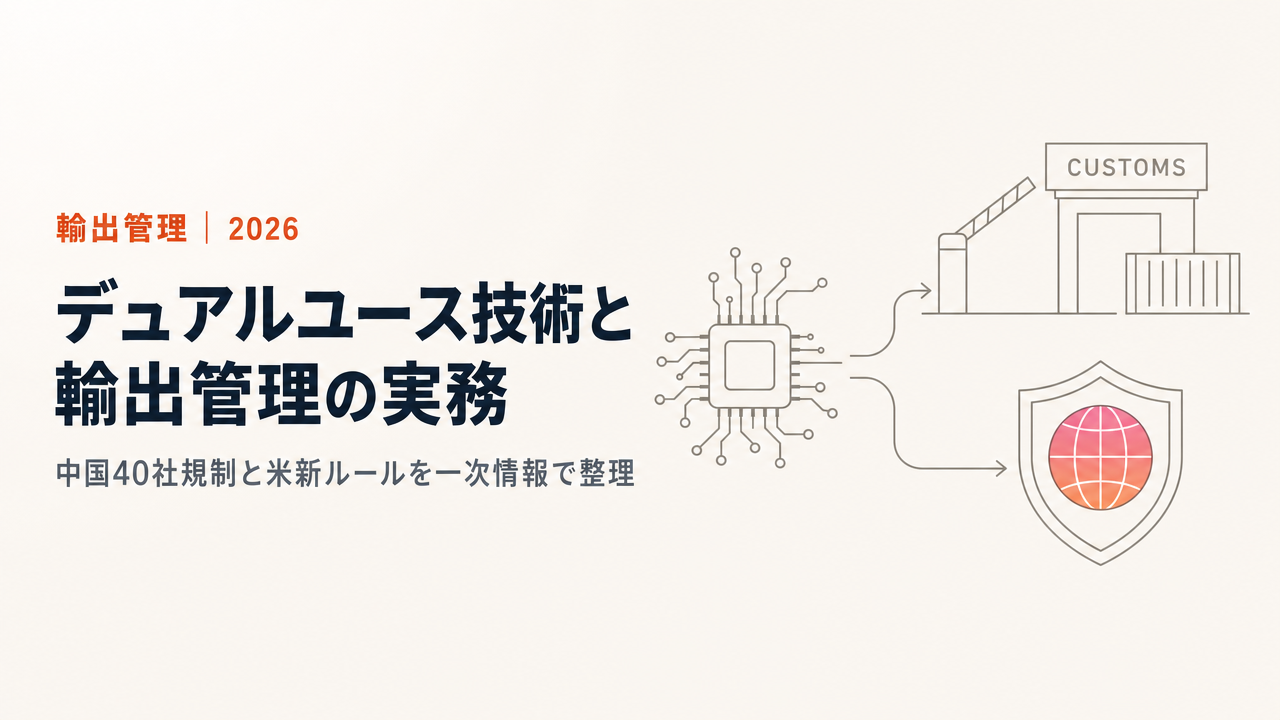
Dual-Use Technology and Export Control: The Complete Guide [Updated July 2026] — China's 80-Entity Measures Against Japan (Two Waves in February and June), the U.S. Affiliate Rule (50%), and METI Security Trade Control Guidance v3.0
This is Ryuta Hamamoto from TIMEWELL.
For most companies, "dual-use" has long been close to a textbook concept. It comes up in export-control training, it sits in a corner of the internal manual just in case, and it almost never becomes a real problem in day-to-day deals. That describes a great many firms.
That premise broke in 2026 — and not as a one-off event. China's export restrictions against Japan have accumulated in stages across January, February, and June.
The trigger was January 6. China's Ministry of Commerce announced in Notice 2026 No. 1 that it would generally tighten export controls on dual-use items bound for Japan1. In substance, exports to Japanese military end users, or for end uses that contribute to enhancing Japan's military capabilities, would in principle be denied. Then on February 24, MOFCOM placed 40 Japanese companies and organizations on the "Export Control List (管控名単)" and the "Watch List (関注名単)" through Notices No. 11 and No. 122. And on June 29, Notices No. 27 and No. 28 added another 40 entities, swelling the total to a cumulative ~803.
From 40 to 80 in half a year. The doubling itself tells you this is not a one-shot retaliation but a policy that will be operated on an ongoing basis.
This article walks through the definition of dual-use (civil-military) technology, the two-stage expansion of China's measures against Japan in 2026, the simultaneous easing of defense-equipment transfers on the Japanese side, the U.S. Affiliate Rule (50%), and what companies should actually do in practice. It closes with where TRAFEED — which automates classification with AI — fits in.
[Self-Check] Are any of your handled items classified as dual-use?
Semiconductors, integrated circuits and electronic components, precision machinery (medical and optical equipment), lithium compounds and rare earths tied to EV batteries (gallium, germanium, rare-earth elements), telecommunications equipment, and PCs were clarified as controlled items in China's January 6, 2026 tightening of dual-use export controls toward Japan (MOFCOM Notice 2026 No. 1)1. On top of that, 40 entities were listed on February 24 (Notices No. 11 and No. 12)2 and another 40 on June 29 (Notices No. 27 and No. 28)3 on the Export Control List and Watch List, reaching a cumulative ~80.
If you want to re-screen your handled items at the HS-code level, a TRAFEED consultation can get you organized within 30 minutes.
→ Book a TRAFEED consultation · TRAFEED product catalog (PDF)
Summary
- The definition of dual-use (civil-military), and why its stakes rose a notch in 2026
- How China's measures against Japan expanded in three stages — January 6 → February 24 → June 29 — and the structure of the cumulative ~80 entities
- The concrete faces added to the export-ban list on June 29, including the National Institute for Defense Studies and defense subsidiaries of Mitsubishi Electric and Mitsubishi Heavy Industries
- The legal basis for China's measures (the Export Control Law of the People's Republic of China and the Regulations on the Export Control of Dual-Use Items)
- The asymmetric structure — "tightening and easing at once" — revealed by the April 21 amendment to the operational guidelines for the Three Principles on Defense Equipment Transfer
- What the U.S. Affiliate Rule (50%, scheduled to re-apply November 10, 2026) demands of Japanese supply-chain management
- Updated practitioner points from METI's "Security Trade Control Guidance, Introductory Edition v3.0" (March, Reiwa 8)
- How the Wassenaar, NSG, AG, and MTCR regimes relate to Japan's catch-all controls
- The practical workflow for HS-code-based classification, end-user criteria, and end-use criteria
- A concrete path to automating classification and screening with TRAFEED
Table of Contents
- What Is Dual-Use (Civil-Military) Technology?
- What Happened in 2026: China's Measures Against Japan Expanded in Two Waves
- The U.S. Affiliate Rule (50%) and METI Security Trade Control Guidance v3.0
- International Export Control Regimes and Japan's Position
- The Operational Workflow for Handling Dual-Use Items
- Automating Classification with TRAFEED
Replace siloed classification work with AI.
METI's FY2024 data shows 52% of foreign exchange law violations stem from classification errors. Download the TRAFEED product catalog covering features and rollout.
What Is Dual-Use (Civil-Military) Technology?
Definition
Dual-use refers to technologies, products, or software that can be used for both civilian and military purposes. Under Japan's Export Trade Control Order and the Foreign Exchange and Foreign Trade Act these are called "dual-use items," organized under Item 2 and beyond of the list controls, separately from weapons themselves (Item 1 of the list controls).
A related term is "military-civilian fusion." That phrase refers to the policy itself of integrating military and civilian technology, talent, and capital as one — something China has strengthened as a national strategy since 2017. Dual-use describes a property of a technology or item; military-civilian fusion describes the national framework for exploiting it. They are often conflated, but keeping them distinct also makes China's later measures easier to understand.
Historical Context
During the Cold War, COCOM (the Coordinating Committee for Multilateral Export Controls) governed Western exports to the Eastern bloc. The 1987 Toshiba Machine COCOM violation — in which high-precision machine tools were allegedly used to machine submarine propellers, said to have improved the quieting performance of the Soviet navy — cast a serious shadow over U.S.-Japan relations. It was the first major incident that made Japanese firms feel viscerally how directly export control ties to management risk.
After the Cold War, COCOM was dissolved and succeeded by the Wassenaar Arrangement (WA), which began operating in 1996. The WA is a multilateral framework for bringing transparency to exports of conventional weapons and dual-use items, and Japan has participated as an original member4.
The Reversal from Spin-Off to Spin-On
Historically, the mainstream of technical progress was "spin-off" — military technology flowing down into civilian use (the internet, GPS, microwave ovens). Since the 2010s, however, fields where civilian technology exceeds military technology have surged.
| Field | Situation | Representative examples |
|---|---|---|
| Semiconductors | Commercial leads the frontier | TSMC, Samsung advanced logic |
| AI / machine learning | Private sector leads research | Large language models, image recognition |
| Drones | Consumer-grade reaches military-divertible levels | Industrial multicopter makers |
| Communications | Private-sector-led standardization | 5G, satellite broadband |
In this "spin-on" era, an utterly unremarkable civilian product can become a core component of a military system depending on how it is combined. The difficulty of export control is, I would say, almost entirely concentrated here. The era in which you could comfortably draw a line and say "it's a civilian product" is over.
What Happened in 2026: China's Measures Against Japan Expanded in Two Waves
First, get the terms right: not the Unreliable Entity List, but the Export Control List and the Watch List
When discussing the measures against Japan, mistaking the name of the list throws off your practical judgment too. What Japanese companies were placed on in this series of measures is not China's "Unreliable Entity List (不可靠実体清単)." It is two lists that China's Ministry of Commerce operates under the Regulations on the Export Control of Dual-Use Items: the "Export Control List (管控名単)" and the "Watch List (関注名単)"2. The names are similar, but the weight of the measures imposed is entirely different.
| List | Nature | Practical meaning |
|---|---|---|
| Export Control List (管控名単) | Exports of dual-use items are, in principle, prohibited | A de facto embargo. Transactions in progress are also halted immediately |
| Watch List (関注名単) | Subject to strict review | General licenses become unavailable; individual licenses, risk assessment reports, and written pledges are required |
Put roughly, the Export Control List says "do not ship," and the Watch List says "if you ship, take on considerable effort and accountability." Which list your counterparty is on completely changes the response required.
The three-stage timeline (January 6, February 24, June 29)
Tracking MOFCOM's measures by notice number makes the structure clear.
| Notice | Publication / effective date | Content |
|---|---|---|
| Notice 2026 No. 1 | January 6 | General tightening of export controls on dual-use items bound for Japan. Exports for Japanese military uses, or for end uses that contribute to enhancing Japan's military capabilities, are in principle prohibited1 |
| Notices No. 11 and No. 12 | February 24 | Listed 40 Japanese companies and organizations. 20 on the Export Control List plus 20 on the Watch List2 |
| Notices No. 27 and No. 28 | June 29 | Added another 40 entities. 20 on the Export Control List plus 20 on the Watch List. Cumulative total to ~803 |
The point to hold onto here is that the January 6 Notice No. 1 is not the date 40 companies were listed. Notice No. 1 was strictly a "general tightening"; the first time specific entity names were put on a list was February 24. News summaries sometimes wrongly write "40 companies in January," but if you follow the primary sources, both the date and the substance are different.
The faces in the second wave (June 29): defense research institutes and defense subsidiaries of the heavy-industry and electronics groups
What I most want to convey in this article is the second wave of June 29. Nearly all leading law firms and news outlets now include this June round, but plenty of internal manuals stop at February.
The 20 entities added to the Export Control List (export ban) under Notice No. 27 include a lineup of the Ministry of Defense's research organizations: the National Institute for Defense Studies, the Ground Systems Research Center, the Naval Systems Research Center, and the Aerospace Systems Research Center — four institutes in all. On top of that, defense subsidiaries of Mitsubishi Electric and Mitsubishi Heavy Industries make up the majority: NIKKO TOKKI, Mitsubishi Electric Defense & Space Technologies, Mitsubishi Precision, MHI Oceanics, and others3. It is a configuration that deliberately targets the very organizations that conduct defense-equipment R&D.
The 20 companies added to the Watch List (strict review) under Notice No. 28 sit in fields China has designated as potentially involving dual-use items — unmanned aircraft, nuclear fuel, pyrotechnics. The stated reason for listing was that these are Japanese entities whose end user and end use of dual-use items cannot be confirmed; it is not a finding that any of them acted improperly3. The companies named are legitimate Japanese manufacturers whose products are primarily for civilian use, caught within a broadly drawn category.
The substance of the measures does not end at being listed, either. For the 20 entities on the Export Control List, it is not only that exports of dual-use items are prohibited: organizations and individuals outside China are also barred from transferring or supplying Chinese-origin dual-use items to those entities, and activities in progress must be halted immediately. For the 20 companies on the Watch List, every transaction now requires submission of a risk assessment report and a written pledge that the dual-use items will not be used for any purpose that contributes to enhancing Japan's military capabilities3.
The full official names of all ~80 entities are compiled in the companion article. For matching against your counterparties, you need the entire roster rather than representative examples, so use that alongside this piece.
The legal basis for China's measures
This series of measures is not issued on a whim; it rests on clear domestic law. The bases are the Export Control Law of the People's Republic of China and the Regulations on the Export Control of Dual-Use Items, which took effect on December 1, 20245. The export ban of the Export Control List is tied to Articles 28 and 29 of those Regulations, and the strict review of the Watch List to Article 26. China is stacking up its targets methodically, in line with its own legal system — this is not the kind of thing that is easily withdrawn through diplomatic negotiation. Reading it that way sharpens the resolution of your response.
Political escalation and economic impact
Japan's government reacted the day the first wave landed. According to press reports, Deputy Chief Cabinet Secretary Kei Sato said at a February 24, 2026 briefing that the measure was "utterly unacceptable and deeply regrettable," lodging a strong protest with China and demanding withdrawal2. That a second wave nonetheless came in June shows this is not a phase where protest alone stops the momentum. Reports have framed the June measures as a scene of deepening confrontation between the Takaichi administration and China.
The economic impact swings widely depending on how "dual-use items" are interpreted. Takahide Kiuchi, Executive Economist at Nomura Research Institute, estimates that if China interprets "dual-use items" broadly, the items potentially affected could reach roughly 42% of Japan's total imports from China in 2024 (approximately ¥25.3 trillion)6. If the interpretation widens to include rare earths and semiconductor materials, even companies whose names are not on any list cannot stay unaffected on the procurement side.
Practical supply-chain impact
Companies not listed among the 40, and then the 80, are not unaffected either. There are three reasons.
The first is spillover through counterparties. Suppliers and subcontractors of listed entities may find it hard to continue the transactions themselves. The second is difficulty sourcing critical materials. If China restricts exports of gallium, germanium, and rare earths, the effects reach the entire population of Japanese firms handling semiconductors, batteries, and motors. The third is scrutiny of third-country transactions. China is also watching for circumvention exports, so transactions routed through Hong Kong, Singapore, or Malaysia come under monitoring.
The asymmetry of the April 21 amendment to the Three Principles on Defense Equipment Transfer
While China was tightening controls, the Japanese side was moving in the opposite direction. On April 21, 2026, the Ministry of Economy, Trade and Industry and the Ministry of Foreign Affairs amended the operational guidelines for the Three Principles on Defense Equipment Transfer7. From the perspective of civilian companies handling dual-use items, the important points are the following.
| Amendment item | Implication for civilian companies |
|---|---|
| Eased conditions for third-country transfer of jointly developed products | More business opportunities for civilian suppliers that make components of defense equipment |
| Clearer scope for components and services | Clearer criteria for when your product is exported as part of "equipment" |
| Expanded list of recipient countries for finished equipment | Potentially more flow of civilian-derived products |
Here lies the structural twist. China tightens controls, while Japan eases transfers. On the same "dual-use items" playing field, tightening and easing are running at the same time. Companies handling dual-use items now have to manage, within a single workflow, a combination of controls in which opposite forces act depending on the export destination. The details are organized in a separate article.
The U.S. Affiliate Rule (50%) and METI Security Trade Control Guidance v3.0
2026 was not a year in which only China moved. U.S. export control regulations and Japan's operational guidance were also substantially updated at almost the same time. As an export control officer, three points need to be on your dashboard.
The U.S. Affiliate Rule (50%) — scheduled to re-apply November 10, 2026
On September 30, 2025, the U.S. Department of Commerce Bureau of Industry and Security (BIS) promulgated the interim final rule commonly called the "Affiliate Rule" in the Federal Register (90 FR 47201), with an effective date of September 29, 2025. Under it, affiliates and subsidiaries in which an Entity List company holds, directly or indirectly, 50% or more equity are automatically subject to the same EAR restrictions as the parent listing.
The U.S. government subsequently stayed the application of the main provisions for one year, from November 10, 2025 to November 9, 20268. The stay period is a grace period for companies to build out their compliance frameworks. The main provisions are set to re-apply on November 10, 2026, and are then expected to continue indefinitely. Do not read this as "it's stayed for a year, so it's irrelevant for now"; understand it as something that will certainly arrive a year from now, and prepare on that basis.
The cases where this bites in practice look like the following.
| Case | Risk |
|---|---|
| A 50%+ subsidiary of an Entity List company is a key component supplier to you | Exports and re-exports of products incorporating U.S.-origin technology or parts effectively halt |
| Your distributor or reseller sells into China via an affiliate of an Entity List company | Potential re-export control violation and exposure to U.S. sanctions |
| Somewhere in a China- or third-country-routed transaction chain there is an affiliate of an Entity List company | Even without a direct contractual relationship, you can be caught indirectly by the EAR |
In other words, looking only at your direct counterparty is not enough. You need to trace the chain of ownership on a 50% basis and keep your entire supply chain visible.
[Re-applies Nov 10] Impact-assessment checklist for the U.S. Affiliate Rule (50%)
The U.S. Affiliate Rule — under which a 50%+ subsidiary of an Entity List company is automatically in scope — was stayed for one year from November 10, 2025 to November 9, 2026, and is expected to re-apply on November 10, 20268.
- Is any of your key component suppliers 50%+ owned by an Entity List company?
- Could your customers or distributors indirectly deliver to an Entity List company?
- Are EAR-controlled items used anywhere in your China- or third-country-routed schemes?
- Is your capital-relationship map of parents, subsidiaries, and group companies up to date?
- Has your internal Compliance Program (CP) been updated to cover the Affiliate Rule?
If even one of these is unresolved, a TRAFEED consultation can get it organized within 30 minutes.
METI "Security Trade Control Guidance, Introductory Edition v3.0" (March, Reiwa 8)
In March, Reiwa 8 (2026), METI revised its introductory security trade control guidance to version 3.09. The main changes from version 2 (Reiwa 3) are as follows.
| Update point | How v3.0 handles it |
|---|---|
| Organizing the operation of catch-all controls | Reflects the amended catch-all controls effective October 9, 2025, with a redrawn end-use flowchart |
| Foreign End User List | Notes the recent expansion to 835 entities and illustrates procedures for screening listed parties and their affiliates |
| Deemed exports (resident criteria) | Organizes the deemed-export controls under FEFTA (technology provision to residents falling under specified categories) with worked examples |
| Export control frameworks for SMEs | Presents a "minimum CP" as the bare-minimum internal procedure when running with one or two people |
| Relationship with the Economic Security Promotion Act | Clarifies the overlap with Specified Critical Materials and Specified Critical Technologies |
The defining feature of v3.0 is that it organizes, in a single volume, the relationships among "conventional security trade control (FEFTA)," "the Economic Security Promotion Act," "deemed-export controls," and "catch-all controls." It is content you can use as a baseline both for onboarding new export control staff and for revising your internal CP.
The catch-all amendment (effective October 9, 2025) and the 835-entity Foreign End User List
The amendment to catch-all controls that took effect on October 9, 2025 broadened the scope in which a license application is required when a certain concerning end use applies, regardless of the destination country. In parallel, METI amended the Foreign End User List as of September 29, 2025, expanding the number of listed entities to 83510.
The practical meaning is simple: there is more "cross-referencing work against listed parties, affiliates, and group companies." According to METI's "Analysis of FEFTA Violation Cases (FY2024)," released in December 2025, 52% of violation cases stemmed from classification errors and 36% from deficiencies in the management framework11. From what I see in the field, the more a company depends on its staff's manual work, the more its violation risk piles up with every regulatory revision.
International Export Control Regimes and Japan's Position
The four major regimes
Controls on dual-use items are not decided piecemeal by each country. The structure is that content agreed among several international regimes is transposed into each country's domestic law.
| Regime | Scope | Members (2026) |
|---|---|---|
| Wassenaar Arrangement (WA) | Conventional weapons and dual-use items | 42 |
| NSG (Nuclear Suppliers Group) | Nuclear-related items and technology | 48 |
| AG (Australia Group) | Chemical and biological weapons-related | 43 |
| MTCR (Missile Technology Control Regime) | Missile-related technology | 35 |
Japan is a member of all four, and the agreed control targets are reflected in Appendix 1 (list controls) of the Foreign Exchange and Foreign Trade Act and the Export Trade Control Order. Unlike China's measures against Japan, these are frameworks that go through international agreement, so movement is relatively gradual. That said, as noted below, discussions on expanding scope continue for semiconductor manufacturing equipment, quantum, and AI-related items.
The relationship with catch-all controls
Even goods or technology that do not fall under list controls require a license application if military diversion can be objectively judged, or if the end-user or end-use criteria apply. This is the "catch-all control."
| Category | Basis | Trigger for the judgment |
|---|---|---|
| List control | Appendix 1 (Items 1–15) | Specifications and performance thresholds |
| Catch-all (end-use criterion) | METI notification | The use falls under weapons of mass destruction or conventional weapons |
| Catch-all (end-user criterion) | Foreign End User List | The buyer is a party of concern |
| Catch-all (inform criterion) | Notice from METI | A case-specific government notification exists |
The latest developments in regime revisions
At its end-2025 plenary, the WA added certain semiconductor manufacturing equipment (specific EUV lithography accessory equipment), cryogenic equipment related to quantum computing, and specific accelerators for AI inference to its control targets. These are now entering the stage of sequential implementation into each country's domestic law.
The NSG is discussing high-performance carbon fiber for uranium enrichment, the AG is examining synthetic-biology-related equipment, and the MTCR is reviewing solid propellants for small-satellite launch vehicles. Details can be tracked on METI's security trade control page12.
The Operational Workflow for Handling Dual-Use Items
From here, we organize the workflow a company actually runs on an export deal, in five steps.
Step 1: Preliminary applicability check (HS code and item classification)
Start from the HS code (tariff classification code) and screen which item of Appendix 1 your product might fall under. Because HS codes are a classification for tariffs, they do not map one-to-one to export-control items. Even so, they are an effective entry point for a first pass.
To do classification in earnest, cross-reference the item-by-item matrix tables (published by METI and CISTEC) against your product's specification sheets. The judgment criteria are centered on numerical specifications (accuracy, temperature range, resolution, and so on).
Step 2: List-control classification
Prepare a classification document (parameter sheet) and check it against the judgment criteria for each item of Appendix 1.
| Item | Scope | Representative judgment indicators |
|---|---|---|
| Item 5 | Advanced materials | Tensile strength, fiber orientation, purity |
| Item 6 | Materials processing | Positioning accuracy, number of axes, temperature range |
| Item 7 | Electronics | Operating temperature, radiation hardness, computing speed |
| Item 8 | Computers | Compute performance (TOPS/FLOPS) |
| Item 9 | Communications | Frequency band, encryption strength |
| Item 10 | Sensors | Sensitivity, detection wavelength, resolution |
If it falls within a list control, an export license application to METI is required. Even when the conclusion is "non-applicable," record the rationale as a classification document.
Step 3: End-user check (matching the Foreign End User List and China's lists)
Cross-reference the buyer, the end user, and the final end user against METI's Foreign End User List. Listed parties are treated as foreign end users of concern, and exporting dual-use items to them requires an individual license.
From 2026, matching against China's lists has been added to this. The process of confirming whether your counterparty is on China's Export Control List or Watch List (a cumulative ~80 entities), or is a company with a capital relationship to them, has become a permanent part of practice.
Step 4: End-use check
Confirm the following about the end user and the end use.
- The use is not connected to development, manufacture, use, or stockpiling of weapons of mass destruction (nuclear, chemical, biological, missile).
- It is not connected to development, manufacture, use, or stockpiling of conventional weapons.
- The stated use is not unnatural (e.g., a bulk order for what is a general-purpose product, no need for technical support, cash and immediate settlement).
The end-use criterion is triggered "when it can be objectively known" and "when there is a notice (inform) from METI." When the judgment is difficult, advance consultation with METI or CISTEC is the realistic move.
Step 5: Issuing the non-applicable certificate and keeping records
For cases judged non-applicable, issue the "non-applicable certificate (parameter sheet)" that buyers often request, and keep the rationale for the judgment on file internally. The statutory retention period is seven years, but considering traceability across the supply chain, a longer retention is desirable in many cases, as I see it.
Details are explained in the Non-Applicable Certificate Writing Guide. For discussions of an espionage-prevention law and a security clearance system, see also The Spy Prevention Law and Business.
Automating Classification with TRAFEED
Running the workflow up to this point by hand, with an in-house export control officer, has become difficult, in my view. There are three reasons.
The first is that list-controlled items keep growing with every revision of the international regimes. The second is that China, the U.S., and the EU are each tightening different controls, so a separate cross-reference is needed for each export destination. The third is that the lists you must reference keep multiplying — the 835-entity Foreign End User List, China's Export Control List and Watch List, the U.S. Entity List and SDN List, and more. Looking at the Chinese example, where targets doubled in half a year, it is clear that keeping up manually is close to its limit.
TRAFEED is built as the world's first export-control AI agent, designed to automate this operational workflow.
| Capability | Description |
|---|---|
| HS-code-driven classification support | Enter product specifications and it judges the possibility of falling under Appendix 1 |
| Multilingual screening | Cross-references the Foreign End User List, the SDN List, China's Export Control List and Watch List, and EU and U.K. sanctions lists across languages |
| Automatic reflection of regulatory revisions | Automatically ingests WA, NSG, AG, and MTCR revision information and updates to national sanctions lists |
| Auto-generated classification documents | Outputs in parameter-sheet format, ready to route into internal review |
| Audit log | Retains every classification history, aligned with FEFTA's retention-period requirement |
TRAFEED's AI judgment accuracy has been confirmed at 95% or higher in a joint proof-of-concept with Okayama University using approximately 30,000 past review records (internal study). Even so, the final classification is made by your company's export control officer; the AI is a tool that supports that judgment. The structure is such that the effort-reduction effect shows up most clearly at mid-sized and small manufacturers that have no dedicated export control officer, or that run with just one or two people.
Frankly, the companies that feel "we only deal in civilian goods, so this doesn't concern us" are exactly the ones I would like to run a classification check through the AI at least once. In the 2026 regulatory environment, the bigger risk is not realizing that your own product falls under a dual-use item.
2026, the Year Regulations Moved in Two Waves: Making Dual-Use Management a Rapid-Response Capability
China's measures against Japan (the general tightening of January 6, the 40-entity listing of February 24, and the second wave of June 29 reaching a cumulative ~80), the April 21 amendment to the operational guidelines for the Three Principles on Defense Equipment Transfer, the U.S. Affiliate Rule (50%, scheduled to re-apply November 10, 2026)8, METI's Security Trade Control Guidance v3.0 (March, Reiwa 8)9, the catch-all amendment effective October 9, 2025, and the 835-entity Foreign End User List10. 2026 was a year in which the regulatory environment moved in quick succession, and the workload of export control officers at companies handling dual-use technology has clearly increased. On top of that, opposite forces are acting at once — China tightening, Japan easing transfers. You have to handle this asymmetry within a single workflow.
TIMEWELL's TRAFEED, the world's first export-control AI agent, automates dual-use classification, catch-all controls, and cross-referencing across counterparty lists with AI.
Issues TRAFEED can solve
| Issue | How TRAFEED solves it |
|---|---|
| Dual-use classification is locked in individuals and cannot be reproduced when a staff member leaves | Stores the classification rationale as structured data and automates handover |
| Checking your own applicability against the 835-entity Foreign End User List and China's ~80-entity measures takes time | Upload a counterparty list and get a bulk cross-reference in seconds |
| The 50% ownership-chain check ahead of the Affiliate Rule's re-application (November 2026) is manual | Automatically expands the capital relationships of parents, subsidiaries, and group companies |
| Item-by-item comparison tables and CP updates can't keep up with each regulatory revision | Automatically catches legal updates and reflects them in the classification logic |
→ Book a TRAFEED consultation (30 minutes) / → See the TRAFEED product page
Conclusion
- In 2026, dual-use (civil-military) shifted from a textbook definition to a real regulatory risk.
- China's measures against Japan expanded in three stages — the general tightening of January 6 (Notice No. 1), the 40-entity listing of February 24 (Notices No. 11 and No. 12), and the second wave of June 29 (Notices No. 27 and No. 28) — reaching a cumulative ~80 entities.
- Those listed are not on the "Unreliable Entity List" but on the export-banning Export Control List and the strict-review Watch List. The basis is the Export Control Law of the People's Republic of China and the Regulations on the Export Control of Dual-Use Items (effective December 2024).
- China's tightening and Japan's easing of defense-equipment transfers (April 21) are proceeding at the same time, so companies must manage opposite dynamics within a single workflow.
- The U.S. Affiliate Rule (50%) will re-apply on November 10, 2026 and is expected to continue indefinitely thereafter. You should prepare your ownership-chain checks on the premise that it will be here a year from now.
- Because the lists to reference and the revision information keep growing, AI-driven automation has become a realistic option.
The fact that targets doubled in half a year implicitly suggests a third wave is possible. Rather than stopping at confirming whether a company name is on a list, I recommend building a framework now that can see through both the flow of Chinese-origin items and the layers beyond your counterparties.
References
- CISTEC flash report, "China's Tightening of Export Controls on Dual-Use Items Bound for Japan (Flash)" (January 6, 2026, MOFCOM Notice No. 1) — https://www.cistec.or.jp/service/keizai_anzenhosho/china/data/20260106-2.pdf
- JETRO, "China Tightens Export Controls on Dual-Use Items Toward Japan" (January 2026) — https://www.jetro.go.jp/biznews/2026/01/daa0760fd28a2226.html
- CISTEC flash report, "Chinese Authorities Place Japanese Companies, Universities, etc. on the Export Control List (20 in total) and the Watch List (20 in total) (Flash)" (February 25, 2026, Notices No. 11 and No. 12) — https://www.cistec.or.jp/service/keizai_anzenhosho/china/data/20260225.pdf
- JETRO, "China Places 40 Japanese Companies and Organizations on the Export Control List and Watch List, Banning Exports of Dual-Use Items and Tightening Review" (February 2026) — https://www.jetro.go.jp/biznews/2026/02/e4f19a798abdc080.html
- CISTEC flash report, "Chinese Authorities Add Japanese Companies, etc. to the Export Control List (20 in total) and the Watch List (20 in total) (Flash)" (June 29, 2026, Notices No. 27 and No. 28) — https://www.cistec.or.jp/service/keizai_anzenhosho/china/data/20260629.pdf
- Xinhua (Japanese), "China Places 20 Japanese Entities, Including the National Institute for Defense Studies, on Its Export Control List" (June 29, 2026) — https://jp.news.cn/20260629/b17450419a1548679f8a6b1058933062/c.html
- People's Daily (Japanese edition), "China's Ministry of Commerce Adds 20 Japanese Companies and Organizations to Its Export Control List" (June 29, 2026) — https://j.people.com.cn/n3/2026/0629/c94476-20472207.html
- Export Control Law of the People's Republic of China / Regulations on the Export Control of Dual-Use Items (effective December 1, 2024)
- METI, "On the Partial Amendment of the Three Principles on Defense Equipment Transfer, etc." (April 21, 2026) — https://www.meti.go.jp/press/2026/04/20260421003/20260421003.html
- METI, "Security Trade Control Guidance, Introductory Edition v3.0" (March, Reiwa 8) — https://www.meti.go.jp/policy/anpo/
- METI, "Amendment to the Foreign End User List" (September 29, 2025) — https://www.meti.go.jp/policy/anpo/
- METI, "Analysis of FEFTA Violation Cases (Security Trade Control) (FY2024)" (December 2025) — https://www.meti.go.jp/policy/anpo/gaitameho_document/ihanjireigaitamehou6.pdf
- Federal Register, "One Year Suspension of Expansion of End-User Controls for Affiliates of Certain Listed Entities" (November 12, 2025; one-year stay and re-application of the Affiliate Rule) — https://www.federalregister.gov/documents/2025/11/12/2025-19846/one-year-suspension-of-expansion-of-end-user-controls-for-affiliates-of-certain-listed-entities
- Nomura Research Institute, Takahide Kiuchi, "Economic Impact of China's Export Restrictions on Japan (Estimate)"
- Wassenaar Arrangement — https://www.wassenaar.org/
Related Articles
- Which Japanese Companies Are on China's Export Control Lists? The Full List of ~80 Entities and Organizations
- The Three Principles on Defense Equipment Transfer: What Changed in the April 21, 2026 Amendment?
- Non-Applicable Certificate: How to Write Parameter Sheets and Run Classification
- 52% of FY2024 FEFTA Violations Were Classification-Driven — The Top 5 Fatal Mistakes Hidden in METI's Statistics
Footnotes
-
CISTEC, "China's Tightening of Export Controls on Dual-Use Items Bound for Japan (Flash)" (January 6, 2026, MOFCOM Notice 2026 No. 1) https://www.cistec.or.jp/service/keizai_anzenhosho/china/data/20260106-2.pdf ↩ ↩2 ↩3
-
CISTEC, "Chinese Authorities Place Japanese Companies, Universities, etc. on the Export Control List (20 in total) and the Watch List (20 in total) (Flash)" (February 25, 2026, Notices No. 11 and No. 12) https://www.cistec.or.jp/service/keizai_anzenhosho/china/data/20260225.pdf ↩ ↩2 ↩3 ↩4 ↩5
-
CISTEC, "Chinese Authorities Add Japanese Companies, etc. to the Export Control List (20 in total) and the Watch List (20 in total) (Flash)" (June 29, 2026, Notices No. 27 and No. 28) https://www.cistec.or.jp/service/keizai_anzenhosho/china/data/20260629.pdf ↩ ↩2 ↩3 ↩4 ↩5 ↩6
-
Wassenaar Arrangement https://www.wassenaar.org/ ↩
-
The Export Control Law of the People's Republic of China and the Regulations on the Export Control of Dual-Use Items (effective December 1, 2024). The Export Control List rests on Articles 28 and 29 of the Regulations, and the Watch List on Article 26. ↩
-
Estimate by Takahide Kiuchi, Executive Economist at Nomura Research Institute. If China interprets "dual-use items" broadly, the items potentially affected could reach roughly 42% of Japan's total imports from China in 2024 (approximately ¥25.3 trillion). ↩
-
METI, "On the Partial Amendment of the Three Principles on Defense Equipment Transfer, etc." (April 21, 2026) https://www.meti.go.jp/press/2026/04/20260421003/20260421003.html ↩
-
Federal Register, "One Year Suspension of Expansion of End-User Controls for Affiliates of Certain Listed Entities" (November 12, 2025). The interim final rule was promulgated on September 30, 2025 (90 FR 47201, effective September 29, 2025), stayed from November 10, 2025 to November 9, 2026, and re-applies on November 10, 2026. https://www.federalregister.gov/documents/2025/11/12/2025-19846/one-year-suspension-of-expansion-of-end-user-controls-for-affiliates-of-certain-listed-entities ↩ ↩2 ↩3
-
METI, "Security Trade Control Guidance, Introductory Edition v3.0" (March, Reiwa 8) https://www.meti.go.jp/policy/anpo/ ↩ ↩2
-
METI, "Amendment to the Foreign End User List" (September 29, 2025, 835 entities) https://www.meti.go.jp/policy/anpo/ ↩ ↩2
-
METI, "Analysis of FEFTA Violation Cases (Security Trade Control) (FY2024)" (December 2025) https://www.meti.go.jp/policy/anpo/gaitameho_document/ihanjireigaitamehou6.pdf ↩
-
METI, Security Trade Control https://www.meti.go.jp/policy/anpo/ ↩
![[2026 Edition] Customer Due Diligence (End-User Screening) in Practice — How to Cross-Reference the Foreign User List and Entity List](/images/columns/default-column.png)