Hello, this is Ryuta Hamamoto from TIMEWELL.
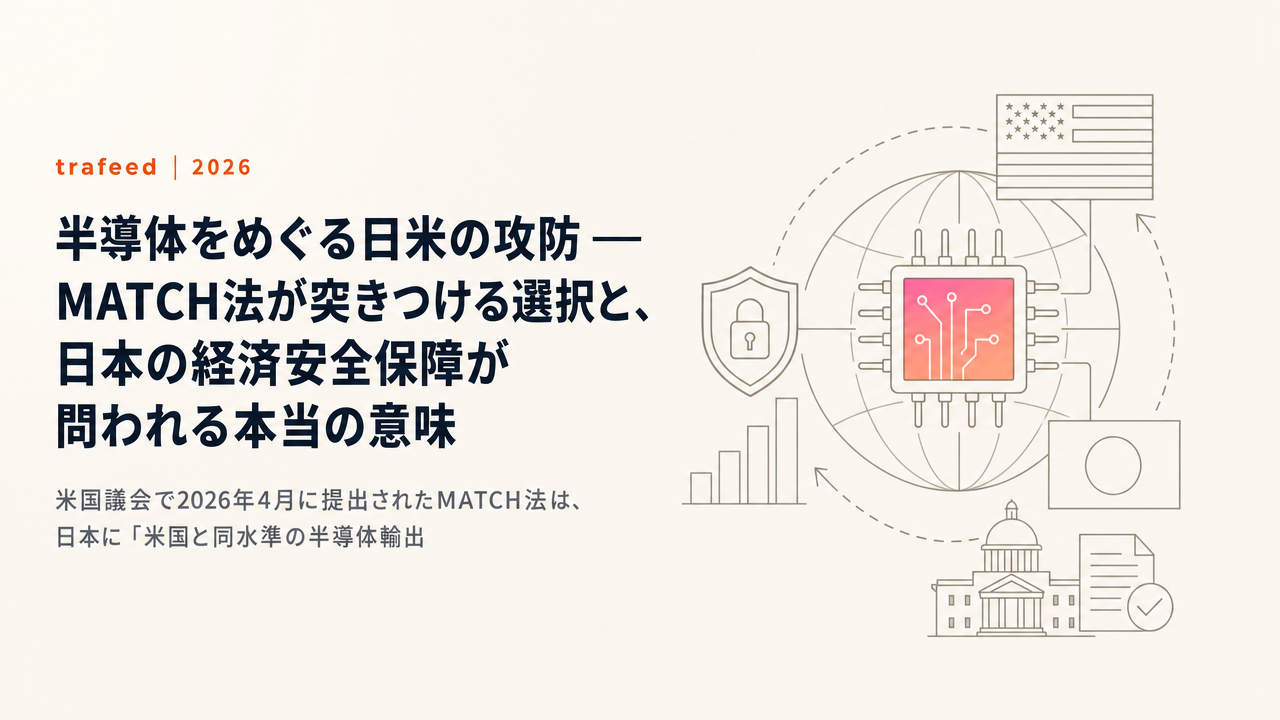
If you work export controls for semiconductor manufacturing equipment, components, or field service, the MATCH Act is worth reading carefully even while it is still a bill. In early April 2026, bipartisan members of the U.S. House introduced the Multilateral Alignment of Technology Controls on Hardware Act. A Senate companion followed. The short version that travels in compliance channels is blunt. Allies get a defined window to raise their semiconductor equipment controls to U.S. levels. If they do not, Commerce is directed to extend U.S. jurisdiction and stop the gap itself123.
I write this from Japan, where several of the largest non-U.S. tool suppliers sit. The bill is still American primary lawmaking. The EAR, the Foreign Direct Product Rule, and BIS licensing practice are the spine. Allied industrial policy is the pressure surface. Below I walk through what the bill actually says, which facilities and equipment classes it targets, how it sits on top of EAR and de minimis, what Japanese and Dutch supply chains would feel first, and which audits are rational to run now rather than after a floor vote. If you want a quick baseline on your export control system before reading on, use our free export-control readiness check.
Fill-in classification checklist: A working sheet for advanced-computing ICs (3A090, 4A090, HBM) and semiconductor manufacturing equipment (3B-series), classified from both Japan’s Appended Table 1 and the U.S. EAR (ECCN, Country Group D:5, 744.23, FDP, License Exceptions). For equipment classes named in MATCH bill materials, you can write where each product sits under each regime. → Download the Semiconductor Classification Checklist (Free. Company name and work email required.)
April 2026: bipartisan House and Senate text with a 150-day allied clock
Start with the facts. House legislation was led by Rep. Michael Baumgartner (R-WA-5), with original cosponsors including Rep. John Moolenaar (R, Chair of the House Select Committee on the CCP) and a bipartisan group of House members3. Senate companion text was introduced by Sen. Pete Ricketts (R-NE), with Sens. Jim Risch (R, Senate Foreign Relations Committee Chairman) and Andy Kim (D-NJ), and later co-sponsorship coverage including Sen. Chuck Schumer (D-NY)45. Congress.gov carries the Senate text as S.4281 for the 119th Congress6.
Bill materials and sponsor releases describe three pillars.
First, expand the controlled semiconductor manufacturing equipment surface. The text aims past the most advanced AI-focused tools and toward chokepoint equipment more broadly, including legacy tools such as DUV immersion lithography systems that still matter for capacity expansion at Chinese fabs43.
Second, designate major Chinese national-champion fabs as covered facilities. Materials name fabs run by ChangXin Memory Technologies (CXMT), Hua Hong, Huawei, Semiconductor Manufacturing International Corp (SMIC), and Yangtze Memory Technologies Corp (YMTC), including subsidiaries and affiliates. The design is closer to facility-level denial than a pure product list43. Listing a company on a control list is a regulatory classification decision. It is not a finding that a commercial manufacturer “is a bad actor” in a moral sense. Treat it as licensing posture, not corporate character judgment.
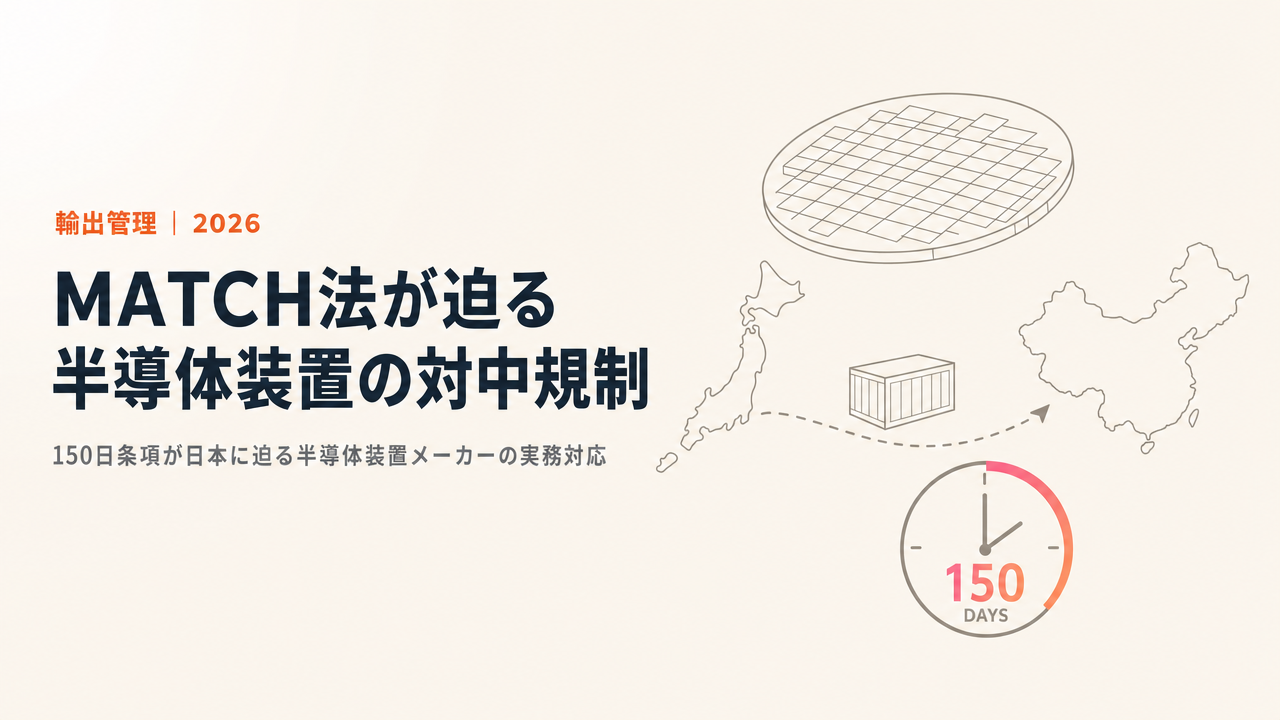
Third, the 150-day allied alignment clause. Commerce would consult with major allied suppliers, including Japan and the Netherlands, and require progress toward export controls comparable to U.S. rules. If allies cannot demonstrate progress within 150 days, the Act directs unilateral U.S. action, including expanded application of the Foreign Direct Product Rule to foreign-produced equipment that uses U.S. software, technology, or components34. Assembly in Japan or the Netherlands would not, by itself, put a tool outside U.S. reach if U.S. content or technology is inside.
CISTEC’s April 2026 note on U.S.-China export control developments summarized the same structure for Japanese readers: if allies that manufacture advanced semiconductor manufacturing equipment fail to implement equivalent controls within 150 days, the U.S. would move unilaterally toward a broad ban on sales of such equipment to countries of concern, including China7. Sponsor materials also target the gap where U.S. companies are already restricted from servicing equipment installed in China while allied service organizations continue48. Maintenance contracts sit inside the risk perimeter, not only new tool sales.
Why now? Congress’s stated view is that successive U.S. China semiconductor controls since October 2022, including the December 2024 package centered on manufacturing equipment, have been partially undercut by continued allied shipments5. ASML and Japanese tool makers have continued to sell DUV and other process tools into China under their domestic rules, supporting capacity growth at facilities such as SMIC and CXMT. Sponsor language is explicit that allied exports have undermined control effectiveness43. The political judgment in the bill is that persuasion alone is no longer enough. Legislation is the pressure tool.
My own view, stated plainly: verbatim passage of the April text is not guaranteed on the midterm calendar. Bipartisan, bicameral introduction still matters. Partial incorporation into an NDAA or a successor vehicle inside 2026 is a realistic path. “Wait for final passage” is a weak posture for any company with China-bound tool, component, or service revenue.
Who feels the bill first: U.S. tools, allied tools, and service orgs
If MATCH becomes law, or if the pressure forces allied governments to raise their own lists, the impact is not limited to one country’s champions. U.S. equipment makers already live under EAR. The bill’s point is to close the allied gap and the service gap around that baseline.
Bill materials state that semiconductor manufacturing equipment is the largest export item from the Netherlands to China, the second-largest from Japan to China, and the third-largest from the United States to China3. That ranking is why the bill is written the way it is.
On the Japanese side, the five names compliance teams keep on the whiteboard are familiar. Tokyo Electron holds top-tier share in etch, deposition, and clean. SCREEN Holdings leads in single-wafer cleaning. Advantest is a global leader in testers. DISCO dominates dicing and grinding, with deep ties into assembly and test. Nikon sits behind ASML in DUV immersion lithography, which is precisely the class the bill materials keep naming910. China revenue ratios move quarter to quarter. In recent periods, some of these companies have seen China account for roughly 30 to 40 percent of revenue. That is concentration risk, not a judgment about any buyer.
MATCH risk also does not stop at “direct sale to a Chinese fab.” Four operational paths matter.
Indirect sales through distributors. Many companies reach China through local distributors rather than a wholly owned sales arm. Covered facilities extend to subsidiaries and affiliates of the named groups. “We sold to a trading company” is not a complete defense in U.S. end-use practice if the ultimate destination was a covered facility4.
Re-exports via Hong Kong and Southeast Asia. Hong Kong has long been watched as a diversion path into mainland China. Singapore, Malaysia, and Thailand routes appear in the same enforcement conversations. Commerce has been tightening diversion monitoring in parallel with list expansion5. Retroactive review of past shipments is part of the risk, not only future orders.
Servicing, maintenance, and technical support. Periodic maintenance, consumable replacement, remote monitoring, and field-engineer dispatch can all be treated as restricted support once a facility or tool class is denied. Bill materials expressly include servicing and technical support4. Companies need a scenario where existing installed-base contracts freeze, not only a scenario where new tools stop shipping.
Expanded FDPR over equipment with any U.S. content. Japanese and other allied tools embed U.S.-origin lasers, optics, control software, and sensors. Expanding FDPR so that any U.S. technology content pulls the foreign-produced item under Commerce jurisdiction is the enforcement lever that makes the 150-day clock credible3. That is a sharp change relative to ordinary de minimis practice.
Sector research has also noted that Japanese tool makers are riding advanced-node and HBM demand, while part of near-term China revenue still rides legacy capacity investment9. If MATCH-style controls land, that China revenue line can compress quickly. Testers are less often the direct subject of tool bans than lithography or process equipment, but total Chinese capex still pulls tester demand with it.
Replace siloed classification work with AI.
METI's FY2024 data shows 52% of foreign exchange law violations stem from classification errors. Download the TRAFEED product catalog covering features and rollout.
Mapping the layers: EAR, de minimis, FDPR, and allied domestic law
MATCH is easier to place if you keep four layers separate.
Layer one: EAR jurisdiction. BIS administers the Export Administration Regulations. Jurisdiction can attach to items exported from the United States, U.S.-origin items wherever located, foreign products that incorporate U.S. content above applicable thresholds, and certain foreign direct products of U.S. technology, plus transactions with U.S. person involvement1112. A tool assembled in Japan can still be an EAR reexport if U.S. content or controlled U.S. technology sits inside it.
Layer two: de minimis. Under EAR §734.4, U.S.-origin content above 25% of the foreign product’s value for most destinations, or 10% for a narrower set of destinations, can pull the whole foreign product under the EAR12. In practice, de minimis worksheets decide many China export questions for non-U.S. equipment. MATCH’s FDPR expansion language points toward an “any U.S. content” posture for the equipment classes in scope, which would force those worksheets to be redesigned rather than tweaked3.
Layer three: Foreign Direct Product Rule expansions. FDPR is already the main way U.S. controls reach foreign-made items that are the direct product of specified U.S. technology or software. MATCH would use that doctrine as the unilateral backstop if allies do not align34.
Layer four: allied domestic law. Japan’s Foreign Exchange and Foreign Trade Act, administered by METI, runs list controls under Appended Table 1 of the Export Trade Control Order and catch-all controls under Item 1613. Semiconductor manufacturing equipment saw major Japanese list additions in July 2023. The Netherlands has its own national implementation path around ASML and related tools. MATCH is secondary pressure on those domestic systems. It is not a substitute for them.
For a fuller Japan-U.S. semiconductor map, see our overview of Japan-U.S. semiconductor export controls. A worked example still helps. Exporting a Japanese-made deposition tool toward a covered Chinese facility requires at least three checks today: Japanese list classification, U.S. de minimis and FDPR analysis, and Entity List or other party-based restrictions. One hit is enough to require authorization. Shipping without it is an enforcement event.
What MATCH adds is a fourth political axis: force allied lists up, or expand U.S. reach until the commercial result is similar. Will Tokyo respond by amending its own Export Trade Control Order again, or absorb unilateral U.S. action over domestic sales? The former preserves more Japanese regulatory agency. The latter is, in effect, a transfer of licensing gravity to Commerce. METI already partially amended the Export Trade Control Order in November 2025, including modules that incorporate field-programmable logic devices14. A MATCH-driven Japanese response, if it comes, most likely rides that same implementation path: order amendments and list updates, announced with little runway.
I expect METI to prefer announcing some form of additional restriction inside any 150-day window rather than ceding the field entirely. Industry hearings happen. Final calibration often lands in diplomatic negotiation and appears shortly before enforcement. Equipment makers should plan for a short gap between announcement and effective date.
Kill the gray zone: refresh classifications before the text hardens
The most useful work before floor action is unglamorous classification hygiene.
An export classification compares product specifications against the applicable control list, entry by entry. Japanese teams usually manage this with CISTEC-style item-specific comparison tables. U.S. teams do the same work against ECCNs and license exceptions. Either way, large regulatory shifts make old worksheets stale for three reasons. The law moves. Product generations move. Boundary products wobble when numeric thresholds sit near the edge.
The failure mode I see most often is commercial pressure on a gray-zone item. Sales wants the China order. The technical argument is contestable. The team marks the item non-controlled and ships. Months later the same file appears in a BIS inquiry or a METI post-shipment audit. CISTEC seminars in Japan keep warning about determination distortion under sales pressure. U.S. counsel know the same pattern under different labels.
If you are preparing for MATCH-style outcomes, push four audits now.
- Re-cross-check China-related classifications against the latest text. Build a version that already reflects the December 2024 BIS equipment package, subsequent Entity List and end-use rule changes, the November 2025 Japanese order amendment, and a placeholder for MATCH-driven allied updates514.
- Rebuild worksheets for DUV lithography, deposition, etch, clean, test, and dicing or grinding tools. MATCH materials push regulation toward legacy capacity tools, not only leading-edge nodes. Items previously treated as out of scope need a second look.
- Audit re-export and distributor paths through Hong Kong and Southeast Asia. Pull two to three years of shipping records. Flag ultimate destinations that may have been covered facilities even if the invoice party was not.
- Recalculate de minimis for U.S.-content products. Refresh supplier origin data. Surface items near or above 25%, and model an “any U.S. content” scenario for tools in the bill’s chokepoint classes. For ECCN lookup patterns, see our ECCN number cheat sheet.
Doing this by hand across hundreds or thousands of SKUs is not realistic for mid-sized tool and component makers. Export control teams are small. Hiring is slow. That is why the industry is moving classification drafting and party screening onto software, with humans keeping final sign-off.
Four mechanisms for a long U.S.-China tech conflict
MATCH is one bill. The broader pattern is longer. Semiconductor, AI, and frontier-tool controls are not a one-quarter event. Compliance systems need to stop being “patch each Federal Register notice” and start being continuous.
In conversations with export control leaders at mid-sized and larger manufacturers, four mechanisms keep coming up.
Automated regulatory monitoring. BIS, OFAC, the European Council, the UK, and METI do not update on one calendar. Manual reading has already failed at scale. You need a pipeline that collects official notices and extracts only the changes that hit your products and parties.
Continuous party screening. Entity List, SDN, Military End-User List, Japan’s Foreign End User List, and related lists have to run against new and existing counterparties. MATCH’s subsidiary-and-affiliate language makes beneficial ownership and corporate hierarchy resolution mandatory, not optional4.
Classification knowledge bases. Store past determinations, rationales, and mapping to control text so new reviews can reuse prior work. Consistency across reviewers is the point. Gray-zone wobble shrinks when the history is visible.
Workflow hard stops. Sales cannot overturn a controlled determination by email pressure. Classification, license application, and shipment release need system gates. That is governance more than technology. Leadership either backs it or the system fails under the first big order.
Excel and inbox workflows do not survive MATCH-scale change. TRAFEED is the export control AI agent we built to support those four mechanisms: list and catch-all classification drafting, multi-list party screening with ownership depth, and a knowledge base aligned to Japanese and U.S. practice. The system drafts with cited grounds. Your compliance officer still decides.
Large tool makers already have specialized teams and custom systems. Mid-sized component and sub-assembly suppliers in their ecosystems usually do not. If MATCH expands the denied surface, that mid-layer takes a disproportionate hit. TRAFEED is priced and designed for that layer as much as for the primes.
If you want a 30-minute working session on MATCH impact scope or China-path vulnerabilities, use TRAFEED online consultation.
Closing
The MATCH Act debate is larger than one bill number. It marks a shift from “the United States sets rules and hopes allies follow” toward “the United States legislates a clock and a unilateral backstop.” U.S. companies cannot treat allied shipments as someone else’s problem. Allied companies cannot treat EAR analysis as optional because final assembly happened outside the United States. Both sides need one integrated view of U.S. rulemaking, allied list updates, party screening, and service restrictions.
My working probabilities, offered as opinion rather than prediction markets: verbatim 2026 passage of the April text is maybe 30 to 40 percent. Some form of partial enactment through NDAA or successor vehicles is higher, in my view above 50 and closer to 70. Japanese additional restrictions under diplomatic pressure inside a 150-day window are more likely than pure inaction. The open question is how much industry runway those restrictions include.
Competitiveness in semiconductor equipment is no longer only process capability and service quality. Regulatory response speed is part of the product. Refresh classifications, map service contracts, recalculate U.S. content, and fix the governance path from determination to shipment. If you want help scoping that work, book a consultation. Feature detail is in the TRAFEED product catalog (PDF).
Related articles
- China's Export Controls Targeting Japan — Economic Security Risks Japanese Companies Face in 2026
- EAR99 vs ECCN, and Where 'Not Subject to the EAR' Sits
- List Controls vs. Catch-All Controls — A Guide for Japanese Export Control Teams
References
Footnotes
-
Bloomberg, coverage of bipartisan U.S. bill extending China semiconductor equipment controls to allies including Japan (April 3, 2026) — https://www.bloomberg.com/jp/news/articles/2026-04-03/TCW3JCKK3NYL00 ↩
-
Nikkei, U.S. lawmakers push new bill to tighten China semiconductor controls and seek coordination with Japan and the Netherlands (April 2026) — https://www.nikkei.com/article/DGXZQOGN1607M0W6A410C2000000/ ↩
-
Representative Michael Baumgartner, “Baumgartner Introduces Bipartisan Bill to Tighten Controls on Sensitive Chipmaking Equipment” (April 2, 2026) — https://baumgartner.house.gov/2026/04/02/baumgartner-introduces-bipartisan-bill-to-tighten-controls-on-sensitive-chipmaking-equipment/ ↩ ↩2 ↩3 ↩4 ↩5 ↩6 ↩7 ↩8 ↩9 ↩10
-
U.S. Senate Committee on Foreign Relations, “Risch, Ricketts, Kim Introduce MATCH Act; Level the Global Playing Field for U.S. Tech” (April 8, 2026) — https://www.foreign.senate.gov/press/rep/release/risch-ricketts-kim-introduce-match-act-level-the-global-playing-field-for-us-tech ↩ ↩2 ↩3 ↩4 ↩5 ↩6 ↩7 ↩8 ↩9 ↩10
-
JETRO, U.S. Commerce Department announces new China export controls centered on semiconductor manufacturing equipment (December 2024) — https://www.jetro.go.jp/biznews/2024/12/f4fdfe5162642930.html ↩ ↩2 ↩3 ↩4
-
Congress.gov, S.4281 — Multilateral Alignment of Technology Controls on Hardware (MATCH) Act, 119th Congress — https://www.congress.gov/bill/119th-congress/senate-bill/4281/text ↩
-
Center for Information on Security Trade Control (CISTEC), latest U.S.-China export control developments — https://www.cistec.or.jp/service/uschina.html ↩
-
ASCII.jp, analysis of potential impact on Japanese semiconductor companies from the new U.S. congressional bill — https://ascii.jp/limit/group/ida/elem/000/004/394/4394393/ ↩
-
Rakuten Securities Tousil, sector report on Japanese semiconductor manufacturing equipment makers — https://media.rakuten-sec.net/articles/-/49350 ↩ ↩2
-
Toyo Keizai Online, coverage of Japanese lithography systems and competitive positioning — https://toyokeizai.net/articles/-/930738 ↩
-
METI, Security Export Control official page — https://www.meti.go.jp/policy/anpo/ ↩
-
Business & Law, fundamentals of U.S. Export Administration Regulations (EAR) — https://businessandlaw.jp/articles/a20231226-1/ ↩ ↩2
-
JETRO, catch-all controls in security export controls: Japan — https://www.jetro.go.jp/world/qa/04A-020118.html ↩
-
METI, Cabinet Decision on Partial Amendment of the Export Trade Control Order (November 11, 2025) — https://www.meti.go.jp/press/2025/11/20251111001/20251111001.html ↩ ↩2
![ECCN Number List and Cheat Sheet [2026 Edition]: Categories 0-9 x Groups A-E, Frequent Numbers, and How They Map to Japan's Export Control Items](/images/columns/eccn-number-list-cheatsheet-2026/cover.png)