Hello, I'm Ryuta Hamamoto from TIMEWELL.
Watching the stock market in 2026, you notice that the lead role has clearly changed hands. In October 2025, NVIDIA became the first company in the world to break through a $5 trillion market capitalization. In Japan, Kioxia, which had only just listed in December 2024, has seen its share price multiply several times over in a short span, carried by demand for AI-oriented memory. The market caps of semiconductor makers have become the thermometer of the global economy. That is the era we have entered.
That said, the reason I wanted to write this series is not the stock rally itself. It is that news of an entirely different character keeps breaking around the very same semiconductors. Taiwanese prosecutors were reported to have moved on suspicion that NVIDIA AI servers had flowed from Taiwan through Japan and onward to China. The U.S. and China traded export-control cards and then, in the autumn of 2025, simultaneously withdrew some of them in a "truce." And once 2026 arrived, the U.S. shifted its helm not only toward tightening but toward an offensive policy of exporting AI wholesale to its allies. Semiconductors are no longer mere electronic components; they have become national strategy itself.
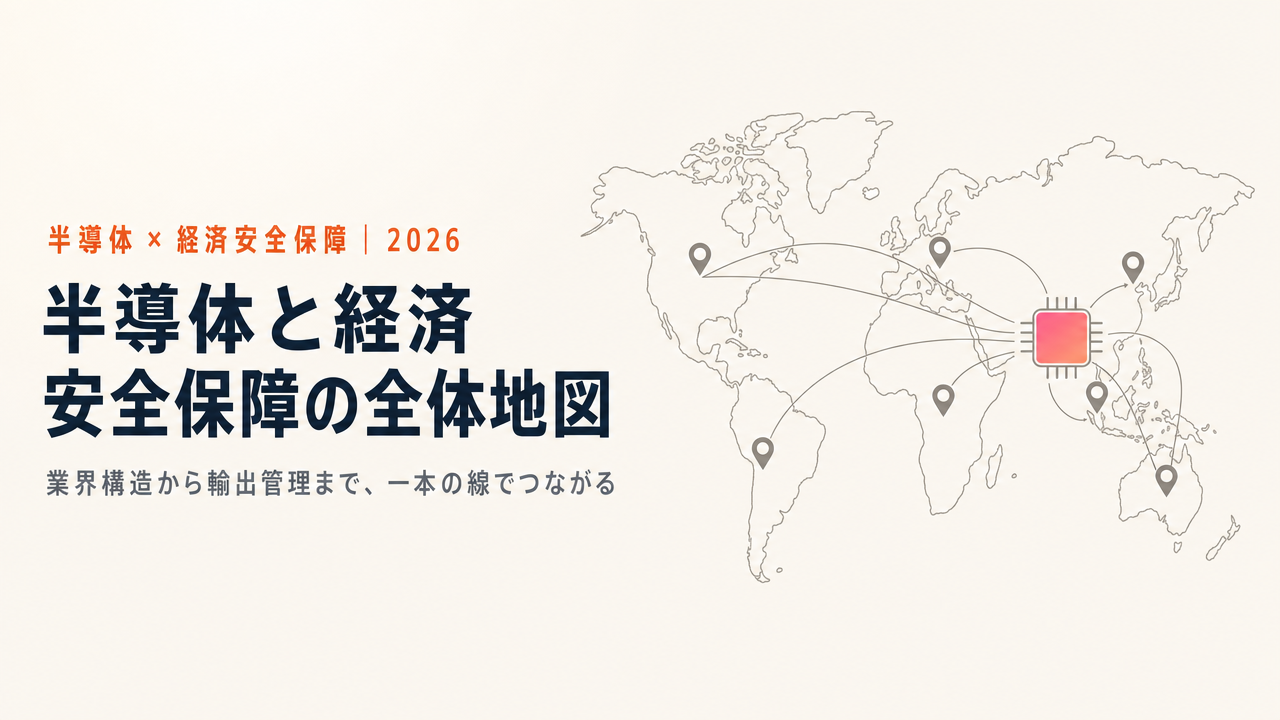
This article is a map for grasping that whole picture. How does the semiconductor industry actually work? Why has it become the core of economic security? What laws have countries deployed, and how did the situation swing from 2025 into 2026? I have organized it so that the flow can be followed even without being an expert, and it bridges to the detailed article on each theme. By the time you finish reading all of it, the fragments of news should connect into one large picture.
Semiconductors Are Built on a Division of Labor Where No Single Company Can Make Them
The first thing I want you to grasp is the fact that the most advanced semiconductors cannot be completed by any single company. The company that designs, the company that manufactures, the company that sells the manufacturing equipment, and the company that supplies the materials are divided up across national borders.
The image might be close to a full-course meal at a fine restaurant. The person who plans the menu, the kitchen that actually does the cooking, the artisan who builds the special oven that only that kitchen can use, the producer who raises the finest ingredients. The roles are cleanly separated, and if even one of them is missing, not a single dish comes out. Semiconductors are exactly like this: no matter how brilliant a designer you have, no single company can make even one grain of an advanced chip on its own.
Following the rough flow, it goes like this. The UK's ARM provides the intellectual property that forms the foundation of circuit design, and design-specialist companies like NVIDIA, Apple, and AMD (called fabless companies, because they own no factories) use it to design chips. But because they have no factories of their own, they outsource manufacturing to Taiwan's TSMC. And TSMC, in turn, can do nothing to etch the most advanced chips without the EUV lithography machines (equipment that prints circuits using extreme ultraviolet light) made by the Netherlands' ASML. Furthermore, those machines and factories run on top of the silicon wafers (the disc-shaped material that becomes the foundation of a chip), for which Japanese companies such as Shin-Etsu Chemical and SUMCO hold roughly 60% of the world.
Mapping it onto the cooking analogy from earlier: ARM is the basic form of the recipe, NVIDIA and the others are the chefs who plan the menu, TSMC is the only kitchen in the world that can finish this ultra-difficult dish, ASML is the special oven that can only be placed in that kitchen, and Japan's materials makers are the source that supplies the ingredients. If any one of them stops, the course never comes out. That is exactly why one company's trouble can halt dinner tables around the world.
What matters here is that this chain is not a single straight road; dependence is concentrated on specific companies. Over 90% of the most advanced logic semiconductors are manufactured by TSMC, and ASML holds a 100% global share of EUV lithography machines. HBM (high-bandwidth memory), the high-speed memory used for AI, can only be mass-produced by three companies: SK Hynix, Samsung, and Micron. This three-way oligopoly translates directly into a supply risk for AI servers, which is why the U.S. added HBM to its advanced-computing controls in December 2024. The symbolic moment is that in 2025, NVIDIA overtook Apple to become TSMC's largest customer. It was the historic instant when the lead role of the semiconductor industry shifted from smartphones to AI.
Once you understand this division of labor, and in particular the power balance of the manufacturing equipment and materials that sit upstream, you can see why one company's supply stoppage shakes the entire world. I dig into the export-control pressure points as seen from the equipment and materials side, with diagrams, in Export Controls on Semiconductor Manufacturing Equipment and Materials.
Replace siloed classification work with AI.
METI's FY2024 data shows 52% of foreign exchange law violations stem from classification errors. Download the TRAFEED product catalog covering features and rollout.
Why Semiconductors Became a National Lifeline
Concentrated dependence breeds efficiency in peacetime, but it becomes a fatal weakness in a crisis. The place where that weakness appears most sharply is Taiwan.
About 90% of the world's most advanced logic semiconductors are made in Taiwan. This single point makes a Taiwan contingency the greatest risk to the global economy. If Taiwan's semiconductor supply stops, we can no longer make AI, smartphones, cars, or weapons. Bloomberg Economics estimates that a full-scale conflict over Taiwan would inflict roughly $10.6 trillion in losses on the world economy, about 10% of global GDP. Conversely, the very fact that the world depends on Taiwanese chips becomes a deterrent that discourages military invasion. Imagine a situation where everyone in town draws the water they live on from a single well. Destroy that well, and everyone goes thirsty, including the person who destroyed it. So no one can lay a hand on it. Taiwan's semiconductors are the same: attack them, and even the attacker's own economy dries up. This mutual dependence, this "destroy it and you hurt yourself too," is precisely the idea called the silicon shield.
Cracks are now beginning to form in that shield. In 2026, it was reported that AI servers loaded with NVIDIA chips had nearly been diverted to China after being falsely declared, on paper, as bound for Japan, and that Taiwanese authorities had launched an investigation. At least part of the shipment reportedly did pass through Japan. What I do not want you to misunderstand here is that Japan was not the perpetrator of the smuggling. Japan was misused as a "legitimate destination" in the declaration, in effect a transit point that was exploited. As for the specific number of units and the amounts involved in this case, I should note that, within the range I have been able to check, the corroboration in primary sources is not yet sufficient; at this point it is most accurate to treat it as reporting-based information. Even so, it does not change the fact that the incident confronted us with the very structure by which the most advanced chips the world is trying to fence off can slip through the regulatory net and flow out.
The stock rally is also two sides of the same coin as this tension. Precisely because semiconductors have become a strategic resource to be fought over, money is pouring into the companies that hold them. Why a Taiwan contingency and a stock rally are two sides of the same coin is something I write about in detail in The Geopolitics of Semiconductors.
Regulation Became a Weapon, and a Truce Came in Autumn 2025
Once semiconductors become a strategic resource, countries begin to use laws as weapons. The moves from 2024 into 2026 were exactly that exchange of blows. And it was not a monotonous, one-directional tightening; countries tightened, then loosened, then braced again. That swing is precisely what characterizes the recent period.
When you hear "export controls," it sounds difficult, but in essence it is doing airport baggage screening on a national scale. Is this item allowed to be taken out? Is this counterparty allowed to receive it? The state checks, and stops anything dangerous. It should be easier to picture if you think of semiconductors and their manufacturing technology as now being on the same "take-out caution list" as handguns and knives. The problem is that this list keeps getting rewritten according to each country's calculations.
In the United States, the Commerce Department's BIS (Bureau of Industry and Security) has used the Export Administration Regulations to progressively tighten exports of advanced semiconductors and manufacturing equipment to China. In September 2025, it revoked the VEU (Validated End-User) authorizations that had until then been permitted inside China, affecting Intel's Dalian plant and the Chinese sites of Samsung and SK Hynix. At the end of that same September, it introduced the so-called 50% affiliates rule, which automatically pulls into scope any subsidiary that is at least 50% owned by a company already on the Entity List. The mesh of the net grew finer still. Because this 50% rule is of especially high interest to practitioners, I lay out who is affected in A Complete Guide to the BIS 50% Affiliates Rule.
But in the autumn of 2025, the current reversed. Following the November meeting between Trump and Xi Jinping, part of the tightening entered a truce. The freshly introduced 50% affiliates rule was suspended for one year, until November 9, 2026, and NVIDIA's H200, whose exports to China had been under a presumption of denial (denied in principle), was loosened to case-by-case individual review under a January 2026 BIS rule. This is a spot where misunderstandings spread easily, so let me write it carefully. The often-discussed arrangement to "pay a fixed share of China sales to the U.S. government" is not about the H200. That deal was struck in the summer of 2025 and concerned different chips, the H20 and AMD's MI308, and the share was 15%. The chips involved and the mechanism are different things. Debate the two while conflating them and you will misread the tightening and loosening of the rules. I explain this distinction in detail in Sorting Out the H20, H200, MI308, and the 15% China Sales Fee.
China, for its part, made mineral resources its trump card. It put gallium, germanium, and medium-to-heavy rare earths, which are indispensable for semiconductors and rare-earth applications, on a license-required basis, and in October 2025 it rolled out an extraterritorial (de minimis) rule requiring Chinese permission even for foreign products that contain 0.1% or more of Chinese rare earths. It was, in effect, China imitating with resources the very logic the U.S. had long been good at: "if even a little of our technology is in it, our permission is required." This expansion, too, was suspended for one year under the November 2025 U.S.-China agreement. The U.S. halted the 50% affiliates rule, and China halted its rare-earth squeeze. It was a mutual truce in which each side pulled its cards back. I have compiled these moves in A Whole Map of China's Rare-Earth Export Controls.
Japan was not standing idle either. Following its 2023 move to place 23 categories of semiconductor manufacturing equipment under a METI license requirement, amendments to the Foreign Exchange Act and the Export Trade Control Order took effect on May 28, 2025, newly adding 21 items related to advanced semiconductors and quantum computers to the list controls (Appended Table 1). This time the licensing requirement applies not to specific countries but to all regions. The list includes cutting-edge technologies whose names may not ring a bell, such as GAAFET-structure transistors and cryo-CMOS that operates at ultra-low temperatures, but in short it was Japan signaling its intent that "technologies directly tied to the next-generation computing base must pass a national check no matter where they are shipped." It is a complementary measure, keeping step with U.S. advanced-computing controls. I have compiled the details in Japan's List Controls on 21 Advanced Semiconductor Items.
The sequence of this tightening and loosening becomes far easier to understand when laid out on a timeline. I have made the flow from 2024 through 2028 traceable in The U.S.-China AI Semiconductor Regulatory Calendar. Note that after 2026 began, there were also reported moves on the Chinese side to halt exports of dual-use goods to Japan's defense-related companies. This is said to be a countermeasure against Japanese remarks concerning Taiwan, but here again, within the range I have been able to check, the corroboration in primary sources is not yet sufficient, so it should be handled cautiously as reporting-based information. I organize the surrounding developments in China and Japan Export Controls 2026. In the U.S. Congress, debate continues over bills to further constrain semiconductor exports to China, and the EU is putting new regulatory frameworks for quantum and semiconductors into shape. I have made it possible to compare the finer country-by-country differences side by side in Each Country's High-Tech Regulations.
The U.S. Goes on Offense: From Restriction to Full-Stack AI Exports
Reading this far, you may get the impression that the U.S. is doing nothing but tightening. But the U.S. of 2026 has another face. It turned not only to defense, but to offense.
The trigger was the explosion of demand for generative AI and the unexpected bottleneck it produced. Power. No matter how many of the latest GPUs you stack up, without the electricity to run them, they are just boxes. In the U.S., data-center power demand has surged and the capacity of the transmission grid can no longer keep up. On a reporting basis, there have been accounts of moves such as Microsoft restarting a shuttered nuclear plant to secure power. What came after the semiconductor shortage was a power shortage. Incidentally, because the power constraint is so severe, some quarters have even floated the idea of placing computing resources in space, though this is best viewed for now as something still at the demonstration stage.
This wall of power led to a shift in policy. In 2025, the U.S. had once put together the AI Diffusion Rule, which finely constrained the global allocation of AI chips. It was an ambitious rule, published by the Biden administration as an interim final rule in January 2025, that even included a framework for classifying the weights (parameters) of AI models as controlled items. The Trump administration, however, rescinded it before it took effect. What it then put forward was a change of direction away from regulation for its own sake. Under the American AI Exports Program, based on Executive Order 14320, it began promoting to allied countries a "full-stack AI export" that bundles not just chips but AI models and even data centers into a single package. In April 2026, the Commerce Department's ITA opened a call for proposals for the consortium that would carry this package.
The UAE (United Arab Emirates) is emblematic. In July 2026, BIS moved the UAE out of the tightly regulated country group and elevated it to the favored Country Group A:5. The UAE government and authorized companies can now access advanced-computing items without a license. Export data centers wholesale to the energy-rich Gulf states, and you resolve the wall of power outside your own borders while fencing an ally into the American technology sphere rather than China's. Defense (China-facing controls) and offense (export promotion to allies) have become two sides of the same coin. This is an indispensable lens for reading the U.S. of 2026. I dig into the latest thinking on how to manage and how to distribute access to the AI base in Export Controls on AI Access 2026.
At Last, AI Models Themselves Enter the Frame of Export Controls
The object of export controls has climbed upward one step at a time, from chips to manufacturing equipment and then to computing resources. On the extension of that line, might the reach finally extend to "AI models themselves"? In 2026, this debate has suddenly taken on a sense of reality.
Let me write this carefully. The framework for classifying the weights of AI models as controlled items had, as I touched on earlier, already been laid out in the AI Diffusion Rule (before it was rescinded). This much is a confirmable fact. On top of that, in June 2026, it was reported that an order had been issued to cut off foreign access to a specific deployed model. The reporting says the target was a top-tier model from Anthropic, and that the party involved strongly objects and the dispute continues. But as of July 2026 this order still cannot be confirmed in primary sources such as the Federal Register, and I will refrain from asserting it. At this stage, viewing it as an unresolved and contentious matter is, I believe, the honest stance.
Even so, my read is that the direction of this trend will not stop. If the regulation up to now was baggage screening that stops "the weapon itself" at the border, what is now being asked is the harder question of whether one can stop "the private tutor who teaches you, step by step, how to build the weapon." It has been pointed out that the most advanced AI, depending on how you ask, can "generate" technical information that is properly subject to strict control, such as missile guidance, semiconductor manufacturing, and methods of cyberattack. Rather than searching for existing information like a search engine, it stitches fragments together and writes a new blueprint. This is exactly where it does not fit within the conventional framework of regulation. That is precisely why regulatory attention has no choice but to turn from the chip toward the contents of the model that runs on top of it. The individual case needs verification, but as a major tectonic shift I feel it is the real thing. I dig into this issue, together with an examination of the case, in The Era When AI Models Become Subject to Export Controls.
So, What Should Companies Do?
Having read this far, some of you may feel that this is a grand story but wonder what it has to do with your own company. If anything, it is the opposite: this change is directly tied to the practical work of ordinary companies.
Manufacturers and trading companies that handle advanced semiconductors and manufacturing equipment are affected, of course, but companies that have built AI into their operations cannot stay uninvolved either. Before exporting or providing something, you need to perform a classification screening (in Japanese, gaihi hantei) to determine whether that product or technology is controlled, and you are also expected to screen whether your counterparties are restricted-entity companies. What troubles practitioners here is re-export control, typified by the U.S. Export Administration Regulations (EAR). Even for a transaction within Japan, if U.S.-origin parts or technology are included above a certain proportion, U.S. rules reach it, under what is called the de minimis rule. The threshold is 25% in principle, and only 10% for the most heavily embargoed destinations (Country Group E:1, namely Cuba, Iran, North Korea, and Syria), and unless you have a grip on how much U.S.-origin content is in your own products, you can end up brushing against re-export controls without realizing it. On top of that, there is catch-all control, under which even items not on any list require a license if there is a risk of diversion to weapons of mass destruction and the like.
Whether your own products or technologies might get caught by these controls is something you can realistically start assessing, in broad strokes, with the Export Control Self-Check. The problem on top of that is that these criteria get rewritten on the order of weeks. As with the H200 review criteria and the 50% affiliates rule mentioned at the outset, a premise that held until yesterday can change today. It is no longer a speed that human hands alone can keep up with. I have compiled a concrete approach to the EAR in The Practice of EAR Compliance.
This is where TRAFEED, which we are developing, comes in. TRAFEED is an export-control AI agent compliant with the standards of Japan's Ministry of Economy, Trade and Industry; it automates classification screening and counterparty screening and keeps up with regulations that change moment by moment. Its AI classification accuracy is 95% or higher (a joint validation with Okayama University, based on roughly 30,000 past review records; internal survey), and it reflects regulatory changes quickly. That said, please do not forget the principle that the final classification determination is made by your company's export control manager. It is an ironic story, but in an era when AI becomes subject to regulation, the one that handles that regulation is, again, AI. How the practical work of export control should be designed is something I explain concretely in Corporate Export-Control Operations.
The story around semiconductors begins with the industry structure and then connects, all in one line, to geopolitics, the laws of each country, tightening and truce, the promotion of AI exports, and the regulation of AI models. The greatest lesson from 2025 into 2026 was this: regulation does not advance in one direction; it is used as a political card, tightened and loosened again and again. No matter which piece of news comes through next, if you keep this map at hand, you should be able to tell where in the whole picture it is happening. Let's move on to the specifics and raise the resolution.
The primary sources I referred to are two BIS rules in the U.S. Federal Register. One is "Revision to License Review Policy for Advanced Computing Commodities" (effective January 15, 2026; document number 2026-00789), which changed the review of the H200 for China to case-by-case. The other is "Enhanced Favorable Treatment for the United Arab Emirates" (July 14, 2026; document number 2026-14132), which elevated the UAE to the favored country group. In addition, I checked the Ministry of Economy, Trade and Industry's security trade control pages (the amendments to the Foreign Exchange Act and the Export Trade Control Order, and the all-region license requirement for the 21 advanced-semiconductor items). Each detailed article also compiles, at its end, the corresponding primary sources and their publication dates.
If you are reviewing export-control operations or classification workflows, download the TRAFEED product catalog (PDF) or contact us.