
Hello, I'm Ryuta Hamamoto from TIMEWELL.
At the end of How Each Country Regulates High Technology, I wrote that "the trend of weaponizing rules has finally moved beyond semiconductors themselves and begun reaching all the way to AI models." This time, I want to look at the front line of that trend — an unprecedented event that actually happened in June 2026. The target of export controls leapt from visible "things" to an invisible "AI model itself." In a sense, this is the final chapter in the story of semiconductors and economic security.
What Happened on June 12, 2026
It started at 5:21 PM Eastern Time on June 12, 2026. The U.S. Commerce Department's Bureau of Industry and Security (BIS) sent a directive — a format known as an "is informed" letter — to Anthropic's CEO, Dario Amodei, signed by Commerce Secretary Howard Lutnick. The content: for the company's flagship AI models "Fable 5" and "Mythos 5," an export license would be required for access by all foreign nationals (regardless of whether they were inside or outside the United States, including the company's own foreign-national employees).
A quick bit of background. Fable 5 is the highest-performing, generally available model in Anthropic's Claude lineup. Mythos 5 is a sibling model with comparable performance, available only through a limited program. Both are among the smartest AI in the world right now.
The problem was the weight of an order to "stop access by foreign nationals." Because Anthropic cannot determine in real time whether a given user is a foreign national, the only way to stay compliant was to temporarily suspend both models for all customers. Frontier AI that hundreds of millions of people were supposed to be able to use was halted by a single government directive. No one had ever seen anything like it. The trigger, as reported, was that a method had been found to bypass one model's safety guardrails (a jailbreak) and use it to identify cyber vulnerabilities in critical infrastructure — a concern reportedly raised by another company.
In fairness, I should note that Anthropic strongly objects to this directive. In a statement, the company said that "applied across the industry, it would essentially halt all new model deployments by every frontier model provider," and that "we believe this is a misunderstanding and are working to restore access." Regarding the jailbreak in question, the company pushed back that "only a few minor, already-known vulnerabilities were demonstrated, and that capability is widely possible with other companies' models as well." What's interesting is that Anthropic had, if anything, been a company that previously supported tougher China chip controls. The side that had backed regulation now found itself opposing the application of regulation to its own deployed model. And note: on this June directive specifically, the company is moving not through litigation but through negotiation with the government. As of June 2026, this matter remains unresolved.
Replace siloed classification work with AI.
METI's FY2024 data shows 52% of foreign exchange law violations stem from classification errors. Download the TRAFEED product catalog covering features and rollout.
What "First" Precisely Means, and the Old Weapon Called "Deemed Export"
It is actually not accurate to simplify this news as "the first time an AI model became subject to regulation." This is a point worth drawing carefully.
Classifying AI model "weights" (the collection of parameters that determine performance) as subject to control had, in fact, already begun with the "AI Diffusion Rule" of January 2025. That rule assigned a dedicated control number (ECCN 4E091) to the weights of frontier models trained above a certain compute threshold (on the order of 10^26 operations). So "AI models being brought under the export-control concept" came earlier. What makes the Fable 5 case "a first" is something else. It was the first case in which the government, by individual order, directly halted access to a specific model that is actually deployed and used by hundreds of millions of people every day — what experts have called "a private, one-off enforcement order rather than a published rule."
The legal instrument used is also interesting: the decades-old concept of "deemed export." This is the principle that the very act of disclosing controlled technology or software to a foreign national within the United States is treated as an "export" — equivalent to exporting it to that person's home country. Show a blueprint to a foreign-national engineer domestically, and that counts as an export to their home country. In this case, the principle was applied to an AI's inference API (the gateway through which an AI is called and used externally). One analysis framed the novelty this way: "What crosses the border is access to the capability, not the model file." It was the moment an old legal doctrine collided with the newest technology.
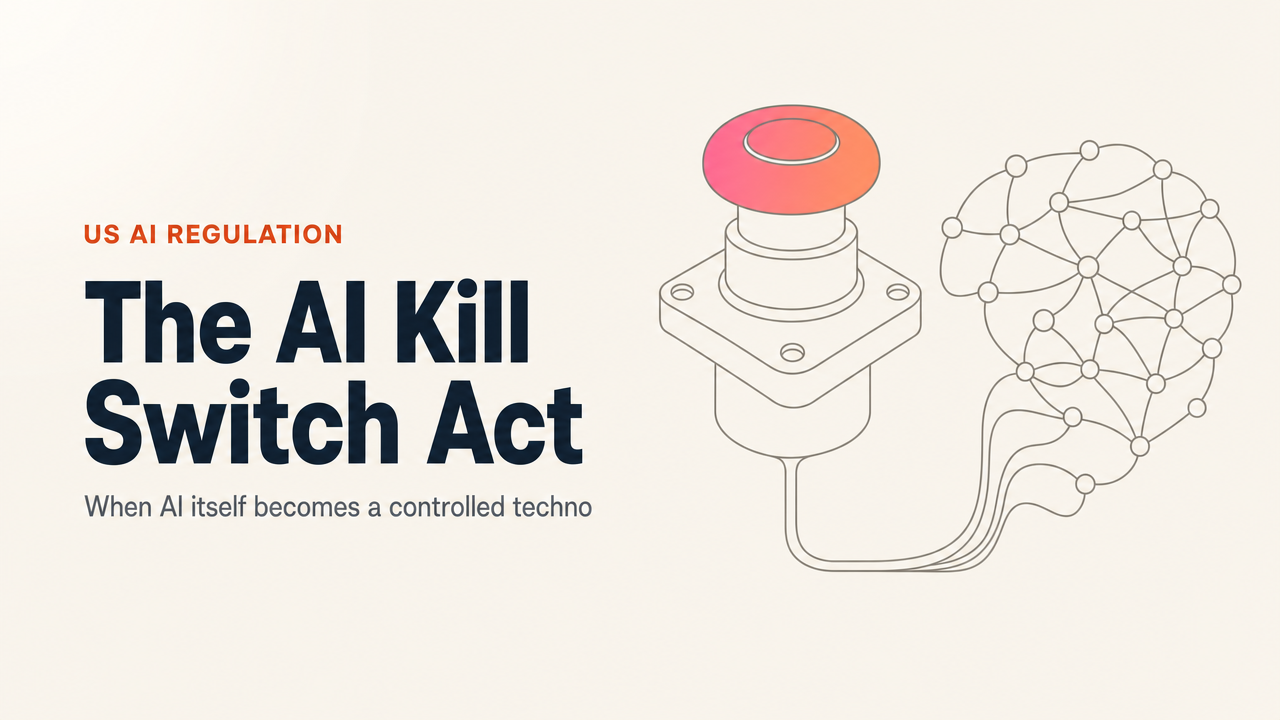
Let me put it a bit more plainly. A deemed export is, by analogy, a rule under which "the very act of showing a controlled blueprint to a foreign-national employee located in Japan is treated as an export to that person's home country." The thing hasn't moved an inch, yet the moment it is shown, an "export" has occurred. The Fable 5 case applied that thinking to an AI's chat gateway, ruling that "the very state of making it accessible to a foreign national is itself an export." Some experts describe this as the arrival of a "kill switch" by which a state can stop an AI at any time. And what cannot be overlooked is that Anthropic had, if anything, been a company that previously supported tougher China chip controls. The side that had been in favor of regulation flipped to opposition the moment regulation reached its own deployed model. It was a case that symbolically captured the moment AI regulation flips from "someone else's problem" to "my problem."
Regulation Has Climbed the Staircase One Step at a Time
If we look back at the history of regulation covered in earlier articles as a single arc, we can see that regulation has steadily climbed a staircase, one step at a time.
The first step, in 2022, was controls on advanced semiconductors themselves and on manufacturing equipment aimed at China. The second step, from 2023 into 2024, tightened the specifications of those controls and even caught HBM, the memory used for AI, in the net. The third step, in 2025, extended to the global allocation of AI chips, to compute resources delivered via the cloud, and to model weights (the AI Diffusion Rule). And the fourth step, in June 2026, was blocking access to a deployed AI model itself. Chips, equipment, compute, and then the model. From the bottom up, from physical hardware toward something more abstract and more valuable, the hand of regulation has reached up one step at a time. What I feel as I look at this staircase is that this is not haphazard — there is a consistent direction. The value to be protected is shifting from the silicon wafer to the intelligence that runs on top of it.
Why Is AI Viewed as So Dangerous?
So why would a state go so far as to halt an AI model itself? Behind it lies a fear of the "weaponization" of AI. If earlier regulation was a baggage check that stopped "the weapon itself" at the border, this time the difference is that they moved to stop "the private tutor that walks you through how to build the weapon."
Frontier AI can, depending on how you ask, generate technical information that is normally tightly controlled — missile guidance algorithms, semiconductor manufacturing techniques, methods for cyberattacks. When one research institution tested major U.S. AI models, it reported that every tested model output controlled technical information in at least one category. This is the tricky part. AI is not a search engine that finds existing information; it is a reasoning engine that "synthesizes" new blueprints by stitching together fragments of knowledge. The directive against Fable 5, too, was triggered by a method that bypassed the safety guardrails to identify vulnerabilities in critical infrastructure.
Concerns about weaponization are also becoming reality in the military world. The UN Secretary-General has called for a framework to ban lethal autonomous weapons that operate without human control, and the International Committee of the Red Cross (ICRC) has warned that "AI must not be put on the battlefield without oversight." In January 2026, China's military aired a demonstration on state television of a single soldier operating a swarm of roughly 200 autonomous drones (though it is worth noting that this was a controlled, staged demonstration, not an independently verified combat capability). The smarter AI becomes, the more it is at once a convenient tool and a potential designer of dangerous weapons. It is precisely because of this dual nature that countries have begun reaching for the models themselves.
This Trend Probably Won't Stop
Finally, let me state my own view. The Fable 5 matter is still in negotiation between Anthropic and the government, and the outcome remains unclear. Even so, I believe this trend — AI models becoming subject to export controls — will not stop.
The reason lies in that "staircase" from earlier. Regulation has climbed steadily upward, one step at a time, from semiconductors to manufacturing equipment to compute to AI models. It is hard to imagine countries voluntarily stepping back down once they have climbed up. If anything, the more capable AI becomes, the more regulation should head deeper, toward the very contents of the model. Even among experts, "capability-based regulation" — automatically bringing models that exceed a certain performance threshold under control — has begun to be discussed. One legal expert advises companies to "build the prospect of an AI model suddenly becoming unavailable into your business continuity plan (BCP), and consider building redundancy across multiple models."
This is not someone else's problem for any company that uses AI. The AI you could use yesterday is stopped by regulation today. The Fable 5 matter at the top of this article showed that this can become reality. So how should companies design their export-control operations in this uncertain era? In the next and final installment, Corporate Export-Control Operations, I will explain how to prepare in concrete terms.
Note: The suspension of access to Fable 5 and Mythos 5 is based on Anthropic's official statement (June 12, 2026) and reporting by outlets such as CNBC, Axios, Fortune, Just Security, and IAPP; the AI Diffusion Rule is based on the Federal Register (January 2025); and the weaponization of AI is based on analyses from Just Security, the ICRC, the UN, and others. The events described in this article reflect information as of June 2026, and the situation is fluid.
If you are reviewing export-control operations or classification workflows, download the TRAFEED product catalog (PDF) or contact us.

![ECCN Number List and Cheat Sheet [2026 Edition]: Categories 0-9 x Groups A-E, Frequent Numbers, and How They Map to Japan's Export Control Items](/images/columns/eccn-number-list-cheatsheet-2026/cover.png)