Hello, I'm Ryuta Hamamoto from TIMEWELL.
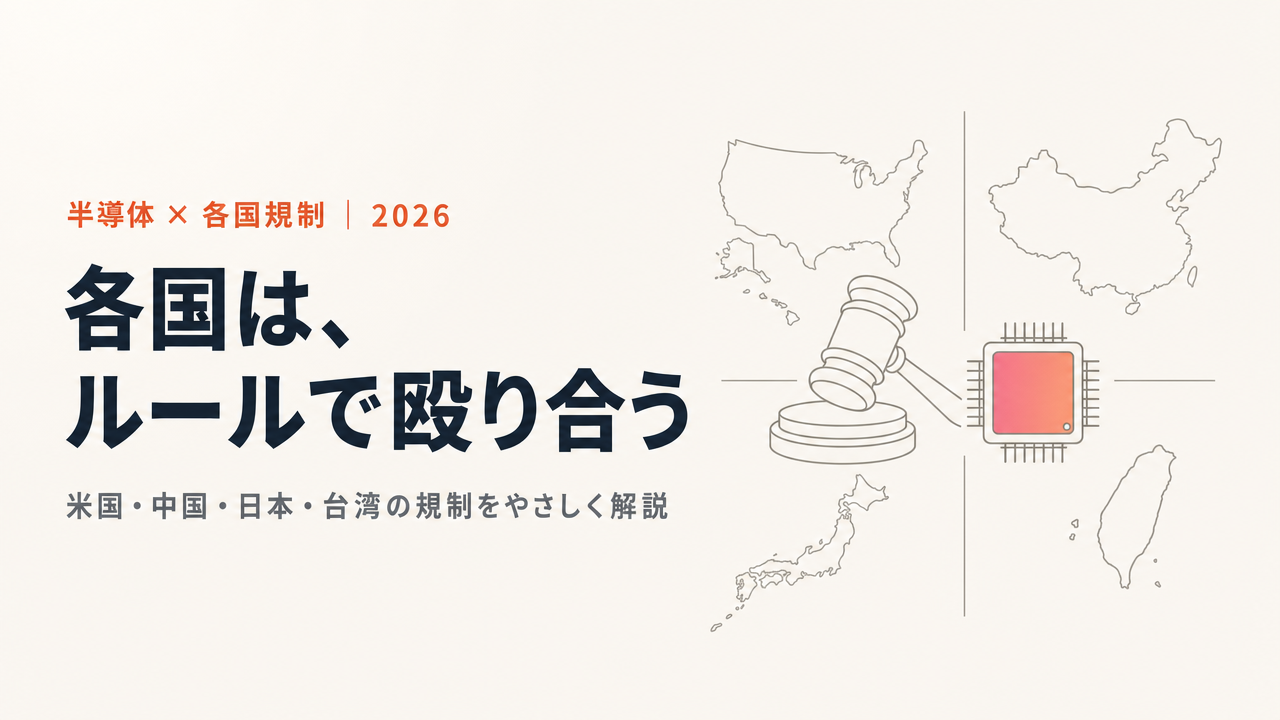
At the end of The Geopolitics of Semiconductors, I made the point that what ultimately drives concentration risk, soaring stocks, and leak incidents comes down to one thing: the law. This time, we look at the laws themselves. What rules are the US, China, Japan, and Taiwan throwing at one another over semiconductors, and what is each of them trying to protect?
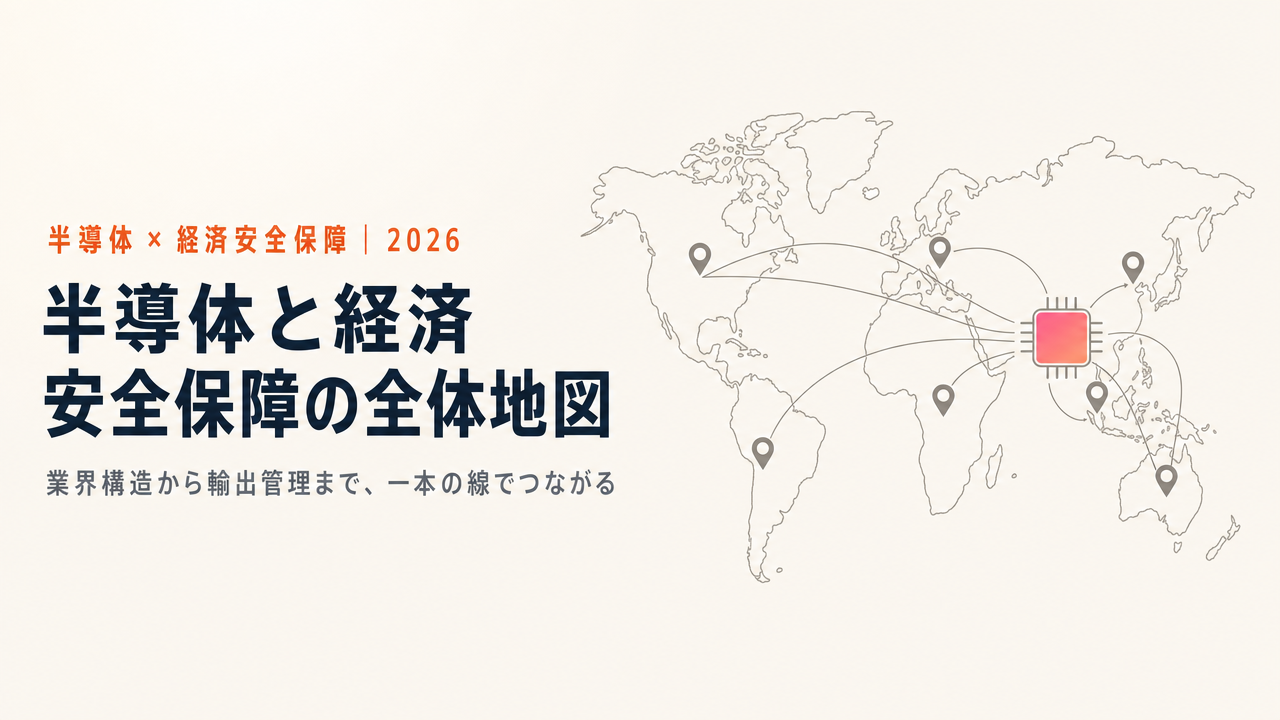
First, one map of the whole picture. Boiled down, there are only three things a country can do for the sake of economic security: keep it away from the enemy (export controls), make sure you can build it yourself (industrial policy), and stop it from being stolen (leak prevention). The US and China are mainly trading blows over "keeping it away," Japan emphasizes "being able to build it," and Taiwan emphasizes "stopping it from being stolen." Keep these axes in mind and even complicated news sorts itself out neatly. As for "export controls," think of it as a national version of baggage screening. The state checks "may this item be taken out of the country?" and "may it be handed to this party?" and stops anything dangerous. The problem is that this checklist is being rewritten furiously, according to each country's calculations.
The United States: Opening and Closing Regulation Like a Faucet
The country that has led the world in export controls is the United States. Within the Department of Commerce, an agency called BIS (the Bureau of Industry and Security) administers the rules under the Export Administration Regulations (EAR). The mechanism has three pillars: the "ECCN," which assigns a number to a controlled item; the "Entity List," a blacklist of prohibited recipients (being added means a presumption of denial); and the "FDPR," an extraterritorial rule under which US regulation reaches a foreign-made product if even a little American technology or equipment was used. Because the most advanced semiconductors cannot be made without US software and equipment, this FDPR bites.
From 2022 through 2024, the US tightened its controls on China steadily. Advanced semiconductors, manufacturing equipment, and even HBM, the memory used for AI-one after another, exports to China were banned. But under the Trump administration from 2025 onward, the picture changed completely. Regulation became not a wall that stays shut, but a "faucet" that can be opened and closed.
The most telling example is the saga over NVIDIA's high-performance chips. Following the timeline: in April 2025 exports to China were effectively banned; in July the policy reversed and resumed; in August came an unusual arrangement to "pay the US government 15% of China revenue"; and in December the more powerful H200 was approved for export on the condition that "25% of revenue be paid as an export tax." As for the global AI-chip allocation rule created under the Biden administration (the AI Diffusion Rule), it was rescinded just two days before it was to take effect. Loosening and tightening regulation has itself become a tool of negotiation. Even the CHIPS Act's semiconductor subsidies were restructured under the Trump administration so that the government invested about $8.9 billion in Intel and took an equity stake of roughly 9.9%. American regulation is now, at once, a genuine security measure and an instrument for dealmaking.
Replace siloed classification work with AI.
METI's FY2024 data shows 52% of foreign exchange law violations stem from classification errors. Download the TRAFEED product catalog covering features and rollout.
China: Rare Earths as a Means of "Starving Out the Fortress"
Having been on the receiving end of the blows, China strikes back too. Its greatest weapon is mineral resources, rare earths chief among them. Picture surrounding a fortress and cutting off its food supply-a siege to starve the defenders out. If the US cuts off the "weapon" that is chips, China cuts off the "provisions" that are raw materials.
China controls the vast majority of the world's rare-earth refining, and it has weaponized this step by step. The semiconductor materials gallium and germanium (August 2023); graphite, used in EV batteries; and antimony, which also has military uses (2024, with shipments falling roughly 97% after the controls). In 2025 it placed seven medium and heavy rare-earth elements under a licensing system, and that October it rolled out a rule that froze the world in its tracks. Under this extraterritorial measure, "any product containing even 0.1% of Chinese rare earths by value requires Chinese approval, even for a transaction between two foreign companies." It is China's version of the US FDPR-and at an extraordinarily low threshold. In other words, China began using its own resources as a "faucet" able to affect transactions all over the world. (This October measure was suspended for one year under a temporary US-China truce, but the April controls on the seven elements remain in force.)
And what feels especially raw for Japan are the events of early 2026. As retaliation for Prime Minister Takaichi's remarks concerning Taiwan, China first, in January, restricted exports of dual-use items (goods with both civilian and military applications) bound for Japanese military-related use. Then, on February 24, it named roughly 20 Japanese firms and bodies-including Mitsubishi Heavy Industries, Kawasaki Heavy Industries, and JAXA-on its export-control list, and placed around 20 more, such as SUBARU and TDK, on a watch list. No event has shown so vividly that the maneuvering of economic security is not some faraway country's affair but can target Japanese companies directly.
Japan: Both Wheels of "Defense" and "Cultivation"
So how is Japan moving? Its distinguishing feature is that it runs both wheels at once: defense (leak prevention) and cultivation (domestic production). The legal foundation rests on two pillars: the Foreign Exchange Act and the Economic Security Promotion Act.
On the defense side, since July 23, 2023, the export of 23 categories of advanced semiconductor manufacturing equipment has required a license from the Ministry of Economy, Trade and Industry (METI). These are the families of tools-lithography, etching, deposition, cleaning, inspection-indispensable to leading-edge manufacturing. This moved in step with US controls on China, with Japan, the US, and the Netherlands in effect coordinating to constrain China's advanced semiconductor manufacturing on the equipment front. What is characteristically Japanese, though, is that the framework names no specific country and instead applies "to the whole world," while allowing 42 friendly countries and regions to use simplified procedures. It is a design that avoids causing offense.
On the cultivation side, the Economic Security Promotion Act, enacted in 2022, designated semiconductors as a "critical material." This is an official seal of approval marking them as "goods whose supply chain the nation should protect," and it has translated into generous subsidies for domestic production. TSMC's Kumamoto plant and Hokkaido's Rapidus (with cumulative government support of about 2.9 trillion yen) sit atop this framework. The penalties for violations are by no means light: for a serious unlicensed export related to weapons of mass destruction, an individual faces up to 10 years' imprisonment and a fine of up to 30 million yen, while a corporation faces a fine of up to 1 billion yen. Japan's position is a hard one. It joins US-aligned controls on China, and as a result it draws direct retaliation from China. Advancing defense and cultivation at the same time while balancing between the US and China-that is the reality.
Taiwan: The Laws of the "Vault Keeper" Protecting Talent and Know-How
Last comes Taiwan. Taiwan's concern differs slightly from that of the US and China: it puts the most effort into preventing its leading-edge manufacturing technology and talent from flowing to China-that is, into "stopping it from being stolen." It would be a disaster if the keeper of the household vault were poached away by a rival with a fat paycheck. So the idea is to protect the vault keeper by law.
The symbol of this is the 2022 amendment to the National Security Act. Infringing the trade secrets of a technology designated as a "national core key technology" for the benefit of China and the like was made a serious crime as the "economic espionage offense," carrying 5 to 12 years' imprisonment and a fine of up to NT$100 million. Behind it lies a sense of crisis over "talent poaching"-Chinese companies luring away Taiwanese engineers with high pay and carrying off the technology along with them. There is also a list compiling which technologies are "core," which began with 22 items and has expanded year by year to 32 and then 42. In semiconductors, this includes advanced manufacturing technology below 14nm.
This law is no ornament. In April 2026, a former engineer was given a 10-year prison sentence for leaking TSMC's 2nm technology-the first prison term handed down under the statute. On top of that, the Taiwanese government keeps its most advanced nodes locked down on the island through the "N-2 rule" mentioned last time. It protects technology and talent by law and keeps the leading edge at home. For Taiwan, semiconductors are not only an industry but the very shield that defends the nation.
A Useful Aside: Controls Come in Two Kinds, "List" and "Catch-all"
Here is one aside that is more useful than anything else for understanding export controls. Japan's regime is broadly divided into two kinds: "list controls" and "catch-all controls." Knowing this makes the news look one notch clearer.
List controls are a predefined "list of dangerous goods." They specify items that are off-limits by performance (specs), and once the threshold is exceeded a license is required no matter which country the recipient is in. It is the same as how airport baggage screening sets a rule that "blades longer than X centimeters are prohibited"-the line is drawn mechanically by the item's specifications. Catch-all controls, on the other hand, are a complementary rule that stops even an item not on the list if it involves a "dangerous use or a dangerous party." Picture an officer pulling aside a suspicious-looking passenger; the focus is on the use and the recipient (who is going to use it for what). Even an ordinary general-purpose product requires a license if it turns out to be likely headed for the development of weapons of mass destruction.
In other words, "we're not a high-tech company, so this doesn't apply to us" does not hold. List controls look at the "goods," and catch-all controls look at the "use and the recipient." This two-tiered structure is the basic architecture of export controls.
Seen this way, you can tell that four countries and regions are fighting a rule-by-rule brawl, each with a different weapon. The US has its faucet, China its siege, Japan its defense and cultivation, Taiwan its vault keeper. And this trend of "weaponizing rules" has at last spilled beyond semiconductors themselves to reach AI models. A world that had been regulating chips has finally begun regulating the contents of AI. We take up that frontline in The Era When AI Models Become Subject to Export Controls.
Reference: The regulatory developments in each country are based on primary sources and reporting (2025-2026), including announcements from the US BIS, White House fact sheets, client alerts from law firms such as Hogan Lovells and Covington, Japan's Ministry of Economy, Trade and Industry, The Japan Times, Focus Taiwan, and Digitimes.
If you are reviewing export-control operations or classification workflows, download the TRAFEED product catalog (PDF) or contact us.