Hello, I'm Ryuta Hamamoto from TIMEWELL.
In the previous article, we saw how the critical chokepoints of the semiconductor industry are concentrated among a startlingly small set of players — TSMC, ASML, and the three memory makers. This time, let's look at how that "concentration" bares its teeth at the level of nation-states. Why does a story about one company's manufacturing capacity get tangled up with an ominous word like "contingency"? Why are semiconductor stocks exploding? And what does the 2026 case — in which chips are alleged to have flowed from Taiwan through Japan to China — actually mean?
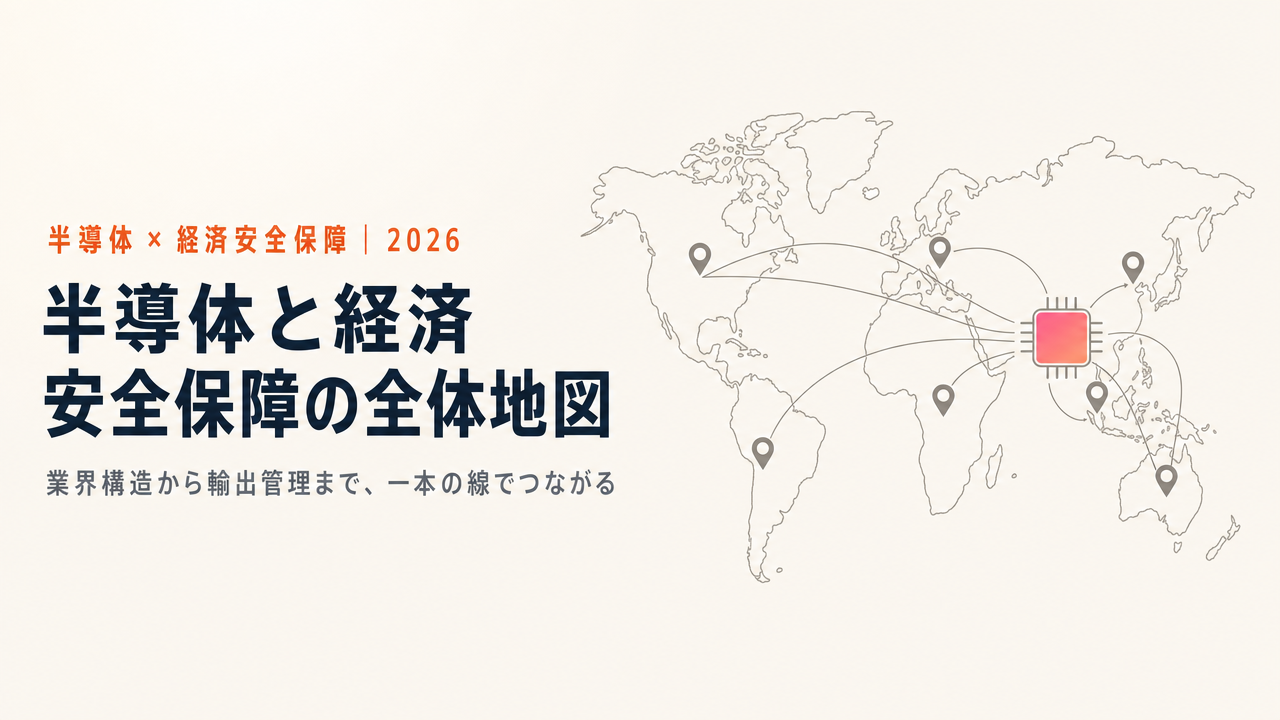
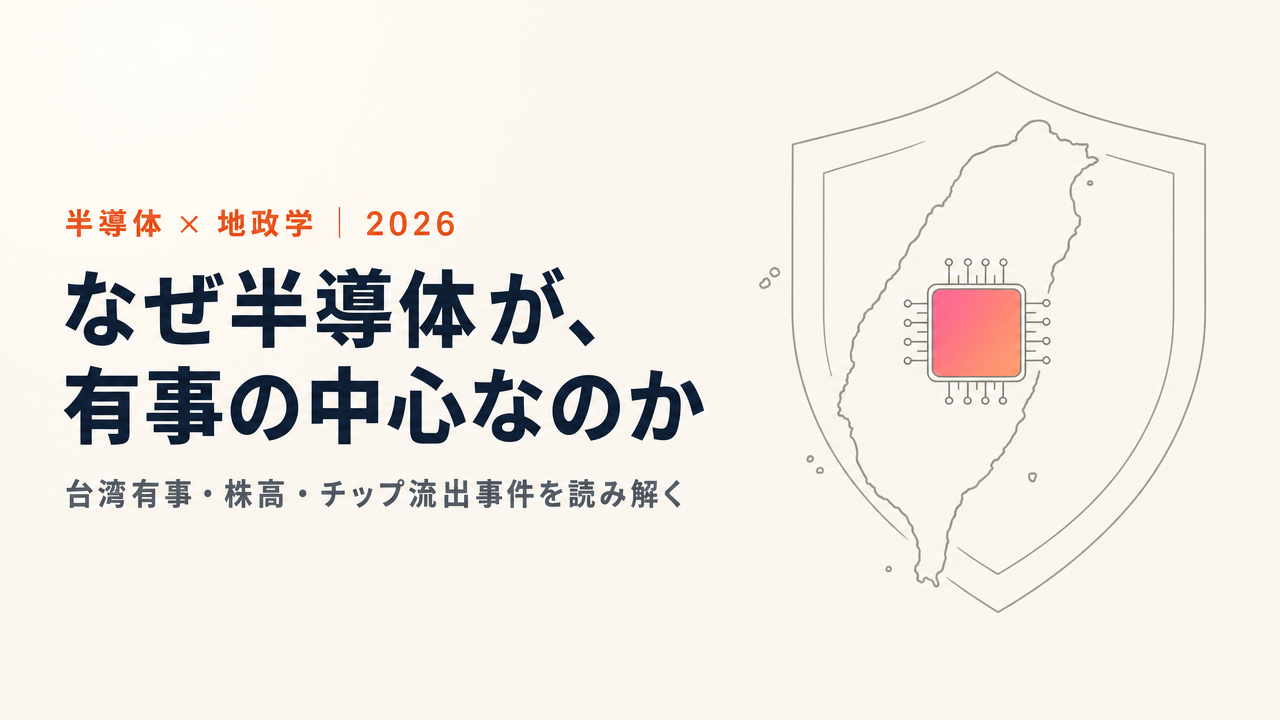
The world has put its entire savings in one bank called Taiwan
Let's start with how abnormal the concentration is. About 92% of the world's most advanced logic chips — the high-performance chips that become the brains of AI systems and smartphones — are made on a single island, Taiwan.
To grasp how precarious this is, picture it in terms of money. Imagine your entire savings sitting in just one bank. As long as that bank is convenient, there's no problem. But if it catches fire or gets robbed, your assets vanish in an instant. Right now the world economy has placed its entire savings — semiconductors — in one bank called Taiwan.
And that bank happens to sit in the most geopolitically tense place on earth. China regards Taiwan as part of its own territory and has not ruled out unification by force. If Taiwan's chip supply stops, no one anywhere can build AI systems, smartphones, cars, or weapons. Bloomberg Economics estimates that a full-scale conflict over Taiwan would cost the world economy roughly $10 trillion, about 10% of global GDP (a more refined February 2026 figure put it at $10.6 trillion, or 9.6% of world GDP). That isn't the direct damage of war — it's the scale of economic paralysis caused simply by chips going dark.
This is exactly why the idea of the "silicon shield" emerged. Because the world depends on Taiwan-made chips, attacking Taiwan means dragging the attacker's own economy down with it. In a town with only one well, smashing that well leaves you thirsty too. This mutual dependence — "break it and you hurt yourself" — is what shields Taiwan. You could say Taiwan's semiconductors are the most powerful defensive equipment that carries no weapons at all.
Replace siloed classification work with AI.
METI's FY2024 data shows 52% of foreign exchange law violations stem from classification errors. Download the TRAFEED product catalog covering features and rollout.
A crack in the shield — the chip leak that ran through Japan
But the shield is not invincible. In 2026, a case erupted that symbolized its fraying edges.
In May 2026, Taiwan's Coast Guard Administration simultaneously searched 12 locations across Taipei, New Taipei, Taoyuan, and Taichung, and Keelung prosecutors detained three people. The suspicion: that they tried to route roughly 50 AI servers made by a major manufacturer, loaded with NVIDIA chips — worth more than $15 million in total — to China using falsified paperwork. The method went like this: the export documents listed the destination as "a country in Northeast Asia," the goods left Taiwan, passed through that country to Hong Kong, and were ultimately meant to reach mainland China. According to reports, that "country" was Japan, and at least one shipment had already passed through Japan and reached Hong Kong.
The one thing I absolutely do not want misunderstood here is that Japan was not the perpetrator of the smuggling. Japan was merely misused as a declared transit point, and Taiwanese authorities are still scrutinizing the customs records. Why was Japan chosen? The experts' read is sharp: "Japan is a close U.S. ally with high trust, so it draws little suspicion as a shipping route." In other words, Japan's very "trust" was turned against it as cover for a back door — the irony being that the more trusted you are, the easier your trust is to exploit. This remains a suspected case under investigation, and even the specific chip models among the seized goods have not been confirmed. Even so, it laid bare the reality that the cutting-edge chips the world is desperately trying to fence off can still slip through the regulatory net and flow away.
One thing that often gets confused: in the United States, an executive at a major server company and others were indicted over a reported $2.5 billion in transshipment exports in a case dubbed "Operation Gatekeeper." That U.S. case is a separate matter from this Taiwan case. An indictment is one stage of an investigation and trial, not a finding of guilt. The tighter the rules get, the more sophisticated the loopholes become — a cat-and-mouse game now playing out on a global scale.
The "rehearsal" already began in 2022
A Taiwan contingency is not a bolt from the blue. The "dress rehearsals" have already taken place.
In August 2022, when then-U.S. House Speaker Pelosi visited Taiwan, China conducted large-scale military exercises in six maritime and airspace zones encircling the island. Setting up zones that completely surrounded Taiwan was a historic first, and it was widely read as a de facto "blockade rehearsal." Five of the ballistic missiles China launched at that time fell inside Japan's EEZ (exclusive economic zone). More symbolic still was the number of Chinese aircraft crossing the "median line" of the Taiwan Strait. Before Pelosi's visit, it had been just 23 times a year; for all of 2022 it jumped roughly 24-fold, to 564 aircraft. The tacit rule of the median line effectively vanished that year.
There was a technological turning point too. In August 2023, while the U.S. Commerce Secretary was in the middle of a visit to China, Huawei released its new "Mate 60 Pro" smartphone without any advance notice. Pry it open, and inside sat a 7nm chip that China's SMIC had made without EUV equipment — using DUV instead. It was a political message that "even under U.S. sanctions, we can produce advanced domestic chips," and it sent a shock through Washington. The U.S.-China struggle over semiconductors has been quietly intensifying for years now.
If a blockade comes — the nightmare a wargame paints
Even when you say "contingency," it may be hard to picture concretely what happens. The U.S. think tank CSIS ran tabletop exercises (wargames) of a scenario in which China imposes a naval blockade of Taiwan dozens of times. The conclusion is visceral. Taiwan holds scant reserves of natural gas; under a strict blockade, in many cases its gas runs out in about 10 days, and its economy could collapse within weeks. It isn't only armed invasion — simply ringing the ports could halt the world's semiconductor factories.
So would this risk disappear if China pushed ahead with domestic production? Here lies a trick of the numbers. China's "semiconductor self-sufficiency rate" changes dramatically depending on how you measure it. The share of chips made within China was about 16.7% in 2021, but roughly 60% of that was made by foreign-owned plants. Chips made purely by Chinese firms came to just 6.6%. The Chinese government had set a target of "70% by 2025," but fell far short, and has now pushed the goalpost out to "80% by 2030." While China is gaining a presence in mature, general-purpose chips, it still cannot grasp the "throat" — EUV, leading-edge nodes, and HBM. That is precisely why China tries to obtain advanced chips even by slipping past regulations. The leak case at the top of this article is, in part, an expression of that desperation.
Why semiconductor stocks are rising this far
Geopolitical tension and stock-market euphoria — these two seemingly opposite things are two sides of the same coin. Precisely because semiconductors have become a strategic resource that everyone is fighting over, capital is rushing into the companies that control them. The structure is the same as in the era when oil was a strategic resource and the oil majors held power.
Look at the numbers and the euphoria is plain. On October 29, 2025, NVIDIA became the first company in the world to top a $5 trillion market cap. In Japan, the Nikkei average hit a record closing high of 66,329 yen on May 29, 2026. The driver is the semiconductor sector. Advantest, which holds about 70% of the global share in AI-chip testing equipment, overtook Tokyo Electron by market cap in September 2025 for the first time in about 20 years. SoftBank Group, which owns ARM, also surged, and in June 2026 it briefly passed Toyota to become Japan's largest company.
That said, let me pause for a word here. Euphoria this intense naturally draws warnings of a bubble. The Bank of England and the IMF have cautioned that "if an AI bubble bursts, a sharp market correction could follow," and investor Michael Burry — known from "The Big Short" — has pointed to the possibility that hyperscalers are inflating profits by under-reporting depreciation on AI equipment. The rise in semiconductor stocks is the flip side of chips becoming a strategic resource, but it also carries the risk that expectations have run too far ahead. I think it's dangerous to judge by looking at only one side.
An all-out effort to dilute "Taiwan dependence" — and a Taiwan unwilling to let go
If putting all your savings in one bank scares you, you spread it across several. What's happening around the world right now is exactly this all-out effort at "diversification."
The lead actor is still TSMC, which is building six fab clusters in Arizona under one of the largest investments ever, totaling $165 billion. It is also building a plant in Kumamoto, Japan, and expanding into Germany. Each country is desperate to hold its own manufacturing capacity, too: Japan has poured a cumulative roughly 2.9 trillion yen in government support into Rapidus, and the U.S. government has taken an equity stake in Intel, the former king. This is the "de-risking" current — "let's be able to make the important things close to home."
But there's a tug-of-war here. Taiwan itself does not want to let go of leading-edge manufacturing. That, after all, is the very essence of the silicon shield. The Taiwanese government originally followed an "N-1 rule," releasing overseas only technology one generation behind what it runs at home, but by the end of 2025 it tightened this into an "N-2 rule," restricting exports to two generations behind. The cutting-edge 2nm will, for the time being, be made only inside the island of Taiwan. When the U.S. proposed "let's split leading-edge production 50-50 between the U.S. and Taiwan," Taiwan flatly rejected it. The world wants to diversify; Taiwan wants to keep its grip on the core. This very bargaining tells the story of how semiconductors have become not a mere product but a strategic national asset.
What is ultimately driving the concentration risk, the soaring stocks, and the smuggling case we've examined here? It's the "rules" that each country deploys — in other words, laws. Who is allowed to make what, and who is allowed to sell to whom? Those rules are starting to be used as weapons. Next, in the high-tech regulations of each country, we'll take a concrete look at what kinds of rules the United States, China, Japan, and Taiwan are rolling out.
Sources: The Taiwan leak case draws on Bloomberg, Japan Times, Focus Taiwan, and Asia Times (May 2026); Pelosi's Taiwan visit and the military exercises on CSIS ChinaPower and Japan's Ministry of Defense; the stock figures on CNBC, the Nikkei, and Bloomberg; the damage estimate on Bloomberg Economics; and the domestic-production trends on company IR materials and other reporting (all from 2022 through 2026). The leak case remains a suspected matter under investigation.
If you are reviewing export-control operations or classification workflows, download the TRAFEED product catalog (PDF) or contact us.