Hello, this is Hamamoto from TIMEWELL.
Over the past year, I have heard the same two complaints across every industry: GPUs are expensive, and memory is hard to get. A company sets out to build an AI-powered service of its own, gets a quote, is startled by the cost of components, and scales the plan back. I have sat in the room for that scene more than a few times. On the surface this is a question of money, but dig one layer down and you reach a question of availability: can you actually buy the semiconductors you need, in the quantity you need, when you need them? And the availability of semiconductors has now grown beyond the headache of a single company's procurement team into a matter of national economic security.
Let me be clear about the nature of this article up front. What follows is the author's personal analysis and opinion, based on information that is public as of June 29, 2026, drawn mainly from companies' earnings announcements, research-firm reports, and government regulations. It does not guarantee or predict future prices, and it does not recommend any investment or procurement decision. The forward scenarios in the second half are no more than my own reading, and there is no guarantee anywhere that they will play out that way. Neither the author nor TIMEWELL Inc. accepts any liability for whether the predictions prove right or wrong, or for the outcome of any decision made by reference to them. With that said, I will lay out the facts we currently know as accurately as I can, and we will think together about what they tell us. My stance is simple: price and availability cannot be separated, and treating both as an economic-security problem makes it easier for a company to see what to do.
What you will learn from this article
- How much GPU and AI-related product prices have actually risen (real figures, separated by subject)
- How to read the memory supply crunch, the epicenter of the increases, from the chipmakers' earnings
- Why prices are climbing this far, organized around four forces: AI demand, supply constraints, geographic concentration, and export controls
- The author's three scenarios on a six-month, one-year, and two-year horizon
- How Japanese companies and readers should set up their procurement and export-control posture right now
What is happening now, and which products rose by how much
First, let me check the common phrase "GPUs doubled in a year" against the actual numbers. To put the conclusion first, that phrasing becomes inaccurate when you get the subject wrong. The steepest increases are in memory; the rise in the GPU chip itself is not nearly as large. Let me go through it in order.
The easiest place to verify is in finished products, such as NVIDIA's professional GPUs. According to reports, the price of the RTX Pro 6000 Blackwell rose roughly 55 percent against its suggested retail price in a year, reaching 13,250 dollars1. That is about 1.5 times, not double. For the large systems aimed at AI data centers, however, the picture changes. Analysts estimate that a server rack of the next-generation Vera Rubin generation carries a total component cost of roughly 7.8 to 9.1 million dollars, and within that, the memory cost is reported to have ballooned about 485 percent, or roughly fivefold, from the previous generation23. The GPU chip alone is estimated at around 55,000 dollars apiece, an increase of just under 60 percent versus the prior generation3. To organize it: memory on its own is up roughly twofold from early 20254, the memory cost of an AI server is up about fivefold across generations, a standalone GPU chip is up about 1.5 times, and a whole system is up around 50 percent. In other words, what you point to when you say "prices rose" changes the number entirely. Conflate these and you easily produce misinformation, so I make a point of keeping them separate. I should also add that these rack costs and per-chip prices are research-firm estimates, not a price list published by NVIDIA.
The impact of the semiconductor surge is showing up close to consumers as well. Component cost increases have been reported as one factor behind price hikes on smartphones and PCs, and I have written separately about Apple's pricing trend in Apple's Price Hikes and the Semiconductor Surge. The point to hold on to here is that the lead actor in the increases is not the GPU logic chip but the memory that surrounds it. In the next section, let me look into the earnings of the memory makers at the epicenter.
Replace siloed classification work with AI.
METI's FY2024 data shows 52% of foreign exchange law violations stem from classification errors. Download the TRAFEED product catalog covering features and rollout.
The epicenter is memory: chipmakers' earnings reveal the supply crunch
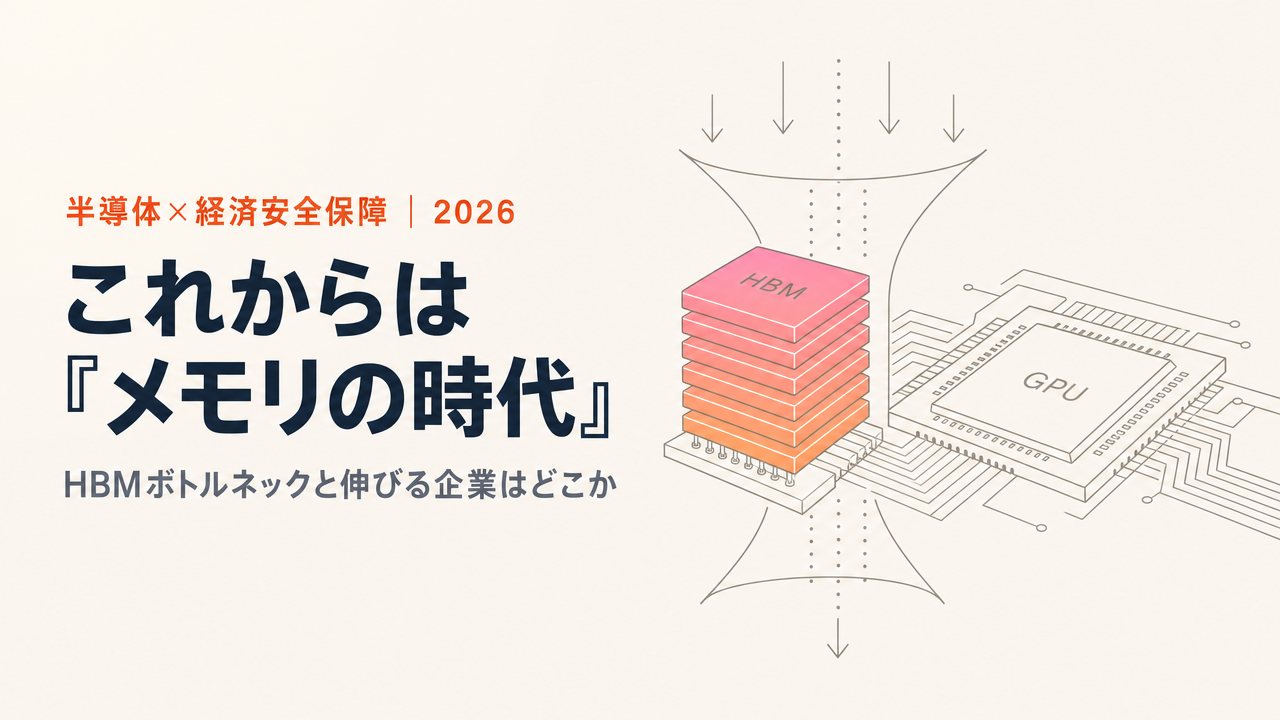
Memory is the component that holds the data being computed. The representative types are DRAM (fast, but erased when the power is cut, used as temporary storage), NAND (storage that survives a power cut), and HBM (high-bandwidth memory), the ultra-fast type wired directly into AI chips. The crunch in these three, and HBM and server DRAM in particular, sits at the center of today's price surge. You can see it clearly by reading the chipmakers' earnings.
Micron's fiscal 2026 third-quarter results (ended late May 2026, announced June 24) set a record with revenue of 41.46 billion dollars, about 16 percent above market expectations. Adjusted earnings per share of 25.11 dollars also far exceeded forecasts, and the stock rose about 14.6 percent on the day of the announcement5. On the earnings call, management said demand significantly exceeds supply, explaining that HBM3E and HBM4 for AI are sold out through calendar 2027, with demand extending into 2028. Capital expenditure has been raised to roughly 27 billion dollars5. South Korea's SK hynix likewise announced that first-quarter 2026 revenue reached 52.576 trillion won (about 35.5 billion dollars), surpassing 50 trillion won in a single quarter for the first time, with operating profit of 37.61 trillion won and an operating margin of 72 percent. It explicitly attributed this to higher sales of high-value products such as HBM and high-capacity server DRAM6. Samsung Electronics, too, saw its semiconductor division's first-quarter operating profit swell about 49-fold year on year, earning more than 90 percent of company-wide profit. It also disclosed that it began mass production of HBM4 in February 20267.
The fact that all three companies have officially acknowledged that demand exceeds supply, and are posting record margins while doing so, speaks eloquently to how tight upstream supply is. Price data backs this up. According to tallies by research firms and others, DRAM contract prices have roughly doubled from early 2025, and rose 80 to 90 percent quarter on quarter in the first quarter of 2026 alone4. As makers shifted capacity toward higher-margin server products and HBM, even general-purpose DRAM ran short, and the whole product range rose in a chain reaction. When I talk with executives on the ground, the refrain that they cannot read component supply, or cannot put together a quote for the next fiscal year, has clearly grown louder over this past year. Rising prices are also proof of how many people around the world want these parts.
Why prices are climbing this far: four forces and economic security
Let me organize the reasons prices are rising this much into four forces, in terms a newcomer can follow. The first is demand. With the spread of generative AI, data centers have come to want orders of magnitude more memory and compute chips. By Micron's reckoning, the HBM market will expand from roughly 35 billion dollars in 2025 to about 100 billion dollars in 2028, a size comparable to the entire DRAM market of a few years ago4. Demand is reshaping the very form of the market. The second is supply constraints. Semiconductors are not a product you can ramp up the moment an order comes in. It takes years for a new fab to begin supplying a meaningful volume, and the industry view is that no real relief will arrive until 2027 to 20288. On top of that, advanced packaging that combines multiple chips into one (a technology called CoWoS) has become the bottleneck in production, and Taiwan's TSMC capacity for it is reported to be already fully booked for 20269. Demand can surge suddenly; supply cannot. That time lag pushes prices up.
The third is geographic concentration. The chokepoints of advanced logic, HBM, and advanced packaging are skewed toward Taiwan and South Korea, so if a contingency or a disaster strikes, the supply network could jam at a single point. This is the so-called single point of failure risk, and before price even enters the picture, it raises the worry of whether you can obtain the parts at all. The fourth is export controls. In a final rule dated January 15, 2026, the US Department of Commerce's Bureau of Industry and Security changed the licensing policy for advanced computing semiconductors bound for China and Macau, moving from a default of denial to case-by-case review. The scope covers chips roughly equivalent to NVIDIA's H200 and AMD's MI325X, drawn by thresholds of total processing performance and bandwidth10. Further, on June 1, 2026, the US indicated its view that the ban on AI chip shipments extends to Chinese firms located outside China11, and on June 10 it was reported that Taiwan, in step with the US, is weighing tighter controls on AI chip exports to China12. Because each move in the rules makes "whether you can buy them" depend on a political judgment, price, availability, and regulatory compliance become risks all at once.
When these four overlap, semiconductor procurement is no longer simple purchasing; it becomes the practice of economic security. I cover the background of why AI has grown into such a heavy, capital-intensive industry in detail in The Heavy Industrialization of AI. And I have laid out the broader structure of how semiconductors came to sit at the center of economic security in The Big-Picture Map of Semiconductors and Economic Security. To bring it back to practice: tracking regulatory updates, redoing classification determinations, and cross-checking counterparties against end users are tasks that, as transactions multiply, simply cannot be handled by hand. The reason we offer the export-control AI agent TRAFEED is precisely that we believe a foundation is needed to do this both fast and safely. For the avoidance of doubt, TRAFEED supports export control, classification determinations, and counterparty screening; it does not provide price forecasts or investment advice.
What comes next: three scenarios over six months, one year, and two years
From here, the discussion turns to the future. As I wrote at the outset, what follows is not a confirmed forecast but three scenarios I draw from the materials available now. Any of them could be wrong.
Let me lay out the materials first. The research firm TrendForce presented figures for its second-quarter 2026 outlook of general DRAM rising 58 to 63 percent quarter on quarter, and NAND 70 to 75 percent13. Analysts estimate that the unit price of HBM4 could rise from the current roughly 16.6 dollars per gigabyte to about 53 dollars around 2027, when the next generation enters mass production3. On the supply side, Micron has a long-term investment plan in the US on the order of 200 billion dollars, and also plans to build a new fab in Hiroshima to bring AI memory supply online in 2028. Samsung and SK hynix are advancing expansion investments too, but for the time being these center on infrastructure and packaging and are unlikely to translate into an immediate increase in wafers8. On the demand side, it was reported that in October 2025 Samsung and SK hynix reached an agreement to supply OpenAI with up to 900,000 DRAM wafers per month at full scale, a sign that large customers are increasingly locking in supply through long-term contracts8.
Here is my six-month read, given all this. I believe the base case is a continued crunch. New fabs are not yet effective and lock-in through long-term contracts continues, so prices are most likely to stay high or keep rising gradually. Next, the one-year read. This is the fork in the road. In a neutral scenario the pace of increases slows and some product categories turn flat. In a continued-crunch scenario, where AI data center construction continues beyond expectations, the price increases in HBM and server DRAM stretch out further. Finally, the two-year read. In an optimistic scenario, new fab clusters come online from late 2027 into 2028, supply catches up with demand, and prices ease gradually. That, however, assumes that capacity expansion proceeds as planned and that AI demand settles down from its current rapid growth. If either assumption fails, relief slips later. Personally, I take a view between optimism and continued crunch, leaning neutral, in which gradual relief begins around 2028. But as I keep saying, this is not a guarantee, only one reading. I think it is important to hold several scenarios at once and to be ready to move whichever one becomes reality.
Implications for Japanese companies and readers: how to set up procurement and export control
Finally, let me bring all of this down to what Japanese companies and readers can do. First, procurement has become a competition to secure quantity, not to negotiate unit price. For both memory and GPUs, without long-term contracts and multiple sourcing channels, you cannot lock in quantity, let alone price. As long as large customers keep locking in supply through long-term contracts, the later you act, the worse your position. Second, rethink inventory and the supply chain. When prices swing sharply within a quarter, the calls that pay off are whether to hold a thicker buffer of needed inventory, or to widen your choice of components at the design stage. Because memory's share of AI infrastructure cost has risen structurally, you may also need to estimate investment plans themselves more conservatively.
Third, export-control compliance. As the US begins applying its rules even outside its borders and Taiwan, as an ally, widens its own, Japanese companies cannot stay unconcerned with the rules on re-export and resale. Advanced semiconductors, GPUs, and memory are core materials for economic security, and the supply crunch and price surge are procurement risks that connect directly to export-control and geopolitical risk. For example, as reported from an estimate by the Information Technology and Innovation Foundation (ITIF), if the US and China fully decoupled (economically split apart) in semiconductors, Japanese companies would gain about 12 billion dollars in revenue from the loss of competitors, while the industry as a whole would lose more than 80,000 jobs14. Japan has positioned semiconductors as a national project, committing support equal to 0.71 percent of GDP from 2022 to 2025, and in Hokkaido, Rapidus plans to bring 2-nanometer mass production online in 2026 to 202715. On the materials side, too, as China tightens its rare-earth export restrictions on Japan, Japan is reported to have cut its dependence on China from roughly 90 percent in 2010 to around 60 percent recently, with a further reduction to around 50 percent discussed as a goal16. These national moves mean companies have more support programs and procurement options available to them.
What pays off here is the shift from person-dependent checking to checking by system. Tracking regulatory updates, redoing classification determinations, cross-checking counterparties against end users, and layering multiple jurisdictions of the US, China, Japan, and Taiwan to inspect each transaction: keeping this chain of work running on the experience and grit of a single staff member alone becomes untenable as transactions multiply. The more the price surge inflates the value of each semiconductor transaction, the larger the loss that a single overlooked item invites. If you want to work out concretely how to make your own procurement and export control both fast and safe, please tell me about your current situation through a one-on-one consultation. I will help you sort it out in line with the practice of export control.
Let me confirm once more at the end. This article's reading of the current situation is based on public information as of June 29, 2026, and the forward scenarios are the author's personal view. It does not guarantee or predict prices, and it is not advice on investment or procurement. Neither the author nor TIMEWELL Inc. accepts any liability for whether the predictions prove right or wrong, or for the outcome of any decision made by reference to them. In making any decision, always combine the latest primary sources with confirmation from a professional familiar with your own circumstances.
If you are reviewing export-control operations or classification workflows, download the TRAFEED product catalog (PDF) or contact us.
References
Footnotes
-
Nvidia raises RTX Pro 6000 Blackwell GPU pricing to $13,250, a 55% increase over MSRP in a year — Tom's Hardware — 2026 — https://www.tomshardware.com/pc-components/gpus/nvidia-raises-rtx-pro-6000-blackwell-gpu-pricing-to-usd13-250-55-percent-increase-over-msrp-in-a-years-time ↩
-
Nvidia's memory costs soar 485%; latest AI systems now cost $7.8M to build — Tom's Hardware — 2026-06 — https://www.tomshardware.com/tech-industry/artificial-intelligence/nvidias-memory-costs-soar-485-percent-latest-ai-systems-now-cost-usd7-8-million-to-build-memory-now-comprises-25-percent-of-the-total-cost-rubin-gpus-a-mere-usd50-000-apiece ↩
-
NVIDIA Vera Rubin Rack BOM about 9.1 million dollars; memory cost and HBM4 unit price from 16.6 to 53 dollars per GB (Bernstein estimate) — Bitget News — 2026-06-08 — https://www.bitget.com/news/detail/12560605449583 ↩ ↩2 ↩3
-
AI Boom Fuels DRAM Shortage and Price Surge — IEEE Spectrum — 2026-02-10 — https://spectrum.ieee.org/dram-shortage ↩ ↩2 ↩3
-
Earnings call transcript: Micron tops Q3 2026 estimates, shares jump 14.6% — Investing.com — 2026-06-24 — https://www.investing.com/news/transcripts/earnings-call-transcript-micron-tops-q3-2026-estimates-shares-jump-146-93CH-4759504 ↩ ↩2
-
SK hynix Fiscal 1Q26 Financial Results — StorageNewsletter — 2026-04-29 — https://www.storagenewsletter.com/2026/04/29/sk-hynix-fiscal-1q26-financial-results/ ↩
-
Samsung Q1 2026 Earnings: Record Chip Profits — InsiderFinance — 2026-04-30 — https://www.insiderfinance.io/news/samsung-q1-2026-earnings-record-chip-profits ↩
-
Samsung and SK Hynix to scale up memory production capacity in 2026 to meet AI demand (new fabs through 2027 to 2028, 900,000 wafers per month agreement for OpenAI) — DataCenterDynamics — 2026 — https://www.datacenterdynamics.com/en/news/samsung-and-sk-hynix-to-scale-up-memory-production-capacity-in-2026-to-meet-ai-demand/ ↩ ↩2 ↩3
-
Foundry Allocation Status Q1 2026 (TSMC CoWoS booked out for 2026, capacity expansion plan) — Silicon Analysts — 2026 — https://siliconanalysts.com/analysis/foundry-allocation-status-q1-2026 ↩
-
Revision to License Review Policy for Advanced Computing Commodities — US Department of Commerce, BIS (Federal Register 2026-00789) — 2026-01-15 — https://www.federalregister.gov/documents/2026/01/15/2026-00789/revision-to-license-review-policy-for-advanced-computing-commodities ↩
-
US says ban on AI chip shipments applies to Chinese firms outside China — Al Jazeera — 2026-06-01 — https://www.aljazeera.com/economy/2026/6/1/us-says-ban-on-ai-chip-shipments-applies-to-chinese-firms-outside-china ↩
-
Taiwan mulls curbs on AI chip exports to China to align with US — Taipei Times — 2026-06-10 — https://www.taipeitimes.com/News/biz/archives/2026/06/10/2003858815 ↩
-
AI Server Demand to Drive Memory Contract Price Increases in 2Q26 — TrendForce — 2026-03-31 — https://www.trendforce.com/presscenter/news/20260331-12995.html ↩
-
Understanding US Allies' Current Legal Authority to Implement AI and Semiconductor Export Controls (references ITIF's decoupling cost estimate) — CSIS — 2025 — https://www.csis.org/analysis/understanding-us-allies-current-legal-authority-implement-ai-and-semiconductor-export ↩
-
Japan Seeks to Revitalize Its Semiconductor Industry (national project, 0.71% of GDP, Rapidus 2026 to 2027) — CSIS — 2025 — https://www.csis.org/analysis/japan-seeks-revitalize-its-semiconductor-industry ↩
-
China-Japan Trade Tensions and Rare Earths Supply Chain Risks (rare-earth restrictions on Japan, dependence on China from 80 to 90 percent down to around 50 percent) — AInvest — 2026 — https://www.ainvest.com/news/china-japan-trade-tensions-rare-earths-supply-chain-risks-strategic-diversification-future-semiconductor-resilience-2601/ ↩