Hello, this is Hamamoto from TIMEWELL.
Over the past year or so, the conversation around semiconductors has shifted, quietly but unmistakably, from "we don't have enough GPUs" to "we don't have enough memory." For a long time NVIDIA's GPUs were the headline act of the AI boom, but lately more investors and analysts are saying that the next thing to bite will be memory. Gavin Baker, founder of Atreides Management and a well-known technology investor, is one of them. From 1999 to 2017 he was at Fidelity, where he ran the firm's OTC portfolio and posted a track record that placed him near the top of his peers1. As reported in media coverage and X posts, Baker is said to have stated that in 2027 somewhere between 30 and 40 percent of capital expenditure by the hyperscalers, meaning the operators of the giant data centers such as Amazon, Google, and Microsoft, will go toward memory2. He is also said to have remarked that only three companies, Micron, SK hynix, and Samsung, can mass-produce leading-edge HBM.
I should note up front that I have not been able to confirm this remark against a primary source from Baker himself; it comes through podcast summary sites and X posts, so it is secondhand. Even so, as we will see, it lines up broadly with estimates that independent analysts have published separately, so directionally I take it to be sound. Let me also be clear about what kind of article this is. This is the author's personal analysis based on public information as of June 2026. The discussion later on of "companies that stand to gain" is not a settled forecast, nor is it a recommendation of any investment or security. My stance is simple: the memory crunch is not merely a question of component prices. It is better understood as an economic security problem, in which the supply of a strategic resource is concentrated in a handful of companies and regions. Frame it that way, and the moves a company can make become easier to see.
What you will learn from this article
- What HBM is and why it is indispensable for AI GPUs, explained for beginners with the help of an analogy
- Where the bottleneck lies, mapping the supply side through the three-company oligopoly and the capacity constraints of advanced packaging
- How far demand can swell, looking at hyperscaler investment and the price spillover known as AIflation
- Where in a memory-centered ecosystem the tailwinds may blow, as the author sees it (not investment advice)
- What it means for economic security that memory has become a strategic resource
What HBM is and why AI GPUs cannot do without it
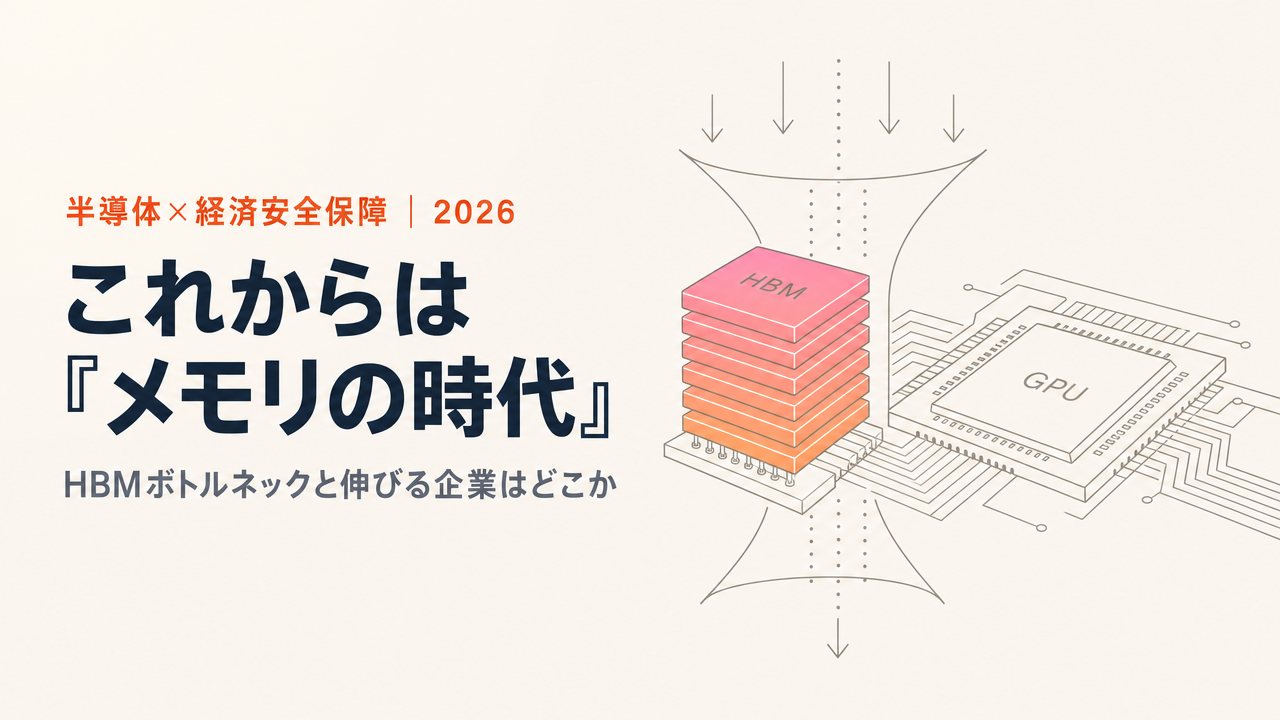
Let me start with HBM. HBM stands for High Bandwidth Memory. What sets it apart from ordinary memory is that it stacks many DRAM chips, the semiconductors that store data, vertically on top of one another, places that stack right next to the GPU, and connects them with a very wide data pathway. To wire the chips through vertically, it uses a technology called TSV, or through-silicon via, which means drilling tiny holes through the chip and running vertical wiring to connect the layers electrically above and below. The result is that a great deal of data can be exchanged at once, and over a very short distance.
Here is an analogy. Think of the GPU as a reader who devours books at a furious pace. No matter how fast the reader is, if the bookshelf is far away and the books can only be fetched one at a time, the reader will spend most of the time idle, waiting for the next book. Ordinary memory is, in effect, that distant warehouse. HBM, by contrast, stacks the bookshelf itself right beside the reader's desk in several tiers, with many conveyor belts running in parallel. Because the reader is no longer kept waiting, the GPU can finally deliver its full speed. Training and inference for generative AI involve orders of magnitude more of this book-passing, so without HBM a GPU is a treasure left unused. If you would like to get a firmer grounding in the parts that make up a semiconductor, I would suggest reading An Introduction to the Structure of the Semiconductor Industry first; the discussion ahead will come into sharper relief.
What is happening here is a shift in the center of gravity of value. Until now the contest was about who could build the fastest reader, that is, the highest-performance GPU. But the reader has become so fast that what now determines the overall speed is how quickly, how high, and how close to the desk you can stack the bookshelf. That is precisely why attention is gathering on the companies that can build the bookshelf. When Baker said the next thing is memory, boiled down, I understand it to come down to this single point.
Replace siloed classification work with AI.
METI's FY2024 data shows 52% of foreign exchange law violations stem from classification errors. Download the TRAFEED product catalog covering features and rollout.
Where the bottleneck lies: a three-company oligopoly and the wall of advanced packaging
So how many companies can build that bookshelf? This is the crux of the whole matter. In practice, only three companies can mass-produce leading-edge HBM: Micron, SK hynix, and Samsung Electronics. According to Counterpoint Research's tally, HBM revenue share in the first quarter of 2026 was 58 percent for SK hynix, 21 percent for Samsung, and 21 percent for Micron3. The same three-way structure carries over to the next-generation HBM4, and for the HBM4 destined for Rubin, NVIDIA's next-generation GPU, SK hynix is reported to have secured roughly two-thirds of the supply4. The beating heart of the world's AI servers is held by just three companies.
What is more, stacking DRAM is not enough to finish HBM. You still need the step of placing the stacked HBM side by side with the GPU on a single substrate and connecting them with wide wiring. The technology used here is CoWoS, an advanced packaging method in which Taiwan's TSMC excels. CoWoS stands for Chip on Wafer on Substrate, a so-called 2.5D integration technique that arranges multiple chips densely on a single base and unifies them. According to TrendForce, TSMC's CoWoS capacity is on track to expand from roughly 35,000 wafers per month at the end of 2024 to on the order of 130,000 wafers per month by the end of 2026, yet even so it is projected to fall short of demand, with tightness continuing through 20275. On top of that, the more layers you stack the HBM vertically, the more the bonding step, in which the layers are pressed together with heat, and the TSV yield become walls. In other words, several constraints bite at the same time: the capacity to make leading-edge DRAM, the capacity to stack it vertically, and the CoWoS capacity to place it beside the GPU. The narrowest point of the chokepoint moves back and forth between HBM and CoWoS depending on the period.
When supply is this concentrated in a small number of companies and a particular region, it is not only price and availability that matter. Geopolitical risk and export-control risk become tied directly to procurement. Each time a regulation is updated, you have to redo the classification of whether goods are controlled, and reconcile your counterparties against end users; the more transactions you have, the less this can be handled by hand. The reason we offer TRAFEED, an export-control AI agent, is that we believe you need a foundation that supports both speed and safety as a system. To be clear, TRAFEED supports export control and counterparty screening; it does not perform price forecasting or offer investment advice.
How far demand can swell: hyperscaler investment and AIflation
While supply is hard to grow, demand remains on fire. The 30-to-40-percent figure from Baker that I mentioned at the outset fits well with the estimates of independent third parties. SemiAnalysis, a semiconductor research firm, sees the share of memory in hyperscaler capital expenditure rising roughly fourfold over a few years, from around 8 percent in 2023 to 2024 to about 30 percent in 20266. The brokerage CLSA is more bullish, reportedly estimating that the share will climb from 35 percent in 2026 to 48 percent in 20277. The range varies depending on the assumptions, but the sense that memory accounts for 30 to 40 percent of capital expenditure is common across several specialist institutions.
This strength of demand shows up sharply in the manufacturers' earnings as well. Micron's fiscal third-quarter 2026 results showed, according to the company's official announcement, record revenue of 41.46 billion dollars8. Gross margin exceeded 80 percent on a GAAP basis and is said to have reached about 85 percent on a non-GAAP basis, an extraordinarily high level for a memory company. Management explained that its HBM for all of 2026 is sold out and that it is shipping HBM4 in volume to a major customer. SK hynix, too, posted record quarterly profit in the first quarter of 2026, with an operating margin reported to have reached about 72 percent9. The margin figures directly mirror a situation in which demand far outstrips supply.
The trouble is that this surge does not stay inside the data center. As manufacturers shifted capacity toward high-margin AI servers and HBM, even general-purpose memory grew scarce. TrendForce's outlook has general DRAM contract prices rising 58 to 63 percent quarter on quarter in the second quarter of 2026, and NAND rising 70 to 75 percent10. The burden has been passed on to the products we handle every day. On June 25, 2026, Apple raised prices on the MacBook and iPad by up to 300 dollars, citing the rising cost of memory and storage chips as the reason11. Microsoft, too, raised the price of the Xbox, saying the cost of its storage and memory had more than doubled. This phenomenon, in which AI demand triggers a semiconductor surge that then spreads all the way to consumer products, has begun to be called memflation, or AIflation12. AIflation is a coined term for a state in which the price increases caused by AI demand seep out across a broad swath of the economy. If you would like to look more closely at the backdrop to Apple's price increase, see Apple's Price Hike and the Surge in Semiconductor Costs, and for an outlook on how far GPU and memory prices may rise from here, see A Forecast for GPU and Memory Prices.
Where the tailwinds may blow: a memory-centered ecosystem (the author's view)
From here on the discussion turns to the future. Let me say again: what follows is not a settled forecast but one reading the author draws from the structure we have examined. It is neither a recommendation to buy any particular company's stock nor investment advice, and there is no guarantee it will play out this way. I have no intention of asserting which companies will grow; please read it as a hypothesis about which layers are more likely to enjoy a tailwind.
The axis is, of course, the three companies that build the bookshelf: Micron, SK hynix, and Samsung Electronics. With HBM sold out and margins at levels never seen before, I see the near-term tailwind blowing toward this oligopoly. That said, margins this high also carry the destiny of a cyclical industry, in which they can deflate all at once once supply and demand reverse, so optimism alone is not the whole story. Next, I am watching the step of placing the bookshelf beside the desk, namely the advanced packaging represented by TSMC's CoWoS. No matter how many GPUs you have, the product cannot be finished unless you can secure a slot here. One layer further down, the makers of the bonding equipment that joins the layers when stacking HBM vertically, companies such as BESI of the Netherlands and ASMPT of Taiwan, will, I think, have more to do as the number of stacked layers grows. The makers of the test equipment that handles inspection, and the specialist firms in the interconnects that widen the bandwidth between GPU and memory, also look set to gain presence in a memory-centered world.
What I want to flag is the scale of the uncertainty. How long can Micron's exceptional margins last? Will the yield on HBM4 improve as planned? Will hyperscaler investment decelerate somewhere along the way? Will custom HBM, designed in-house by customers, spread and change the balance of power in price negotiations? Every one of these depends on the outcome, and the reading can easily prove wrong. That is exactly why I want the company names listed here to be taken not as answers but as examples of hypotheses derived from the structure. I, for one, will not make any definitive claims.
Memory as a strategic resource: the implications for economic security
Finally, let me pull the view up a level. HBM and memory are no longer mere electronic components; they have become strategic resources. According to media reports, the share of the world's memory output consumed by data centers has risen from somewhere between 20 and 30 percent a few years ago to about 70 percent today11. The structure in which AI infrastructure absorbs memory has taken hold, and its supply is held almost entirely by three companies and a limited region of East Asia. Before you even get to price and availability, this means a single point of failure risk: if something happens at a particular company or in a particular region, AI development around the world could grind to a halt all at once. Samsung and SK hynix are reported to have warned that this memory shortage could continue beyond 202713. The view is that the tightness will not unwind in the short term.
When supply is this lopsided, procuring memory is no longer a job for the purchasing department alone. Leading-edge semiconductors, GPUs, and HBM are core resources for economic security, and the tightening of supply and the surge in prices are, at the same time as a procurement risk, contiguous with export-control and geopolitical risk. As U.S. export controls begin to reach companies outside its borders and allied countries fall into step, Japanese companies cannot remain unconcerned with the rules on re-export and resale. The larger the value of each transaction, the larger the loss that a single oversight can bring about. This is why you need to switch from person-dependent checking to systematic checking. If you would like to work through, in concrete terms, how to build a structure that reconciles speed and safety in your own procurement and export control, please tell us your current situation through an individual consultation. We will sort it out together, grounded in the practical realities of export control.
Let me confirm one more time. The situational understanding in this article is based on public information as of June 2026, and some points, such as Baker's remarks and certain Micron figures, rely on secondhand information or official announcements and have not been confirmed against primary sources. The statements about companies that stand to gain are the author's personal views; they do not guarantee or predict future share prices or performance, and they are not investment advice. Neither the author nor TIMEWELL, Inc. accepts any responsibility for the outcome of decisions made in reliance on them. In making any decision, always combine the latest primary information with confirmation from a specialist suited to your own circumstances.
If you are reviewing export-control operations or classification workflows, download the TRAFEED product catalog (PDF) or contact us.
References
Footnotes
-
Gavin Baker — Atreides Management (team profile and biography) — Atreides Management, LP — accessed 2026-06-29 — https://atreidesmgmt.com/team/gavin-baker/ ↩
-
The AI Cost Crisis: AI Is Becoming Memory (secondhand summary of Baker's 30-40% and three-companies-only remarks, via X @PodcastAlphaX 2026-06-27, not confirmed against a primary source) — suijeneris Substack — 2026-06-28 — https://suijeneris.substack.com/p/the-ai-cost-crisis-ai-becoming-memory ↩
-
Global DRAM and HBM Market Share (HBM revenue share SKH 58 / Sam 21 / Mic 21, HBM4 forecast 54 / 28 / 18) — Counterpoint Research — 2026-06-25 — https://counterpointresearch.com/en/insights/global-dram-and-hbm-market-share ↩
-
SK hynix reportedly to supply about two-thirds of NVIDIA HBM4 — TrendForce — 2026-01-28 — https://www.trendforce.com/news/2026/01/28/news-sk-hynix-reportedly-to-supply-about-two-thirds-of-nvidia-hbm4-samsung-targets-early-delivery/ ↩
-
TSMC CoWoS capacity expansion (expansion from 35,000 to 130,000 wafers per month, tightness continuing through 2027) — TrendForce — 2026-04-30 — https://www.trendforce.com/presscenter/news/20260430-13028.html ↩
-
Memory will consume 30% of hyperscaler spending this year (SemiAnalysis estimate) — Tom's Hardware — 2026 — https://www.tomshardware.com/tech-industry/memory-will-consume-30-percent-of-hyperscaler-spending-this-year ↩
-
Memory to take 48% of hyperscaler capex by 2027 (CLSA estimate) — Crypto Briefing — 2026-06-23 — https://cryptobriefing.com/memory-share-hyperscaler-capex-2027/ ↩
-
Micron Technology Fiscal Q3 2026 Results (revenue 41.46 billion dollars, gross margin 84.6%, HBM sold out, HBM4 in volume production, Micron official announcement / SEC Form 8-K; note: the SEC original returned 403 when accessed) — U.S. SEC / Micron Technology — 2026-06-24 — https://www.sec.gov/Archives/edgar/data/0000723125/000072312526000013/a2026q3ex991-pressrelease.htm ↩
-
SK Hynix posts record earnings on AI memory demand (record profit in Q1 2026, operating margin about 72%) — CNBC — 2026-04-23 — https://www.cnbc.com/2026/04/23/sk-hynix-earnings-ai-memory-shortage-hbm-demand.html ↩
-
DRAM and NAND contract prices to climb again in Q2 (DRAM +58-63%, NAND +70-75%, TrendForce tally) — Tom's Hardware — 2026-06-01 — https://www.tomshardware.com/pc-components/dram/dram-and-nand-contract-prices-to-climb-again-in-q2 ↩
-
Apple raises prices on MacBook and iPad, citing memory chip costs (Apple price hike up to 300 dollars, Microsoft Xbox price hike, data centers consume about 70% of memory) — CBC News — 2026-06-25 — https://www.cbc.ca/news/business/apple-price-hike-ipad-macbook-ai-memory-chip-2026-9.7248577 ↩ ↩2
-
Memflation: the semiconductor boom's hidden cost (the terms memflation / AIflation, references a Gartner forecast) — TechHQ — 2026 — https://techhq.com/news/memflation-semiconductor-boom-hidden-cost/ ↩
-
Samsung and SK Hynix warn AI-driven memory shortages could last until 2027 and beyond — Tom's Hardware — 2026 — https://www.tomshardware.com/tech-industry/artificial-intelligence/samsung-and-sk-hynix-warn-ai-driven-memory-shortages-could-last-until-2027-and-beyond ↩