Hello, this is Hamamoto from TIMEWELL.
On June 25, 2026, Apple decided to raise its prices. Products like the MacBook and the iPad, which had been refined almost every year but kept their price largely unchanged, all became more expensive at once. The reason Apple gave was not design and not a new feature, but the cost of semiconductors, specifically the sharp jump in the price of the parts known as memory1.
Read the headline alone and the story ends at "Apple got expensive again." But if you trace what sits behind this price increase, you find that the AI boom, the handful of memory makers that exist worldwide, U.S. tariffs, and a weak yen all connect along a single line. Why does the popularity of generative AI push up the price of the PC you buy? I want to follow that mechanism step by step, unpacking the jargon as we go. For my part, I read this price increase not as "one company's circumstances at Apple," but as a sign that a tectonic shift in the foundation called semiconductors has finally reached our wallets.
On June 25, 2026, Apple raised the prices of the Mac and the iPad
First, let me lay out what actually happened. On June 25, 2026, Apple raised the prices of the Mac, the iPad, the HomePod, the HomePod mini, the Apple TV, and the Apple Vision Pro. The iPhone, the Apple Watch, and the AirPods, on the other hand, were left out. This breakdown matches across multiple reports, including CNBC, CNN, and Japan's Ketai Watch213.
The size of the increases was reported specifically as well. In the United States, the 13-inch MacBook Air went up 200 dollars to start at 1,299 dollars, the entry-level MacBook Pro went up 300 dollars to start at 1,999 dollars, and the iPad Air moved from 599 dollars to 749 dollars1. An Apple representative left a comment to the effect that they had never seen component prices climb this abruptly, which suggests the situation caught even Apple off guard internally1.
In Japan the increases look larger than in the United States. According to Ketai Watch, the 13-inch MacBook Air rose from 184,800 yen to 224,800 yen, a 40,000-yen jump; the standard iPad went from 58,800 yen to 74,800 yen; the HomePod went from 44,800 yen to 59,800 yen; and the Mac Studio leapt more than 90,000 yen, from 328,800 yen to 419,800 yen3. The market reaction was cold. On the day the price increases were announced, Apple's stock fell more than 6 percent, reported as its steepest drop since April 20252. Investors, too, took this not as a simple price revision but as a warning about the company's earnings structure.
Just to be clear, the iPhone itself was not included in this round of increases. The iPhone 17 keeps its 799-dollar starting price4. There is talk online of an iPhone 18 price increase as well, but as I will touch on later, that is not confirmed information at this point.
The real culprit behind the increase is the surge in memory chip prices
The memory Apple cited as the reason refers to two kinds of semiconductors: DRAM, which holds data temporarily, and NAND flash, which stores photos and apps. If you picture a desk, DRAM is the desktop where you spread out the documents you are working on, and NAND is the drawer where you put documents away. Both are indispensable parts inside PCs and phones, and the larger their capacity, the more comfortably the device runs.
The prices of these two rose in an extraordinary way once 2026 began. According to data compiled by the research firm TrendForce, first-quarter 2026 contract prices, compared with the previous quarter, climbed roughly 90 to 95 percent for commodity DRAM and roughly 90 percent for server DRAM, the largest quarterly increase on record. PC-grade DRAM rose more than 100 percent, NAND flash rose 55 to 60 percent, and enterprise SSDs rose 53 to 58 percent5. In other words, there were parts whose price nearly doubled in half a year.
What is more, the momentum was not a one-off. The same TrendForce expected commodity DRAM to rise a further 58 to 63 percent and NAND flash a further 70 to 75 percent in the second quarter of 2026 as well6. Rather than rising once and then settling down, prices rose, and then rose again on top of that. Apple CEO Tim Cook was reported to have said in a Wall Street Journal interview that the price increases were "unavoidable," and that the company had tried to keep from passing the cost on to customers but the situation had become unsustainable7. As reported, he likened the situation to a "100-year flood" and said he had not seen anything like it in a career of more than 40 years7. Whatever the truth of the metaphor, when a part at the core of your costs nearly doubles in half a year, it is easy to understand that even a high-margin company like Apple cannot fully absorb it.
Take AI-driven development all the way to production
WARP is a hands-on program for teams who want more than headlines. Former enterprise DX and data strategy leads work alongside you until it runs.
Why AI makes your Mac more expensive
This is where many people get stuck: "When AI gets popular, why does my PC get more expensive?" The key lies in the fact that memory is a commodity component. The massive data centers that run AI and the PCs and phones in our homes source the same DRAM and NAND from the same factory lines. I wrote in detail about how semiconductors are built through a division of labor across design, fabrication, and equipment in An Introduction to the Structure of the Semiconductor Industry, but the memory world is unusually concentrated on the supply side: the major players are effectively just three companies, Samsung, SK Hynix, and Micron.
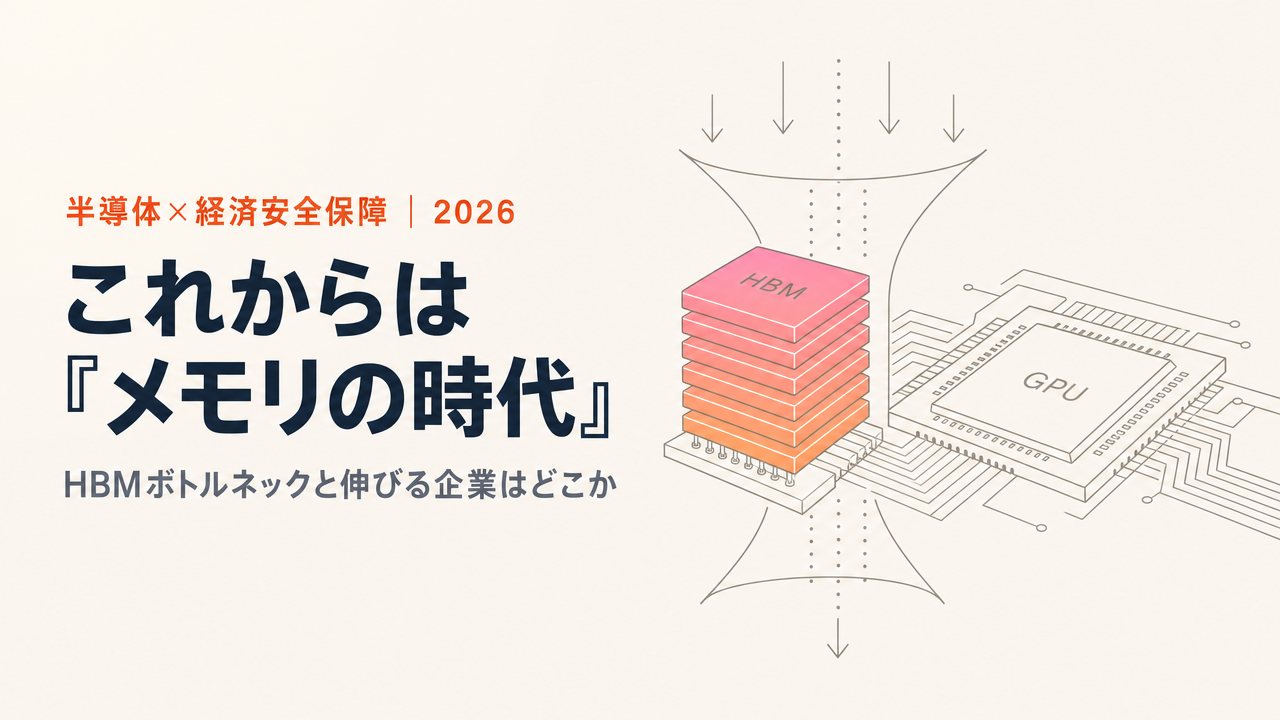
The problem is that AI memory is overwhelmingly more profitable for the makers. The special memory used in AI computation, called HBM (high-bandwidth memory, a part made by stacking many memory dies to achieve ultra-high speed), consumes roughly three times as many wafers, the silicon disks that serve as the raw material for chips, to produce the same capacity as DDR5, a common type of memory8. And because its margins are far higher, makers are all redirecting their capacity toward HBM. HBM's share of total DRAM wafer use was reported to have risen from 19 percent in 2025 to roughly 23 percent in 20268.
Put yourself in the maker's shoes and the behavior is simple. On the same production line, prioritize the profitable AI products. That cuts into production of consumer-grade commodity memory, which goes scarce, and the price jumps. This is the true nature of the current surge. The demand-side figures are dramatic too: the research firm IDC expects data centers to consume roughly 70 percent of the memory chips produced in 20269. Data centers' share of DRAM consumption was reported to have been somewhere around 20 to 30 percent in 2022, which means that in just a few years the lead role for memory shifted from consumers to data centers9. Picture a restaurant kitchen where the burners are almost entirely taken up by banquet dishes for a large group booking, so the orders from regular customers take forever to come out. What is happening now is close to that. Because memory accounts for a significant share of the cost of a Mac or an iPad, once that figure rises by tens of percent, reaching the price tag of the finished product was only a matter of time.
The "lead-time delays" happening behind the price increases
Alongside price, another thing quietly progressing is the lengthening of lead times. When parts are scarce, prices not only rise; the time it takes to get hold of them also stretches out. Reports and industry analysis indicate that the delivery time for DDR4 and DDR5 memory modules has stretched, in many cases, beyond 20 to 30 weeks10. That means waiting more than half a year, and makers have been forced to respond by delaying new product launches, holding back on the amount of memory they install, and trimming their product lineups.
A frequently cited symbol of the squeeze is OpenAI's massive data center plan known as "Stargate." According to a JETRO business brief, OpenAI was reported to be in talks with Samsung and SK Hynix over a supply of roughly 900,000 DRAM wafers a month, and the SK Group was said to have commented that this is "equivalent to roughly twice the world's HBM output"11. In other words, a single company's AI plan is on a scale large enough to shake memory supply and demand around the world. The same brief also noted that the inventory of major DRAM makers plunged from 13 to 17 weeks' worth at the end of 2024 to 2 to 4 weeks' worth in October 2025, and that the spot price of 16Gb DDR5 leapt from 6.84 dollars in September to 27.2 dollars on December 111. Thin inventory, and a fourfold jump on the spot market. With that, there is no way lead times could stay stable.
So when will it settle down? This is what everyone wants to know, but I can say no more than that the industry's view, as reported, is that it "will not normalize until somewhere around 2027 to 2028"11. Ramping up memory output requires new factories, and standing one up takes years. It is not the kind of thing where you decide today and double output next month.
Tariffs and a weak yen pushed up the size of Japan's increases
Up to here the story has been about memory itself, but two factors make the increases felt in Japan even larger: tariffs and the exchange rate. Effective January 15, 2026, the United States introduced a 25 percent tariff on semiconductors under Section 232 of the Trade Expansion Act12. It was designed narrowly, with an exemption mechanism for companies that manufacture within the United States or commit to manufacturing investment there. In fact, Tim Cook was reported to have announced more than 10 billion dollars in additional U.S. manufacturing investment on top of the previously announced 50 billion dollars12. The tariff made it clear that semiconductors have become a tool in the give-and-take between nations. I dig deeper into the cross-border tug-of-war over semiconductor exports in The Japan-U.S. Struggle Over Semiconductors.
The other factor is the weak yen. Alongside the memory surge, the impact of exchange rates has been reported as a reason for Japan's increases. Some media outlets referred to a dollar-yen level in the 161-yen range, but that is a figure from reporting, not one we independently verified against daily market data3. Even so, when a weak yen layers on top of rising dollar-denominated component costs, it stands to reason that the price in Japan would swell to look even larger than the 200- to 300-dollar increases in the United States.
This matter of tariffs and exchange rates is a notch trickier than the memory surge. Prices and lead times will eventually return once supply and demand loosen, but the judgment of what to source from which country and to whom to sell carries a hidden trap in the form of regulation and economic security. When sourcing semiconductors and advanced components, the work of confirming that your counterparty is not subject to sanctions and that the intended use does not run afoul of regulations is indispensable. A mechanism like TRAFEED, which uses AI to support export controls and transaction screening, is needed precisely because the supply chain has become a question not just of price but of regulatory risk. We have entered an era where you have to satisfy the desire to source cheaply and quickly and the requirement to stay within the rules at the same time.
Apple's price increase as the tip of the iceberg
Finally, let me organize what this Apple price increase is a sign of. Trace it in order and it goes like this. Investment in AI infrastructure swells. Makers prioritize high-margin HBM. That tightens the supply of commodity memory. Prices surge and lead times lengthen. Tariffs and a weak yen pile on top. And at the very end, the pressure reaches the price tag of the consumer-facing finished product. This price increase is no more than the tip of an iceberg that surfaced at the end of this long chain. Below the waterline, the upstream semiconductor supply chain is moving in a big way.
Here let me touch on one point that should be handled carefully. Specific figures are circulating in some places, such as the iPhone 18 series being repriced 10 to 15 percent higher, with a base model at 849 dollars and the Pro Max at 1,199 dollars, but these are analyst and industry observations, not something Apple has officially announced. Estimates that the iPhone 18 Pro would rise by roughly 270 dollars if all costs were passed through are likewise hypothetical calculations. At this point they should not be treated as confirmed information. Forecasts that smartphone shipments will fall are consistent in direction across multiple studies, but the specific numbers remain in the realm of prediction. What is confirmed is only the fact that on June 25, the Mac, the iPad, and certain other products were repriced.
Seen through the eyes of a corporate procurement officer, the lesson of these events is clear. Core components like semiconductors and memory not only swing widely in price and lead time with supply and demand; they also carry the geopolitical risks of tariffs and export controls. From which country, from which company, and for what use you source them: each of these decisions ties directly to both cost and compliance. I recommend first securing the groundwork on why semiconductors sit at the center of cross-border dealings in An Introduction to the Structure of the Semiconductor Industry, and then inspecting the situation as it applies to your own supply chain. If you have concerns about screening your suppliers or building out an export-control framework, we can talk through concrete next steps in a one-on-one consultation. Once you can read the structure behind the price news, you can also see a little more clearly what is coming next.
References
Footnotes
-
Apple hikes the prices of MacBooks and iPads because of memory chip shortage — CNN Business — 2026-06-25 — https://www.cnn.com/2026/06/25/tech/apple-hikes-the-prices-of-macbooks-and-ipads-because-of-memory-chip-shortage ↩ ↩2 ↩3 ↩4
-
Apple posts worst day in over a year after MacBook and iPad price hikes — CNBC — 2026-06-25 — https://www.cnbc.com/2026/06/25/apple-macbook-ipad-price-hike-memory.html ↩ ↩2
-
Apple raises prices across iPad, Mac, HomePod and more; iPhone excluded — Ketai Watch (Impress) — 2026-06-25 — https://k-tai.watch.impress.co.jp/docs/news/2120199.html ↩ ↩2 ↩3
-
Apple debuts iPhone 17 (official information on the iPhone 17's 799-dollar starting price) — Apple Newsroom — 2025-09-09 — https://www.apple.com/newsroom/2025/09/apple-debuts-iphone-17/ ↩
-
Memory Price Outlook for 1Q26 Sharply Upgraded; QoQ Increases to Hit Record Highs — TrendForce — 2026-02-02 — https://www.trendforce.com/presscenter/news/20260202-12911.html ↩
-
AI Server Demand to Drive Memory Contract Price Increases in 2Q26 — TrendForce — 2026-03-31 — https://www.trendforce.com/presscenter/news/20260331-12995.html ↩
-
Tim Cook Says Apple Price Increases Are 'Unavoidable' Due to Memory Costs (citing a WSJ interview) — MacRumors — 2026-06-17 — https://www.macrumors.com/2026/06/17/apple-increasing-prices/ ↩ ↩2
-
AI to Consume 20% of Global DRAM Wafer Capacity in 2026, HBM and GDDR7 Lead Demand — TrendForce — 2025-12-26 — https://www.trendforce.com/news/2025/12/26/news-ai-reportedly-to-consume-20-of-global-dram-wafer-capacity-in-2026-hbm-gddr7-lead-demand/ ↩ ↩2
-
Data centers will consume 70 percent of memory chips made in 2026 — Tom's Hardware — 2026-06 — https://www.tomshardware.com/pc-components/ram/data-centers-will-consume-70-percent-of-memory-chips-made-in-2026-supply-shortfall-will-cause-the-chip-shortage-to-spread-to-other-segments ↩ ↩2
-
Global Memory Shortage Crisis: Impact on the Smartphone and PC Markets in 2026 — IDC — 2026 — https://www.idc.com/resource-center/blog/global-memory-shortage-crisis-market-analysis-and-the-potential-impact-on-the-smartphone-and-pc-markets-in-2026/ ↩
-
OpenAI's "Stargate" plan ripples through global DRAM supply and demand (United States) — JETRO (Japan External Trade Organization) — 2025-12-18 — https://www.jetro.go.jp/biznews/2025/12/15a468207aff54ec.html ↩ ↩2 ↩3
-
Adjusting Imports of Semiconductors into the United States (Presidential proclamation on the Section 232 25% tariff) — The White House — 2026-01-14 — https://www.whitehouse.gov/presidential-actions/2026/01/adjusting-imports-of-semiconductors-semiconductor-manufacturing-equipment-and-their-derivative-products-into-the-united-states/ ↩ ↩2