Hello, I'm Ryuta Hamamoto from TIMEWELL.
This is the final installment of the series. We started with the structure of the semiconductor industry, then moved through geopolitics, the regulations of various countries, AI and electric power, and finally the export control of AI models. We have covered some very big topics. To close, I want to bring that grand story all the way down to the ground level of your own operations.
If you have been thinking "this is all too large-scale to have anything to do with my company," this is the part you should read. The big currents, the US-China maneuvering and the weaponization of AI, ultimately come down to a single practical judgment that every company has to make, one transaction at a time: "Is it okay to export this?" Getting that right is the best preparation there is for protecting your business going forward.
Export compliance, in the end, comes down to these two things
Export controls look intimidating, but the core of what a company has to do boils down to just two things: classification and customer screening. Understand these two and you can see roughly 80 percent of the practical work.
The first, classification (gaihi-hantei in Japanese), is the sorting question of "Is it okay to send this out?" The Japanese term combines the first characters of "controlled" and "not controlled," and the task is to determine whether a product or technology you export falls under the regulated lists of the Foreign Exchange and Foreign Trade Act (the appended tables of the Export Trade Control Order). The determination is made not by the name of the item but by its performance, its specs. For a machine tool it might be the number of axes or the precision; for a cryptographic device, the key length. You match each of these numerical thresholds, one by one, against a detailed set of rules called the cargo ministerial ordinance. It is the same idea as airport baggage screening, where you check "do the contents here match the specs of a prohibited item?" The catch is that the criteria run to hundreds of pages and are rewritten frequently. In practice, you make the determination using checklists called item-by-item comparison tables and parameter sheets, then compile the result into a classification report.
The second, customer screening, is the matching question of "Is this someone I'm allowed to hand it to?" You check whether your trading partner or the ultimate user of the product appears on a restricted list. Examples include Japan's Foreign User List (15 countries and 835 entities as of October 2025) and the US Entity List. Picture a "no-entry list" posted at a reception desk, and you check every visitor against it one by one. At the same time, you keep an eye out for "red flags," such as a partner who is reluctant to disclose the end use, who places a bulk order that does not fit their line of business, or who tries to pay cash up front for expensive goods. Neglect any of this and you can become the target of criminal penalties or an export ban under the Foreign Exchange Act.
Replace siloed classification work with AI.
METI's FY2024 data shows 52% of foreign exchange law violations stem from classification errors. Download the TRAFEED product catalog covering features and rollout.
The scary part is that honest companies violate the rules by "accident"
Here is a fact many people get wrong. There is an image that export control violations are committed deliberately by companies acting in bad faith. Yet when you look at the Japanese statistics, 60 to 70 percent of Foreign Exchange Act violations stem from classification errors, that is, honest mistakes rather than intent. A company running its business in good faith can be charged with a violation simply for getting one determination wrong. That is the real danger of export controls.
Just how subtle classification can be is symbolized by the Okawara Kakohki case. In 2020, executives of this machinery maker were arrested and indicted on suspicion of having exported a spray dryer to China without a license, on the allegation that it could be diverted to the production of biological weapons. Yet just before the trial, prosecutors withdrew the indictment, and the court later ruled the arrests illegal. In June 2026, a judgment ordering the state and the Tokyo Metropolitan Government to pay roughly 166 million yen in damages was finalized. One of the executives died while in detention. This was not the exposure of a violating company; it was a case in which even the investigating authorities misjudged whether the item was controlled. Classification is so subtle that the professional authorities themselves got it wrong.
In the past there were also cases in which a precise three-dimensional measuring machine was later found to have reached a third country without the proper license, and in which a civilian crop-spraying unmanned helicopter ended up reaching an overseas firm said to be linked to the military. In both, the pitfall was the assumption that "it's a civilian product, so it's fine." These are not about judging any particular company; they should be taken as institutional lessons about dual use, showing that even a legitimate civilian product can fall within broad regulatory categories. GPS, drones, and measuring machines alike are "dual-use," usable for peaceful purposes and for weapons. You have to draw that line anew with every single export.
Why this everyday work suddenly got so much harder
Classification and screening are not new tasks; they have been part of the job for a long time. So why has it become an issue again now? Because every change we have traced through this series has pushed the difficulty of the work up all at once.
First, the speed at which the rules change is abnormal. Controlled items on the lists are amended in principle every year, and several times a year at that. The US repeatedly tightens and loosens controls on AI chips, while China rolls out one rare-earth restriction after another. As we saw last time, this is an era in which even AI models themselves can become controlled overnight. Something that was "not controlled" yesterday becomes "controlled" today if an amendment lowers the threshold. Second, the substance of the rules has grown more complex. Recall China's "0.1 percent of value" extraterritorial rule. If your product contains even a trace of Chinese rare earths, a transaction between two foreign companies can require Chinese approval. You have to trace back and verify even materials you do not handle directly. And the scope of what is covered keeps expanding without limit, from chips to manufacturing equipment to computing resources to AI models.
For a small handful of staff to run all this by hand while combing through official gazettes every day is already pushing past the limits of human processing capacity. It is like a fire engine still using a hand pump while the fire only grows larger. And if that staff member transfers to another role, the know-how leaves with them; the risk of key-person dependency is serious too. CISTEC, the industry body for export controls, has itself publicly raised the issue of "the unreasonable burden of spending so much effort on classification, which isn't the essence of the work." This has moved beyond a stage that any single company's effort can solve.
"Licenses" come in types too: individual and comprehensive
Once classification has determined that an item is controlled, the next step is to obtain a license. There is a useful distinction to know here as well. Licenses come broadly in two kinds: individual licenses and comprehensive (bulk) licenses. An individual license is one you apply for transaction by transaction. It is meant for spot deals; it takes effort but can be used without any special internal framework. A comprehensive license, on the other hand, is a mechanism for obtaining approval in bulk for trusted combinations of partners and items. It is meant for companies that export continuously, and it spares you from filing every single time. To use a comprehensive license, however, you must put export control regulations in place internally, build up a track record of in-house reviews, and at times submit to on-site inspections by the authorities, in other words, maintain a self-management system as a condition. It is a structure in which the companies that take export controls seriously have an easier time with the procedures.
On the screening front, the concept of "red flags" matters too. These are signs that a transaction is suspicious. For example, a partner who won't disclose the use of the product, a neighborhood bakery placing a bulk order for advanced lasers, or someone trying to pay cash up front for expensive goods that would normally be paid in installments. When you notice this kind of discomfort, you have a duty to verify thoroughly. "I didn't know" is no defense. Export control is the steady accumulation of unglamorous work: gauging the performance of an item, confirming who the partner is, and choosing the type of license. That is exactly why it gets harder year by year to run on human effort alone.
In an age of AI regulation, handling regulation with AI
This is where TRAFEED, which we at TIMEWELL are developing, comes in. There is a touch of irony to it: in an era when AI is becoming the subject of regulation, it is also AI that handles that regulation.
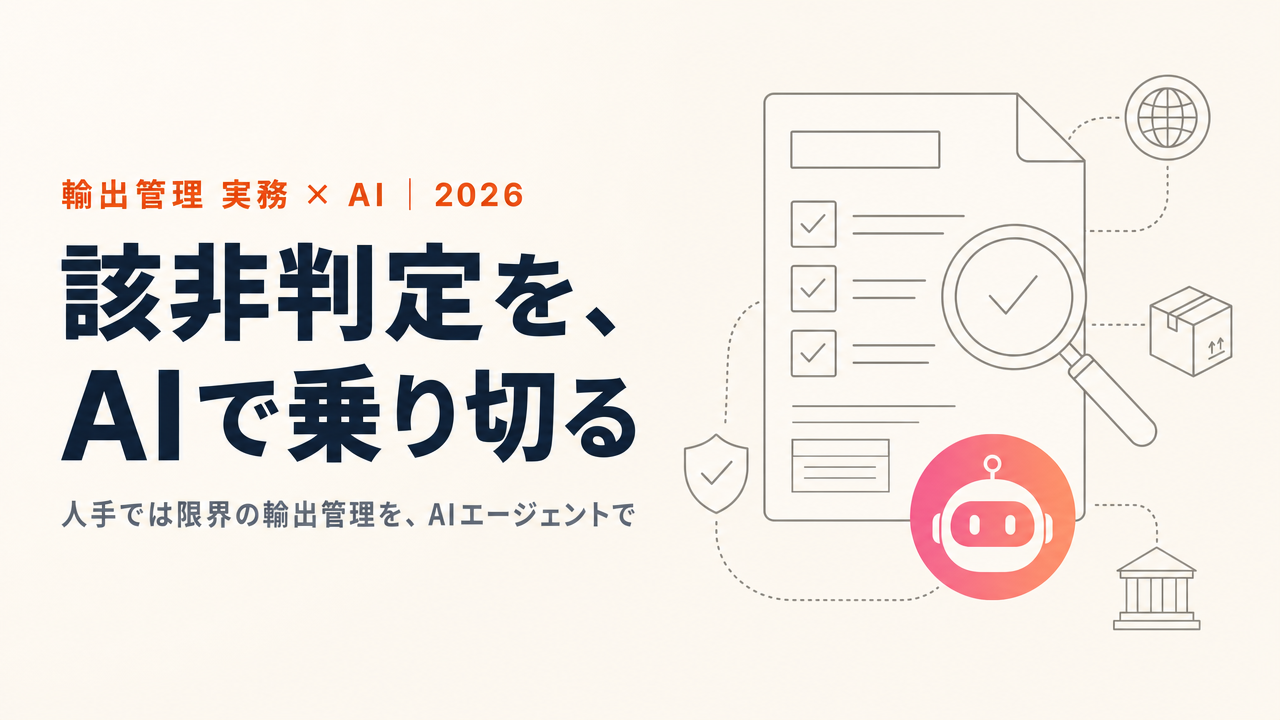
TRAFEED is an export control AI agent compliant with the standards of Japan's Ministry of Economy, Trade and Industry. It automates the two tasks above, classification and customer screening. Enter the product information and it determines whether the item is controlled; it checks your trading partner against lists of parties of concern. Above all, it keeps up with the constantly changing regulations of each country. Instead of your staff reading through official gazettes from around the world every morning, the AI takes in those changes and reflects them in its determinations. Think of it as replacing the hand pump with an automatic sprinkler. It resolves key-person dependency, raises the speed and coverage of determinations so nothing is missed, and leaves a digital audit trail of "who judged what, and where." It is multilingual as well, so even companies with overseas locations can apply consistent management.
Of course, this is not a matter of simply handing everything over to the AI. The final judgment carries human responsibility, and difficult cases require expert knowledge. What TRAFEED aims for is not to replace people but to take over the routine, voluminous matching work so that people can concentrate on the genuinely difficult cases that truly call for judgment. As the Okawara Kakohki case shows, even professionals get classification wrong. That is precisely why you need a structure that guards twice over, with people and AI together. If you are struggling with export controls in practice, please take a look at the TRAFEED service page.
Closing the series
Finally, let me look back over this long journey. We have seen that semiconductors are built through a division of labor among companies all over the world; that the key chokepoints are concentrated in a surprisingly small number of players; that this concentration produces both the geopolitical risk of a Taiwan contingency and soaring stock prices at the same time; that nations are slugging it out using rules as weapons; that AI is exploding demand and extending the front lines into electric power and even space; and that AI models themselves have finally become the subject of regulation.
These may look like scattered, separate news items, but they are in fact connected by a single thick line. Semiconductors are no longer mere electronic components; they have become a strategic commodity that determines the fate of nations and the continuity of businesses. And the regulations surrounding that strategic commodity will only grow stricter and faster from here. As the regulation of AI models has shown, there is no sign of this trend stopping.
That is exactly why I strongly recommend reviewing your own export controls while you still can. Whatever news comes next, with the map you have gained from this series and the practical preparation to shore up your own footing, you should be able to respond without panicking. Let's get through this age of semiconductors and economic security together.
Sources: Japan's export control system, classification, and enforcement cases are based on the Ministry of Economy, Trade and Industry, CISTEC, JETRO, the Tokyo Chamber of Commerce and Industry, and various news reports. Please check the service page for the features and scope of TRAFEED.
If you are reviewing export-control operations or classification workflows, download the TRAFEED product catalog (PDF) or contact us.
![[FY2024 Data] 52% of Foreign Exchange Act Violations Trace Back to Classification Errors - METI Statistics on the 5 Most Common Export Compliance Failures](/images/columns/gaitameho-violation-analysis-2024-meti-data/cover.png)