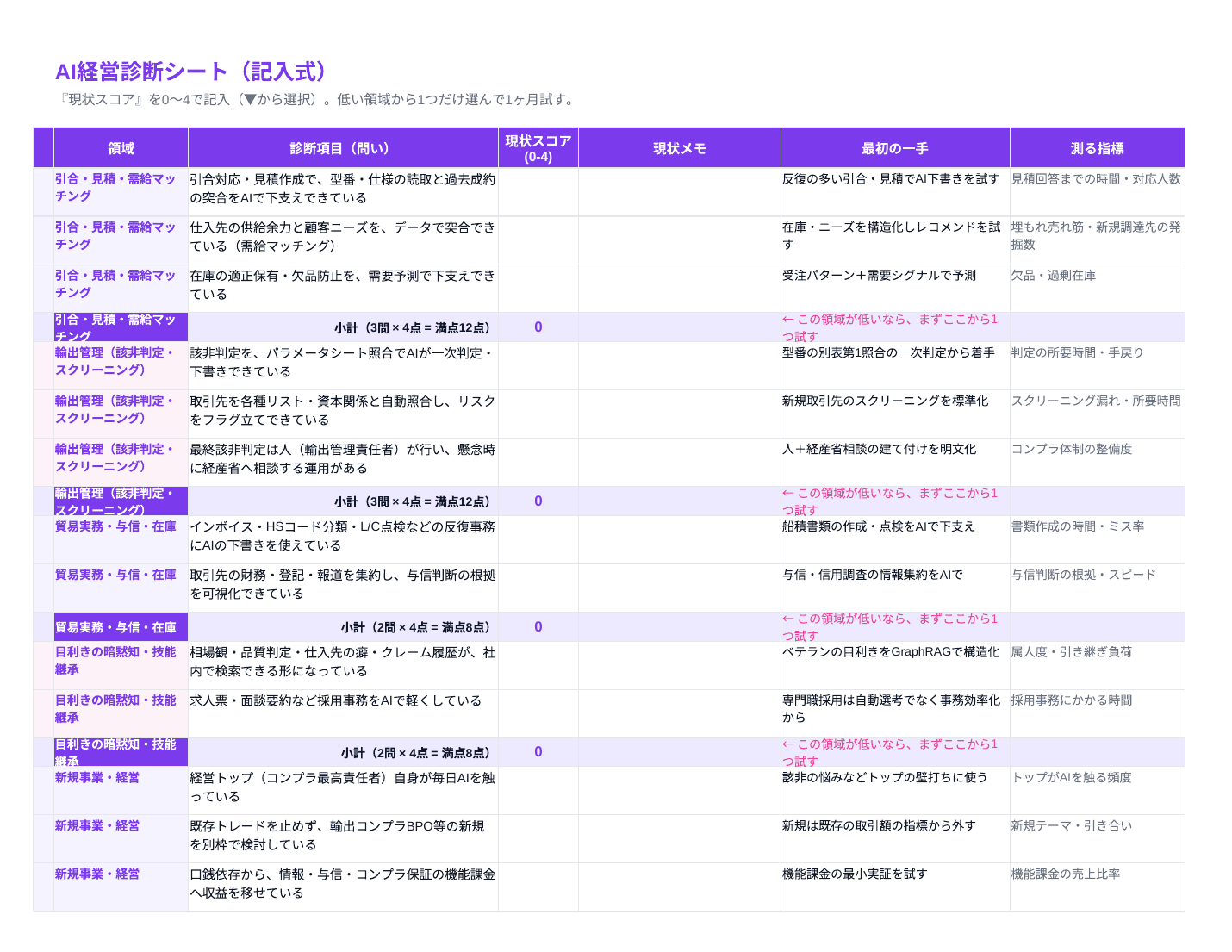
AI Management Diagnostic Sheet — Trading Company (editable Excel)
A fill-in sheet that self-scores five areas—inquiries & quotes, export control (classification & screening), trade ops & credit, transferring the "eye," and new business & management—to decide where to add AI first.
Download the Excel sheet (free)Excel (.xlsx) ・ no email required
Hello, this is Ryuta Hamamoto from TIMEWELL.
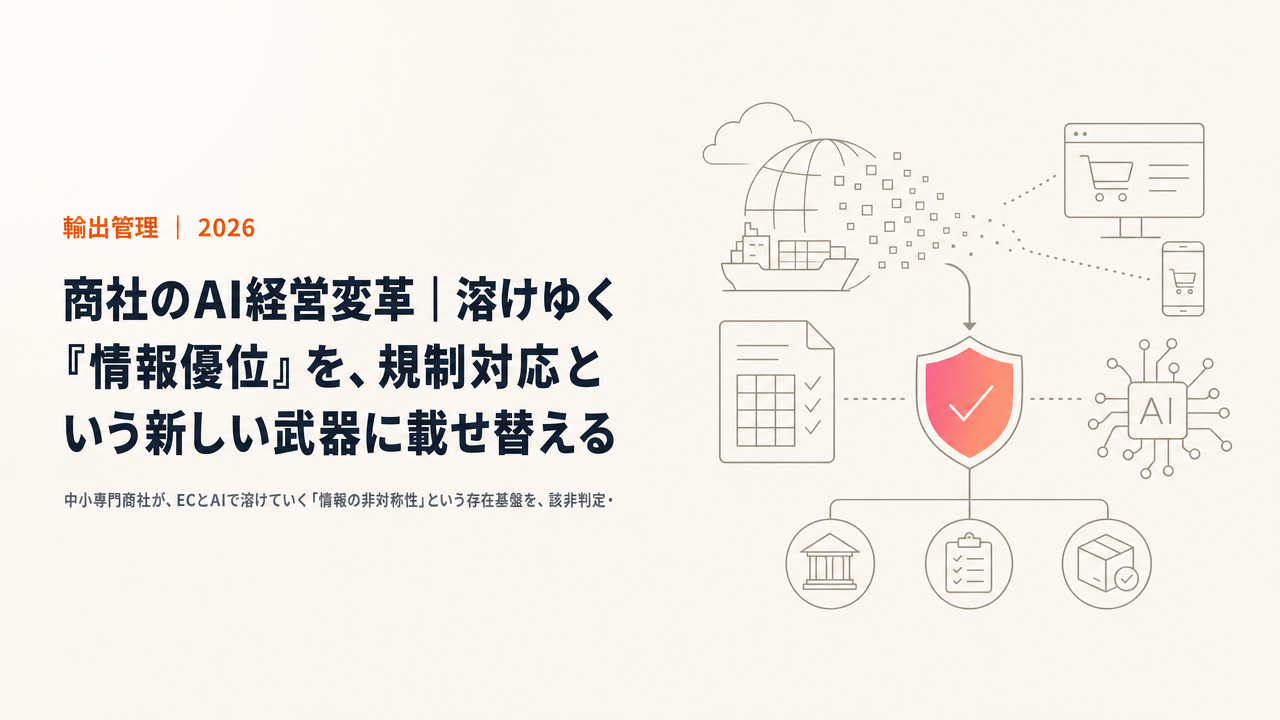
When I talk with the owners of trading companies, I meet a peculiar crisis sense you don't find in other industries. The longer a company has lasted, the more often this slips out: "If someone told me we just move goods from left to right, I'd have no words to answer." A margin was built on information asymmetry to begin with. Standing between supplier and customer, holding the market prices, stock, quality, and overseas circumstances the other side doesn't know—that information advantage was the very base of the company's existence.
And the net, e-commerce, and AI come straight for that base. Customers look up market prices themselves; makers start direct sales. So for a trading company, AI appears not as a mere efficiency tool but as a threat that dissolves existing value itself. That is the tricky part.
But I believe there is a reversal unique to this industry. Ironically, at the very same import-export juncture, a new information asymmetry is being born. Export-control classification, counterparty screening, investigation of ownership and end-users. The complex and fluid regulatory information of economic security is a new information advantage no one can easily hold. Reload the melting old advantage onto the new advantage of compliance. Don't discard your existing counterparty network or trade operations—add AI on top of them. This article, with small specialized trading companies in mind, follows that path.
Let me state the backbone up front. Every first step begins with the owner personally touching AI every day and becoming AI-native. Because the export-control compliance program is set up with an executive as its chief officer, this works especially for trading companies. I'll explain why later.
Start with the nerve-wracking classification
Is there ever a morning like this? An overseas inquiry comes in. Not a bad deal. But your hand stops. Is it okay to export this product? Does it fall under list control or not? The only person you can hand that judgment to is one veteran—or, honestly, no one who feels confident. Look into it and time melts away; wave it through on instinct and the shadow of criminal penalties flickers. With a wide range of goods, isn't classification the very task that frays your nerves the most and is the most person-dependent?
Export control is a world grounded in the Foreign Exchange and Foreign Trade Act (the Act), where half-measures don't cut it. It has a two-track structure: list control, which matches items listed in Appended Table 1 of the Export Trade Control Order by part number and spec, and catch-all control, which nets even non-listed goods by use or end-user. Judgment is done by matching against the goods ordinance and parameter sheets, and the principle is to first consult METI at the slightest concern.
And the price of a mistake shakes management. In cases shown by METI's SME outreach program, unauthorized export of an infrared camera (to China) drew a 1-million-yen fine and a 3-month export ban; a magnetic-measurement device violation (to Myanmar) drew 2 years' imprisonment, a 6-million-yen fine, and a 7-month all-region export ban. It doesn't run as a side task, yet there is no room to place a dedicated person. This bind is the reality for many small trading companies.
That is exactly why this is the entrance where you can feel AI the most. The first defensive move is to make classification and counterparty screening "standard equipment." Match the handled goods' part numbers and specs against the parameter sheets of Appended Table 1 and make a first-pass judgment of list control. AI drafts the classification document; a human confirms it. New and existing counterparties are auto-checked against each country's entity lists and end-user information, and risky ones are flagged. A process that relied on one veteran's memory and manual work becomes a system where juniors can handle first response. It no longer stops when the person in charge is out.
TIMEWELL's "TRAFEED" is an export-control AI agent that carries exactly this. It conforms to METI standards and supports multiple languages, and in a joint demonstration with Okayama University it showed classification accuracy of 95% or higher (about 30,000 past review records; own figures). But let me always add one thing. The final classification is made by your company's export-control officer. AI is a tool that speeds up first-pass judgment and drafting; it does not take over the judgment. The mindset that "if AI judges it, violation risk is zero" does not hold in the world of the Act, and we do not promise that.
First, try it on the one item you're hesitating over right now. You can also check where your export-control and classification structure stands today with the export-control check. Not company-wide rollout at once, but one item, one counterparty. For a small company with limited people and money, that is the right order.
Replace siloed classification work with AI.
METI's FY2024 data shows 52% of foreign exchange law violations stem from classification errors. Download the TRAFEED product catalog covering features and rollout.
The first step: the compliance chief officer—the top—touches AI
Before I line up the moves, let me place what comes first in sequence. The owner personally becoming AI-native. For a trading company, this has special meaning.
The export-control compliance program is set up with an executive as its chief officer. That is, how far to use AI in classification and counterparty screening, and where humans take over the judgment—this line is decided by management, not a single floor staffer. Unless the top grasps by hand what AI can do and where it is risky, they will design the structure wrong. A practice of "it's fine because AI judged it" does not hold in the world of the Act. The top needs to hold that line as a felt sense.
There is another reason. AI is now the cheapest sparring partner an owner can have. "Among our handled items, tentatively list those that might catch on catch-all control, from a use standpoint." "To pass a veteran's market sense to juniors, what should we record?" Even if half the answers need verification, becoming able to spot that half yourself is the entrance to being AI-native. In export control, that "I can verify it myself" sense becomes compliance strength itself.
Japan's generative-AI usage rate is 55.2% in the Ministry of Internal Affairs and Communications' 2025 White Paper on Information and Communications. The biggest adoption concern was "we don't know how to use it effectively." That "we don't know" isn't filled by outsourcing or training. The top touches it for even ten minutes a day. I have rarely seen a company's AI use take root well when it skipped this part.
This article is also continuous, in a different industry's terms, with the same series. If you have a manufacturer with physical equipment, AI transformation for parts manufacturers is a useful reference.
Cutting cost: add AI to the daily trade clerical work
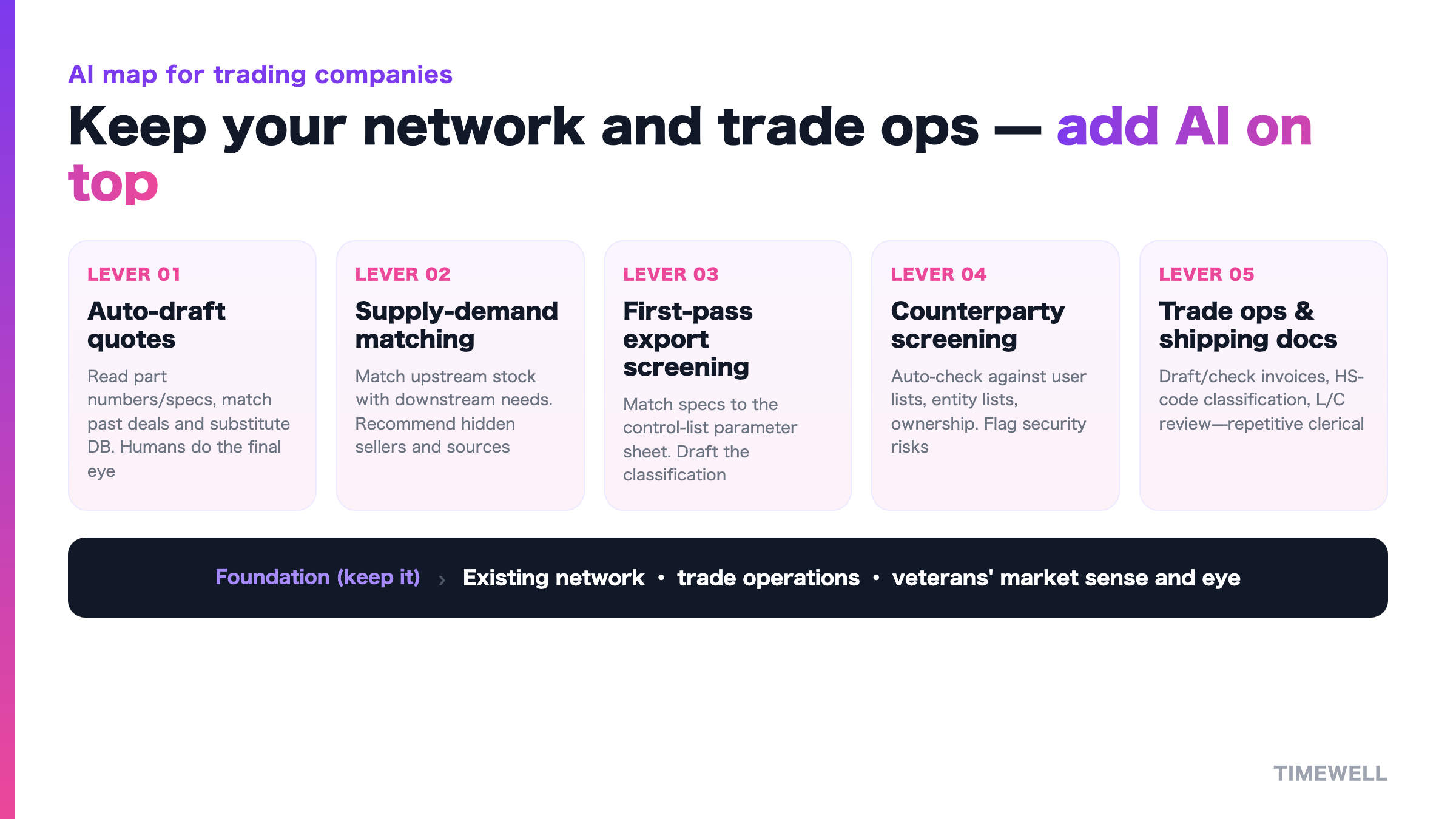
Once you've raised the defensive pillar of classification, the next step is to cut the cost of daily clerical work a little more broadly. The principle is the same: don't replace your existing business systems—just add AI in front of or beside them.
The easiest place to start is handling inquiries and quotes. Read the part numbers and specs (material, dimensions, standards) coming from customers, match them against handled items, past deals, and a substitute-goods database, and have AI draft the quote and alternative proposals. Concentrate the veteran's eye on the final check. Juniors can handle first response, and the risk of work stopping when someone leaves drops.
A step further is supply-demand matching. Match suppliers' stock and supply capacity with customers' needs in structured data. Have AI surface hidden sellers and unexpected sourcing. In an age when customers finish their own sourcing on the net, this is an attempt to rebuild the value of "ask us and the best combination comes out."
The repetitive clerical work of trade operations also benefits from AI. Creating invoices and packing lists, HS-code classification, L/C document checks. Have AI draft and check highly routine work, and put humans on confirmation. In every case, the idea is to add AI beside existing systems, not to discard them.
Here is one sparring prompt to sort out where to start, together with the owner and with AI. Paste it as is and replace the text inside【】with your own information. One more prompt—for producing the seed of a new pillar—is included in the free diagnostic sheet (Excel).
You are an operations-improvement consultant for small specialized trading companies. On the premise of adding AI without discarding the existing counterparty network and business systems, help decide which trade clerical work or function to tackle first.

# Input (I will fill this in)
- Handled goods and main flow:【e.g., industrial electrical parts, sourced from domestic makers, sold to equipment makers at home and abroad】
- Three most time-consuming clerical tasks or functions now:【e.g., inquiry/quote handling / shipping documents like invoices / classification】
- Owner and time per case / per month for each:【e.g., quotes: 3 salespeople, XX min per case, XX/month】
- Person-dependent tasks:【e.g., market sense and supplier quirks rely on one veteran】
- Existing systems in use:【e.g., sales management is XX; quotes in each person's Excel】

# Your tasks
(1) Evaluate the three tasks on "routineness," "frequency," "person-dependence," and "regulatory risk (does export control apply)."
(2) For each, separate the drafting/matching AI can take over from the judgment humans must make.
(3) Choose the one task to add AI to first, and show the grounds (for tasks involving export control, presuppose human + METI consultation).
(4) Show a one-month PoC plan for that one task, week by week. Keep existing systems.
(5) Define measurement indicators (time, count, error rate, etc.).

# Output format (follow exactly)
1. Evaluation table: columns are [Task / Routineness (high-mid-low) / Frequency / Person-dependence / Regulatory risk / What AI drafts / Judgment humans keep / Estimated time saved (assumed, with formula)]
2. The one task to tackle and the reason (within 3 sentences)
3. One-month PoC plan (Week 1-4, what to do and the number to measure each week)
4. Definition of measurement indicators (what, when, how to record)

# Constraints
- Do not use abstract words like "efficient" or "convenient"; write what changes and how, using verbs.
- For tasks involving export control, do not write "if AI judges it, we're safe." Presuppose human + METI consultation for the final judgment.
- Label unknown numbers "assumed" and add the premise and formula. Do not fabricate.
- At the end, list the three weakest assumptions or overlooked risks most likely to break this plan.
Let me sort out the nature of the numbers, just once. The regulatory structure and violation cases of the Act, and the fact that the ratio of wholesale to retail trade (the W/R coefficient) has shrunk to nearly half over the long term, are systems and public statistics. On the other hand, most of the "AI cut hours by X%" effect figures in this article are vendor or own figures, with no guarantee the same number appears on your floor. That is why, rather than lining up flashy numbers, I recommend measuring on one of your own items or tasks. In an article that handles the strict world of export control, I do not write sloppy numbers.
Turn the veterans' eye into an internal asset
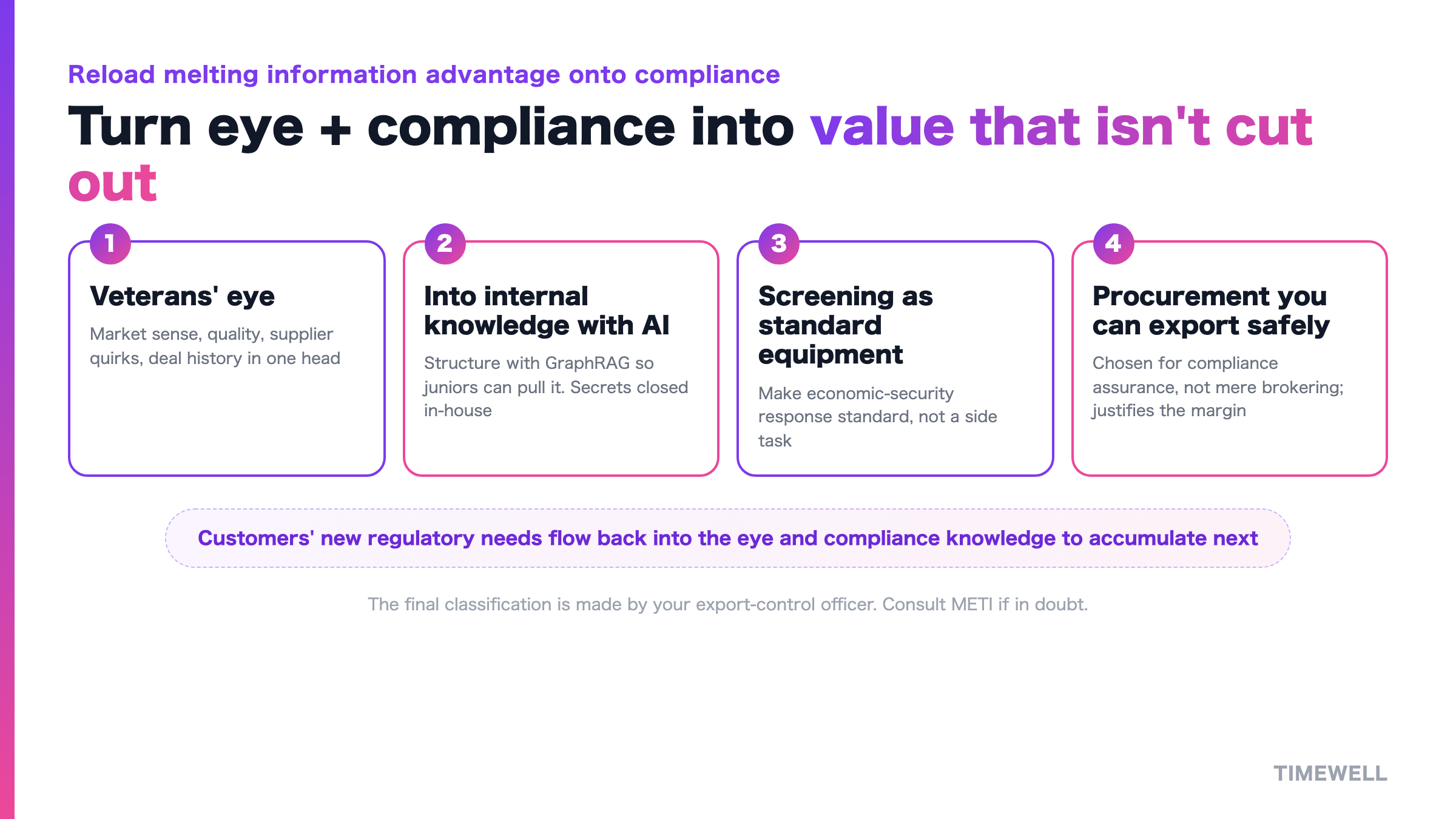
A trading company's biggest asset is inside the heads of veteran sales staff. Market sense, an eye for quality, connections, per-supplier quirks. Because these are completely person-dependent, when that person leaves, the company's value itself vanishes. Here too, you can add AI.
Take tacit knowledge—market sense, quality-judgment criteria, past complaint and deal history, supplier quirks—and, instead of letting it be buried, structure it into a searchable internal state. Juniors can ask AI "where did we source the substitute for this standard last time?" or "what does this customer always care about?" TIMEWELL's "ZEROCK" handles confidential information that can't leave the company entirely inside domestic servers, and connects to this context as a base for cross-searching the veterans' tacit eye—part numbers, specs, past deals, prices, supplier quirks.
This is not a replacement for veterans. Final market judgment and credit decisions continue to rest with humans. It is simply the act of preserving, in a lasting form, the foundation of judgment that vanishes when they retire.
The same idea works for hiring and skill transfer. Lighten job-posting drafts and interview summaries with AI, and turn the record of a veteran's judgment directly into teaching material for juniors. Fill the chronic gap of "not enough people to instruct" with a record of knowledge. AI implementation patterns in HR is a useful reference here. But on tone: framing AI as a "tool to cut people" invites pushback from short-staffed floors. Preserve the person-dependent eye, lighten the clerical burden of export control, and let sales focus on higher-value proposals—that pitch fits the reality of small Japanese trading companies better.
And swap the number you chase. Rather than deal value itself, track the share of continuing deals that carry compliance assurance, and the revenue earned on functions other than the margin. How much value-that-isn't-cut-out did you create? That is the yardstick going forward.
Without stopping the core business, raise a new pillar small beside it
Finally, the story beyond cost reduction. Here, more than anything, it matters not to get the order wrong.
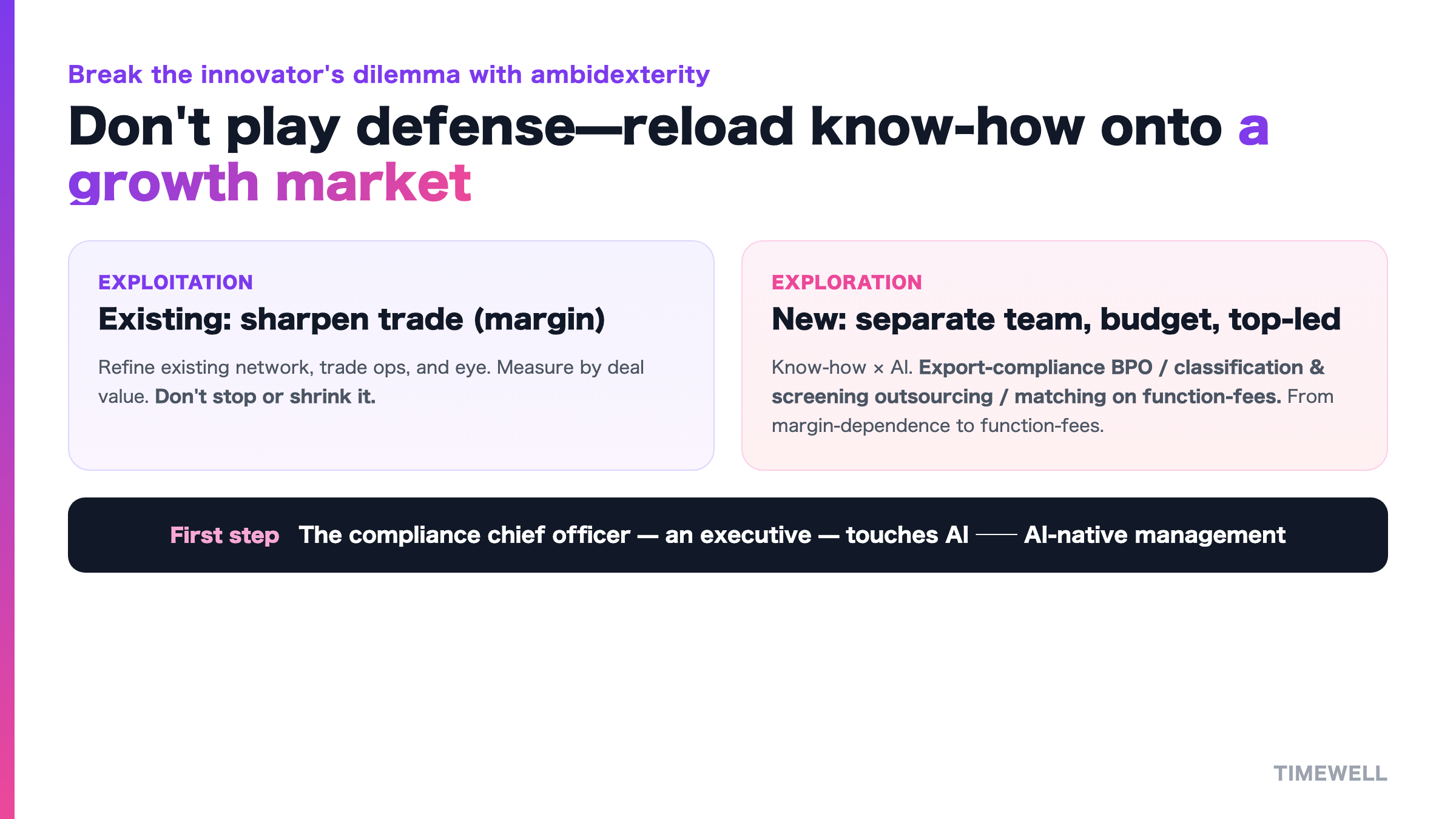
First, make classification and counterparty screening standard equipment in your own company. Firm that up properly. Only when that is done does the next option come into view: taking the know-how you accumulated in your own export-compliance practice, and rather than keeping it inside, offering it to small makers and trading companies with the same worries. Classification and counterparty-screening outsourcing; export-control BPO. Without stopping your existing trade business, try it small right beside it.
But this is "an option for after you've firmed up that much." For a company with no dedicated officer to suddenly take on another company's compliance skips a step. First become able to properly protect your own exports. The depth of that practice is exactly what becomes a product you can offer outside. Don't misstep on this ledge.
The key to growing a new pillar is not to measure it by current deal value or short-term profit. Measure it that way and it gets crushed as "unprofitable" before it grows. If you have spare capacity, use a small separate team; if not, the owner alone spending half a day a week is enough. Without stopping the existing volume, try it small beside it. That, I think, is the plain but sure step from a thin-margin position prone to being cut out, toward being chosen as "a company that can run exports safely."
The sparring prompt for producing the seed of a new pillar is, as I mentioned earlier, included in the free diagnostic sheet. Before you carry it alone, try making AI your partner.
Conclusion: reload the advantage, and the top changes first
Let me organize the key points.
- The information asymmetry that was a trading company's base is melting under the net and AI. The ratio of wholesale to retail trade has shrunk to nearly half over the long term. But at the same import-export juncture, a new information asymmetry—economic-security response—is being born.
- The easiest entrance to feel is the nerve-wracking classification. The first defensive move is to make classification and counterparty screening "standard equipment." Don't bend the human + METI consultation for the final judgment.
- The first step is the top, the compliance chief officer, touching AI. How far to leave to AI is a management decision, and unless the top grasps AI's limits, they design the structure wrong.
- Cut cost with "don't discard, add." Start from the repetitive clerical work of inquiries, quotes, supply-demand matching, and trade operations. Turn the veterans' eye into an internal asset, and set the number you chase not on deal value but on the share of continuing deals backed by compliance assurance.
- A new pillar is an option for "after" you've firmed up your own classification—run it in a separate frame without stopping the existing business. If you lack spare capacity, start with the owner's half a day a week.
Let me write my honest view at the end. Many of the effect figures touched on here are vendor or own figures, with no guarantee the same result appears at your company. And export control is a strict world under the Act that you cannot leave entirely to AI. So rather than shouting flashy efficiency, I recommend the plain sequence—the top first touches AI, tries it on the single most repetitive clerical task, and in parallel makes classification and screening standard equipment. A trading company's old information advantage is melting. But the new advantage of compliance can still be held. The company that manages to load the veterans' tacit eye onto it with data, I believe, holds the value that isn't cut out.
You can download the "AI Management Diagnostic Sheet (Trading Company Edition)" for checking this article against your own company, free from the top of this page. It is an Excel that lets you fill in five areas—inquiries & quotes, export control, trade ops & credit, transferring the eye, and new business & management—while organizing where to start, and it also includes the sparring prompts touched on in the text. First, have the owner fill it in together with AI.
And the easiest first step is the classification of the one item you're hesitating over right now. When you want to sort out how to add AI to your export control, use TRAFEED or an individual consultation.
References and sources
- METI, Commercial Statistics, "Changes in wholesale distribution channels seen from the W/W ratio" 1
- Statistics Bureau / METI, "2021 Economic Census — Activity Survey (wholesale and retail)" 2
- Japan Finance Corporation Research Institute, "Survival strategy of small wholesalers: 3S+P" (Report No.2014-5) 3
- SMRJ J-Net21, "Export control (classification, catch-all control)" / METI, Security Export Control 4
- METI SME outreach program / Tokyo Chamber of Commerce and Industry (export-control violation cases) 5

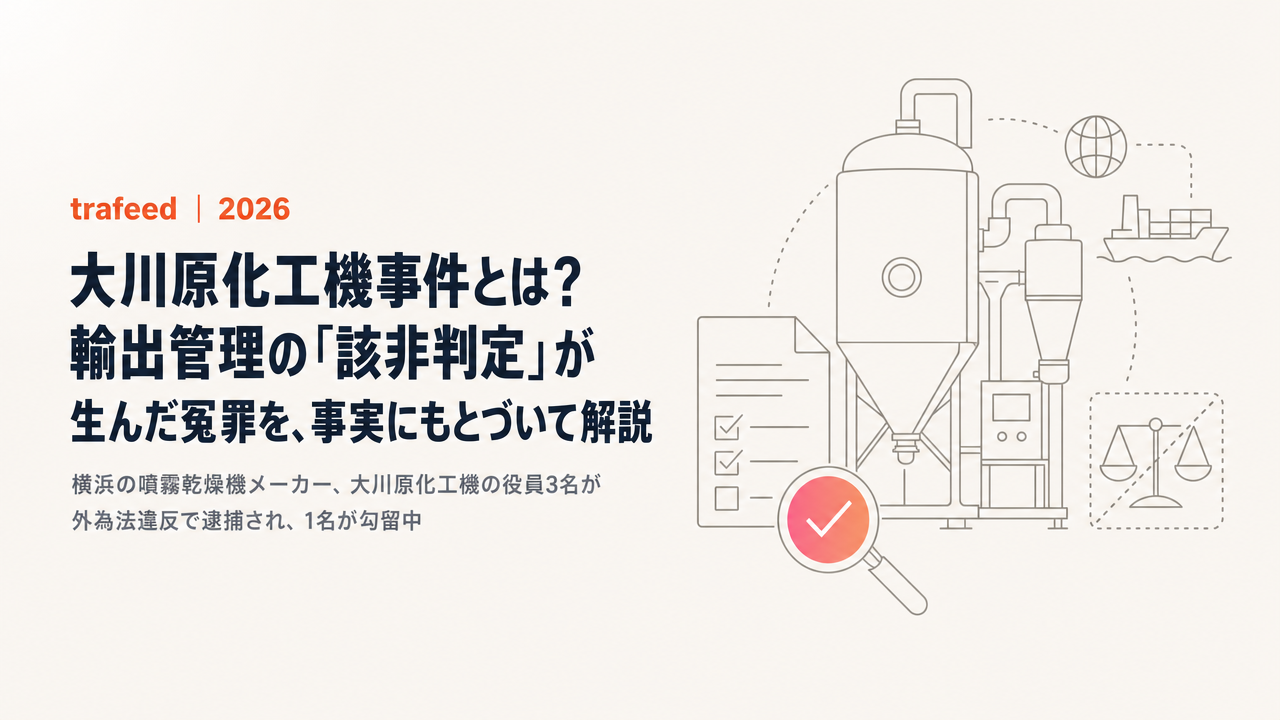
![[FY2024 Data] 52% of Foreign Exchange Act Violations Trace Back to Classification Errors - METI Statistics on the 5 Most Common Export Compliance Failures](/images/columns/gaitameho-violation-analysis-2024-meti-data/cover.en.png?dpl=dpl_b9AFe8evGybVjyMpbtwNVD9Mejnt)
![Japan's Certificate of Non-Applicability Explained — What Foreign Suppliers Must Provide Japanese Buyers [Feb 14, 2026 Update]](/images/columns/non-applicable-certificate-guide/cover.en.png?dpl=dpl_b9AFe8evGybVjyMpbtwNVD9Mejnt)