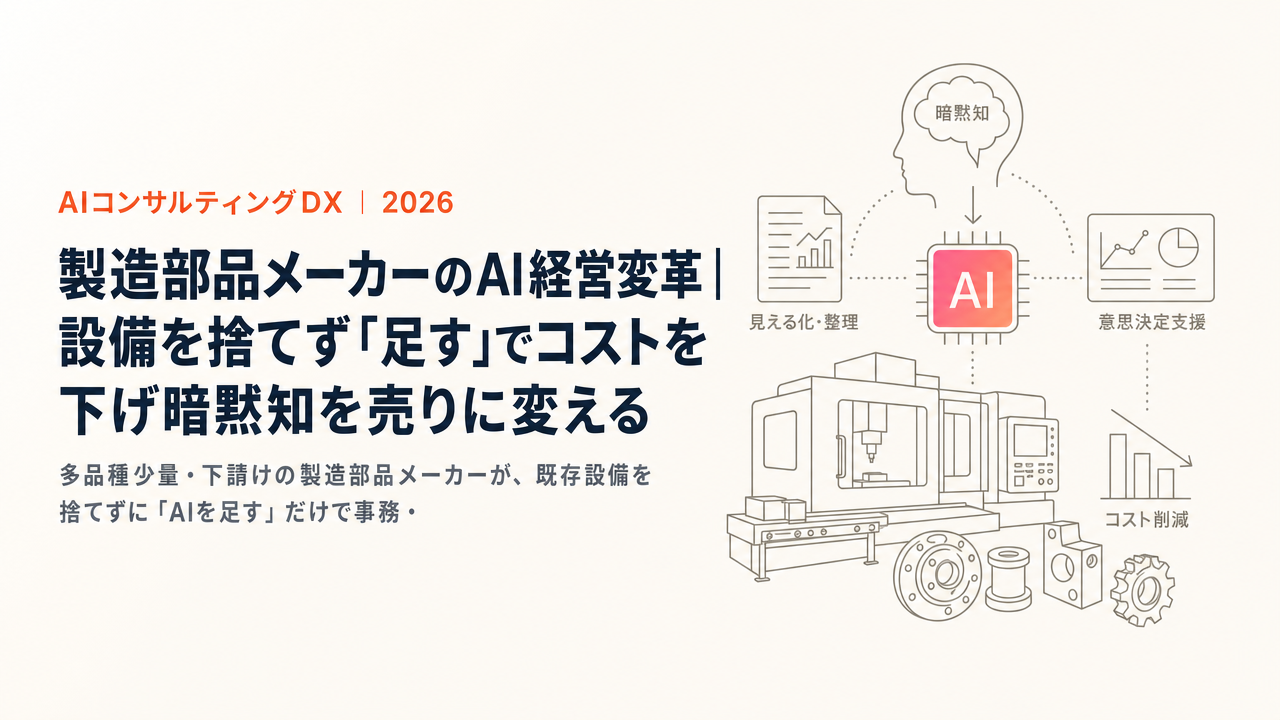
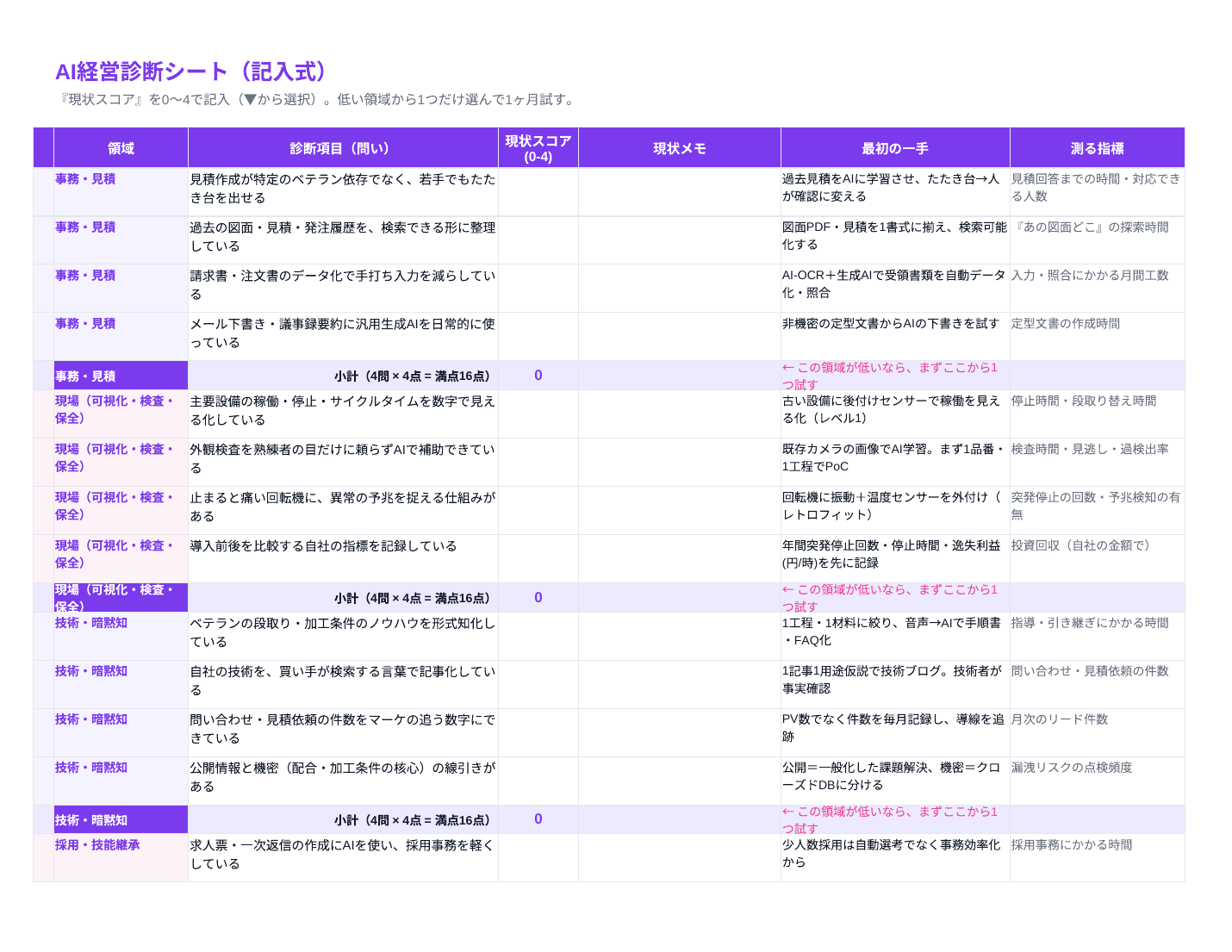
AI Management Diagnostic Sheet — Parts Manufacturer (editable Excel)
A fill-in sheet that self-scores 19 questions across five areas—back office, shop floor, know-how, hiring, and new business—to decide where to add AI first. Includes an action and subsidy quick-reference.
Download the Excel sheet (free)Excel (.xlsx) ・ no email required
Hello, this is Ryuta Hamamoto from TIMEWELL.
When I talk with the owner of a small machine shop and the conversation turns to AI, I often feel their body tense up a little. "Is this really relevant to a small subcontractor like us?" "You're going to tell me to buy another expensive machine, aren't you?" Honestly, I think that wariness is fair. Almost every flashy case study belongs to a large company, and dropping a mass-production success story onto a high-mix low-volume floor usually ends in a swing and a miss.
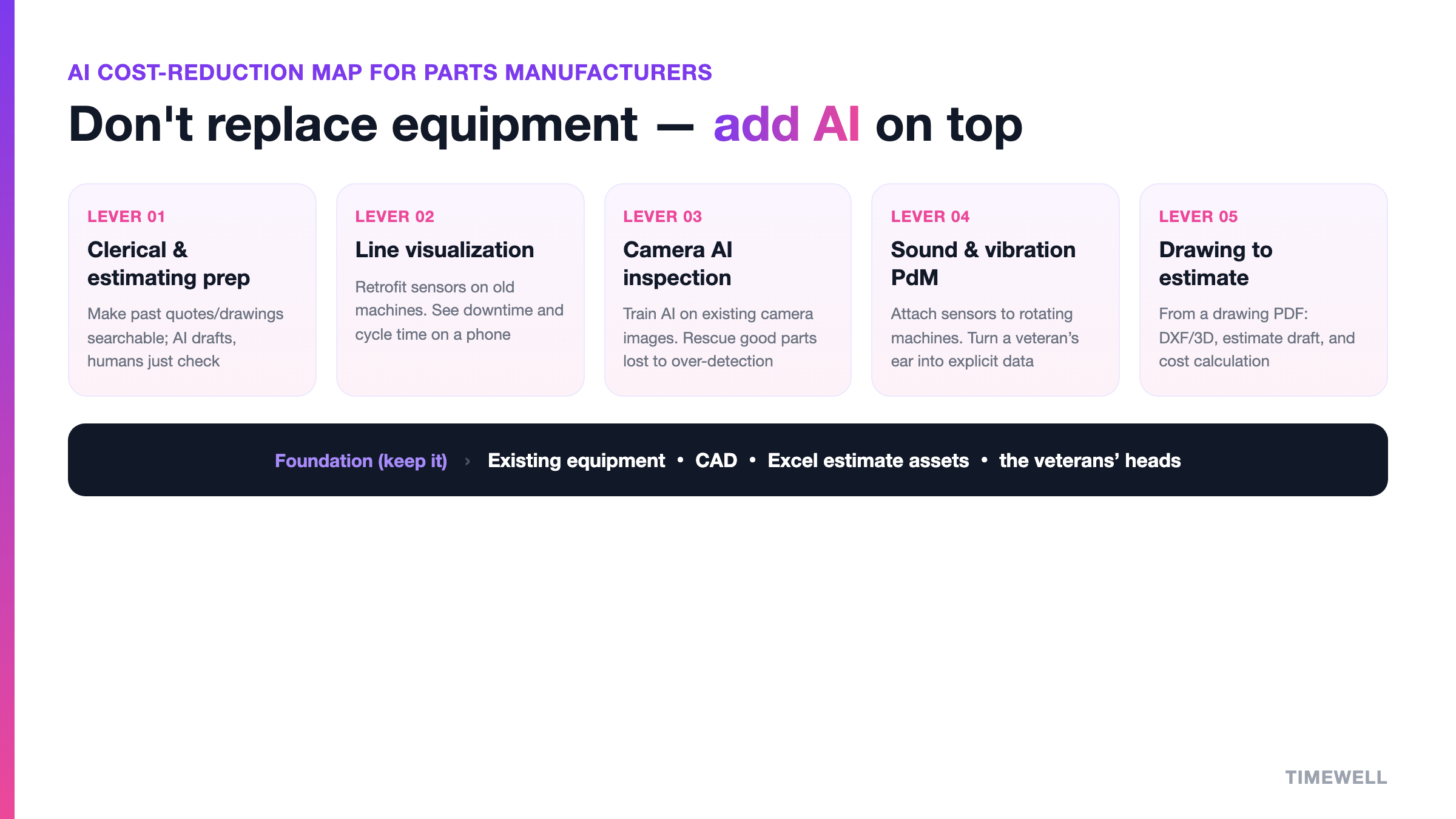
So I will not tell you to replace your equipment—not once. Take what you already have—the machines, the Excel files, and what lives inside your veterans' heads—and add AI on top of it. Focusing only on that, this article walks from getting the estimating that used to stop at the owner into the hands of younger staff, to easing clerical work, inspection, and maintenance, all the way to turning your technology—your single biggest asset—into a selling point. Let me state the backbone up front: every first step begins with the owner personally touching AI every day and becoming AI-native. I'll get to the reasons.
Start with the estimating that stops at the owner
Isn't this a familiar kind of evening? Three inquiries have piled up. But the only people who can price them are you, the owner, or one veteran. That person stares at the drawing, hunts through similar past jobs from memory, and prices it with a unit-cost sense that lives in their head. When they are out, it stops. Younger staff cannot learn it. The reply is late, and you lose the job. At a high-mix low-volume subcontractor, the task that eats the most time and is most person-dependent is this estimating.
This is the easiest place to feel what AI can do. Train AI on your past drawings, quotes, and unit prices, and when a new drawing arrives, have it produce a first draft from the similar jobs and the basis for the price. The owner or veteran only does the final check and fine-tuning. Younger staff can handle the first response, and it no longer stops when one person is away.
TIMEWELL's "ZEROCK" drawing AI works precisely here. Just by uploading a drawing (scanned PDFs and images of paper drawings are supported), it converts a drawing PDF to DXF (2D CAD), generates a 3D model (STEP) from a 2D drawing, and produces an estimate draft and cost calculation. You can respond immediately when a customer asks for 3D data, and once you register your cost table, you can show the basis for pricing as a buildup of material and machining costs. An estimate that used to become "whatever the customer says" within a subcontracting structure turns into material for negotiation.
As a model case, picture an estimate that took the owner an hour becoming 20 minutes for a younger staff member checking an AI draft (this is only a guide; accuracy varies with the type and condition of the drawing—old paper drawings in poor condition or extremely complex shapes presuppose human touch-up). I do not claim "fully automatic just by handing over a drawing." The essence is changing work from building from zero into checking and fine-tuning a draft.
Try just one drawing first. ZEROCK can start from "try it with a drawing at hand." Hand us one drawing and we can DXF it, produce an estimate draft, and look together at whether the effect shows up on one of your part numbers. Not company-wide adoption from day one, but one drawing, one part number—that is the right order for a small firm with limited money and talent. You can also check where your company's AI use stands today with the AI literacy check.
Looking for AI training and consulting?
Learn about WARP training programs and consulting services in our materials.
The first step: the owner touching AI every day
Before the list of moves, let me place the thing that must come first. The owner personally becoming AI-native. This is not a pep talk; it is the practical factor that decides whether the transformation works.
A useful example is Asahi Tekko, a tier-one supplier in the Toyota group. The company attached retrofit IoT onto existing lines to collect shop-floor data automatically and reported significant results. But what I truly pay attention to is not the savings—it is the words of President Tetsuya Kimura: "Machines collect data; only people can find problems and design improvements," and "Improvement means making people's work easier." He is adding AI and data on top of an existing improvement culture, the company's own strength. And above all, the owner is showing the direction and touching it at the front. That, I feel, is the crux.
Why must the owner touch it personally? First, AI is a tool whose limits—what it can and cannot do—are hard to grasp from verbal explanation alone. Unless the owner types in their own problems and feels the quality of the answers that come back, the resolution of investment decisions will not rise. Second, throw it over the fence to the floor and it ends in "we're busy and now we have extra work." It moves only when the top shows the direction and it turns together with bottom-up improvement. Third, AI is now the cheapest sparring partner an owner can have. "List three hypotheses for the common cause behind this month's three defects." Half the answers may be off the mark—but becoming able to judge that yourself is the entrance to being AI-native.
Japan's generative-AI usage rate is 55.2% in the Ministry of Internal Affairs and Communications' 2025 Information and Communications White Paper—a large lag behind China at 95.8% and the US at 90.6%. The biggest adoption concern was "we don't know how to use it effectively." That "we don't know" is not filled by outsourcing or training. The owner touches it even ten minutes a day. I have rarely seen AI adoption succeed at a company that skipped this step. TIMEWELL's AI consulting service "WARP" is also designed around the owner mastering AI as a management tool from the start.
Cutting cost: add AI to clerical and shop-floor work
After estimating, let me widen the cost reduction a little. The principle is the same: rather than replacing systems or equipment, add AI in front of or alongside them.
It may surprise you, but AI enters clerical work before the shop floor. In the SME Support Organization's survey (published March 2026, about 10,000 firms nationwide), AI adoption by function was highest in general affairs and management at 68.3%, and lowest in production at 34.9%. So start with the clerical work that eats the most time. Auto-digitize received invoices and orders with AI-OCR and generative AI to cut manual keying. Feed generative AI your standards, materials, and past troubles so anyone can instantly pull up "how did we handle this last time," removing the wait-for-the-veteran bottleneck.
On the shop floor, the rule of thumb is to enter from "visualization." Retrofit sensors costing from a few hundred yen onto old equipment, and visualize downtime and cycle time on a smartphone—with zero equipment replacement, you can see in numbers where it stops. For visual inspection, train AI on images from your existing cameras and machines to rescue the good parts you were throwing away from over-detection—though 80% of the accuracy is decided by lighting and jigs, so fixing the shooting conditions is a plain but necessary preparatory step. And on rotating machines that hurt most when they stop (motors, pumps, presses), attach a vibration sensor and let AI catch the early signs of anomaly. If a veteran nearing retirement calls out "that bearing is about to go" from the sound alone, record that sound with a microphone, train AI on it, and you lift the judgment out of person-dependence. As a hedge against the labor shortage and skill succession, few investments are easier to explain.
Subsidies help too. For manufacturing, IT adoption, and labor-saving investment, the subsidy rate is generally one-half for SMEs and two-thirds for small businesses (requirements and caps change by year, so check the current year's guidelines before you start). Reducing delivery-delay risk through predictive maintenance is also material for explaining stable supply in subcontracting relationships.
Here is one sparring prompt for sorting out where to start, together with the owner and AI. Paste it as is and replace the text in brackets with your own information. The remaining two prompts (turning tacit knowledge into technical articles / producing new-business seeds) are included in the free diagnostic sheet.
You are an operations-improvement consultant for small manufacturers. On the premise of adding generative AI without discarding existing systems, help a high-mix low-volume, subcontracting parts manufacturer decide which clerical or indirect task to tackle first.

# Input (I will fill this in)
- Main product / type of machining: [e.g., precision sheet metal in stainless, 200 part numbers a month]
- Number of employees: [e.g., 28]
- Three most time-consuming clerical / indirect tasks right now: [e.g., estimating / keying received invoices / answering internal technical questions]
- Owner and time required for each (as far as you know): [e.g., estimating is done by 2 salespeople, 40 min per case, 120 cases a month]
- Existing systems / Excel in use: [e.g., sales management is XX; estimates are in each person's own Excel]

# Your tasks
(1) Evaluate the three tasks on "degree of routineness," "monthly frequency," and "degree of person-dependence (how much only one person can do it)."
(2) For each task, separate the prep work AI can take over from the judgment a human must make.
(3) Choose the one task to tackle first, and give the grounds for why it should be first.
(4) Show a one-month PoC plan for that one task, week by week. Keep existing systems and add AI on top.
(5) Define how to measure the effect (time saved, cases processed, error rate, etc.).

# Output format (follow exactly)
1. Evaluation table: columns are [Task / Routineness (high-mid-low) / Monthly frequency (assumed) / Person-dependence (high-mid-low) / Step AI replaces / Judgment humans keep / Estimated time saved (assumed, with formula)]
2. The one task to tackle and the reason (within 3 sentences)
3. One-month PoC plan (Week 1-4, what to do and the number to measure each week)
4. Definition of measurement indicators (what, when, how to record)

# Constraints
- Do not use abstract words like "efficient" or "convenient"; write what changes and how, using verbs.
- Do not assert unknown numbers; label them "assumed" and always add the premise and formula. Do not fabricate facts.
- At the end, list the three weakest assumptions or easily overlooked risks most likely to break this plan.
Let me say one thing, once, about the nature of these numbers. The shortage index of -18.2 (the 2024 employee shortage diffusion index) and the price pass-through rate of 53.5% (as of September 2025, meaning nearly half of the increased cost is absorbed by the company) are public statistics from white papers and government bodies. On the other hand, most "AI cut X%" effect figures are companies' or vendors' own-company figures, with no guarantee the same numbers appear on your floor. That is why I recommend measuring on one part number and one task of your own rather than lining up flashy figures. This distinction is the premise running through the whole article.
Turn tacit knowledge from a "cost" into a "selling point"
Up to here it was about cutting cost. From here it turns to offense. The technology and veterans' tacit knowledge your company built over 20 or 30 years is not a cost buried inside; it can become a selling point you put out into the world.
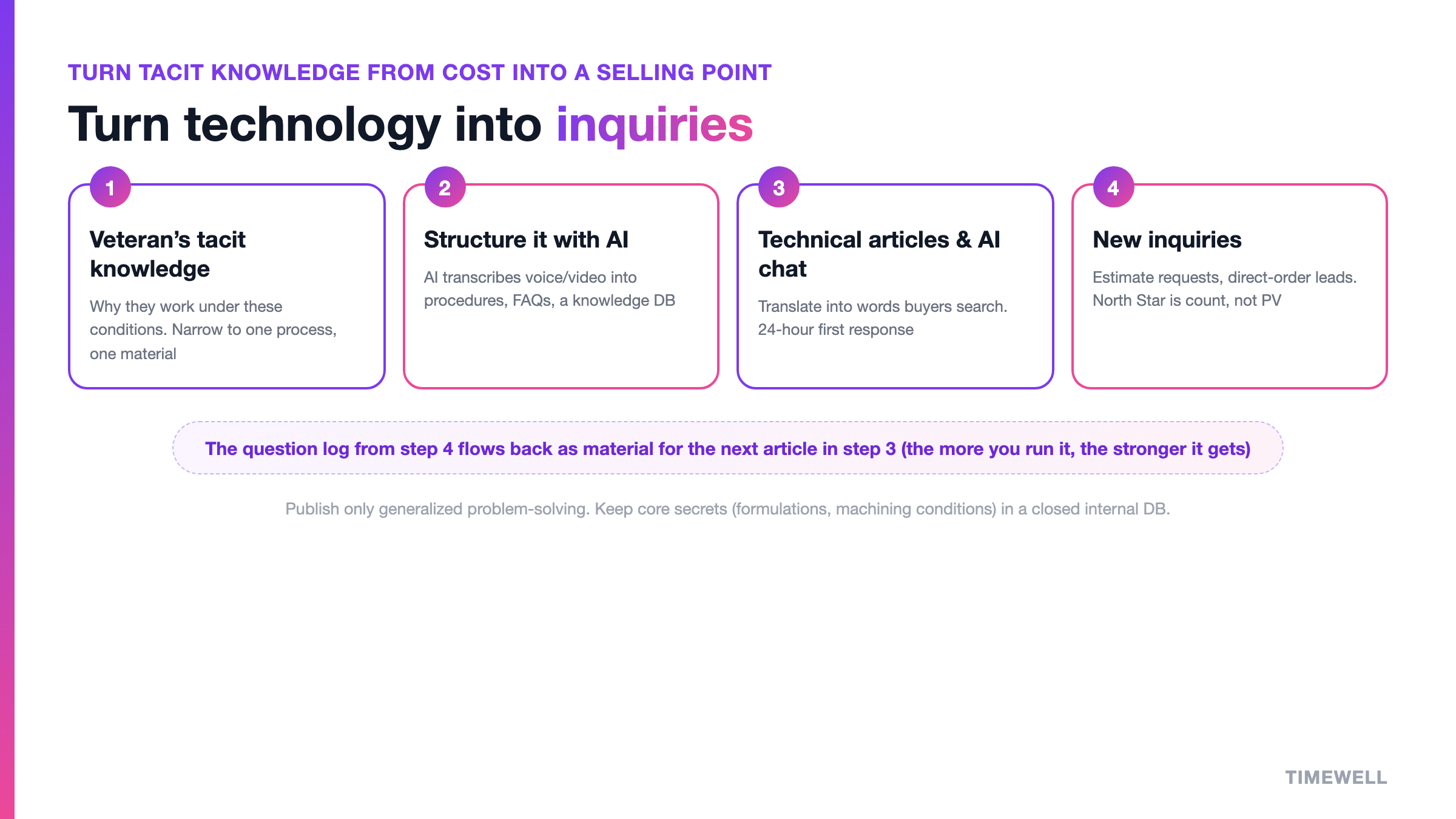
First, have one or two veterans explain "why they work under these conditions" by voice or video, transcribe it with generative AI, and structure it into procedures and FAQs. Narrow it to one process and one material and you can start today. The setups and machining conditions that vanish when someone retires stay as explicit knowledge, without replacing any equipment.
And that knowledge becomes an outward weapon. Turn your technology into technical articles using the words your buyers—the design engineers and purchasers who place orders—actually search for (use cases, materials, problem terms). Have generative AI draft the first version, have an engineer fact-check it, and publish. Put an AI chatbot trained on your FAQs on your site to handle first response 24 hours a day, and use the log of questions that come in as "the next article to write." The key here is to set your target metric to the number of inquiries and estimate requests, not page views. If access grows but deals do not, it is meaningless.
One line to draw: publish "generalized problem-solving with search value" on the public blog, and keep the core of formulations and machining conditions in a closed internal database. Blur this, and you give away your bread and butter for free. The sparring prompt for "turning tacit knowledge into technical-article material" is also included in the diagnostic sheet.
The same thinking works for hiring and HR. Lighten job-posting drafts and interview summaries with AI, and turn a record of a veteran's work straight into a newcomer manual. The chronic problem of "not enough people to instruct" is eased by recorded knowledge. The article on AI implementation patterns in HR is a useful reference. As for tone, though: frame AI as "cutting people" and the floor pushes back. Protect employment and move the people you have to higher-value work. That narrative, I believe, fits the reality of Japan's small firms.
Build a new source of bread, small, next to the existing one
Finally, beyond cost reduction. It would be a waste to spend the slack these moves create only on prolonging the existing business. And yet the more diligent the company, the more filling today's orders becomes the correct answer, and hands never reach the new shoots. A subcontractor's daily life sits right next to this trap.
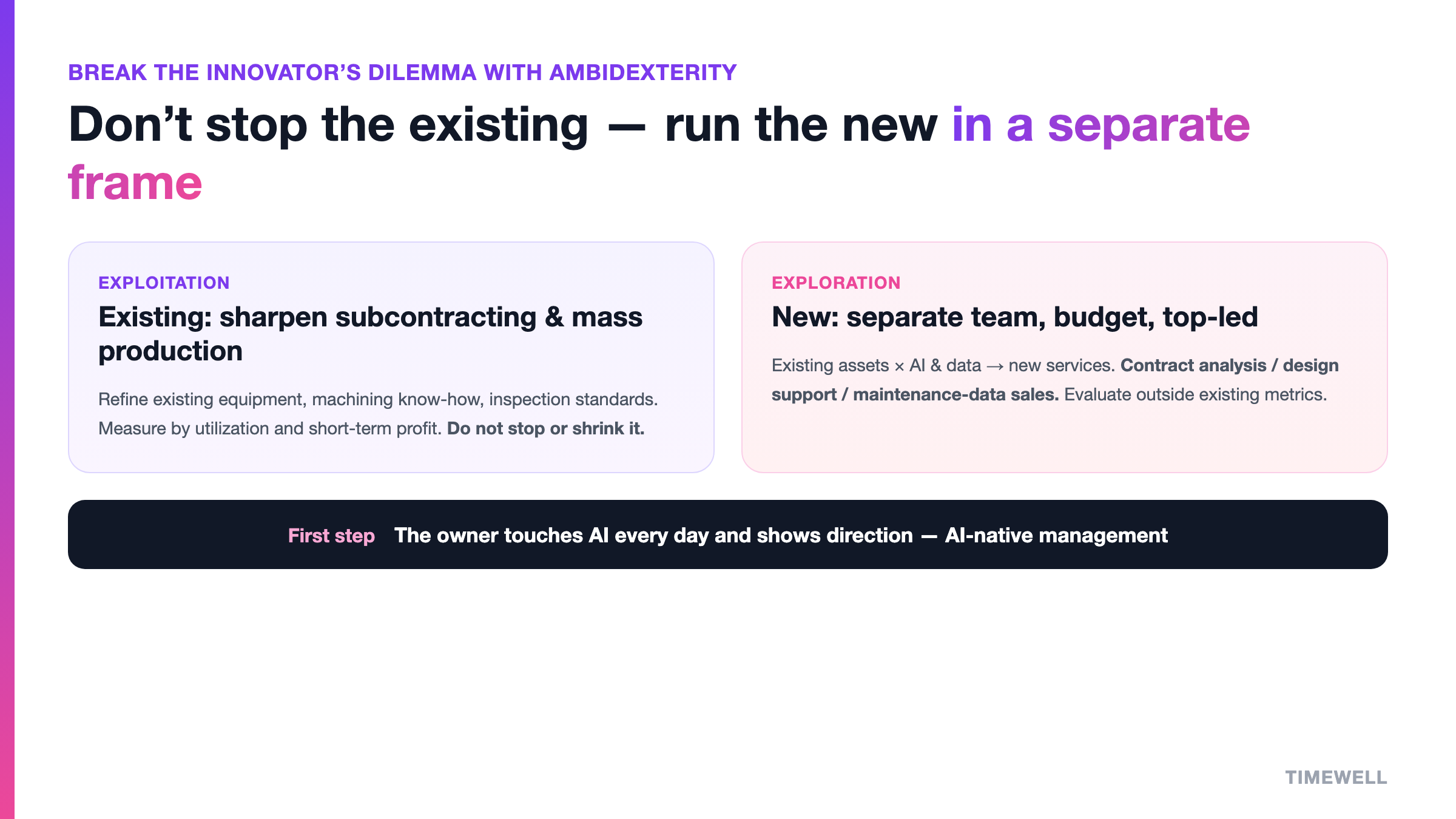
The key to escaping it is not to measure a new effort by current utilization rate or short-term profit. Measure it that way and it gets crushed as "unprofitable" before it can grow. If you have slack, use a small separate team; if not, even half a day a week of the owner's time is enough. Keep it separate from existing orders, and multiply the machining, inspection, and changeover know-how you built over 20 years, and the data you hold (drawings, inspection, operation, defects), by AI. Then what used to be internal cost starts to look like a service you can sell outside. Systematize your inspection know-how with AI and sell it as contract analysis. Offer years of machining insight as design support. Sell equipment operation and maintenance data downstream as predictive-maintenance insight. Try it small, next to the existing mass production, without stopping it. That, I think, is the plain but sure step from a subcontractor to a company that can put out "whose what problem do we solve."
The sparring prompt for producing new-business seeds is also included in the diagnostic sheet. Before you agonize alone, make AI your partner.
Conclusion: start with one drawing, and the top changes first
Let me organize the key points.
- The easiest place to feel it is the estimating that stops at the owner. Use drawing AI to change work from building from zero into checking and fine-tuning. Start with one drawing.
- The first step is the owner personally touching AI every day. Like President Kimura at Asahi Tekko, the companies moving are the ones that add AI on top of an existing improvement culture, with the top showing direction.
- Cut cost by "don't discard, add": prep work for clerical tasks, retrofit sensors for line visualization, camera-based visual inspection, and sound-based predictive maintenance. Keep existing equipment and try small from one task, one machine.
- Tacit knowledge can turn from internal cost into a selling point. Go get inquiries with technical articles and AI chat. The number to chase is inquiries, not page views.
- Build the new source of bread in a separate frame without stopping the existing one. If you have no slack, the owner starts from half a day a week.
Let me write my honest view at the end. AI is not magic; it is a tool. But in this situation—no people coming in, veterans leaving, price pass-through still incomplete—a tool that you can use without discarding your existing assets sits right there as one of the few areas of headroom. Isn't the reason not to touch it the one that has run out?
You can download the "AI Management Diagnostic Sheet (Parts Manufacturer Edition)" for checking this article against your own company, free from the top of this page. It is an Excel that lets you fill in five areas—clerical, shop floor, technology, hiring, and new business—while organizing where to start, and it includes the three sparring prompts referenced in this article. First, have the owner fill it in together with AI.
And the easiest first step is a single drawing. Hand your drawing to ZEROCK and we will DXF it and produce an estimate draft. When you want to sort out together where adding AI would give the highest return, use WARP or an individual consultation.
References and sources
- Organization for Small & Medium Enterprises and Regional Innovation, Japan (SMRJ), "Survey on the Use of AI etc. by SMEs" (published March 2026) 1
- Ministry of Economy, Trade and Industry, Ministry of Health, Labour and Welfare, Ministry of Education, "2025 Monozukuri (Manufacturing) White Paper" (May 2025) 2
- SME Agency / METI, follow-up survey on price-negotiation promotion (as of September 2025) 3
- Information-technology Promotion Agency (IPA), "DX SQUARE," Asahi Tekko case 4
- METI, "Smart Factory" and smart-safety policy materials 5