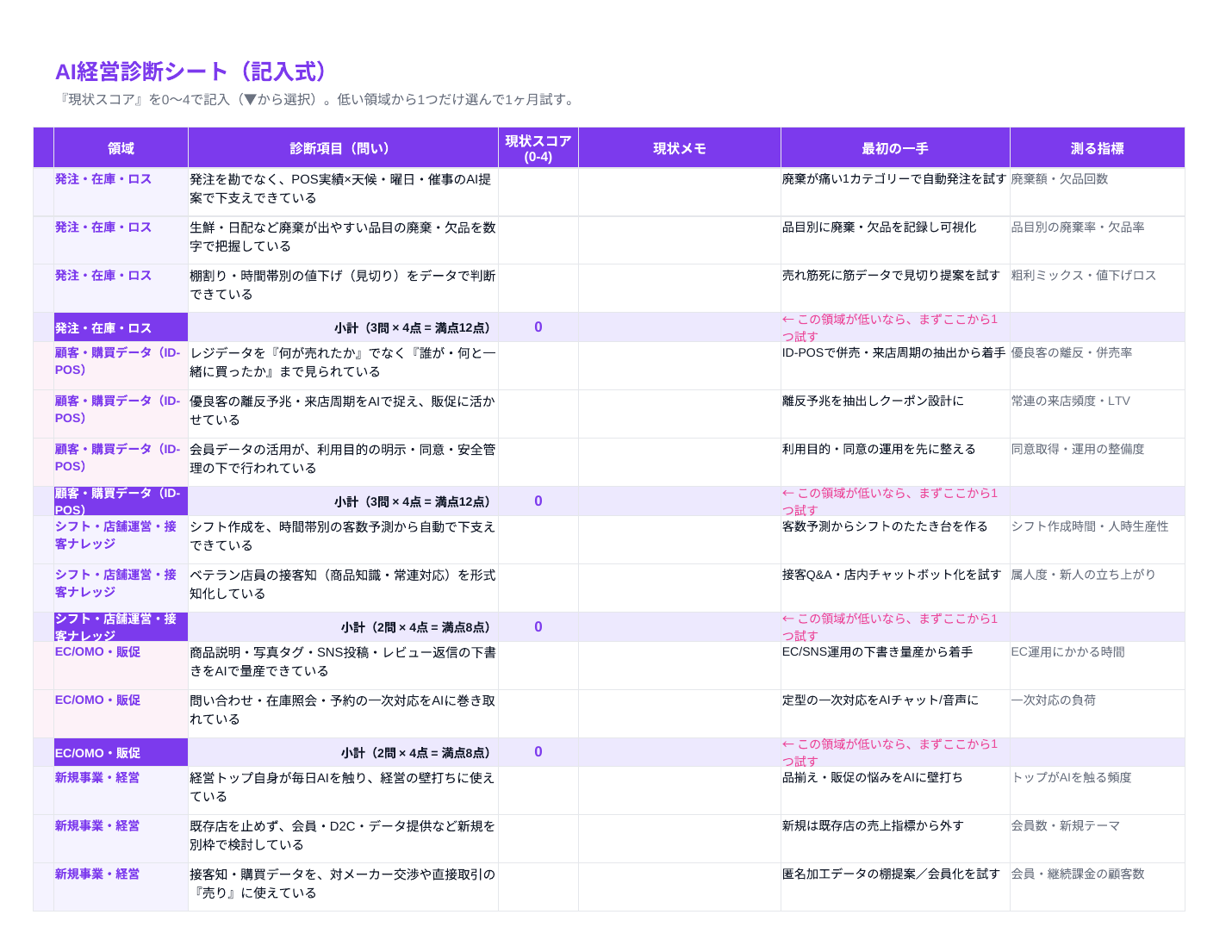
AI Management Diagnostic Sheet — Retail (editable Excel)
A fill-in sheet that self-scores five areas—ordering & inventory, customer & purchase data (ID-POS), store operations & service, e-commerce & promotion, and new business & management—to decide where to add AI first.
Download the Excel sheet (free)Excel (.xlsx) ・ no email required
Hello, this is Ryuta Hamamoto from TIMEWELL.
When I talk with store managers and owners, almost everyone says the same thing. "I have no time at all to think about management." Ringing up sales, stocking shelves, ordering, making shifts, handling complaints. Because the store won't run unless they run the floor, there is no room to sit at a desk and think about six months ahead. I understand that busyness painfully well.
So I won't say a word about ripping out and replacing a big system. Let me start with something you can try in just ten minutes after you close tonight. On your phone or your PC, type this into an AI: "What fresh item had the most waste last week, and does it seem related to the weather or the day of the week that day? Give me three hypotheses." Half the answers may miss the mark. But the moment you can judge for yourself, "no, that's wrong, ours is like this," AI turns into a tool in your hands. This article sticks to one thing: without throwing away the register you have, the customers you have, the shelves you have, or what's inside your veteran clerk's head, you just add AI on top. From there we'll follow how to make gut-feel ordering easier, turn the register data lying dormant into customer understanding, and change a buy-and-line-up business into one connected directly to customers. Let me say the backbone up front: every first step begins with the owner personally touching AI every day and becoming AI-native. I'll explain why later.
Start with the ordering you decide on gut feel
Picture a Friday night. How many of tomorrow's fresh items do you bring in? The forecast is a vague cloudy-then-clear, and the local elementary school has its sports day. You don't clearly remember how the same weekend went in the past. In the end, you order on years of gut feel. Then Sunday evening, you go around slapping half-price stickers on the leftover sashimi and prepared foods. Or the star vegetables run out after lunch, and you bow your head to a regular and say, "I'm sorry." Across the many items a retailer handles every day, ordering is what wears down your nerves the most and depends most on one person.
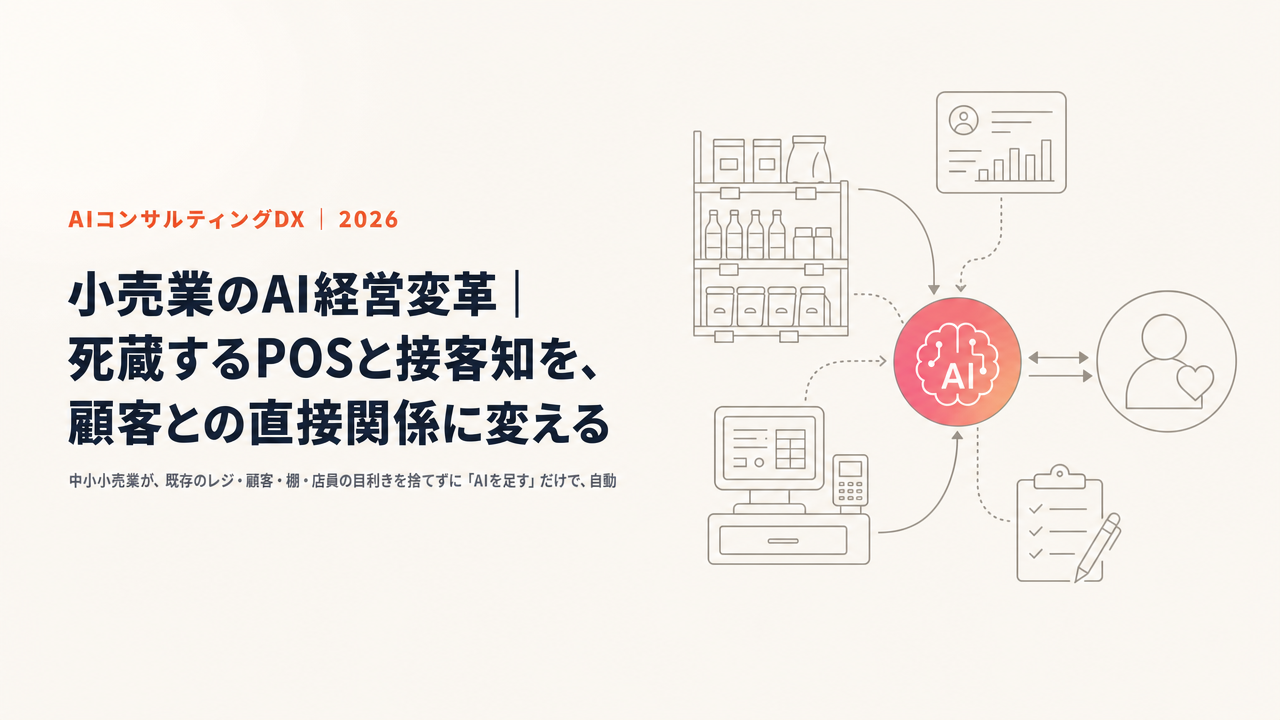
This is the entry point where AI is easiest to feel. AI multiplies your daily register results by weather, day of the week, and nearby events, and produces a first draft of the order quantity per item. For waste-prone goods like fresh and daily-delivery items, the aim is to cut both the loss you throw away and the stockouts you apologize for, at the same time. The manager or veteran just looks at the draft and decides the final number. Building it from a blank slate on gut feel turns into checking and tweaking.
As a model case—and this is only hypothetical—the next day's fresh order that the manager spent 30 minutes assembling on gut feel on Friday night becomes 10 minutes of checking the AI draft. The round of Sunday half-price stickers shrinks, and the number of times you run out and apologize drops too. Of course, I won't say "hand it to the order terminal and it's fully automatic." Sudden weather changes and local events are, in the end, for a person to look at and correct. Let me be honest here: flashy figures like "waste falls by X percent" or "ordering shrinks by X minutes" are usually vendor or large-chain own figures, and there's no guarantee the same number appears at your store's scale and assortment. That's why I recommend picking just one category where waste hurts most, or stockouts draw the most complaints, trying it for one month, and measuring it in your own waste amount. You don't discard the existing order terminal or POS—you just add AI beside it.
Here is one sparring prompt for the manager to organize, together with AI, where to start. Paste it as is and replace the parts in brackets with your own store's information. The other two prompts—turning dormant data into customer understanding, and producing new revenue seeds—are included in the free diagnostic sheet (Excel) you can download from the top of this article.
You are a store-operations improvement consultant for small retailers. On the premise of adding AI on top without discarding the existing POS, order terminal, and store operations, help decide which floor task to tackle first.

# Input (I will fill this in)
- Format and scale: [e.g., one food supermarket, XX-tsubo floor, mostly part-timers]
- Three floor tasks most time-consuming/draining now: [e.g., ordering / shift-making / stocking]
- The category where waste and stockouts hurt most: [e.g., fresh hurts on waste, daily-delivery on stockouts]
- Numbers as far as you know: [e.g., fresh monthly waste assumed XX yen; ordering XX hours daily]
- Data/systems on hand: [e.g., POS, order terminal, weather, event calendar]

# Your tasks
(1) Evaluate the tasks on "drain (time/burden)," "pain of waste/stockout," and "person-dependence."
(2) For each, separate what AI can take over (proposals, drafts) from what humans must judge (final order, service).
(3) Choose the one task to add AI to first, and show the grounds.
(4) Show a one-month PoC plan for that one task, week by week. Keep the existing terminal and POS.
(5) Define measurement indicators (waste amount, stockout count, work time).

# Output format (follow exactly)
1. Evaluation table: columns are [Task / Drain (high-mid-low) / Pain of waste/stockout / Person-dependence / What AI proposes / Judgment humans keep / Estimated reduction (assumed, with formula)]
2. The one task to tackle and the reason (within 3 sentences)
3. One-month PoC plan (Week 1-4, what to do and the number to measure each week)
4. Definition of measurement indicators (what, when, how to record)

# Constraints
- Do not use abstract words like "efficient" or "optimize"; write what changes and how, using verbs.
- Label unknown numbers "assumed" and add the premise and formula. Do not fabricate.
- Write on the premise of not applying a large chain's reduction rate directly to your store.
- At the end, list the three weakest assumptions or overlooked risks most likely to break this plan.
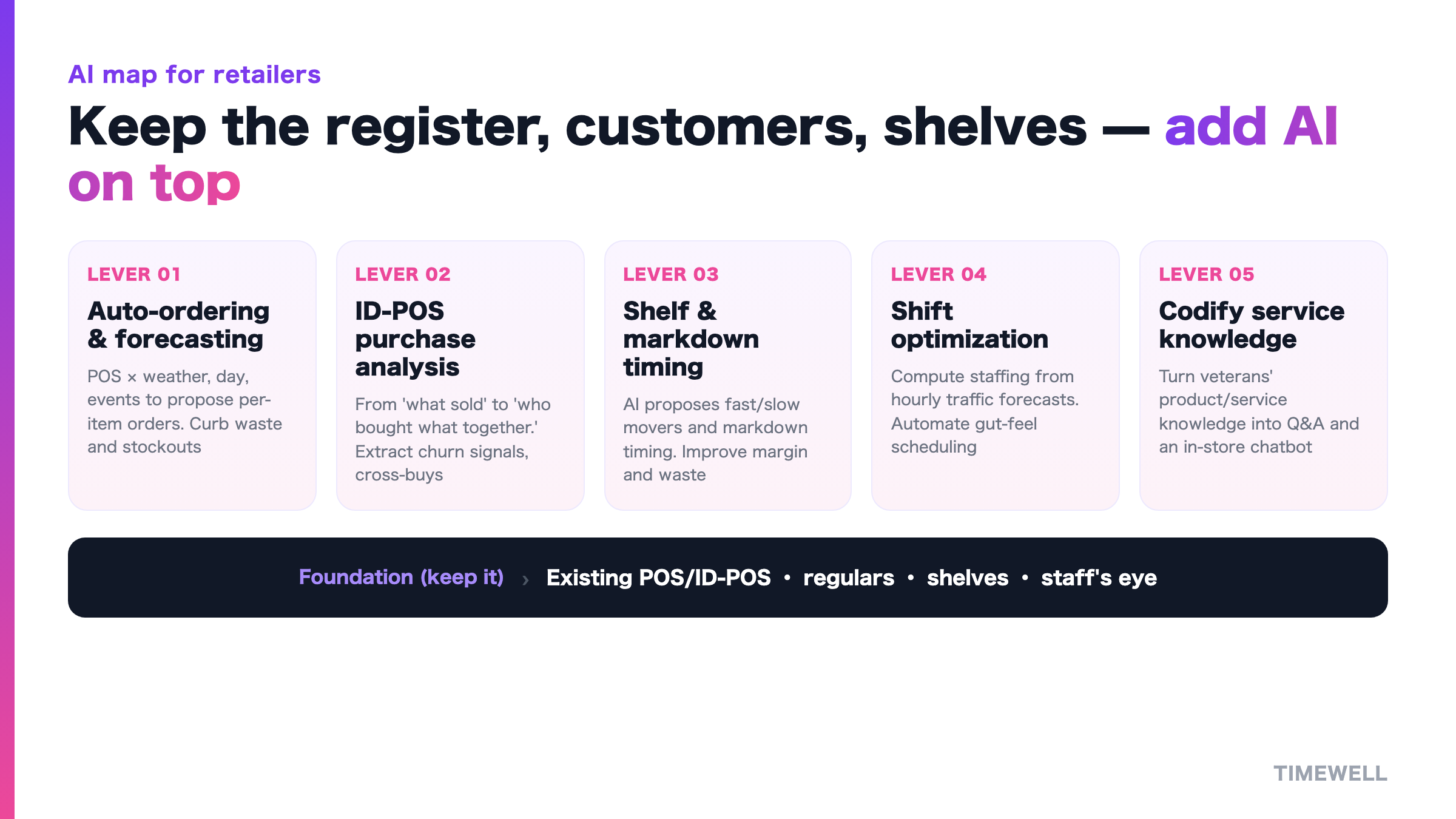
Shift-making, alongside ordering, is a person-dependent task that tends to rely on the manager's gut. Work out the needed headcount from the expected customer count by time of day, and have AI draft the shift. Lighten the work that used to take hours every week, and return the freed time to service and merchandising. This too isn't about discarding the existing way—it's just adding AI to do the prep.
Looking for AI training and consulting?
Learn about WARP training programs and consulting services in our materials.
The first step: the manager steps back from the floor and touches AI
Before we widen the moves, let me place what comes first in sequence. The owner personally becoming AI-native. This is not a pep talk; I see it as the practical thing that decides whether the transformation succeeds.
Many retail owners are, before "what can AI do," in a state of "I don't know where to start—our register, customers, shifts, inventory." This fog doesn't clear through outsourcing or training. The fastest way is for the top to touch it themselves. Why? First, AI is a tool whose "what it can and can't do" is hard to grasp from a verbal explanation alone. Unless you type in your own worry and feel the quality of the answer that comes back, the resolution of your investment decisions won't rise. Second, if you dump it on the floor, it ends as "extra work piled on when we're already busy." It only moves once the top shows the direction. Third, AI is now the cheapest "sparring partner" a manager can have. Assortment worries, how to build a shift, the next promotion—type in what's swirling in your head and sort it out. Those ten minutes after closing that I mentioned at the start reclaim, a little, the "thinking time" that had vanished under the rush of the floor.
The concern Japanese firms cite most often when adopting AI was "we don't know how to use it effectively." That "we don't know" doesn't clear unless the top touches it themselves. I've rarely seen a store that skipped this step succeed with AI. You can also check what stage your own AI use is at with the AI literacy check. This article is continuous with the same series' AI transformation for parts manufacturers—the industry differs, but the backbone, "the top touches it first," is the same.
Turn the dormant register data into customer understanding
Here is the core of AI transformation for retail. Retail is one of the few industries where the register automatically generates primary data every day on "who bought what, when." Unlike manufacturing, you don't need an "investment to create data." The problem is that you're accumulating it but not reading it—the data lies dormant.
Many stores see register data only as a daily sales total. Widen this to "who bought what, together, when." If you have loyalty-card data, have AI pick up signs that a good customer you haven't seen in a while is drifting away, combinations often bought together, and visit cycles. Then put that to work in coupons, in reviewing the assortment, and in the timing of markdowns by time of day. The aim is to improve the margin mix and waste at the same time. A business that used to just line goods on the shelf and wait moves closer to a business with faces—"this person is about due to come," "these two sell when placed together."
Here too, the knack is not trying to do everything at once. Start by having AI pick up just a handful of the top customers who support your sales most, and list what they've bought recently and at what intervals. That alone lets you notice, "that regular hasn't come since last month." Have AI read your whole register history exported to Excel, and ask, "List ten regulars whose purchase volume has dropped versus last month, and for each, suggest which department's staff should reach out." Here again, a person judges at the end. Whether to reach out, and what to recommend, is decided by the clerk who knows that customer. AI takes on the part of picking up and lining up the signs you couldn't notice because they were buried.
There is one premise here you absolutely cannot drop. Using member data and purchase history presupposes purpose disclosure, consent, and safety-management measures under the Personal Information Protection Act. No profiling or third-party provision without the customer's consent. This line takes priority over AI's efficiency, because trust with customers is retail's lifeline.
And then, leave a record of the service intuition. Have a veteran clerk speak, alone, of the product knowledge, service talk, and per-regular handling they've stored in their head over 20 years; transcribe it with generative AI; and turn it into service Q&A, procedures, and a small in-store chatbot a newcomer can consult. This isn't to replace the veteran. When that person quits, the relationship with regular customers vanishes from the store along with them. This is the work of lowering that person-dependence risk and transferring it to newcomers and part-timers. Final service and relationship-building continue to rest with people.
Hiring and e-commerce operations can be lightened with the same idea. Have AI draft recruitment copy for part-timers, first replies to applicants, and summaries of interviews. Product descriptions, photo tags, social posts, and replies to reviews—if you produce them in volume with generative AI, even a small team finds it easier to chase both the physical store and the online store. Watch only the tone here. If you push AI to the front as a "tool to cut people," part-timers brace themselves too. Fill the labor shortage and return the freed time to service and merchandising—that pitch, I think, fits the reality of Japanese retail better. For the HR specifics, AI implementation patterns in HR is a useful reference.
From renting space to a business connected directly to customers
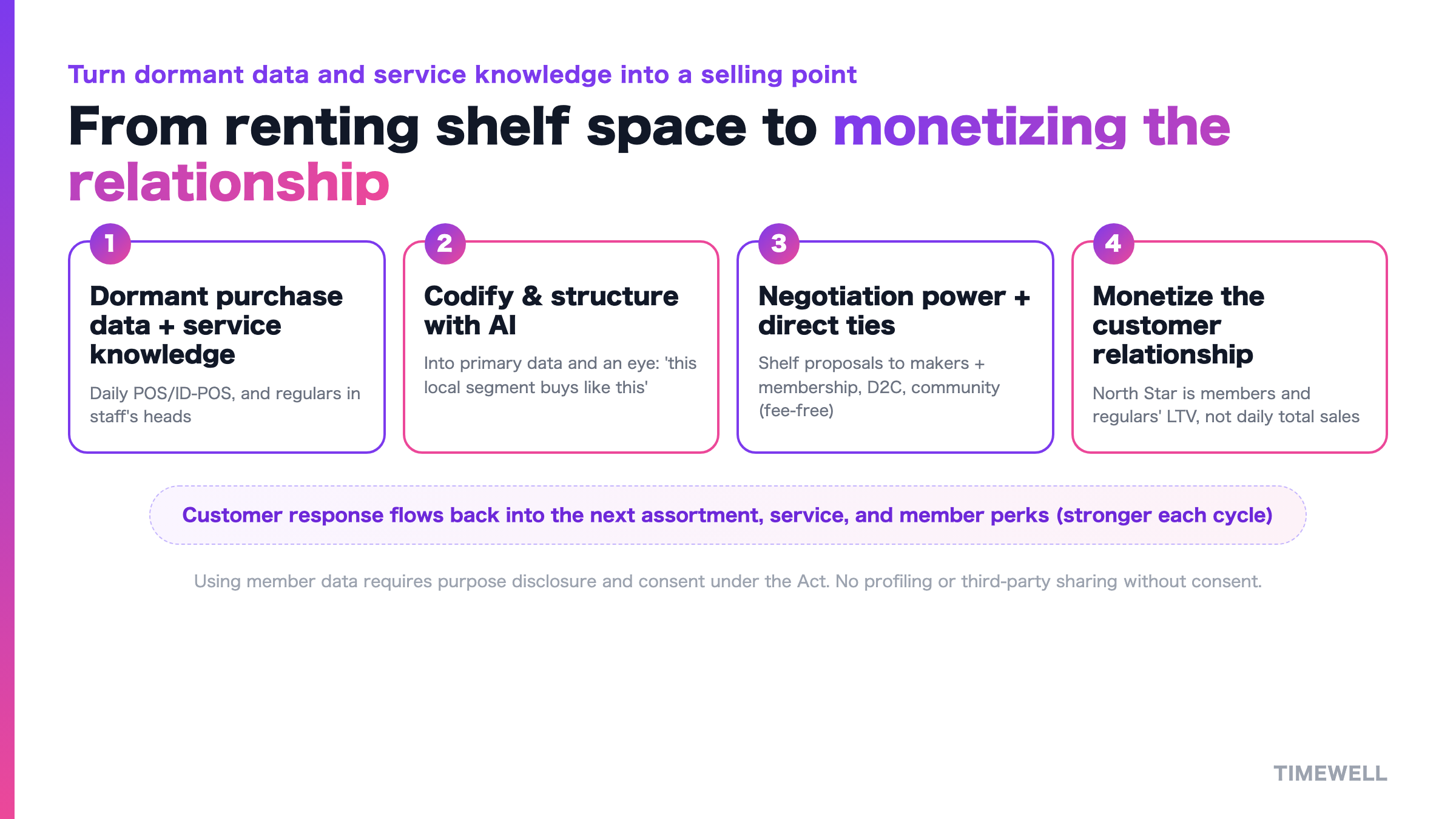
So far this has been about cost and the floor. From here it's offense. The service intuition inside clerks' heads, and the purchase data that piles up daily. Usually this information disappears inside the store—but with AI you can turn it into a record and make it an outward-facing "selling point."
Where it heads is a direct relationship with customers. From loyalty-card data, find the regulars who've come for a long time and buy a lot—in other words, the customers most valuable to your store. Center on them, and turn things into fee-free direct offerings a mall can't tax: little membership gatherings, subscriptions, curated boxes, reservations. With mail-order and live selling centered on "a person with a face," you can widen your trade area from around the store to the whole country. From a "space-renting" business that buys and lines goods on shelves, to a business you earn through the customer relationship itself. The numbers you chase also shift—from the day's total sales to the number of members and continuing customers, and the amount a regular spends over their lifetime.
In TIMEWELL's terms, building regular-customer gatherings, membership, subscriptions, reservations, and the vessel for events connects naturally to "BASE." But this is only a tool. In sequence, it still starts with the manager touching AI. If you rush the offense (membership, D2C) without first firming up the defense (ordering, dormant data), your footing usually wobbles.
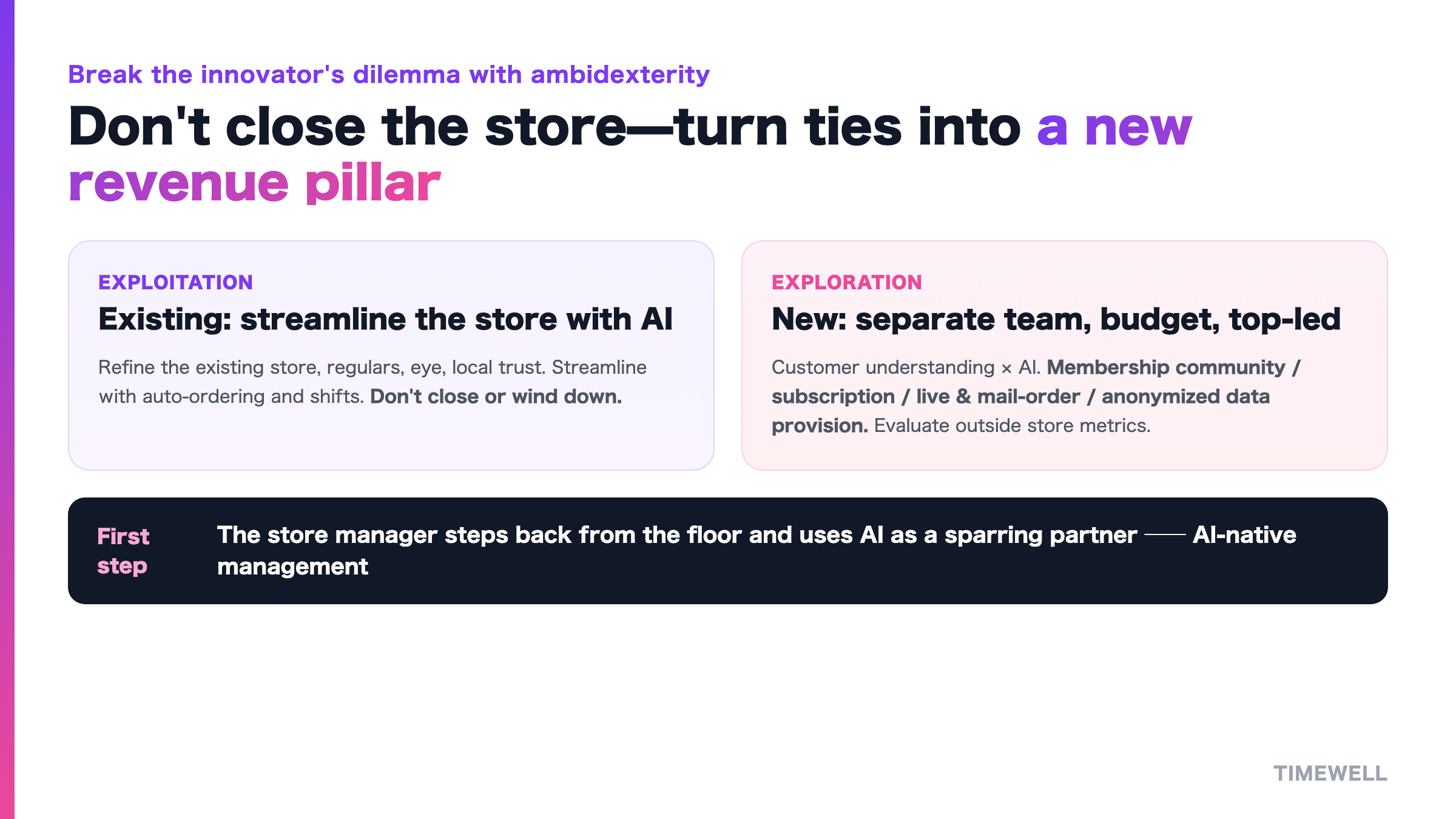
Don't stop the main business—stand a new pillar small, right beside it
Finally, a word about what lies beyond cost reduction. It would be a waste to use the capacity you create only to protect the sales of the existing store. That said, the more serious the store, the more "handling the register and stocking in front of you" becomes the right answer, and there's no bandwidth for new shoots. The trade-area population shrinks, and on malls you drain in fees and price competition. Thinking you're protecting, you slowly bleed out. Retail's daily life sits right next to this trap.
The key to escaping is not measuring a new effort by the store's current daily cash or short-term profit. Measure it that way, and it gets crushed as "not profitable" before it grows. With capacity, use a small separate team; without it, the manager can start with just half a day a week. Not stopping the existing store, and not suddenly winding it down—stand a new pillar, small, right beside it. The materials you use are the relationships with regulars you've built over 20 years, your eye, your local trust, and the purchase data that piles up daily. Try a membership gathering or a subscription. Put anonymized local-x-purchase data to use as material for shelf proposals or joint development toward makers and wholesalers. Without stopping the existing sales floor, try small beside it. That, I think, is the plain but sure first step from "renting space" to a store that can declare "whose kind of life this store supports."
Just once, let me add where retail stands with public numbers. Labor productivity per person in food-and-beverage retail stays at roughly 40% of the all-industry average—margins are thin. On top of that, the no-successor rate in retail is 57.0%, higher than the all-sector average, and many owners carry the anxiety of "can I get this into a form worth succeeding." That is exactly why, rather than making a big new investment, adding AI on top of the register, customers, shelves, and eye you already have—and pursuing streamlining and new-pillar building with both eyes—is the realistic path, as I see it.
Conclusion: dormant data into customer understanding, and the top changes first
Let me organize the key points.
- The easiest entry point to feel is the ordering you decide on gut feel. With an AI first draft, turn building from a blank slate into checking and tweaking. Start with the one category where waste hurts most.
- The first step is the manager stepping back a little from the floor to touch AI. With ten minutes of sparring after closing, reclaim the "thinking time" that had vanished.
- Retail is one of the few industries where the register auto-generates primary data daily. The problem isn't creating data but its dormancy. Turn it into customer understanding. Using member data presupposes consent and purpose disclosure under the Personal Information Protection Act.
- Service intuition can be left as a record. From renting space to a business you earn through "a direct relationship with customers"—membership, subscriptions, data provision. The numbers you chase are members and regulars' lifetime value, not total sales.
- A new pillar goes beside the main business, without stopping it. If you lack capacity, the manager can start with half a day a week.
Let me share my honest view at the end. There's no guarantee the effects touched on in this article produce the same result at your store. So rather than flashy cases, I recommend the plain sequence: the manager first uses AI as a sparring partner to reclaim thinking time, tries the one category where waste hurts most, and measures it in their own waste amount. Retail's treasure lies in the data the register spits out daily but goes unread, and inside the veteran clerk's head. The store that manages to turn that into a record, I believe, is the one that escapes renting space and becomes able to sell the customer relationship itself.
You can download the "AI Management Diagnostic Sheet (Retail Edition)," which checks this article against your own company, free from the top of the page. It's an Excel that lets you organize where to start while filling in five areas—ordering & inventory, customer & purchase data, store operations & service, e-commerce & promotion, and new business & management—and it also includes the three sparring prompts touched on in the article. First, have the manager fill it in together with AI.
When you want to sort out where adding AI—to your register, customers, and inventory—would work, please use WARP AI consulting or an individual consultation.
References and sources
- METI, "Current Survey of Commerce," 2025 annual results (published April 2026) 1
- METI, "FY2024 Survey on Electronic Commerce Market" (published August 2025) 2
- SME Agency, "Productivity analysis of small retail and service businesses" / Japan Productivity Center, "International comparison of labor-productivity levels by industry" 3
- Teikoku Databank, "Survey on corporate trends regarding labor shortage" (October 2025) / "National no-successor rate survey 2025" 4
- Ministry of Internal Affairs and Communications, "2025 White Paper on Information and Communications" / National Federation of Shopping District Promotion Cooperatives, "FY2024 Shopping District Survey" 5
Footnotes
-
https://www.meti.go.jp/statistics/toppage/report/archive/kako/20260414_1.html ↩
-
https://www.meti.go.jp/press/2025/08/20250826005/20250826005.html ↩
-
https://www.meti.go.jp/shingikai/sankoshin/keieiryoku_kojo/pdf/005_04_00.pdf ↩
-
https://www.tdb.co.jp/report/economic/20251117-laborshortage202510/ ↩
-
https://www.soumu.go.jp/johotsusintokei/whitepaper/ja/r07/html/nd112220.html ↩