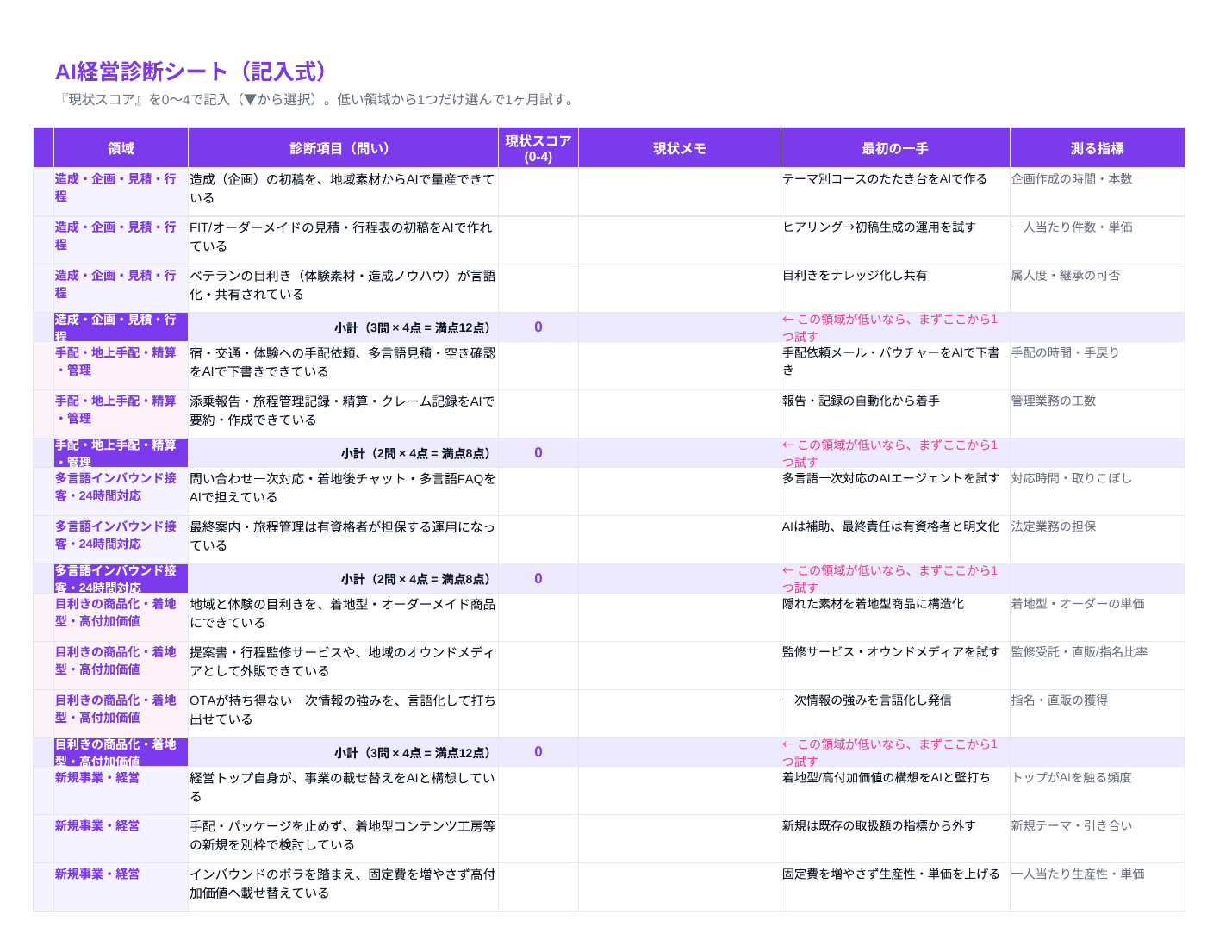
AI Management Diagnostic Sheet — Travel Agency (editable Excel)
A fill-in sheet that self-scores five areas—product planning/quotes, arranging/settlement/admin, multilingual inbound service, productizing the eye (destination trips), and new business & management—to decide where to add AI first.
Download the Excel sheet (free)Excel (.xlsx) ・ no email required
Hello, this is Ryuta Hamamoto from TIMEWELL.
When I talk with owners of small travel agencies and land operators (on-the-ground arrangers), a certain anxiety keeps coming up lately. Inbound customers are at a record high; the phone and inbox never stop ringing. And yet, when they close the books at year-end, the numbers are barely different from last year. If anything, for all the busyness, the take-home has thinned. "Customers are increasing, but we don't profit." Many people voice this uneasy feeling.
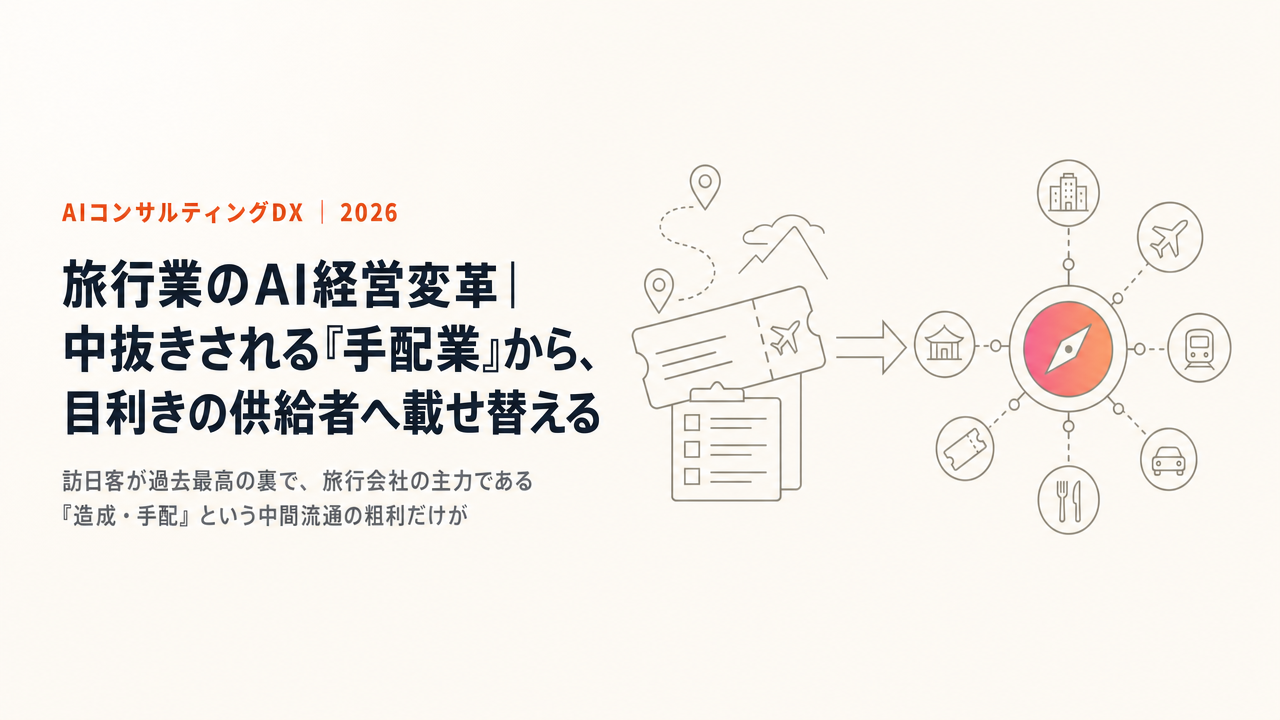
The trick isn't that complex. In 2025, inbound visitors reached about 42.68 million and spending about 9.5 trillion yen—both record highs. Yet packaged tours, the very thing travel agencies were best at, were down about 39.4% from FY2019 on a 43-major-company basis. Behind the festival, the mainstay products have recovered least. The reason: the main booking battlefield moved to online booking sites (OTAs) and customers' direct bookings, and the wholesale margin of "booking, arranging, planning" that agencies held is being quietly disintermediated there. The market isn't shrinking; the place where profit sits has been reassigned.
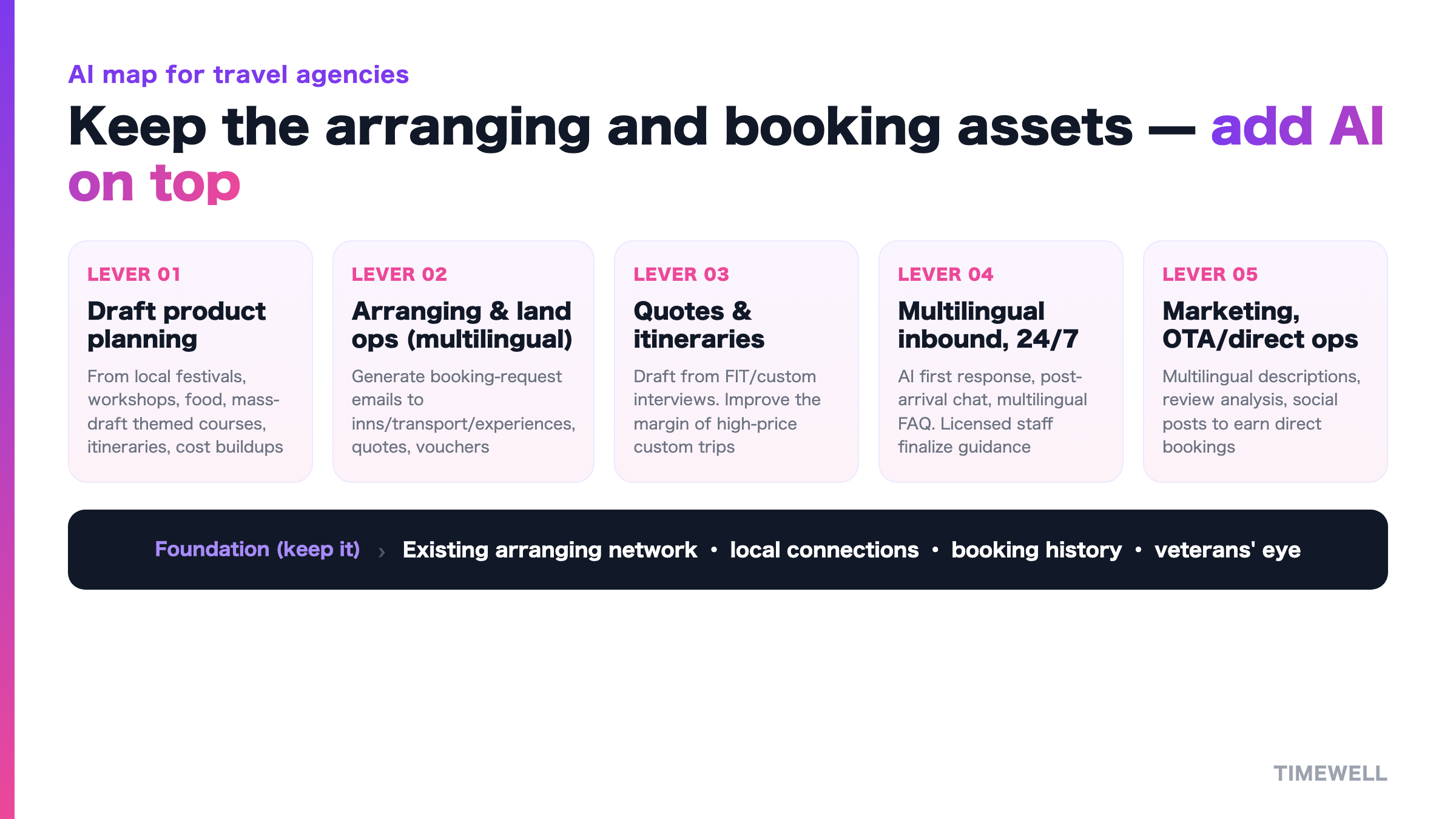
That is exactly why I think travel agencies, of all businesses, have a turn coming for AI. But this is not about discarding your existing arranging network or the local connections built over years and swapping in a new system. Keep the arranging steps you have now, your booking data, and the veterans' eye for the region held in their heads—and add AI on top. This article follows, from a hands-on view, how to make unprofitable custom trips workable, how to lighten multilingual service, and how to turn your greatest asset—an eye for place and experience—into a selling point. Let me state the backbone up front: every first step begins with the owner personally touching AI every day until they can use it well. I'll give the reason later.
Start with the unprofitable "custom order"
Isn't this a familiar scene? An inquiry comes in for an individual arrangement (FIT) or an affluent custom trip. The unit price is high. But once things start moving, someone gathers the local materials, sends arranging emails to inns and experience facilities, gets multilingual quotes, and works it into an itinerary. A staffer spends a full day building it. The price is high, but divided by the time spent, it doesn't pay at all. And those steps live in one veteran's head, so when they take a day off, everything stops. "One-off, one-of-a-kind" handwork eats the most time and is the most person-dependent thing in a travel agency.
This is the entry point where AI is easiest to feel. Hand the customer's hearing memo to AI, have it produce a first-draft itinerary, and the staffer only checks and supervises. Change the work of "creating from zero" into the work of "fixing."
Let me be concrete with a model case (this is a hypothetical premise and varies greatly with the region and the complexity of the case). Take a 5-day FIT itinerary. What used to take about 3 hours per case, once you shift to hearing memo → AI first draft → supervision by licensed staff, shrinks to about 45 minutes per case. A staffer who was maxed out at 8 cases a month can handle around 20. That's the picture. It does not mean "AI decides the itinerary." Final responsibility for itinerary management and guidance is always held by qualified people—tour conductors, licensed guides, and travel-service managers. We don't bend that. AI does the first draft and the prep; people do the judgment and supervision. This division is the crux.
And this isn't something that requires a big upfront cost. If you simply add generative AI without replacing your existing booking and arranging setup, you can run a small trial of a few weeks to a month, without spending heavily up front, and measure by "time" and "cases" whether it works on one of your tasks. Not company-wide all at once, but from one case, one task. For SMEs with limited people and funds, that is the right order.
Try it first on your most recent custom order. Take one past hearing memo, hand it to AI to produce a first draft, and compare it side by side with the veteran's finished work. That alone lets you feel how far you can delegate and where a human is still needed. You can also check what stage your company's AI use is at with the AI literacy check.
Looking for AI training and consulting?
Learn about WARP training programs and consulting services in our materials.
The first step: the owner touching AI every day
Before the list of moves, let me place what comes first in sequence. The owner themselves becoming able to use AI. In travel, this has a special meaning.
What's happening in this industry is not the automation of individual tasks. It is a move of the business's center of gravity itself—"from the shrinking arranging trade to a high-value trade that sells place and experience." Which step to add AI to, and which new pillar to step into—these are not calls a single floor staffer can make. They are management judgments that set the direction of the business. That is precisely why the top must envision it.
The top tries consulting AI about the business. "List 10 hidden experience materials in our region and draft the outline of a custom itinerary for affluent travelers." "Now that online booking disintermediates us, help me organize the strengths for which we'd be chosen in direct sales." Even if half of what comes back is off the mark, becoming able to judge and fix that off-ness yourself is the entrance to using AI well. AI is now the cheapest sparring partner an owner can have.
Japanese firms' generative-AI usage rate sits at just 55.2% in the MIC's FY2025 white paper on information and communications. The biggest concern about adoption was "we don't know how to use it effectively." This "we don't know" won't be filled by outsourcing or training. The top touches it even 10 minutes a day. I've rarely seen AI use take hold at a company that skipped this. The same thinking, in a different industry, runs through AI transformation for parts manufacturers.
Cutting cost: "add" to planning, arranging, and multilingual service
After custom orders, go a little wider and lighten the daily clerical work. The principle is the same: don't replace the system, just "add" AI in front of it or beside it.
In planning, mass-produce themed course ideas, itineraries, and rough cost buildups with AI from first-hand materials—local festivals, farming and fishing, workshops, food. In arranging, generate with AI the request emails to inns, transport, and experience facilities, the multilingual availability checks and quote requests, and voucher drafts. Put the person-dependent steps into records so staff can reuse them. Settlement, tour-conductor reports, itinerary-management records, and complaint-handling summaries can also be drafted with AI.
Then there's multilingual service, so you don't drop the inbound tailwind. Have an AI agent handle first response to inquiries, post-arrival chat support, and multilingual FAQ and tourist information, supplementing on-site work you can't staff. Multilingual listing descriptions and social posts, too—make the first drafts with AI. Instead of being disintermediated, direct your marketing power toward generating "named requests" and "direct sales." That said, this is an industry that handles sensitive personal information such as passports and payments. Information management when inputting to AI needs care, and final guidance and itinerary management are assured by licensed staff. This line cannot bend.
Here is one sparring prompt for sorting out, together with the owner and AI, where to start. Paste it as is and replace the text inside 【】 with your own information. The remaining two (turning the regional eye into a selling point / producing seeds for a new pillar) are included in the free diagnostic sheet.
You are an operations-improvement consultant for small travel agencies. On the premise of "adding" AI without discarding the existing arranging network, local connections, and booking data, help decide which task to tackle first. The premise is that final responsibility for itinerary management and guidance rests with licensed staff.

# Input (I will fill this in)
- Type and scale of business: 【e.g., region-limited agency, destination and inbound arranging, X employees】
- Three most time-consuming tasks now: 【e.g., planning / booking requests and quotes / tour reports and settlement】
- Owner and time per case for each: 【e.g., custom itinerary creation takes X hours per case】
- Person-dependent tasks: 【e.g., regional experience materials and arranging steps are in one veteran's head】
- Data on hand: 【e.g., past booking history, itineraries, a list of regional materials】

# Your tasks
(1) Evaluate the tasks on "time required," "person-dependence," and "effect on the high-value shift."
(2) For each, separate what AI can take over (first draft, prep, groundwork) from what a human must carry (final judgment, statutory duties).
(3) Choose the one task to add AI to first, and show the grounds.
(4) Show a "one-month small demonstration" plan for that one task. Make use of the existing arranging network and data.
(5) Define measurement indicators (creation time, cases per person, unit price, etc.).

# Output format (follow exactly)
1. Evaluation table: columns are [Task / Time required / Person-dependence / Effect on high-value shift / What AI drafts / What humans must carry / Estimated reduction (assumed, with formula)]
2. The one task to tackle and the reason for choosing it (within 3 sentences)
3. One-month small-demonstration plan (what, when, how to measure)
4. Definition of measurement indicators

# Constraints
- Do not use abstract words like "efficient" or "convenient"; write what changes and how, using verbs.
- Do not bend the premise that final responsibility for itinerary management, interpreter-guiding, and itineraries rests with licensed staff and the travel-service manager.
- Label unknown numbers "assumed" and add the premise and formula. Do not fabricate.
- At the end, list the three weakest assumptions or risks most likely to break this plan.
Just once, let me note the nature of the numbers. Visitor count, spending, and the roughly 39.4% drop in packaged tours are public statistics from the government and the Japan Tourism Agency. On the other hand, most of the "AI cuts labor by X%" effect figures this article touches on are the vendors' own figures, and there's no guarantee you'll see the same numbers at your own site. That's why, rather than lining up flashy figures, I recommend measuring "time" and "cases" on one of your own tasks. This distinction is a premise throughout this article.
Turn the eye into a selling point
Up to here it was about cost. From here it's offense. The "eye for place and experience" your company built up over years is not a cost dormant in a veteran's head—it can be turned into an outward-facing selling point.
There is something online booking sites and major platforms can never hold: "first-hand information on place and experience." Only the local firm—rooted in that land, knowing the still-unknown experience materials, and understanding the regulars' knack—has it. First, have one or two veterans talk through "why we recommend this inn, in this order," and use AI to transcribe and structure it into procedures and material lists. The eye that would vanish with retirement is left in words, without capital investment.
And that knowledge becomes an outward weapon. Write your experience proposals in the words buyers actually search (region, purpose, season). Make the first draft with AI, have a human verify the facts, and publish. Place an AI chat trained on your materials and FAQ on your site to give 24-hour first response, and turn the questions that come in into "the next topics to write." What matters here is to track not article views but the count of named requests and quote requests. If access rises but deals don't, it means nothing.
In TIMEWELL's terms, if you want to organize person-dependent arranging know-how and regional materials into a retrievable form, "ZEROCK" connects naturally; for building regulars around destination experiences and running local communities, "BASE" fits. But these are tools. In sequence, it still starts with the top envisioning the business shift. The same thinking works for hiring and skill transfer. Record arranging steps and regional materials as in this chapter, so juniors can pull them up. For more, AI implementation patterns in HR is a useful reference.
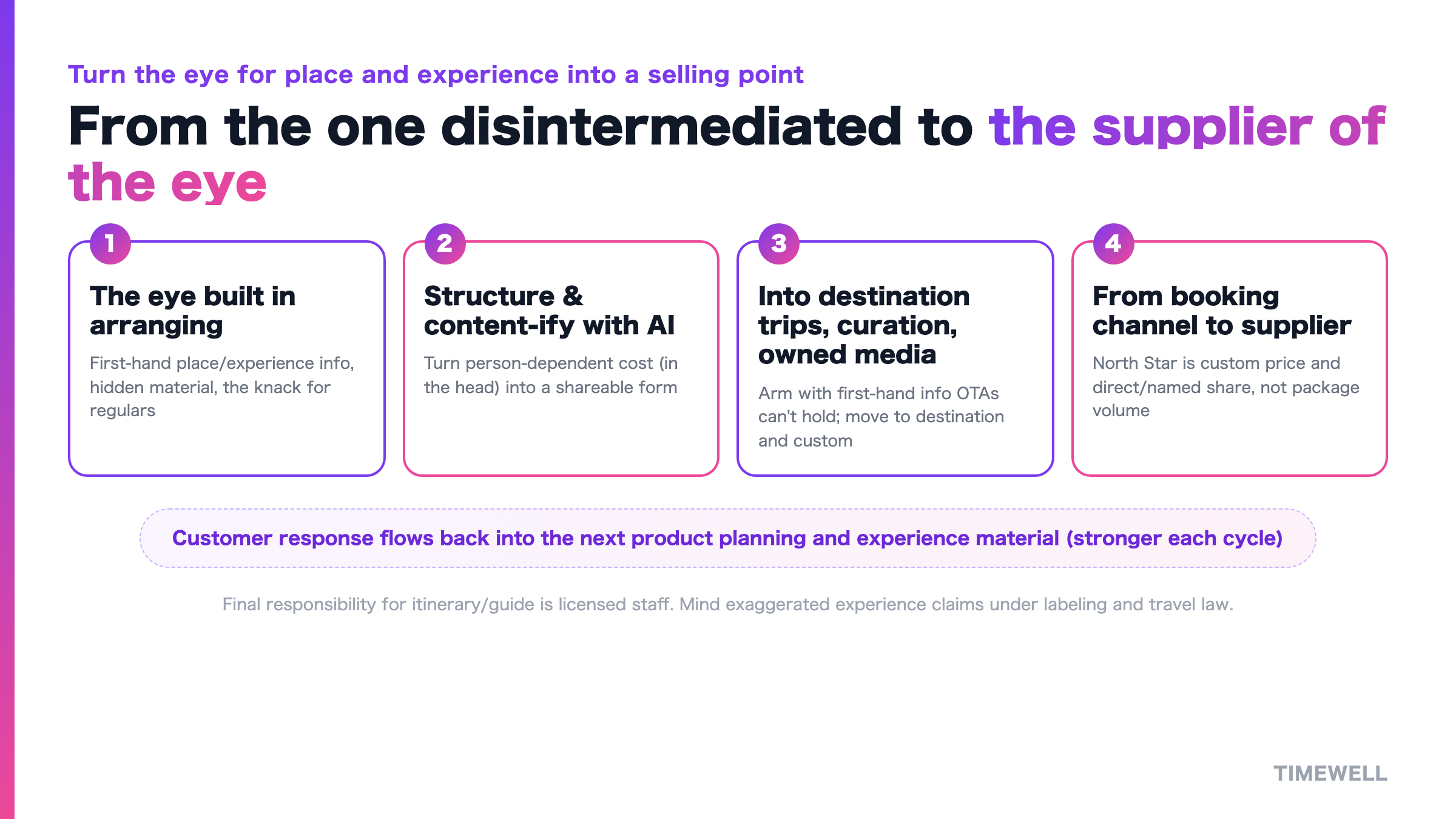
Your position changes. From a disintermediated "booking channel" to an inimitable "supplier of the eye." The numbers you chase also shift—from package handling to the unit price of custom and destination trips, the share of direct and named requests, and the revenue from selling the eye externally.
Without stopping the mainstay, stand a new pillar small beside it
Finally, the part beyond cost reduction. It would be a waste to spend the capacity you free up only on prolonging the shrinking arranging trade. And yet, the more earnest the firm, the more "handling the orders in front of you" becomes the right answer, leaving no hands for new sprouts. Daily arranging life sits right next to this trap.
The key to escaping is not to measure new efforts by the current arranging utilization or short-term profit. Measured that way, they get killed as "unprofitable" before they can grow. If you have capacity, use a small separate team; if not, the owner spends just half a day a week. Set it apart from the existing arranging trade and multiply your years of booking-history data and local connections with AI. Then what used to be an internal cost starts to look like a service you can sell outward. A custom-luxury brand for affluent travelers. Contract creation and high-value work of tourism content for DMOs, municipalities, and accommodations. Land operations and multilingual support for overseas travel agencies. Your own platform bundling experience bookings. Try it small beside the existing arranging and sales, without stopping them. That is the modest but sure step from the disintermediated side to the side that supplies the region's eye.
But let me add one heavy premise. Inbound swings greatly with exchange rates, geopolitics, epidemics, and disasters. Increasing fixed costs on the premise of a record high is dangerous. So the new pillar should start small, with a small team and a separate budget, without inflating fixed costs. Do not bend this caution.
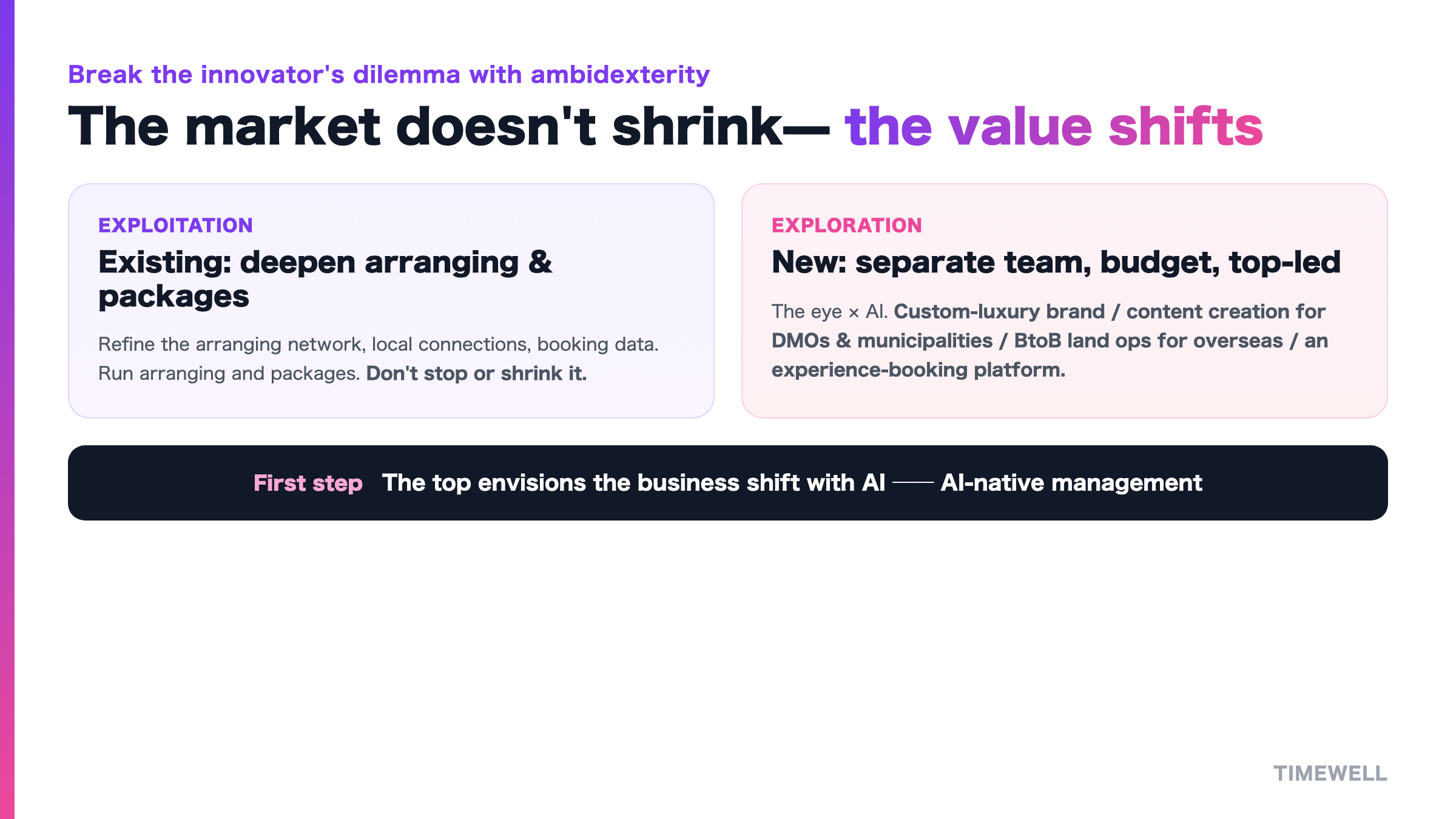
A sparring prompt for producing seeds for the new pillar is also included in the diagnostic sheet. Before you think it through alone, make AI your partner.
Conclusion: from the arranging trade to a supplier of the eye
Let me organize the key points.
- The easiest entry to feel is the unprofitable custom order. With hearing memo → AI first draft → supervision by licensed staff, change the work of creating from zero into the work of fixing. Start with your most recent case.
- The first step is the owner personally touching AI every day. Moving the business's center of gravity from arranging to a high-value trade is a management judgment, not a floor one.
- For cost reduction, "add without discarding." Start with first drafts of planning, arranging, and quotes, and with 24-hour multilingual service. But final responsibility for itinerary management and interpreter-guiding is assured by licensed staff.
- The eye for place and experience can be turned from an internal cost into a selling point. Only the local firm holds first-hand information online booking can't. Chase the count of named and quote requests, not access.
- Stand the new pillar in a separate frame without stopping the mainstay. With no spare capacity, the owner starts from half a day a week. Because this industry swings with exchange rates and disasters, don't over-increase fixed costs.
Let me write my honest view at the end. Many of the effect figures this article touches on are the vendors' own, and they may not be the same at your site. And inbound swings greatly with exchange rates and disasters. Even so—what thins out in the festival is the "booking and arranging" anyone can do. The person who knows the hidden experiences of that region and can appraise them is still only you. When you give that words and product form with AI, your position changes from the disintermediated side to the supplying side.
You can download the "AI Management Diagnostic Sheet (Travel Agency Edition)" for checking this article against your own company, free from the top of this page. It is an Excel that lets you fill in and organize where to start across five areas—planning/quotes, arranging/settlement/admin, multilingual inbound service, productizing the eye/destination trips, and new business & management—and it includes the three sparring prompts touched on in the text. First, have the owner fill it in together with AI.
If you'd like to sort out, together, where adding AI to your arranging network and data would work, please use WARP AI consulting or an individual consultation.
References and sources
- Japan National Tourism Organization (JNTO), "Number of foreign visitors to Japan (December 2025, annual final)" (published January 2026) 1
- Japan Tourism Agency, "Consumption Trend Survey for Foreigners Visiting Japan, calendar year 2025" (published January 2026) 2
- Japan Tourism Agency, "FY2024 Travel handling of major travel agencies, annual total" (published June 2025) 3
- Japan Tourism Agency / Japan Association of Travel Agents (JATA) travel data bank (operator counts) 4
- Japan Tourism Agency, "Sustainable tourism regional development / regional high-value" / Japan Ryokan Association operating-status survey 5