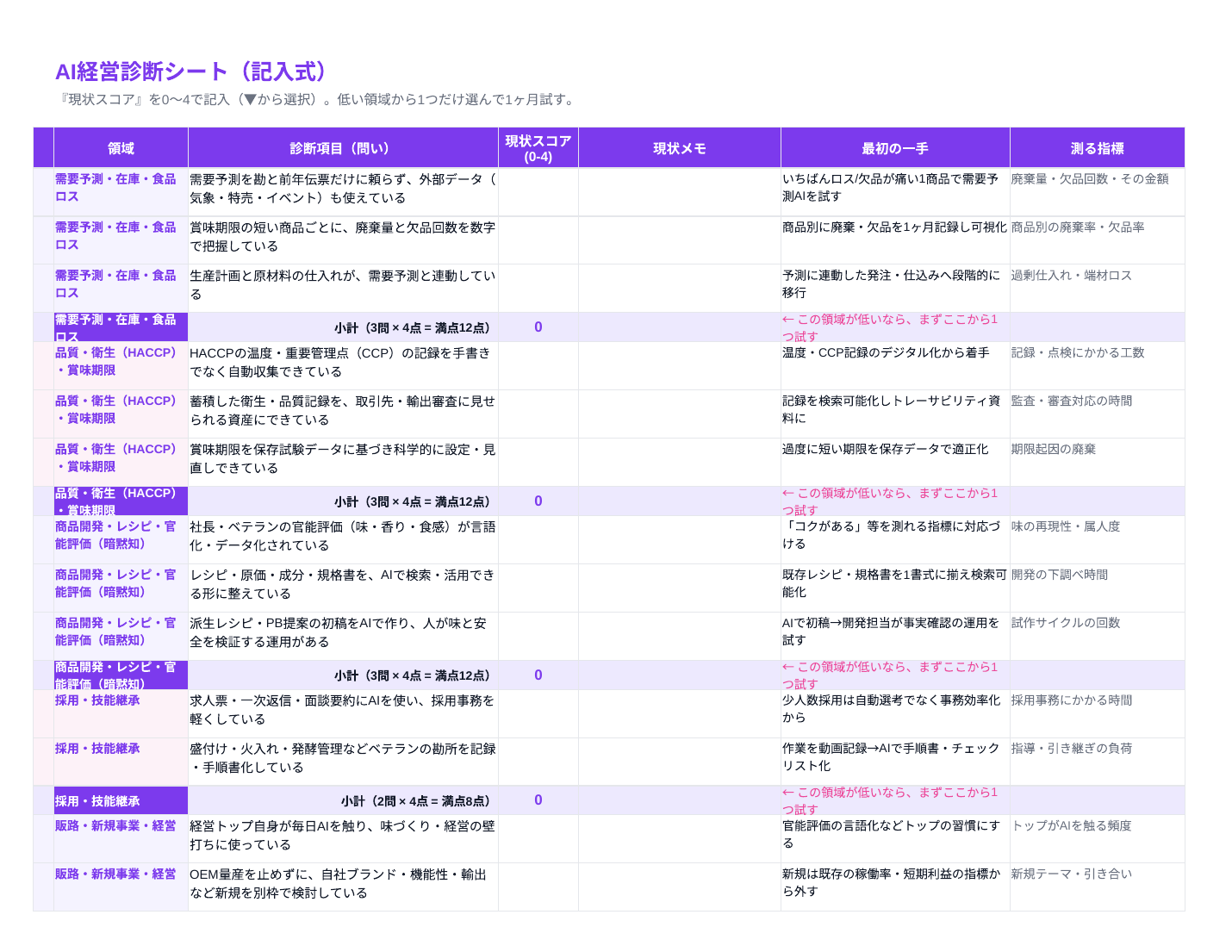
AI Management Diagnostic Sheet — Food Maker (editable Excel)
A fill-in sheet that self-scores five areas—demand & inventory, quality & hygiene (HACCP), product development & recipes, hiring, and new business—to decide where to add AI first. Includes an action and subsidy quick-reference.
Download the Excel sheet (free)Excel (.xlsx) ・ no email required
Hello, this is Ryuta Hamamoto from TIMEWELL.
When I meet the owner of a food maker, their eyes light up the moment the talk turns to taste. "This blend has been off-limits to outsiders since my predecessor's day." "No machine can make this heating-point call." That pride, I believe, is genuine. But in the same seat, I have also watched the voice drop a notch, again and again: "There's no one to pass that palate on to."
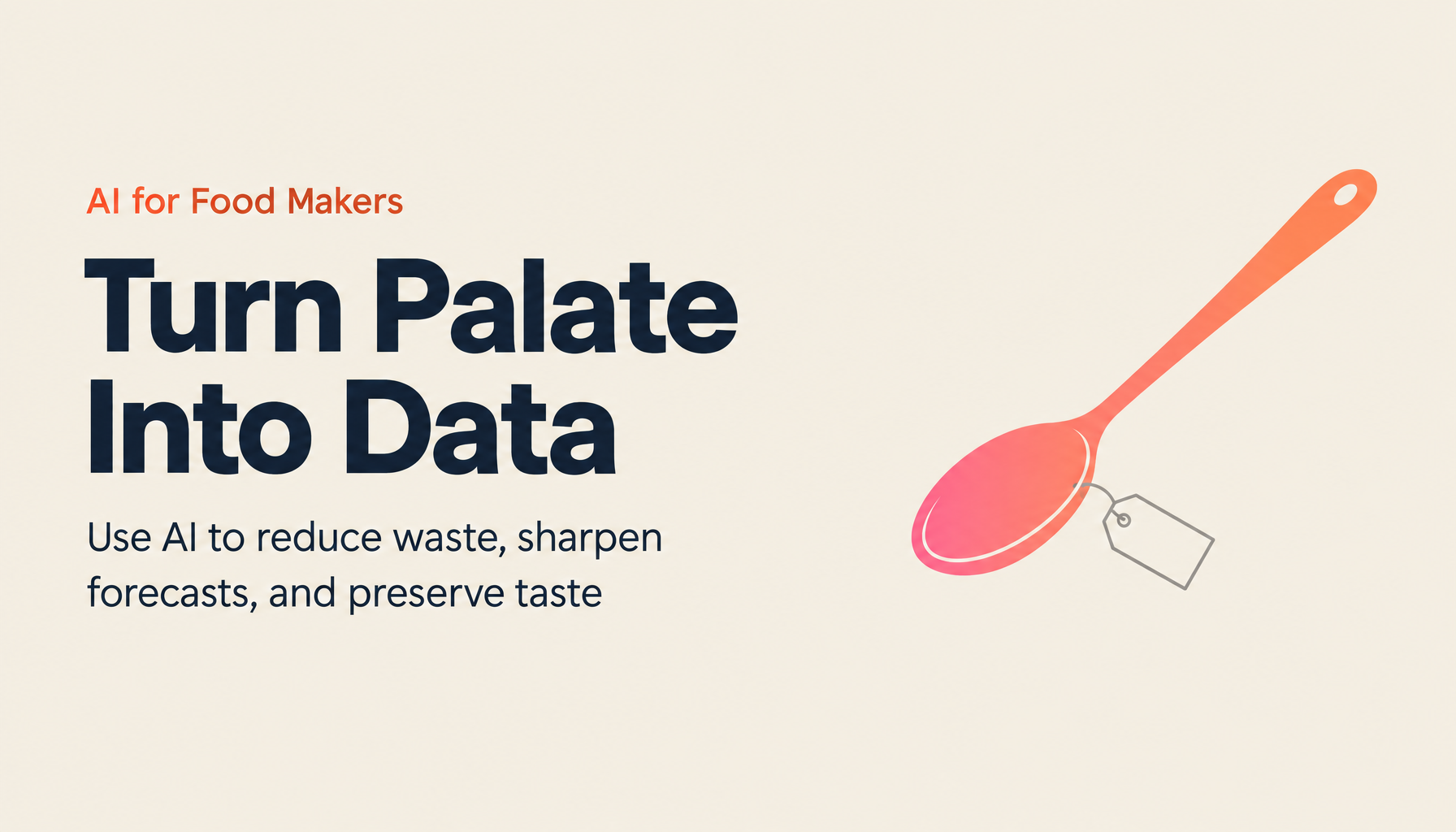
So I won't say a single word about replacing your equipment. Keep the production equipment you have, the secret recipes, the ties to local producers, and the owner's palate—and just add AI on top. This article stays only on that: making tomorrow's "bet" on how much to prep lighter, cutting waste and stockouts at once, lowering the defensive burden of HACCP records, and taking the owner's palate—your single largest asset—all the way to turning it into a selling point. Let me state the backbone first. Every first step begins with the top of the business personally touching AI every day and becoming AI-native. For a food maker, that is the very act of beginning to translate the owner's palate into data with the tool called AI. I'll get to why later.
Start with the Friday-evening bet
Doesn't an evening like this happen? Friday evening. You have to decide how many portions of tomorrow's prepared foods (daily, fresh) to make. Make a lot, and by tomorrow evening you're slapping on discount stickers, and whatever is left becomes waste. Make few, and the shelf empties by early afternoon and you lose the customer who "came all this way." This one-shot gamble is held by the owner or a single veteran, glancing sideways at years of gut feel, last year's slips, and tomorrow's forecast. Truly, at many companies. When that person takes a day off, the read loses its accuracy at once. The shorter the shelf life, the sooner a missed bet comes back that same day as waste or a stockout.
This is where a food maker feels AI most easily. Combine past shipment records with external data—weather, day of week and calendar, planned promotions, local events—and AI produces a first draft of the "what will sell" forecast. The owner or veteran then adds the intuition for new products and the judgment for irregulars, and settles the final prep volume. The aim is to shave both overproduction and stockouts, a little, at the same time. You turn work that used to be decided from scratch by gut into work of looking at a draft and making small adjustments. That is the essence; I do not say "leave it to AI and it's all automatic."
Not all products at once. Start with just the single product where the loss hurts most. When we work alongside you, we pick that one product first and design a four-week trial (PoC) together, using past shipments and weather data. We measure the effect not by the vendor's reduction rate but by your own yardstick—your waste in yen and your stockout count. Before you start, record "that product's monthly waste volume, stockout count, and the money for each," and after four weeks compare with the same yardstick. That's all.
Let me convey just the image with a model case (a hypothetical, to be clear). A factory that had always prepped one prepared-food item at a flat "about 120 portions a day" on a veteran's gut started, after seeing a draft, to vary it between 110 and 135 by day of week and weather. As a result, the Friday overproduction and the Sunday stockouts eased a little—a plain step of about that size. Rather than a flashy "waste down by X percent," starting from a small improvement you can confirm on your own slips is, I believe, the right order for a small firm with limited money and people. You can also check what stage your own AI use is at with the AI literacy check.
Here is one sparring prompt for sorting out "which product to try demand forecasting on first," together with the owner and AI. Paste it as is and replace the text in brackets with your own information. The remaining two prompts (translating the owner's palate into a "taste blueprint," and producing new sources of bread) are bundled into the free diagnostic sheet (Excel).
You are a supply-and-demand improvement consultant for small food makers. On the premise of adding AI demand forecasting without discarding existing production equipment or sales management, help decide which product to tackle first.

# Input (I will fill this in)
- Main product and shelf life: [e.g., daily prepared foods (2-day shelf life), 40% of monthly sales]
- How you forecast demand now: [e.g., a veteran plans by hand from last year's slips and the weather]
- Top 3 products where waste (loss) and stockouts hurt most: [e.g., summer cold noodles hurt on waste; seasonal wagashi on stockouts]
- Numbers as far as you know: [e.g., cold noodles: monthly waste XX kg, stockouts XX times, money assumed at XX yen/month]
- External data on hand: [e.g., POS, weather, promotion calendar, social media]

# Your tasks
(1) Evaluate the products on "shortness of shelf life," "pain of waste/stockout," and "demand variability (sensitivity to weather/season)."
(2) For each product, separate the forecasting steps AI can take over from the judgment humans must make (new products, irregulars).
(3) Choose the one product to try demand-forecasting AI on first, and show the grounds.
(4) Show a one-month PoC plan for that one product, week by week. Keep the existing production plan and run AI alongside.
(5) Define measurement indicators (waste volume, stockout count, money).

# Output format (follow exactly)
1. Evaluation table: columns are [Product / Shelf life / Pain of waste (high-mid-low) / Pain of stockout (high-mid-low) / Demand variability / What AI forecasts / Judgment humans keep / Estimated savings (assumed, with formula)]
2. The one product to tackle and the reason (within 3 sentences)
3. One-month PoC plan (Week 1-4, what to do and the number to measure each week)
4. Definition of measurement indicators (what, when, how to record)

# Constraints
- Do not use abstract words like "efficient" or "optimize"; write what changes and how, using verbs.
- Label unknown numbers "assumed" and always add the premise and formula. Do not fabricate.
- At the end, list the three weakest assumptions or overlooked risks most likely to break this plan.
Just once, let me sort out the nature of the numbers. Figures like "manufacturing accounts for 1.10 million tonnes of business food loss, the largest by sector"1 are public estimates and statistics from government and independent agencies. On the other hand, most effect figures like "waste fell by X percent" are companies' or vendors' own figures, with different conditions and scale. There is no guarantee the same number appears at your factory. That is why, rather than lining up flashy reduction rates, I recommend measuring on your own—one product, one month. This distinction is a premise throughout this article.
Looking for AI training and consulting?
Learn about WARP training programs and consulting services in our materials.
The first step: the owner has AI put their own palate into words
I talked about demand forecasting first, but what truly comes first in sequence is this: the top of the business personally touching AI every day. For a food maker it carries special meaning, because this company's biggest tacit knowledge usually lives inside the palate of the owner or a veteran.
For an owner, the first step is this. Take the taste judgment you do with your own palate, and first have AI put it into words. Type in "Break down the 'rich body' of our miso into five elements a stranger could understand." Half of the breakdown that comes back will be off the mark. But becoming able to judge for yourself "this part is wrong, this part is close"—that is the first step in turning secret tacit knowledge into data, and the entrance to AI-native management.
This "putting the palate into words" back-and-forth speeds up product development directly. Feed existing recipes, cost, nutrition, allergens, and specs into AI, and it quickly produces drafts—proposals for customers, derivative recipes like reduced-salt or high-protein, and trial condition ideas. Of course the first draft can be AI's, but the actual taste and safety are confirmed by humans before it goes out into the world. Generative AI cheerfully produces plausible falsehoods, so the final check of numbers, ingredients, and processes is always the developer's job. Miss this and it turns into an accident.
Why must the top touch it personally? One: how far AI can go in taste-making or demand forecasting, and where the human's job begins, cannot be grasped from verbal explanation alone. Unless the owner types it in themselves and feels whether the answer is any good, the resolution of investment decisions will not rise. Two: throw it over the fence to the floor and it ends in "we're busy enough already." Only when the top shows direction and it turns on both wheels together with on-site improvement does it move. Three: AI is now the cheapest sparring partner an owner can have. New-product plans, material for cost negotiations, hiring worries—before you carry them to the management meeting, nothing is handier for organizing your head.
Japan's generative-AI usage rate is 55.2% in the Ministry of Internal Affairs and Communications' 2025 Information and Communications White Paper. Far behind China's 95.8% and the US's 90.6%, and the biggest adoption concern among Japanese firms was "we don't know how to use it effectively." That "we don't know" is not filled by training or outsourcing. The owner touches it even ten minutes a day and grasps, in their own words, "this works, this doesn't yet." It is plain, but I rarely know of a company that skipped this and succeeded at the DX of taste-making. TIMEWELL's AI consulting "WARP" is likewise designed starting from the manager mastering AI as a management tool. It is a companionship in translating the owner's palate—the biggest asset—into data. On the foundational, monozukuri side, reading the paired AI transformation for parts manufacturers alongside this adds dimension.
Lighten the "defense": HACCP records, blends, and shelf life
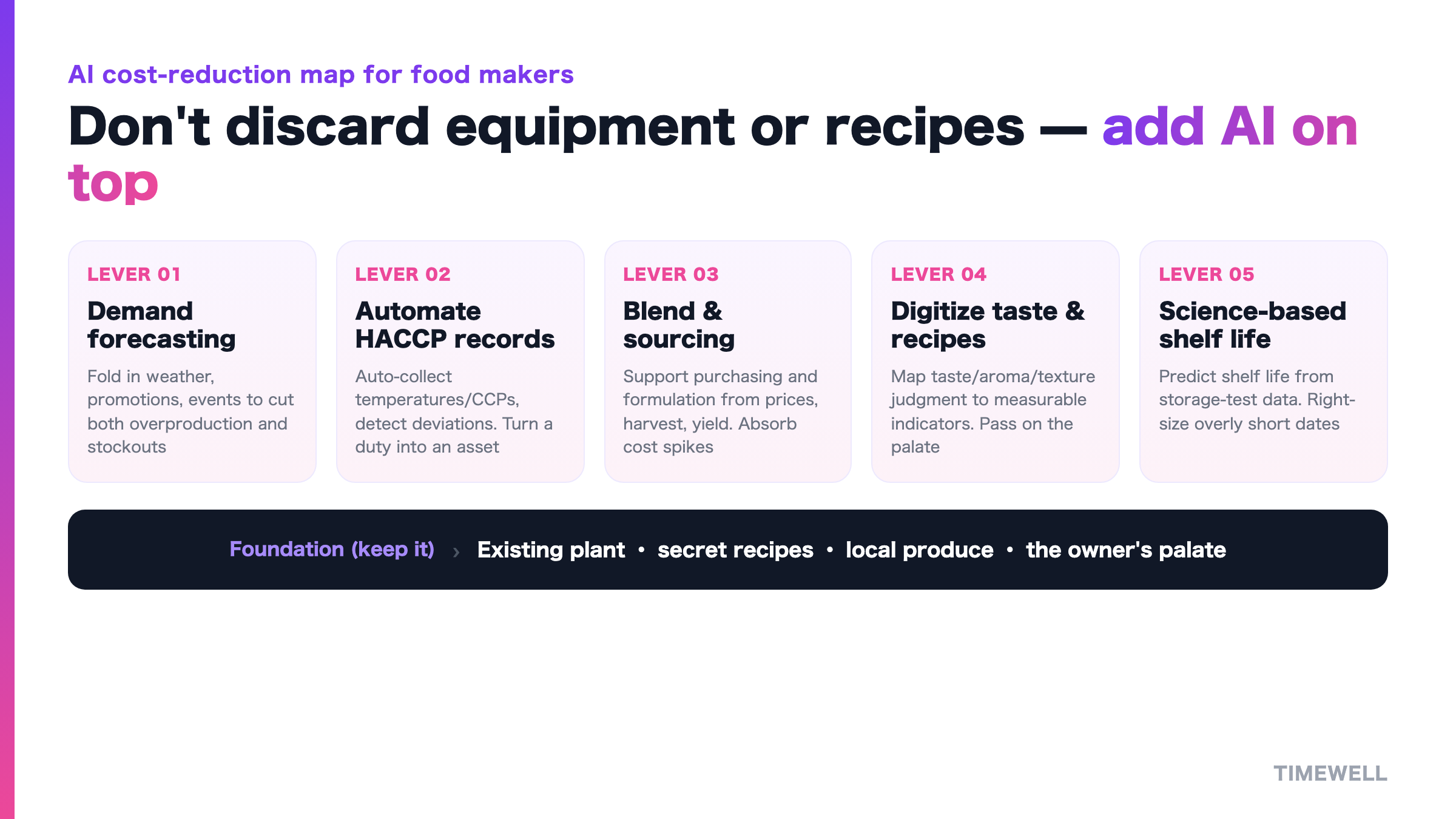
After demand forecasting come the "defensive costs" specific to food makers. The burden of duty and quality assurance is heavy here, so the effect of adding AI is easy to feel. The principle is the same—don't replace equipment, just add ahead of or beside it.
First, HACCP records. Many floors still run temperature and critical-control-point checks on handwritten forms. Change this so retrofit temperature sensors and the like collect them automatically, in a form where you notice at once if you stray outside the range you set. There are two aims: one, lowering the on-site burden of compliance; two, turning the accumulated records into "evidence of quality and traceability." Records change character—from something you grudgingly keep because it's required, into an asset you can proudly show customers and export reviews. Let me make one thing clear here. HACCP-based hygiene management has been mandatory in principle for all food businesses since June 20212, but whether to add AI is voluntary. I will absolutely never do the scare of "you're illegal without AI." Keep the mandated hygiene management and the optional AI enhancement as separate matters.
Next, blends and procurement. Based on raw-material market prices, harvests, and yield data, have AI support the review of blends and the timing of purchases. Rather than discarding existing formulation sheets and recipes, the addition is to have AI read them and think through with you "when this ingredient spikes, where is the room to adjust while keeping the taste?"
One more, plain but effective: science-based shelf-life setting. From raw-material lots, production conditions, and storage-test data, estimate shelf life with AI. Right-sizing, on solid grounds, a date that had been kept overly short for safety's sake itself reduces waste. An overly short date, on its own, generates loss at the storefront.
Turn tacit taste and recipe knowledge from "cost" into a "selling point"
Up to here was lightening recipes and quality assurance as "defensive cost." From here it is offense. Take the food knowledge you now hold internally as person-dependence risk and defensive burden, turn it into data, and flip it into an outward-facing "selling point."
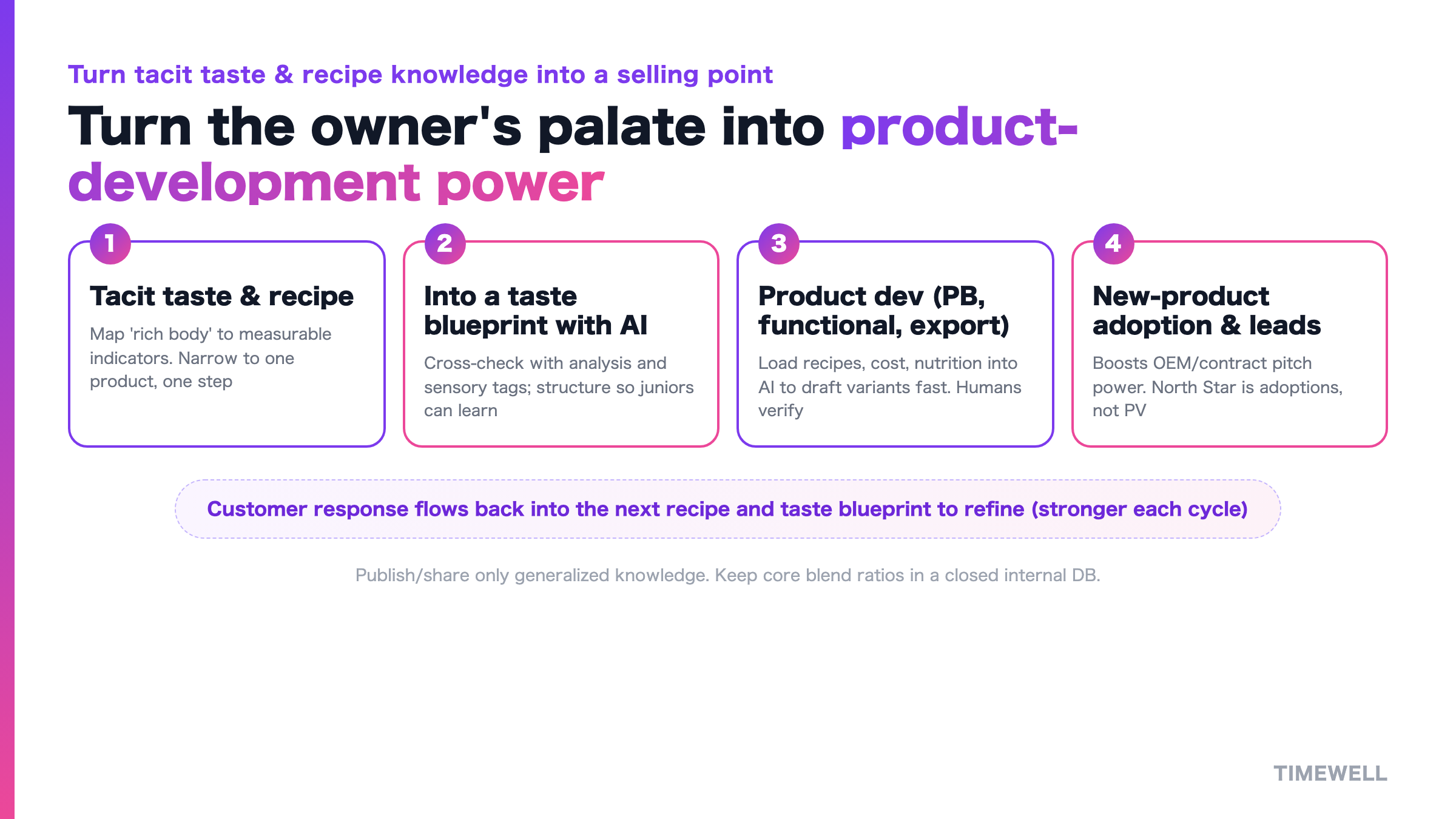
The core of what you do is to record the judgment criteria for the senses—taste, aroma, texture—by matching them against measurable numbers and process conditions. Tie a veteran's words like "rich body" or "light aftertaste," little by little, to recordable indicators—salinity and pH, sugar content, aging temperature and period. Even without a dedicated machine like a taste sensor, you can start from what you can measure now. The "taste blueprint" you build that way leaves the retiring craftsman's palate to the next generation and, at the same time, becomes an outward weapon directly. A company that can speak with data rather than gut—"we can meet your reduced-salt need with our design like this"—is strong in OEM and contract-development negotiations. HACCP-derived hygiene and quality records, too, become a sales asset you show customers and export reviews as "proof of safety and traceability."
What matters here is how you set the number you chase. Measuring the fruit of this effort by the page count of internal meeting materials or by factory utilization is meaningless. What you chase is the number of new-product adoptions and contract-development inquiries. How much of the knowledge you stored on defense did you connect to orders? Turning to offense means exactly that, I believe.
One line to draw. What you may show customers and the world is only "generalized results and thinking." The core—key blend ratios, unique process conditions—stays in an internal database you do not release outside. Blur this and you'll be handing out your source of bread for free. This "translate the palate into a taste blueprint" sparring prompt is bundled into the diagnostic sheet mentioned above.
The same thinking works for hiring and skill transfer. Lighten job-posting drafts and summaries from interview recordings with AI. Record veterans' knack for plating, heating, and fermentation control by video or audio, and drop it into procedures, checklists, and newcomer manuals with AI. It is continuous with the earlier "taste blueprint." Fill the chronic problem of "no one to instruct," without replacing equipment, with a record of knowledge. But as a matter of tone, frame AI in a "cut people" context and the floor tenses up. The reality at many food makers is that they can't keep things running for lack of people. So the framing—lighten the burden, preserve the craft being lost, and move the people you have toward higher-value work like new-product development—fits the reality of Japan's small firms better, I think. For concrete HR steps, AI implementation patterns in HR is a useful reference.
Build a new source of bread, small, next to the existing one
Finally, what to do with the slack that defense creates. Many small food makers run thin-margin but stable mass production on OEM/PB contracts from large retailers and makers. That is a precious breadwinner. But hands full just handling the orders in front of them, they can't reach their own brand or high-value new markets. The more diligent the company, the closer it sits to this trap. The more faithfully you answer the orders in front of you, the more you lose the hands to reach a new shoot.
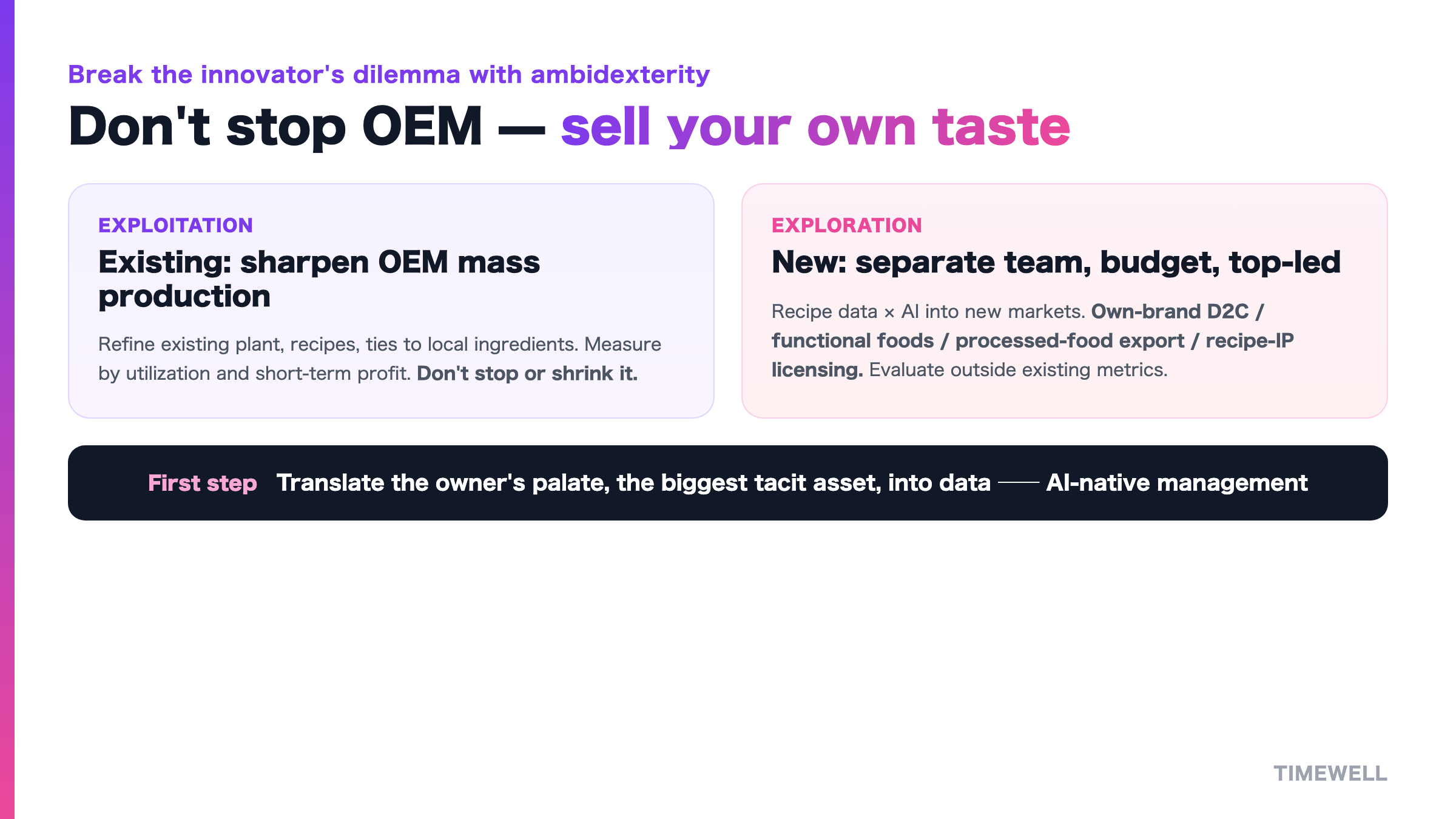
The key to breaking out is to keep the main business (OEM mass production) running and stand a new pillar, small, beside it—and not to measure that new effort by existing utilization or short-term profit. Measure it by the same yardstick and it dies as "unprofitable" before it grows. With slack, use a small separate team and budget; without it, just half a day a week from the owner is enough to start. Take it out of the existing metrics and multiply the recipe, sensory, and quality data your company has stored over years with AI.
A food maker has concrete seeds. Sell your own brand directly to customers and step out from single-legged thin-margin OEM. Direct capacity toward high-value products like foods with function claims. Put processed goods combining local produce with your recipes onto processed-food exports, which the government has set out to expand. And a "taste-design" business that offers recipes, sensory evaluation, and quality data themselves outside as contract development or licensing. From the side that makes others' taste on thin margins, to the side that sells its own taste. Trying it small beside the existing mass production, without stopping it. That is a plain but sure step toward becoming a company that can declare "whose what problem do we solve," out from single-legged subcontracting.
That said, handle any expression claiming function or efficacy carefully, avoiding assertion, so as not to touch the rules of the Pharmaceuticals and Medical Devices Act, the Food Labeling Act, and the Premiums and Representations Act. It is safest to put a specialist's check in here.
The sparring prompt for producing new sources of bread is also bundled in the diagnostic sheet. Before you brood alone, try making AI your partner.
Conclusion: don't discard, add—and translate the owner's palate into data
It got long, so let me organize the key points.
- The easiest entry to feel is the Friday-evening bet on "how many to prep tomorrow." AI demand forecasting shaves overproduction and stockouts at once, a little at a time. Start with the single product where loss hurts most, measured over four weeks in your own waste in yen.
- What comes first in sequence is the owner having AI put their own palate into words. Begin translating the secret taste into data. The top becomes AI-native.
- Lighten defensive costs with "don't discard, add." Automate HACCP records, support blends and procurement, right-size shelf life scientifically. Keep the mandated hygiene management and the optional AI separate.
- Tacit taste and recipe knowledge can be turned into a selling point. Leave it as a taste blueprint and connect it to OEM proposals, contract development, and export. The number you chase is not the page count of materials but new-product adoptions and inquiries.
- Build a new source of bread, small, beside the main business without stopping it. Without slack, start from the owner's half day a week.
Let me write my honest view at the end. Many of the effect figures in this article are companies' or vendors' own figures, with no guarantee the same numbers appear at your factory. AI is not magic; it is a tool. But in this situation—can't hire, veterans leaving, and can't fully pass raw-material spikes into prices—a tool you can use without discarding existing assets sits there as one of the few pockets of upside. And food's tacit knowledge is taste, aroma, texture—the hardest of all to turn into data. That is exactly why the company that can translate it into data first will hold the next product-development power. The owner's palate is the biggest asset no one has yet been able to inherit.
You can download the "AI Management Diagnostic Sheet (Food Maker Edition)" for checking this article against your own company, free, from the top of this page. It is an Excel where you fill in five areas—demand & inventory, quality & hygiene, product development, hiring, and new business—while sorting out where to start, and it bundles the three sparring prompts touched on in the body. First, have the owner fill it in together with AI.
And the handiest step is the single product where loss hurts most. If you'd like to try just four weeks with past shipments and weather, or want an outside eye to sort out where adding AI would work—use WARP AI consulting or an individual consultation.
References and sources
- MAFF, "The State of the Food Manufacturing Industry" (2026) 3
- MAFF / Ministry of the Environment, "Food loss volume (FY2024 estimate)" (published June 2026) 1
- Ministry of Health, Labour and Welfare, "Amendment of the Food Sanitation Act (institutionalizing HACCP-based hygiene management)" 2
- MAFF, "Hygiene management incorporating HACCP principles" 4
- SME Agency / METI, "Price-negotiation promotion month follow-up survey" (September 2025) 5
- Ministry of Internal Affairs and Communications / METI, "2024 Economic Structure Survey" / METI, "2024 Basic Survey of Business Activities" 6
Footnotes
-
https://www.maff.go.jp/j/press/shokuhin/recycle/260630.html ↩ ↩2
-
https://www.mhlw.go.jp/stf/seisakunitsuite/bunya/0000197196.html ↩ ↩2
-
https://www.maff.go.jp/j/shokusan/sanki/soumu/attach/pdf/meguzi-65.pdf ↩
-
https://www.maff.go.jp/j/shokusan/koudou/what_haccp/vision.html ↩
-
https://www.chusho.meti.go.jp/pamflet/hakusyo/2025/chusho/b1_1_6.html ↩
-
https://www.meti.go.jp/press/2025/11/20251128002/20251128002.html ↩