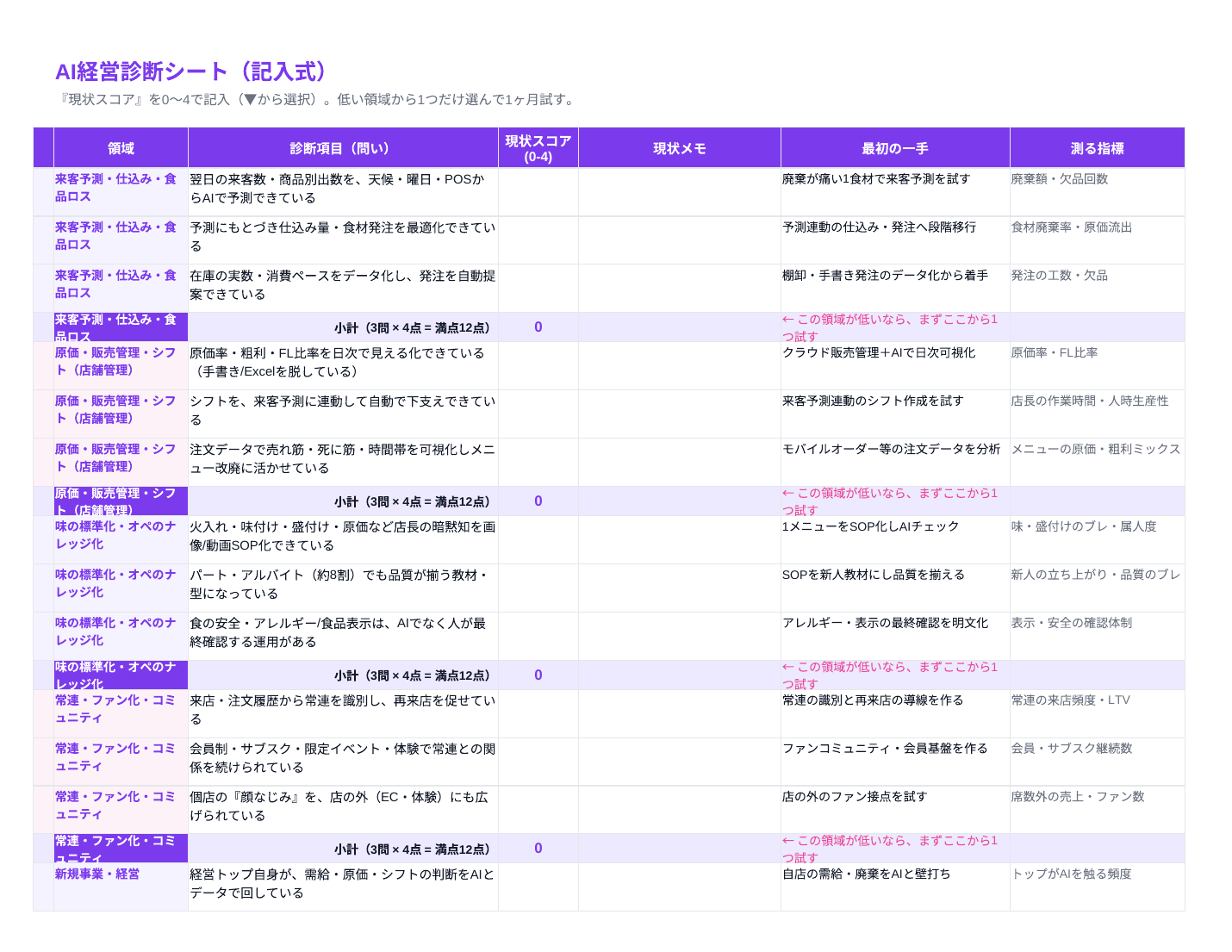
AI Management Diagnostic Sheet — Restaurant (editable Excel)
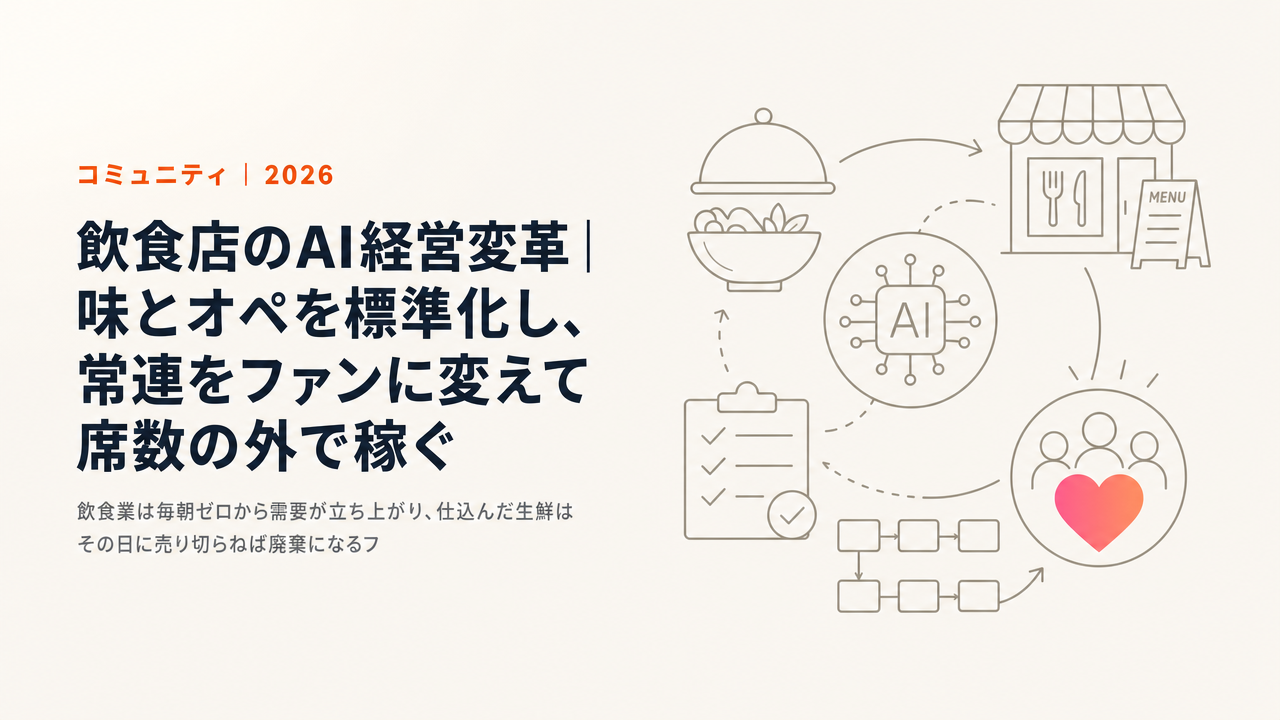
A fill-in sheet that self-scores five areas—traffic forecast/prep/food loss, cost/sales/shifts, taste standardization, regulars & fan-building, and new business & management—to decide where to add AI, balancing defense (labor-saving) and offense (fans).
Download the Excel sheet (free)Excel (.xlsx) ・ no email required
Hello, this is Ryuta Hamamoto from TIMEWELL.
Are you still deciding how many portions of fish to prep this morning on the manager's gut alone? By evening you're staring at the leftovers, muttering "let's cut back a little tomorrow," and the next day you're apologizing for a sell-out instead. On the one day you're a server short, a big party walks in; and next month's shift table is, once again, being pieced together alone by the manager in the middle of the night. Meanwhile, the face and the tastes of the regular who's come for twenty years live in your head and nowhere else. A restaurant's day is one long chain of these reads and hunches.
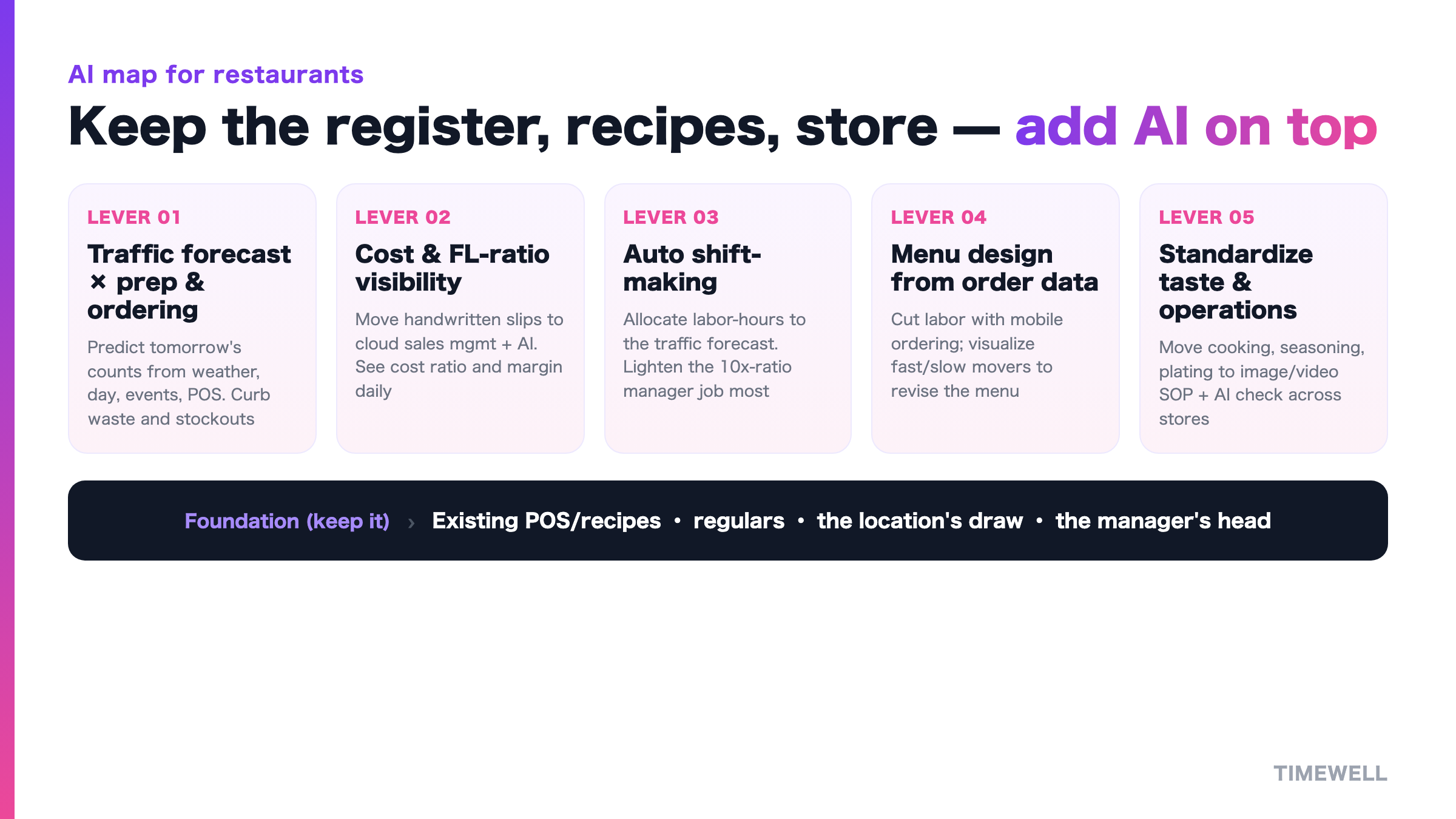
When I talk with restaurant owners, I start the AI conversation from exactly these everyday scenes—not from flashy cooking robots. Keep your register, your recipes, and what's in the manager's head, and add AI on top of them. This article stays narrowly on that: ease the prep and shifts you used to run on intuition, even out cost and taste, and then turn regulars into "fans" to earn beyond the ceiling of your seats. Let me state the backbone up front. Every first step begins with the owner personally touching AI every day and becoming AI-native. I'll explain why later.
Start with the most painful question: how many come tomorrow?
Food service isn't a business where you can stockpile. Prepped fresh food becomes waste if it isn't sold that day, and waste is a direct outflow of cost. Read it short and you sell out, losing the sales in front of you. The moment you miss the forecast, either waste or lost sales is locked in. That is the sharpest pain in dining.
So the easiest place to feel AI is traffic forecasting. Weather, day of week, nearby events, and past order history—let AI read these, and predict tomorrow's traffic and per-item counts. Then translate that into prep volume and ingredient ordering. You draw one guide line of data underneath a read that used to rest on the manager's intuition alone. You don't need to replace your register or POS. You just add AI on top of the order data you already have.
Let me sketch a before-and-after with a model case. Say a store preps eight portions of fish on a Friday night and throws away three on average. AI reads tomorrow's per-item count from weather, day, and past orders, and narrows prep to six. Waste drops, and you don't sell out. On a rainy-forecast day when foot traffic softens, you drop to four to begin with. That is what it means to add grounds to a gut read. (This is only a hypothetical. Hit rate varies with your location and how much data you've accumulated.)
So how do you take the first step? You don't need to hand the whole menu to AI at once. Pick just the one ingredient where waste hurts most. For that ingredient, line up the daily order counts of the past two or three months with that day's weather and day of week, and hand it to AI: "Tentatively read next week's counts for this ingredient from weather and day of week, and add the conditions most likely to throw it off." Use the numbers that come back as a reference for next week's actual prep. Measure the effect on one ingredient over one week, and if it's good, widen to the next. Not all stores and all items at once—one ingredient first. For a restaurant with limited money and people, that's the right order.
Shift-making: the work that drains the manager most
Right next to reading traffic sits shifts. The dining labor shortage isn't only a kitchen problem. What's really depleted is the manager who keeps the store running. By job-openings ratio, cooking is 2.9x while restaurant managers are 10.0x. There are overwhelmingly too few people willing to be managers. And that precious manager spends every month staring down the shift table in the middle of the night. This is a place where adding AI has enormous value.
What you do is allocate hall and kitchen staff to the traffic forecast. Thick on busy days, thin on quiet ones. Have AI build a draft shift table while respecting requested days off and working-hour limits. The manager just reviews and makes final adjustments. Turn work that used to be built from scratch into work that's checked and fine-tuned. That's the essence.
In model-case terms, picture a shift the manager used to build by hand in three hours once a month getting finished in forty minutes from an AI draft. (Only a rough guide; it varies with staff size and how complex your work rules are.) The freed time goes to work only the manager can do—a word to a regular, coaching a junior, setting up next month's play. Let me make the tone unmistakable here. AI's role is not to cut people. It fills the depleted manager role and moves the people you already have to higher-value work. Not discarding people—adding to them. This framing, I believe, is the one that lands honestly on a floor where about 80% of staff are part-time.
Looking for AI training and consulting?
Learn about WARP training programs and consulting services in our materials.
The first step: the top re-reads the manager's intuition with data
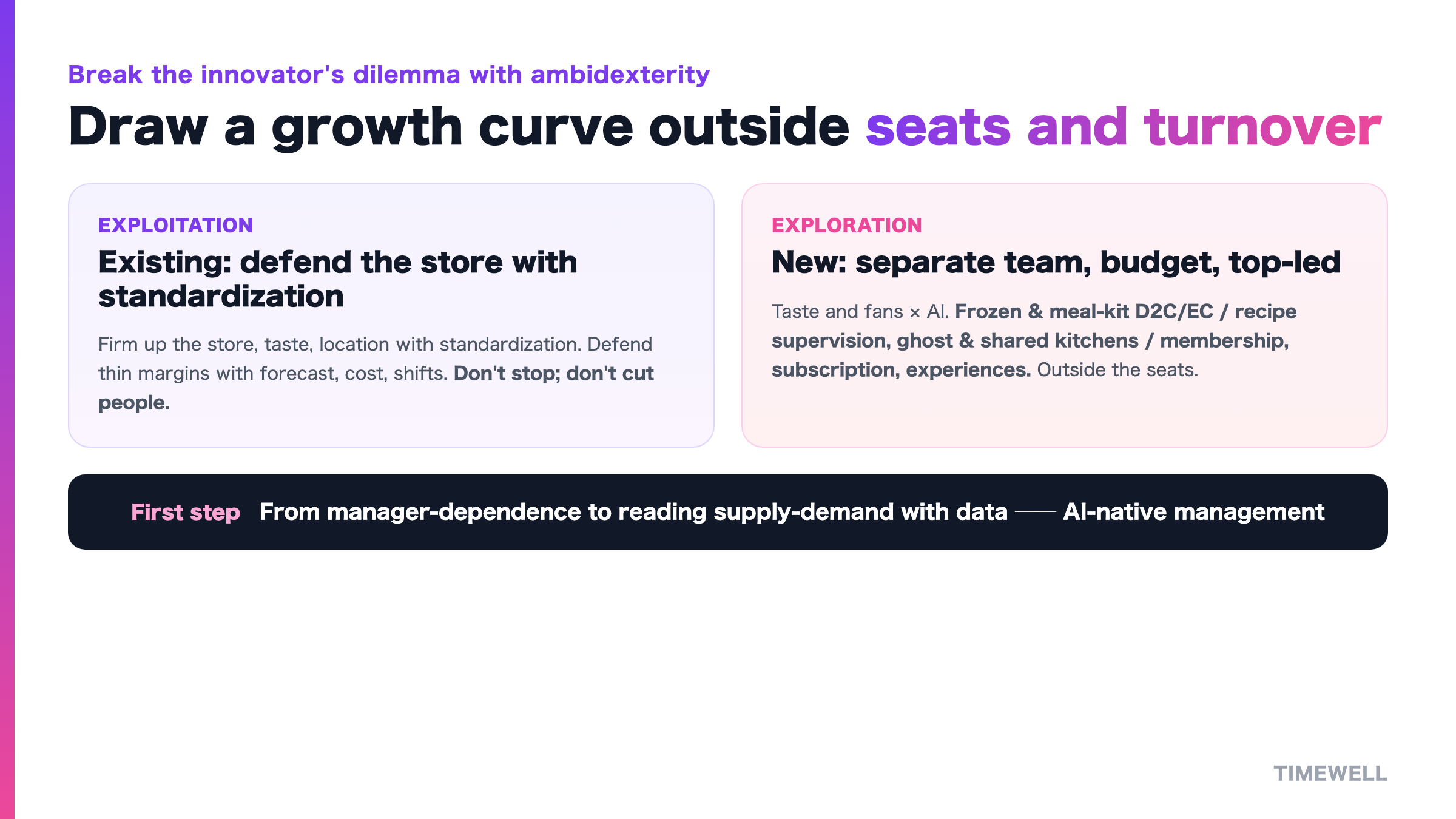
Before I list concrete moves, let me place what comes first in sequence. The owner personally becoming AI-native. In food service, this takes shape as a shift from "intuition-and-experience manager-dependence" to "management that reads supply and demand with data."
At many restaurants, tomorrow's traffic is read by the manager's intuition. That itself is a crystal of long experience, and it's precious. But because that intuition sits in one specific manager's head, neither standardization nor adding stores advances. If that person leaves, the store crumbles. So the top themselves re-reading supply and demand alongside AI becomes the origin of everything.
The method isn't hard. The top talks their store's worries to AI. "Tentatively analyze whether the ingredient with the most waste last month relates to that day's weather and day of week." "How should I ask, to find from order history the timing when our regulars come and what they order?" Half of what comes back can be off the mark—that's fine. Becoming able to judge that miss against your own sense of the store—"this is wrong," "this is right"—is the entrance to being AI-native. Right now, AI is the cheapest advisor an owner can have.
Japanese firms' generative-AI usage rate is 55.2% in the MIC's 2025 white paper. The biggest adoption concern was "we don't know how to use it effectively." That "don't know" isn't filled by outsourcing or training alone. The top touches it even ten minutes a day. I've rarely seen AI adoption go well at a company that skipped this. You can also check where your AI use stands today with the community check.
Even out cost and taste: protect the 0.1 point in thin margins
After traffic and shifts come cost and taste. Food service is an extremely thin-margin business. Labor productivity in dining and services, per employee, sits at roughly one-quarter of all industries. And food-service food loss reaches 700,000 tonnes (FY2024 estimate); at these margins, a 1% move in waste swings profit hard. So making cost visible daily carries real meaning.
Replace handwritten slips and Excel tallies with cloud sales management and AI, and see the cost ratio, gross margin, and the combined food-and-labor cost ratio (FL ratio) daily. Precisely because it's a world where 0.1 point matters, grasp it that day rather than tallying at month-end. Cut labor on ordering and payment with mobile ordering and self-checkout, while visualizing fast movers, slow movers, and time-of-day from the accumulating order data, and feed that into menu revision.
Standardizing taste works on the same idea. Turn the sense in the manager's and skilled cooks' heads—heating, seasoning, plating, cost—into digital procedures with images and video, and check with AI. Have a veteran talk through "why this heat," transcribe it with AI, and make it a procedure. Narrow to one menu item, one step, and you can start today. It works on the chronic problem where about 80% of staff are part-time and taste varies by person even after training.
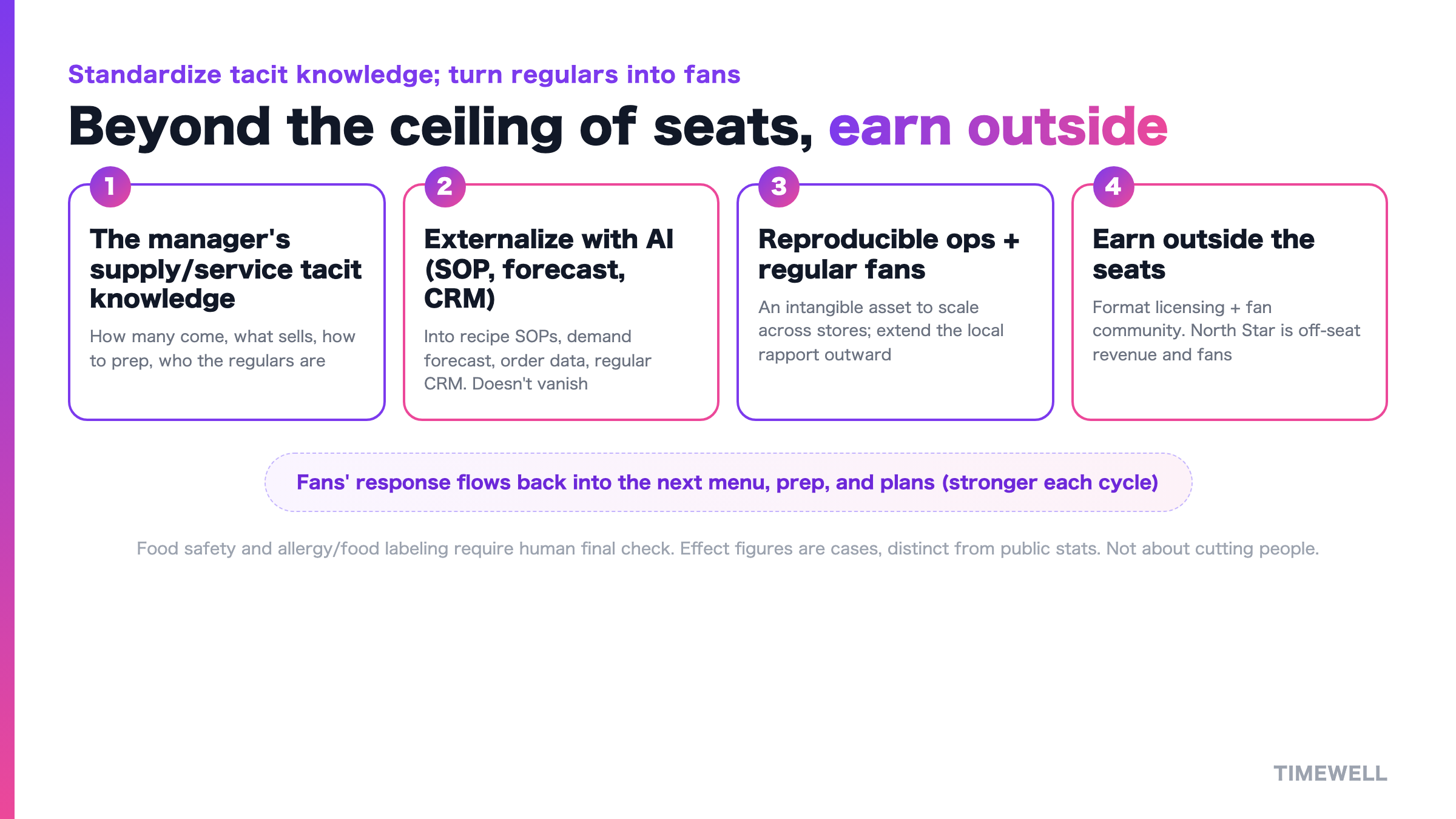
But there's a premise you can never drop: food safety and labeling accuracy. Even if you standardize ordering and recipes with AI, food-allergy labeling, religious accommodation, and food hygiene (HACCP) require a human final check. The risk of mistranslating allergy information in multilingual service and menus in particular demands the utmost care. AI is prep and support; it does not take over responsibility for food safety.
Let me note the nature of the numbers once. That labor productivity is about one-quarter of all industries, food loss of 700,000 tonnes, and a 10x manager job-openings ratio are government and public statistics. On the other hand, the "AI cut waste by X%" effect figures you often see outside this article are mostly vendors' or chains' own published values, with no guarantee the same result appears at your store. That's why, rather than lining up flashy numbers, I recommend measuring on one ingredient or one task in your own store. This distinction is a premise throughout this article.
Here is one sparring prompt for sorting out, together with your owner and AI, where to firm up defense first. Paste it as is and replace the text in brackets with your store's information. The remaining two prompts—turning regulars into fans, and standing a new pillar beside the store—come bundled in the free diagnostic sheet.
You are an operations-improvement consultant for restaurants. On the premise of adding AI without discarding the existing POS, register, and recipes, help decide which defense—waste, cost, shifts—to tackle first. It's a design to lighten the manager role and fill the labor shortage, not to cut people.

# Input (I will fill this in)
- Format and scale: [e.g., izakaya X seats, 1 store or X stores, mostly part-timers]
- Three issues most draining the manager / cutting profit: [e.g., reading prep volume / ingredient ordering / shift-making]
- Ingredients/menus where waste and stockouts hurt most: [e.g., fresh fish on waste, the specialty on stockouts]
- Numbers as far as you know: [e.g., monthly ingredient waste assumed XX yen, cost ratio X%, FL ratio X%]
- Data on hand: [e.g., POS/order history, weather, nearby events, handwritten ordering]

# Your tasks
(1) Evaluate the issues on "impact on profit (thin margins)," "manager drain," and "ease of data-ification."
(2) For each, separate what AI can take over (prediction, suggestion, visualization) from what a human must carry (final judgment, food safety).
(3) Choose the one to add AI to first, and show the grounds (considering the 10x manager depletion).
(4) Show a "one-month small demonstration" plan for that one. Use the existing POS and register.
(5) Define measurement indicators (waste amount, cost ratio, FL ratio, manager work time).

# Output format (follow exactly)
1. Evaluation table: columns are [Issue / Impact on profit / Manager drain / Ease of data-ification / What AI supports / What humans must carry / Estimated reduction (assumed, with formula)]
2. The one to tackle and the reason (within 3 sentences)
3. One-month small-demonstration plan (what, when, how to measure)
4. Definition of measurement indicators

# Constraints
- Do not use abstract words like "efficient" or "optimize"; write what changes and how, using verbs.
- Do not make "cut people with AI" the object. Write it as a design to fill the labor shortage and lighten the manager role.
- Note that food safety, allergy labeling, and labor rules (overtime agreement, minimum wage) require a human final check.
- Label numbers "assumed" or "case value" and add the premise. Add that rice and ingredient prices swing greatly. Do not fabricate.
- At the end, list the three weakest assumptions or risks most likely to break this plan.
Turn regulars into "fans" and earn outside the seats
Up to here was defense. From here it's offense. Food service has a clear ceiling: the store's seats and turnover. However busy you get, the number of seats sets the upper limit on that day's sales. To build a growth pillar beyond this ceiling, you need to extend the store's asset of "familiar faces" outside the store too.
For that, turn regulars into "fans." Identify regulars from visit and order history and prompt revisits. Then run membership, subscription, limited events, and experiences (cooking classes, producer tours) to create sales and fan touchpoints outside the store as well. Take the individual store's "familiar face" out beyond the seats. Ironically, the more you standardize taste and multiply stores, the more the individual store's regular relationship thins. You solve this contradiction by keeping a direct relationship with regulars.
TIMEWELL's "BASE" is exactly the mechanism for continuing that relationship with regulars = fans—membership, subscription, limited events, early information. Even out taste and ops with standardization, while holding fan touchpoints outside the store. Stand a pillar of revenue and fans outside the ceiling of seats. This, I believe, is food service's winning path. But it's only a tool. In sequence, it still starts with the top reading supply and demand with data.
The numbers you chase change too. Not just the day's sales and seat turnover, but the number of regulars and repeaters, the continuation of members and subscriptions, and the revenue earned outside the store (e-commerce, frozen, experiences). How much lasting relationship did you build outside the seats? That becomes the yardstick for the feel of offense.
The same idea works for hiring and development. The digital procedures you built in the earlier chapter become newcomer training material as they are. Drafts of job postings, of communications conveying the store's appeal, and of multilingual menus and service—AI can help with all of them. Fill the chronic shortage of people to train with records. For HR thinking, AI implementation patterns in HR is a useful reference. Here too, what AI carries is prep and support; food safety and heartfelt service itself are human work.
Stand a new pillar small, beside the store
Finally, what to do with the headroom created by defense. Spending the freed time only on filling existing-store orders is a waste. And yet the more diligent the store, the more "handle the business in front of you" becomes the right answer, and there's no hand left for new sprouts. A restaurant's every day sits next to this trap.
The key to escaping is not to measure new efforts by current seat turnover or short-term profit alone. Measure them that way and they get killed as "not profitable" before they grow. Without stopping the main business, stand a new pillar small, beside it. With spare capacity, a small separate team; without it, the owner spending just a half-day a week is enough. While running the existing store, multiply the taste, recipes, and regular relationships you've built up by AI. Then what was shut inside the store starts to look like something you can sell outside the seats. Standardized taste into frozen goods, retort, and meal-kit e-commerce. Recipe supervision, and multi-brand development in shared kitchens. Membership, subscription, and experiences for regulars. Multilingual menus and communications for overseas guests. Without stopping the existing store, test small beside it. That, I believe, is the plain but sure first step toward growing a lasting business beyond the ceiling of your seats.
This article pairs with AI transformation for parts manufacturers, which applies the same thinking to a different industry. The industries differ, but the backbone—"add without discarding," "the top touches it first"—is the same. The sparring prompt for producing new pillars is also bundled in the diagnostic sheet. Before you brood alone, make AI your partner.
Conclusion: add grounds to intuition, turn regulars into fans
Let me organize the key points.
- The easiest place to feel AI is "how many come tomorrow," which you used to read on gut alone. Add grounds to prep and ordering with traffic forecasting. Start with the one ingredient where waste hurts most.
- Shift-making, which drains the manager most, gets a draft from AI, and the manager only makes final adjustments. Not cutting people, but filling the depleted manager role.
- The first step is the top re-reading the manager's intuition with data. Companies where the top touches AI even ten minutes a day are the ones moving.
- Visualize cost and FL ratio daily, and even out taste with procedures and AI. But food safety and allergy labeling require a human final check.
- Offense is turning regulars into fans and earning outside the seats. Membership, subscription, experiences, e-commerce. Stand new pillars in a separate frame without stopping the main business. Without spare capacity, the owner starts with a half-day a week.
Let me write my honest view at the end. Many of the reduction rates you see outside this article are vendors' or chains' own published values, with no guarantee the same result appears at your store. And food service carries absolutely-non-negotiable premises—the prices of rice and ingredients, and food safety. So rather than flashy cases, I recommend this order: the top first practices reading their store's supply and demand with AI, tries forecasting on the one ingredient where waste hurts most, and measures in their own waste amount and FL ratio. Food service's treasure is the read in the manager's head—"how many come tomorrow, what sells, who the regulars are." Add grounds to it to defend, and turn regulars into fans to attack. When you can stand a pillar of taste and fans outside the ceiling of seats, the daily-cash tightrope turns, little by little, into a business that lasts.
You can download the "AI Management Diagnostic Sheet (Restaurant Edition)" for checking this article against your own store, free from the top of this page. It's an Excel where you fill in five areas—traffic forecast/prep/food loss, cost/sales management/shifts, taste standardization, regulars & fan-building, and new business & management—while organizing where to start, and it bundles the three sparring prompts touched on in the text. First, let the owner fill it in alongside AI.
And the easiest first step is to read tomorrow's prep for just one ingredient with AI. When you want to sort out how to build a direct relationship or fan community with regulars, use an individual consultation too.
References and sources
- Cabinet Secretariat / MAFF / MHLW, "Labor-Saving Investment Promotion Plan (food service)" (June 2025) 1
- MAFF, "Business food loss volume (FY2024 estimate)" (published June 2026) 2
- Japan Food Service Association, "Food Service Market Trend Survey, 2025 annual results" (January 2026) 3
- Teikoku Databank, "Bankruptcy trend survey of restaurants (2024)" / Tokyo Shoko Research 4
- METI, "2023 Basic Survey of Business Activities" / RIETI JIP database (labor productivity) 5
Footnotes
-
https://www.cas.go.jp/jp/seisaku/atarashii_sihonsyugi/shouryokukatousi/01.pdf ↩
-
https://www.maff.go.jp/j/press/shokuhin/recycle/260630.html ↩
-
https://www.jfnet.or.jp/wp/wp-content/uploads/2026/01/nenkandata-2025.pdf ↩
-
https://www.tdb.co.jp/report/economic/20260220-laborshortage202601/ ↩
-
https://www.chusho.meti.go.jp/pamflet/hakusyo/2025/PDF/2025gaiyou.pdf ↩