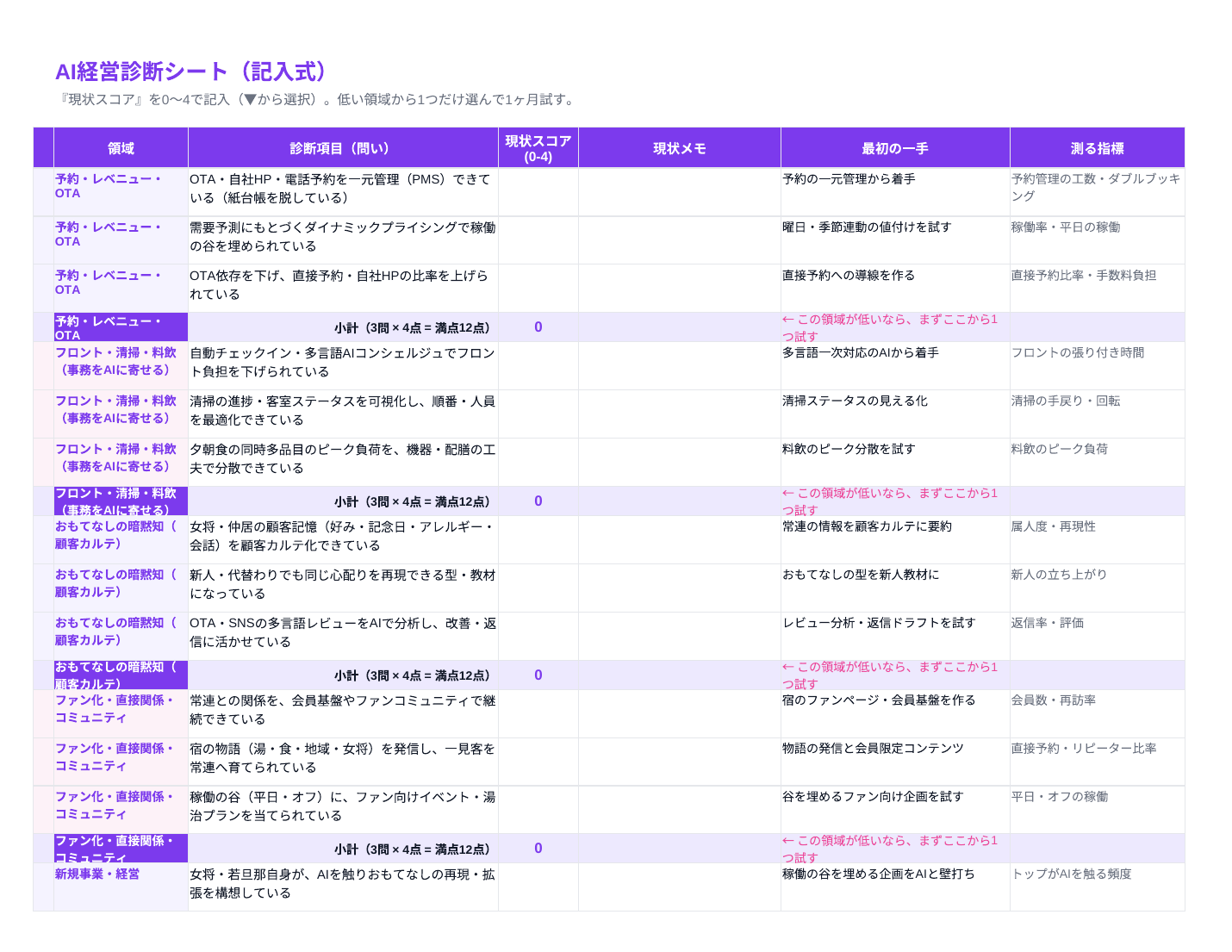
AI Management Diagnostic Sheet — Ryokan (editable Excel)
A fill-in sheet that self-scores five areas—booking & revenue, front/cleaning/F&B, tacit hospitality (guest chart), fan-building & direct relationships, and new business & management—to decide where to add AI while concentrating people on hospitality.
Download the Excel sheet (free)Excel (.xlsx) ・ no email required
Hello, this is Ryuta Hamamoto from TIMEWELL.
Friday evening. Names are lined up on the reservation sheet, and yet the okami decides to close a few rooms this week. Cleaning, serving, the front desk—there simply aren't enough hands to go around. She runs from greeting guests to laying out futons to closing out the bills, and before she knows it, the very thing that matters most—sitting a little longer with a regular, face to face—is the first thing that gets cut. Visit ryokan and you hear this kind of evening, again and again.
Rooms are empty, yet there aren't enough people. No business shows this contradiction as plainly as a ryokan does. So the first thing I want to say is this: ryokan AI is not about "unmanning service." The hands-on hospitality is itself where a ryokan's price comes from. Replace that with a machine and the thing you are selling thins out.
What I have in mind is the opposite. Move the "admin"—booking, cleaning schedules, accounting, multilingual exchanges—to AI, and by exactly that much, send the few people you have back to the single point of hospitality. Then take the memory the okami and staff carry in their heads—each guest, one by one—and turn it into a form you can hand to the next generation. The hot spring, the rooms, the chef, the okami's hospitality—you throw away none of it. On top of that, you add AI. That is what this article is about. Let me state the backbone up front: every first step begins with the okami or young proprietor touching AI themselves, every day. I'll get to why later.
Start where the hands run out first: the front desk and admin
What works first isn't some flashy new business. It's the day-to-day admin that is eating your people right now. Lighten it, and the hospitality time that was being cut comes straight back.
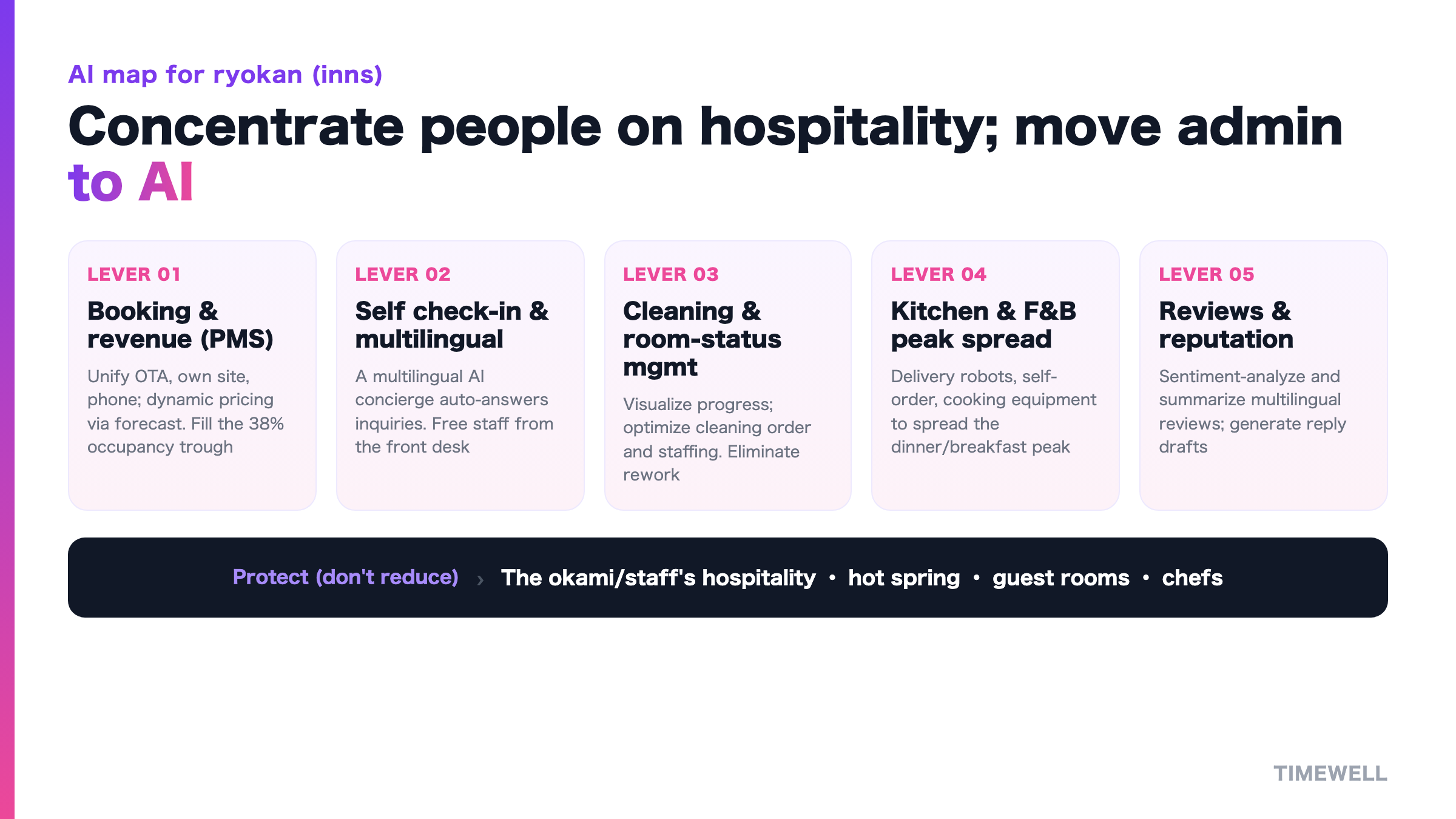
Take them in order. First, booking and inventory. When reservations from OTAs, your own site, and the phone are scattered across separate ledgers, you get double bookings and stop-sell mistakes. Pull them into one system (a PMS), add AI demand forecasting, and price by day of week and season—filling in even a little of the empty weekday trough. At the front desk, combine a self check-in machine with a multilingual AI that answers questions. The bath's hours, nearby sights, meal times—let the machine absorb the same inquiries repeated every night. The person who was tied to the front through the gaps of a split shift can go back to greeting and seeing off. Cleaning, too: just make progress and room status visible on a phone, and the ordering and the rework shrink. Exchanges with overseas guests become something you can take without bracing yourself, once translation sits in between.
One model case, before and after. It is only a hypothetical. A hot-spring inn with a handful of staff and a dozen-odd rooms. Until now, two people were pinned to the front desk on busy check-in evenings, and the okami couldn't leave the counter. Add self check-in and multilingual guidance, and one of those two can move to the entrance, welcoming guests and showing them around. I am not going to claim "X hours saved a day." What matters is the direction: by exactly what the machine absorbs, a person goes back in front of the guest.
Let me be honest about money and people too. Hear "PMS, check-in machine" and you brace for another expensive investment. But that isn't the entrance. Start with just free AI and the spreadsheet you already have. List a regular's tastes and last conversation; have AI draft replies to reviews; use it as a sparring partner for a weekday promotion. This far, the upfront cost is near zero, the monthly extra is zero, and all it takes is a dozen-odd minutes of typing a day. Whether you move on to paid tools, decide after you've felt the response from this smallest setup. For a small inn with limited money and people, this is the order least likely to fail. You can also check where your AI use stands today with the community check.
Here is one sparring prompt for the okami to sort out, together with AI, which admin to move first. Paste it as is and replace what's inside the brackets with your own inn's details. The other two prompts—turning the memory of hospitality into an asset, and standing a pillar of regulars beside the core—come bundled with the free diagnostic sheet.
You are an operations-improvement consultant for ryokan and lodging. On the premise of not reducing hospitality, but moving admin to AI so people can concentrate on hospitality, help me decide which task to tackle first.

# Input (I will fill this in)
- Inn scale and type: [e.g., hot-spring ryokan, X rooms, two meals, okami plus X staff]
- The three tasks most labor-consuming or draining now: [e.g., booking and phone / front desk / room cleaning]
- Occupancy and booking situation: [e.g., weekday occupancy low, OTA is X%, little direct booking]
- Person-dependent tasks: [e.g., regulars' tastes live in the okami's head, pricing is by intuition]
- What you have: [e.g., paper ledger, mostly phone booking, no PMS]

# Your tasks
(1) Evaluate the tasks by "drain," "how much they pull people away from hospitality," and "ease of moving to AI."
(2) For each, separate the admin that can be moved to AI from the hospitality a human must carry.
(3) Choose the one task to move to AI first, and show the grounds.
(4) Show a "one-month small demonstration" plan for that one task. Use existing equipment and operation.
(5) Define measurement indicators (time saved, occupancy, direct-booking ratio, etc.).

# Output format (follow exactly)
1. Evaluation table: columns are [Task / Drain / How much it pulls people from hospitality / Ease of moving to AI / Admin moved to AI / Hospitality humans keep / Estimated reduction (assumed, with formula)]
2. The one task to tackle and the reason (within 3 sentences)
3. One-month small-demonstration plan (what, when, how to measure)
4. Definition of measurement indicators

# Constraints
- Do not make "efficiency" or "unmanning" the object. Write it as AI-ifying admin so people can concentrate on hospitality.
- Add the premise that reduction effects are adoption-case-based and vary greatly by facility. Label numbers "assumed" and add the premise. Do not fabricate.
- Mind hot-spring efficacy labeling under hot-spring law and the Premiums and Representations Act, and food labeling for meals.
- At the end, list the three weakest assumptions or risks most likely to break this plan.
Let me note the nature of the numbers once, to be safe. Ryokan room occupancy of 38.4% (2025 preliminary), roughly half that of business hotels, and 73% of inns still on paper ledgers (2021, Japan Tourism Agency survey)—these are public statistics and surveys. On the other hand, effect figures like "self check-in saves X hours a day" are mostly adoption cases or vendors' own tallies, and they swing widely by an inn's scale and location. There is no guarantee the same number appears at your inn. That's why, rather than lining up flashy figures, I'd have you measure your own hours on the single task that drains you most. This distinction underlies the whole article.
Looking for AI training and consulting?
Learn about WARP training programs and consulting services in our materials.
The first step: the okami and young proprietor touch AI
Before lining up the moves, let me place what comes first, once more. The okami or young proprietor touching AI themselves, every day. This is not a pep talk.
A ryokan's transformation begins the moment the top themselves feel, in their gut, that "the sense I've honed over decades can be reproduced with data too." That won't happen through outsourcing or training. The okami tells AI the inn's worries, just as they are. "For the weekdays when occupancy drops, think up a plan to get regulars to come, from our spring, food, and place." "How should I write down a past guest's conversation and preferences so they come alive in the next welcome?" Half of what comes back will miss the mark. But being able to judge, yourself, "that's not it"—that is the entrance to using AI well.
What matters is that this is not about "making hospitality efficient." Hospitality is carried by people. What the okami talks over with AI is how to move the admin so that person can concentrate on hospitality—and how to hand the okami's care to the next generation. It's the arrangement on the outside of the care itself.
The share of Japanese companies using AI well is still not high. The biggest reason is "we don't know an effective way to use it." At a ryokan where 70% are on paper ledgers, that should feel all the closer to home. But this "we don't know" is not filled by handing it to someone else. The top touches it even ten minutes a day. Inns that skip this step—I've rarely seen their AI adoption go well. I wrote exactly the same thing in the same series' AI transformation for parts manufacturers. The industry differs, but on this one point they are the same.
Hand the memory of hospitality to the next generation
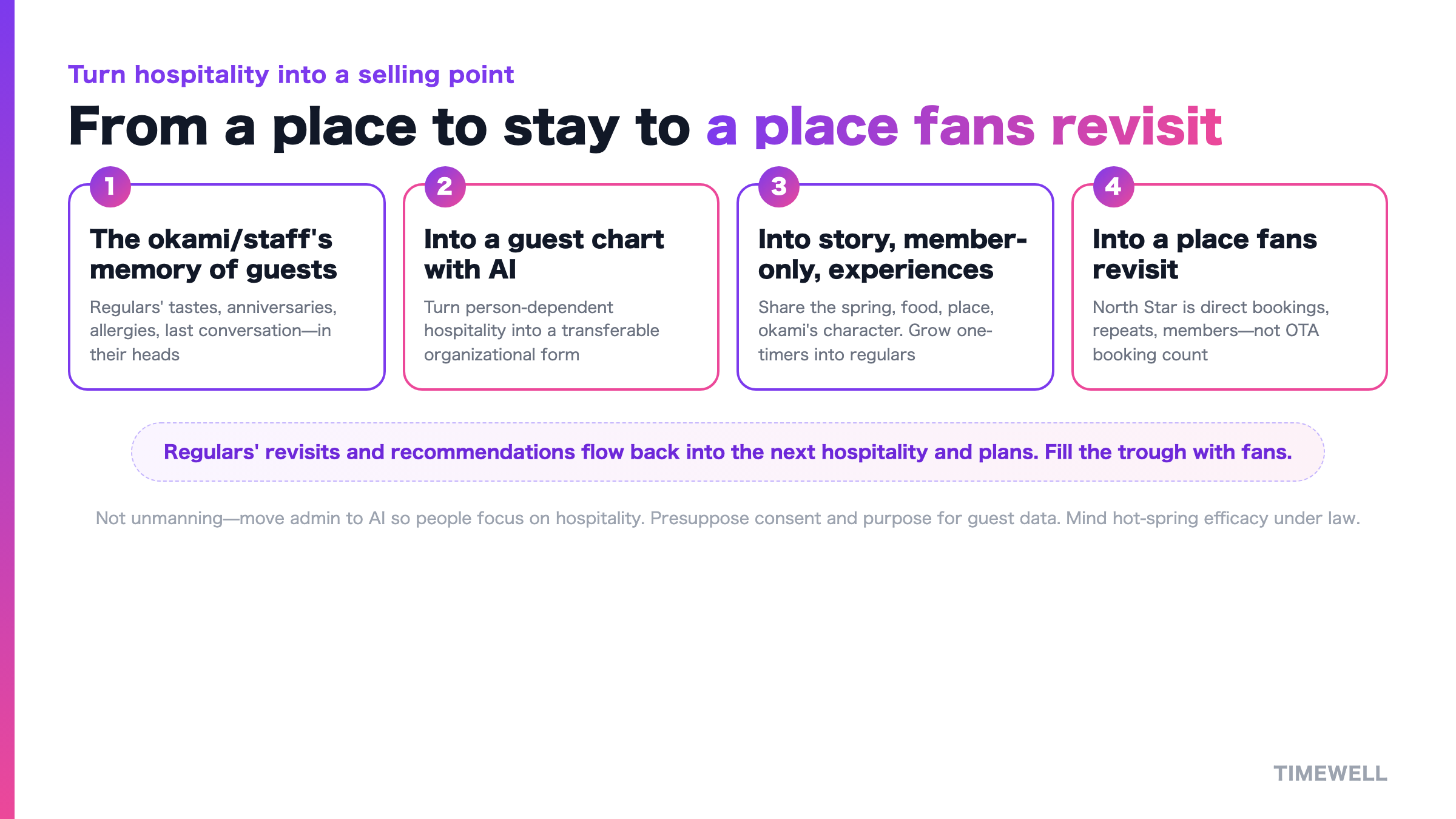
This, I think, is the very heart of AI transformation for ryokan. The tastes, the anniversaries, the disliked ingredients, what you talked about last time—the memory of each regular that the okami and staff hold in their heads. Turn this memory, known only to that person, from something that vanishes into a form that can be inherited.
What you do is summarize and write down this memory, with AI's help, as a "guest chart." "This guest always likes a lighter dinner." "Last year was the couple's anniversary—flowers in the room." "The companion can't take shellfish." Keep such care not only in the okami's head, but as the inn's record. Then a successor, or a staff member who just started, can more easily repeat the same care.
There is a guilt that comes with this, and I know it. Is it all right to turn a guest's heart into data? The hesitation of reducing years of a relationship into a curt list. Please hold on to that feeling. And on top of it, let me say: making a chart is not turning a guest into "information." It is handing the sense you honed over decades to the next generation. What you record is preferences and considerations—not the heart itself. The work of putting your heart in is carried by people, as before. The chart is only the prep work that lets that person put their heart in.
Watching over reviews can be lightened with AI too. Have AI summarize the multilingual reviews scattered across sites and social media, and feed them into improvements inside the inn. Have it draft replies in multiple languages, lowering the floor burden while raising the reply rate. And the guest chart and hospitality form you've kept this way become, as they are, training material for a new hire. Keep "at this inn, we show this kind of care" in words and form. Answer the chronic worry of not being able to hire or find time to train, with the record. For HR thinking, AI implementation patterns in HR is a useful reference.
Keep the core stay sharp, and stand a small pillar of regulars beside it
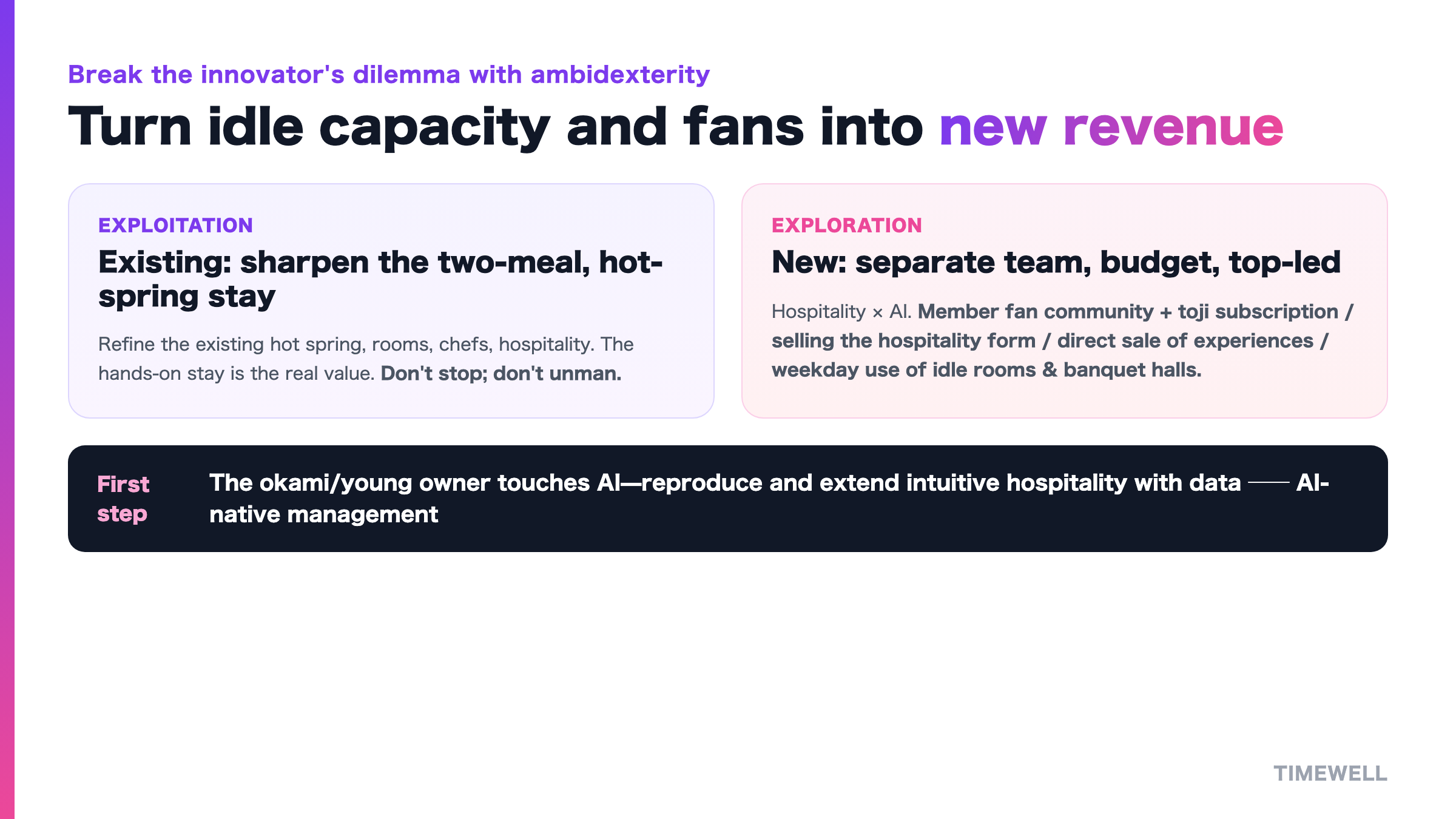
From here it's a little more on offense. Even so, this is not about upending the core business. Keep sharpening the core—the two-meal stay and the hot spring—just as before. And beside it, stand one more small pillar: a direct connection with regulars. That's all.
Today's ryokan hand much of the initiative over booking to outside OTAs. The fees are heavy. To slip out of that, little by little, you need a relationship that grows a one-time guest into a regular who comes again directly. Share the hospitality form kept in guest charts and the inn's story—the spring, the food, the place, the okami's character—and stay connected with regulars, membership-style. Then, on the weekdays and off-season when occupancy dips, aim plans at those regulars (toji cure plans, or gatherings just for fans). Fill the empty rooms with regulars' revisits.
TIMEWELL's "BASE" is a community setup that lets you build such a fan page for the inn in a short time. It shifts a relationship that leaned wholly on OTAs and one-timers toward a direct connection with regulars. But this is only a tool; in sequence, it still starts with the okami touching AI.
The number you chase, I'd like to swap here, too. Not the count of OTA bookings, but the ratio of direct bookings and repeaters, the number of regulars connected, and how often they revisit. How much of a direct relationship, free of fees, have you grown? That, I think, is the number to watch from now on.
There are other ways to stand a pillar. Share the hospitality form and multilingual operation you honed at your inn with nearby small inns, as training or operating support. Bundle food, spring, and regional experiences and sell them directly to regulars. Lend the idle rooms and banquet halls sitting at 40% occupancy—on weekdays—as a spot for local gatherings, work, or filming. Every one of them can be tried small, beside the core, without stopping it.
One realistic caution. The more earnest the inn, the more "getting through the guests in front of you" becomes the right answer, and the hands never reach a new pillar. So do not measure this effort by today's occupancy or short-term profit alone. Measure it that way and it gets crushed as "unprofitable" before it can grow. Run it with a small separate team if you have the slack. If you don't, first have the okami or young proprietor free up just half a day a week for this pillar. That's enough to begin.
Conclusion: admin to AI, people to hospitality
Let me organize the key points.
- A ryokan's price comes from the hands-on hospitality itself. So AI is not an unmanning tool. Move booking, cleaning, accounting, and multilingual work to AI, and send the few people you have back to hospitality.
- The entrance is the front desk and admin, where the hands run out first. And you can start from zero upfront cost—with just free AI and a spreadsheet, the smallest setup.
- The first step is the okami or young proprietor touching AI themselves. Feel, in your gut, that the sense honed over decades can be reproduced with data.
- The core is turning the memory of regulars into a guest chart. Not making guests into information, but handing your sense to the next generation.
- Keep the core stay sharp, and stand a small pillar of regulars beside it. The number to chase is not OTA counts but the ratio of direct bookings and repeaters. If you have no slack, start from the okami's half a day a week.
One honest thing at the end. The reduction effects touched on here are mostly drawn from adoption cases, and there is no guarantee the same result appears at your inn. And I want to stay careful about speaking of AI at ryokan. I have said nothing about replacing hospitality with a machine. The very act of taking hands-on care is where a ryokan's price comes from. That is exactly why, to protect those hands, you move admin to AI, and hand the okami's sense to the next generation in the form of a guest chart. That contradiction—rooms empty yet people short—unravels, little by little, I believe, when you rearrange the roles: admin to AI, people to hospitality.
You can download the "AI Management Diagnostic Sheet (Ryokan Edition)" for checking this article against your own inn, free from the top of this page. It's an Excel where you fill in five areas—booking & pricing, front/cleaning/F&B, the memory of hospitality, the direct relationship with regulars, and new pillars & management—to sort out where to start, and it bundles the three sparring prompts touched on in the article. First, have the okami fill it in together with AI.
When you want to sort out how to build a direct connection or a place where fans gather, use BASE or an individual consultation.
References and sources
- Japan Tourism Agency, "Accommodation Travel Survey (2025 annual, preliminary)" 1
- Japan Tourism Agency / MHLW, "Labor-Saving Investment Promotion Plan (lodging)" (June 2025) 2
- Japan Tourism Agency, "Report on the survey of the state of workforce securing and development in lodging" (March 2025) 3
- Ministry of Internal Affairs and Communications, "Labor Force Survey" / MHLW, "Employment Trend Survey" (lodging headcount and vacancy rate) 4
- MHLW, "Report on Public Health Administration and Services (FY2024)" (ryokan facility counts) 5