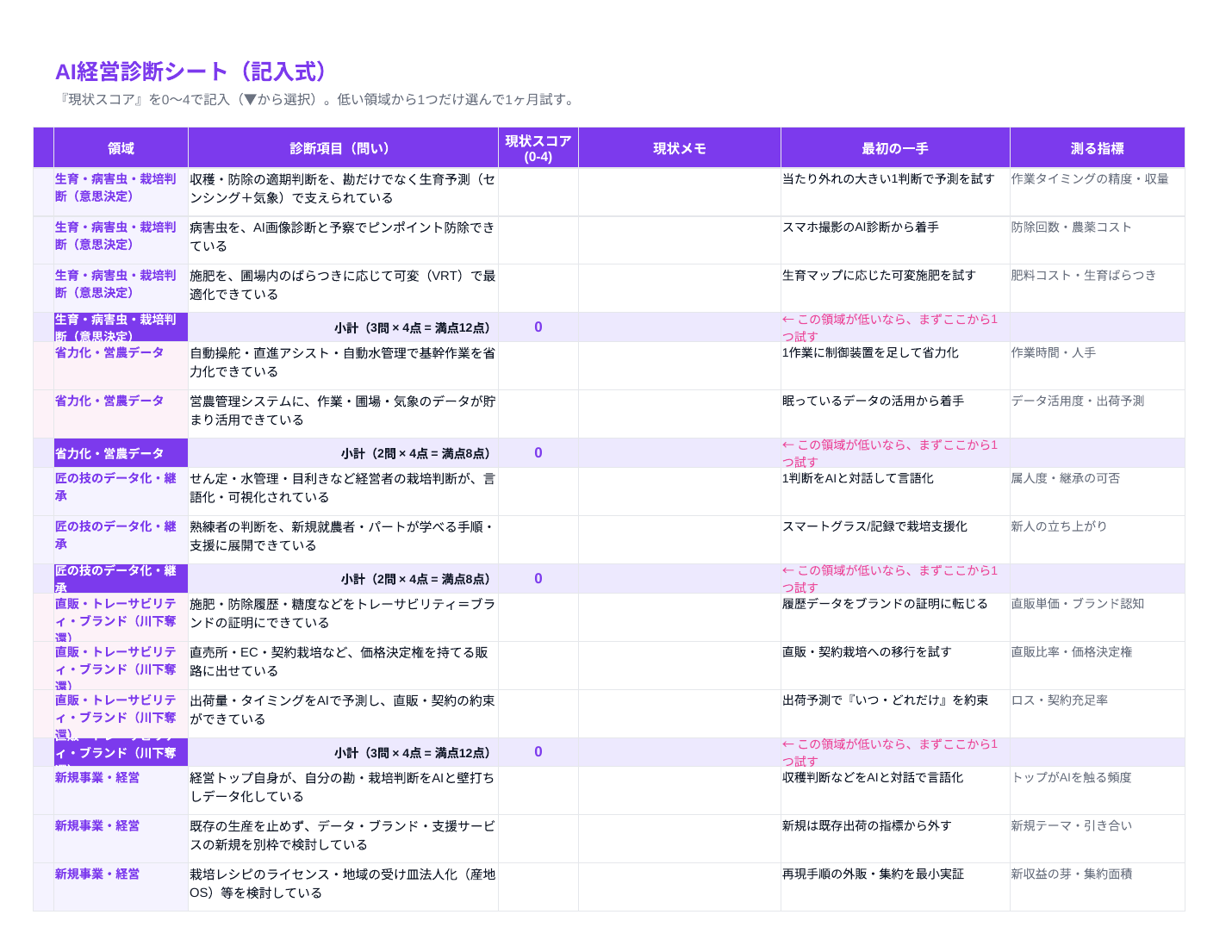
AI Management Diagnostic Sheet — Agriculture (editable Excel)
A fill-in sheet that self-scores five areas—growth & pest decisions, labor-saving & farm data, transferring the master craft, direct sales/traceability/brand, and new business & management—to decide where to add AI first.
Download the Excel sheet (free)Excel (.xlsx) ・ no email required
Hello, this is Ryuta Hamamoto from TIMEWELL.
Picture an orchard in December, still dim before dawn. You pick up a single mikan, look at the color of the skin, and feel its weight in your palm. Harvest today, or wait three more days? You have the reading from the sugar meter. But what finally decides it is the color and sheen of the skin, the memory of this week's cold snaps, and the sense in your fingertips built over decades. Ask "could you put that judgment into words and hand it to someone else?" and you stall a little. Your son hasn't come back yet. All you can tell the part-timer is "the same as last year." A year's worth of intuition inside your head probably stays inside you until the day you put down your hoe.
When I talk with farmers, the moment AI comes up I feel their shoulders tense just slightly. "Does that have anything to do with a family operation like ours?" "Isn't this just another 'buy a machine with a subsidy' pitch?" Honestly, that wariness is fair. Many of the flashy adoption cases belong to large corporate operations, and they don't necessarily map onto a family operation at the mercy of weather and market prices.
So I will not tell you to replace your machines—not once. Keep the machines you have, the canals and fields you have, and the intuition in your head, and "add" AI on top of them. That is all this article is about. We will follow, from a practical angle, how to make the "when to harvest, when to spray" judgment stuck in your head shareable with younger hands and part-timers, how to preserve the intuition your body learned so it doesn't vanish, and how to turn growing records into "grounds for a price that won't be beaten down." Let me state the backbone up front: every first step begins with the owner personally touching AI every day and becoming AI-native. And for those who say "I have no confidence sitting alone at a computer," I will write plainly, midway through, exactly who helps and how far.
Start with the "when to harvest" that's stuck in your head
Does this sound familiar? The harvest window, the spray timing—only you, the representative, can decide them. If your health falters, the orchard stops. The younger ones can't pick it up. A judgment comes a day late and the grade drops. In a family operation, the thing that eats the most time and rests most heavily on one person is exactly this: "when, where, and how to put your hands in."
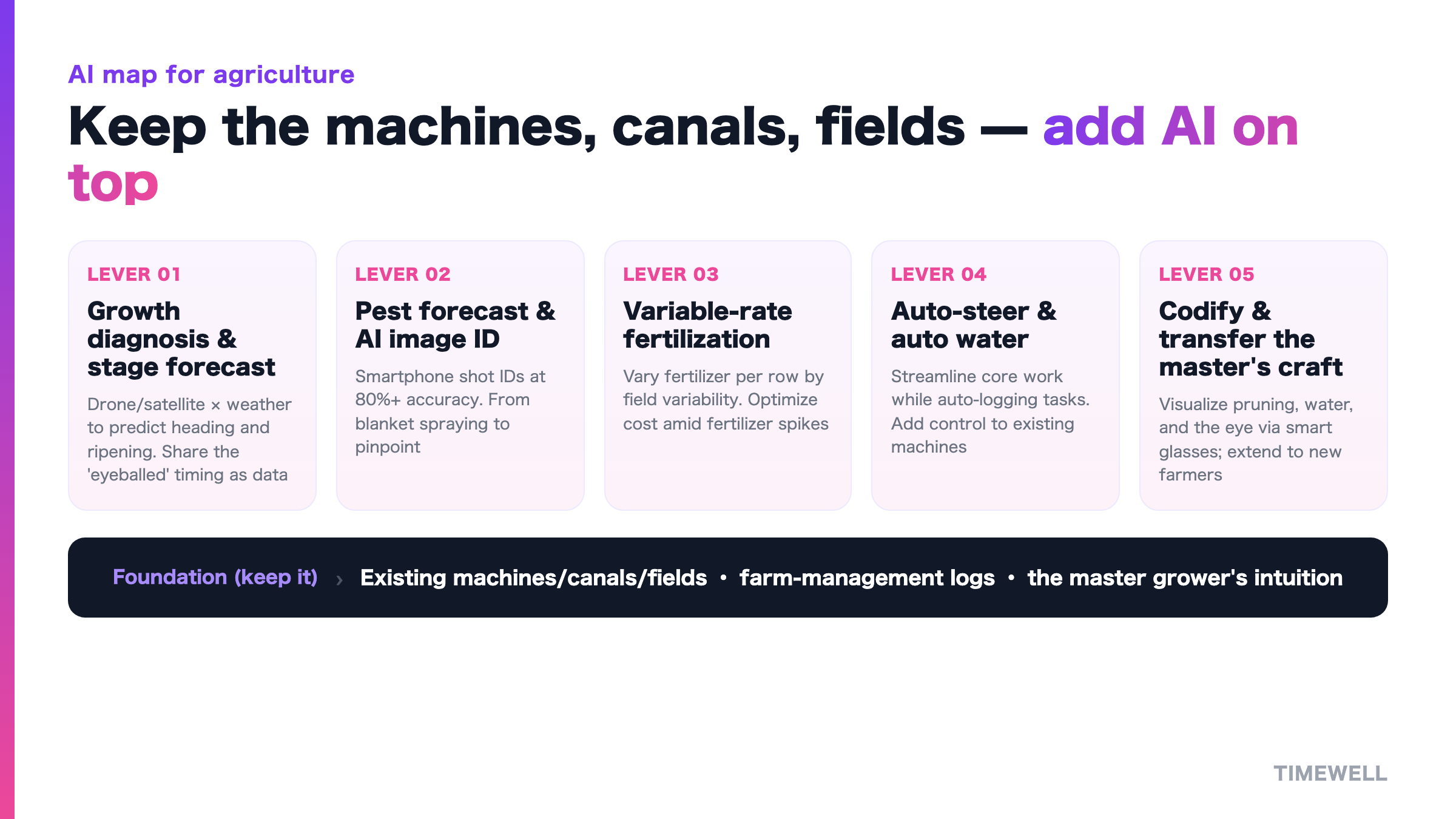
This is the easiest entry point to feel AI at work. Feed AI the growth images captured by drones or satellites together with weather data, and predict the timing of heading and ripening. The harvest window you used to "decide by eye" becomes a number you can share with younger hands and part-timers. For pests, one photo from your smartphone can guess what disease it is and which rows are at risk—turning "just spray the whole orchard to be safe" into pinpoint control on only the blocks where it has appeared or is likely to.
The easy first step really is one smartphone. Photograph a leaf that worries you and run it through a diagnosis app. Or feed one of last year's task records or shipping slips to AI and look together at "where might this year differ?" You don't need to data-ify the whole orchard at once.
As a model case—and this is hypothetical—imagine the spraying you used to run several times a year on one person's intuition, narrowed by forecasting and image diagnosis to "only the risky blocks," cutting spray frequency and pesticide cost while sharing the judgment with part-timers. In fact, in a Kagawa case, evaluating clubroot risk with an AI app revealed over-spraying in 13% of fields, allowing the control level to be lowered. AI works in the direction of reducing blind spraying. That is good for cost and good for the environment.
But let me write this carefully. AI's chemical suggestion is only support. The final judgment presupposes compliance with the registration content and label under the Agricultural Chemicals Regulation Act—it is not an exaggerated "zero pesticides with AI" story. You change work decided by intuition alone into work confirmed and backed by data. That is the essence. You can also check where your AI use stands today with the AI literacy check.
The first step: the top tries talking their intuition through with AI
Before lining up the moves, let me place what comes first in sequence: the owner personally becoming AI-native. In agriculture, this carries an urgent meaning.
Agriculture's greatest asset is the judgment in the owner's head—"when, which row, how much, how to tend." Pruning, water management, spray timing, the grower's eye. These are intuition the person cannot even put into words, and left alone they vanish with retirement. So the top themselves trying to talk their own intuition through with AI becomes the origin of everything.
"How do I decide when to harvest our mikan? I can't quite put it into words, but I want to break down the elements of the judgment together with AI." Type that in, and even if half of what comes back is off the mark, correct that yourself. That is the first step to turning intuition into data. Smart machines adopted with subsidies tend to become buried treasure precisely because this step—the top verbalizing their own intuition—gets skipped, and adopting the machine becomes the goal in itself.
Japanese firms' generative-AI usage rate is 55.2% in the MIC's FY2025 white paper, and the biggest concern about adoption was "we don't know how to use it effectively." That "don't know" cannot be filled by outsourcing or training alone. The top touches it even ten minutes a day. I have rarely seen an AI adoption that skipped this hold up.
Looking for AI training and consulting?
Learn about WARP training programs and consulting services in our materials.
You don't have to face it alone: who helps, and how far
That said—"even if you tell me to touch AI every day, I have no confidence sitting alone at a computer." Moving on without answering that voice would be dishonest, so let me be plain here.
You don't have to start alone. TIMEWELL's AI consulting, "WARP," is designed on the premise of walking beside the owner for the first season. What we do: first, put your intuition into words together. Next, pick just one judgment—among harvest window, spraying, and fertilizing—where the hit-or-miss is largest. Then build and run, together, a small proof that adds AI to that one judgment using your machines and task records at hand. Rather than wrestling with a manual in isolation, you go from verbalizing intuition to the first move with someone beside you to consult. That, I believe, is the realistic way to start AI in agriculture.
Cost and scope vary with the size of the operation, but the thinking is the same. Don't do everything at once. Start from one judgment, one season. The other side—AI and the person walking with you—shows first "if you do this, it would likely change like this," and you judge it in the words of your own orchard. In this order, you can step forward even without being an AI expert. AI transformation for parts manufacturers, continuous with this article, is written on the same backbone of "from the top, small."
Cutting cost: "add" AI to the field
After the decision comes lightening the fieldwork itself. The principle is the same: rather than replacing machines or systems, "add" AI or control devices on top of them.
With fertilizer expensive right now, what works is variable-rate fertilization. Sense the variability within a field and vary the fertilizer amount per row or block by the growth map—stop spreading the same amount everywhere, and apply only what's needed where it's needed. Auto-steer tractors, straight-assist transplanters, and auto water management streamline core work without discarding your existing machines and canals, just by retrofitting control devices, while auto-logging the tasks. In MAFF demonstrations, drone spraying cut work time by about 61% on average, and auto water management greatly reduced the labor of water control—those are reported averages.
Let me write once about the nature of these numbers. Figures like the decline of carriers or the market size of farm stands are MAFF public statistics. On the other hand, effect figures like "X% reduction" or "X% yield rise" are averages from demonstration projects or private cases, and they swing greatly by field, product, and that year's weather. There is no guarantee the same number appears in your orchard. So rather than lining up flashy numbers, I recommend measuring on one block, one judgment of your own.
Here is one sparring prompt for the owner to sort out, with AI, where to start. Paste it as is and replace the contents of the brackets with your own information. The remaining two prompts—turning growing data into a direct-sales and brand selling point, and producing new-pillar seeds—come bundled in the free diagnostic sheet.
You are a consultant well-versed in smart farming and agricultural management. On the premise of adding AI without discarding existing machines, canals, fields, and farm-management systems, help decide which growing decision or task to tackle first. Assume weather and markets dominate, and AI is a support to reduce uncertainty.

# Input (I will fill this in)
- Crops and scale: [e.g., rice X ha, mikan X ha, family farm plus part-timers]
- Three decisions most reliant on intuition / with the biggest hit-or-miss: [e.g., harvest window / spray timing / fertilizer amount]
- Data/equipment on hand: [e.g., farm-management system, drone, weather, past task records]
- Person-dependent judgments: [e.g., pruning and water rely on one representative's intuition]
- Downstream situation: [e.g., mostly JA shipping, little direct sales]

# Your tasks
(1) Evaluate the decisions on "size of hit-or-miss (uncertainty)," "impact on yield/quality," and "ease of data-ification."
(2) For each, separate what AI can take over (prediction, visualization, drafting) from what a human must carry (final judgment, registered-pesticide compliance).
(3) Choose the one to add AI to first, and show the grounds.
(4) Show a "one-season small demonstration" plan for that one. Use existing machines and data.
(5) Define measurement indicators (work time, spray count, yield, grade, etc.).

# Output format (follow exactly)
1. Evaluation table: columns are [Decision/task / Size of uncertainty / Impact on yield/quality / Ease of data-ification / What AI supports / What humans must carry / Metric to measure (assumed)]
2. The one to tackle and the reason (within 3 sentences)
3. One-season small-demonstration plan (what, when, how to measure)
4. Definition of measurement indicators

# Constraints
- Do not use abstract words like "efficient" or "optimize"; write what changes and how, using verbs.
- Do not over-promise yield or income. Add the premise that weather and markets dominate and AI is a support to reduce uncertainty.
- Note that chemical suggestions are AI support and the final judgment follows registration content and label.
- Label effect figures "assumed" or "demonstration average" and add the premise. Do not fabricate.
- At the end, list the three weakest assumptions or risks most likely to break this plan.
Turn the intuition your body learned from "cost" into a "selling point"
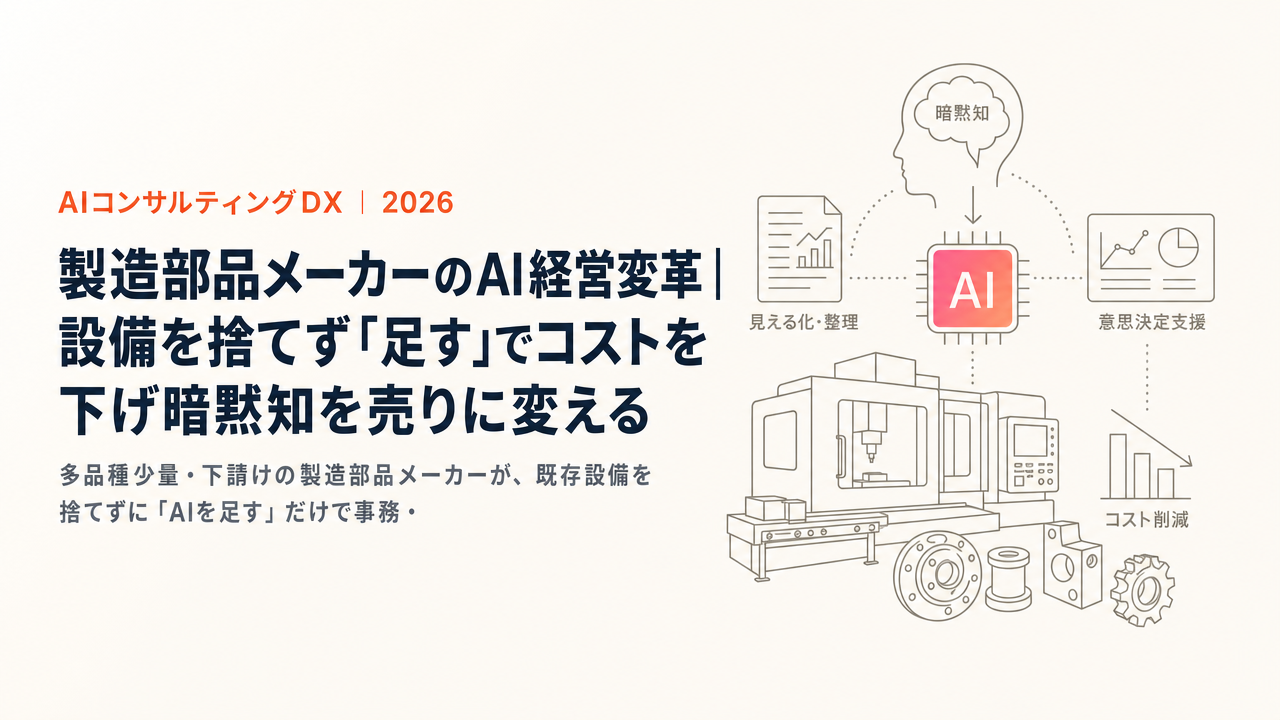
Here is where you go on the offense. The growing intuition you spent decades embedding in your body, and the field, weather, and task records actually piling up in farm-management systems and sensors. Turn these from a cost buried inside you into a "selling point" you can broadcast outward.
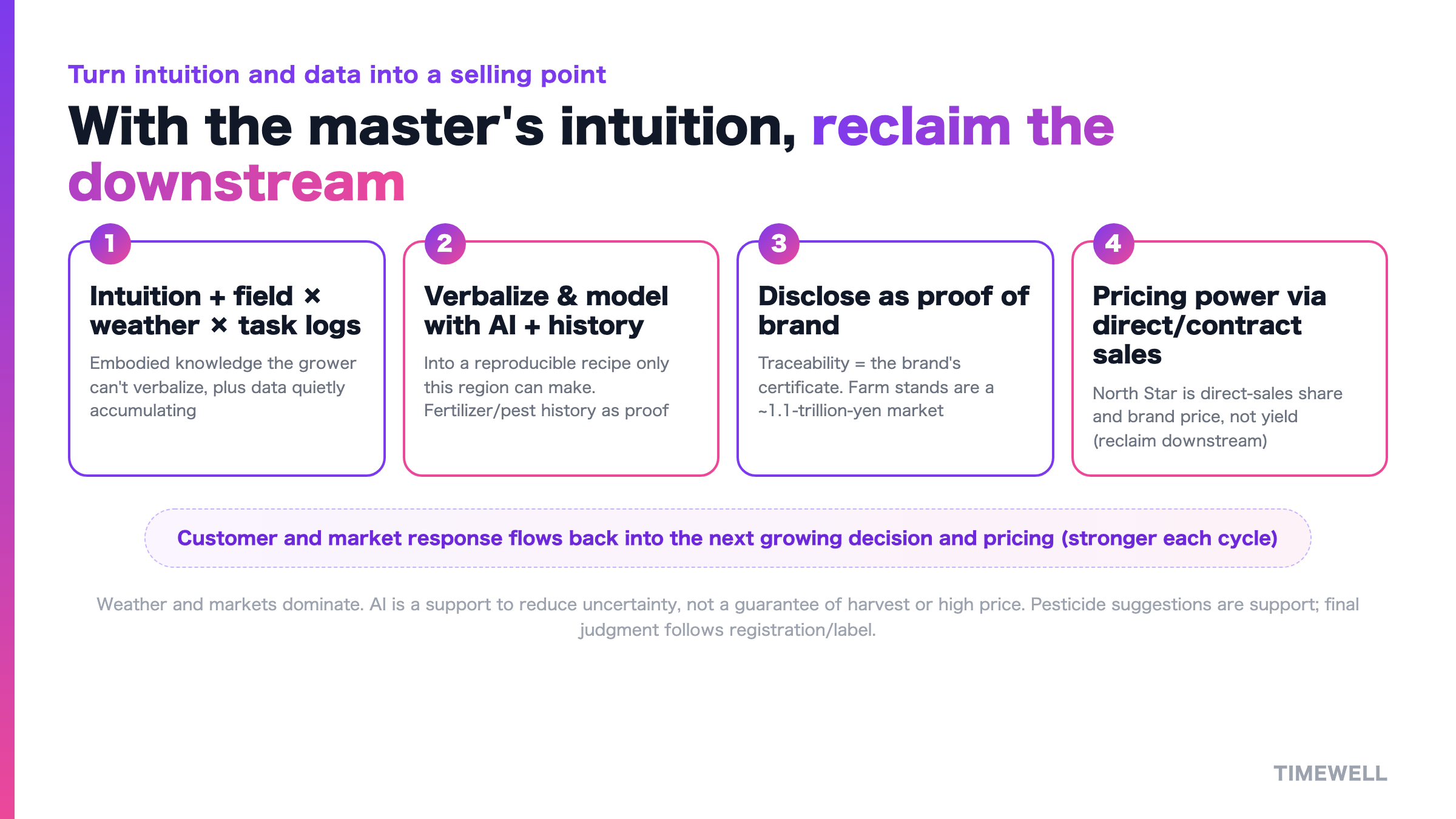
First, transfer. Pruning, training, the grower's eye, temperature and water management—film and visualize such skilled judgments with smart glasses and task records, and extend them with AI to support new farmers and part-timers. In an age when "watch and learn" no longer works, you can preserve intuition in words and data. The average age of carriers is 67.7. What this generation built up is this industry's greatest asset. This is not about denying the carriers. It is the act of respecting that asset and translating it, before it fades, into a form the next generation can learn.
And that intuition becomes an outward-facing weapon. Growing records—fertilizer and pest-control history, sugar content—become a "certificate of brand" that says "this quality, because of this growing." Traditionally, even good produce got beaten down by grade and market rates at markets and wholesalers. But the farmer holds the final product—food—in their own hands. Disclose that record and direct it toward farm stands, e-commerce, contract farming, and hometown tax, and you become able to speak the price yourself. Farm stands are a roughly 1.1-trillion-yen market nationwide. A receiver where producers can set the price exists at that scale.
What matters here is not to put the number you chase on yield alone. How much you raised the ratio of direct and contract sales against market shipping. How much you defended the brand's unit price. That becomes the yardstick of whether you are reclaiming the downstream. When you turn growing know-how and records into outward-facing assets like direct sales and fan connections, TIMEWELL's "BASE" connects naturally. But this too is a tool. In sequence, it still starts with the top turning their own intuition into data.
Drafts of hiring, and of communications conveying the region's appeal, can also be lightened with AI. Turn a skilled grower's task records directly into procedure manuals for newcomers. Cover the chronic shortage of people to teach with records. But framing AI as "reducing people" makes the field push back. In a time when you can't hire, redirect the people you have toward more fruitful work—that framing fits agriculture's reality better, I think. For HR thinking, AI implementation patterns in HR is a useful reference.
Keep the main business running, and stand a new pillar small beside it
Finally, what lies beyond. It would be a waste to spend the slack freed up by cost reduction only on extending the life of existing production. Yet the more earnest the region, the more "getting today's shipment out" becomes the correct answer, and there's no bandwidth for new shoots. Everyday life in a family operation sits right next to this trap.
The key to escaping is not to measure the new effort by current yield or short-term profit. Measured that way, it gets crushed as "unprofitable" before it grows. Don't stop the main business—production—and stand a new pillar small beside it. With slack, a small separate team; without it, even just half a day a week from the owner is fine. Multiply the growing, spraying, and sequencing know-how you accumulated over decades, and the data you hold—field, weather, task, shipment—with AI. Then what used to be an internal cost starts to look like a service you can sell outside. Data-ify your region's high-quality reproducible procedures and offer them, as growing support, to other regions and new farmers growing the same variety. Grow a traceability-based brand direct-sales channel. Consolidate abandoned and exited farmland, make standard work reproducible with AI, and run a "region OS" that even new farmers and part-timers can operate. Try it small beside existing production, without stopping it. That, I think, is a plain but sure step from a structure of merely growing and putting to market, toward a management that decides for itself "what quality, to whom, at what price."
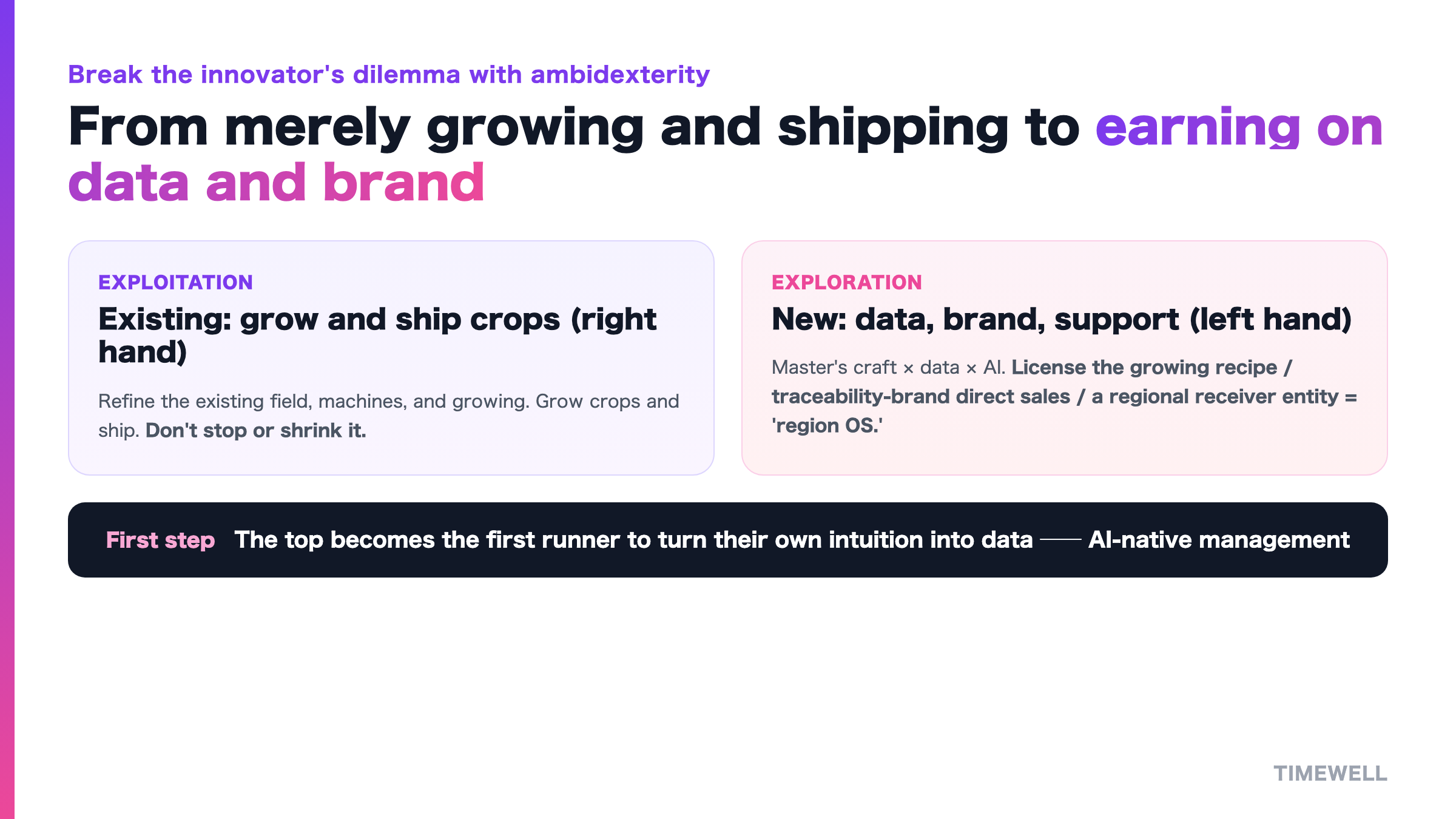
The sparring prompt for producing new-pillar seeds is also bundled in the diagnostic sheet. Before you brood over it alone, try making AI your partner.
Conclusion: intuition into data, reclaim the downstream
Let me organize the key points.
- The easiest entry point to feel is the "when to harvest, when to spray" stuck in your head. With growth forecasting and AI pest diagnosis, change judgments made on intuition alone into work confirmed and backed by data. Start from one smartphone.
- The first step is the top trying to talk their intuition through with AI. But you don't have to face it alone—you can rely on someone walking beside you for the first season.
- Cut cost by "adding, not discarding." Variable-rate fertilization, auto-steer and auto water management, AI pest diagnosis (chemical suggestions are support; final judgment follows registration and label). Keep existing machines and try small on one block.
- The intuition your body learned is not an internal cost—it can become a "selling point." Turn growing records into proof of brand, and reclaim pricing power through direct and contract sales. Chase not only yield but the direct-sales ratio and brand unit price.
- Stand a new pillar in a separate frame without stopping the main business. Without slack, start from the owner's half a day a week.
Let me end with an honest word. Agriculture is an industry dominated by variables beyond human power—weather and markets. AI guarantees neither a bumper crop nor high prices. Even so, I recommend this sequence: the top first talks their intuition through with AI and puts it into words, tries it for one season on the single most hit-or-miss decision, and turns growing records into a weapon for direct sales. Agriculture's greatest asset is in the heads of its carriers. The region that manages to translate it into data without erasing it, I believe, inherits the master craft to the next generation and reclaims the downstream.
You can download the "AI Management Diagnostic Sheet (Agriculture Edition)" for checking this article against your own company, free from the top of this page. It is an Excel that lets you fill in five areas—growth and pest judgments, labor-saving and farm data, transferring the master craft, direct sales and branding, and new business and management—while sorting out where to start, and it also bundles the three sparring prompts touched on in this article. First, try filling it in yourself, together with AI.
And the easiest first step is to photograph one leaf that worries you. When you want to sort out, from the very first season, where adding AI to your fields and data would work, please use WARP AI consulting or an individual consultation.
References and sources
- MAFF, "Summary of the 2025 Census of Agriculture and Forestry (final values)" (published March 2026) 1
- MAFF, "FY2024 White Paper on Food, Agriculture and Rural Areas," Feature 3 (smart-farming demonstrations) 2
- MAFF, "FY2024 Food Self-Sufficiency Rate" (published October 2025) 3
- NARO, "AI pest-disease image-diagnosis system" / Agricultural data collaboration platform WAGRI 4
- MAFF, "FY2024 Sixth-Industrialization Survey" (published March 2026) / Act to Promote Smart-Farming Technology 5