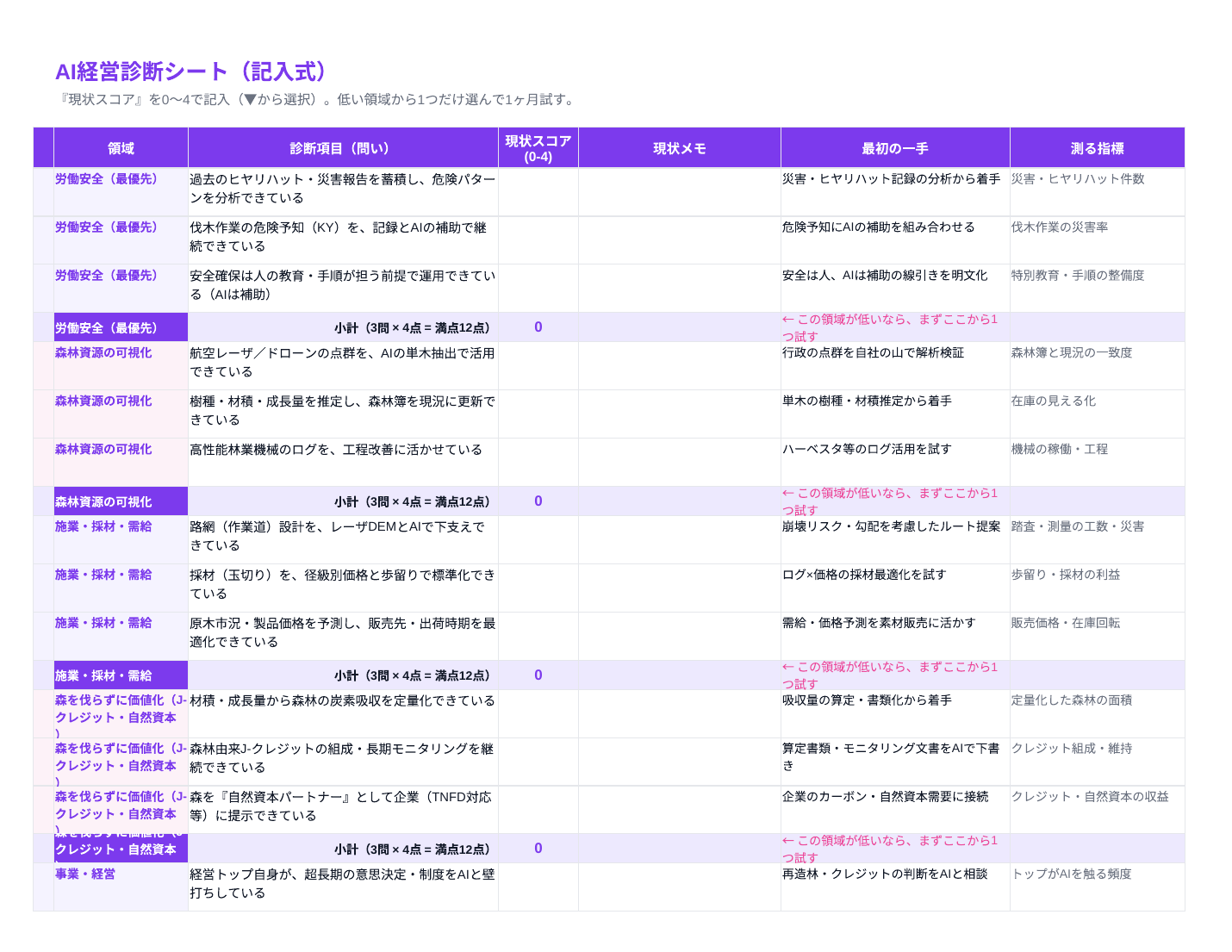
AI Management Diagnostic Sheet — Forestry (editable Excel)
A fill-in sheet that self-scores five areas—occupational safety, forest-resource visualization (LiDAR), silviculture/bucking/supply-demand, monetizing the forest without felling (J-Credit), and business & management—to decide where to add AI first.
Download the Excel sheet (free)Excel (.xlsx) ・ no email required
Hello, this is Ryuta Hamamoto from TIMEWELL.
You enter the mountain before dawn. The slope is steep, the ground slick with wet fallen leaves. You ready the chainsaw, check that the target tree has no hung-up branches, trace the retreat direction in your head twice, and then set the blade in. At the moment it falls, the trunk can spring in an unexpected direction. A day in forestry begins with this as its first goal: "today, again, everyone comes down the mountain, no one missing." Efficiency and productivity come after that.
So when I write about AI in forestry, I have decided the words I place first. Before efficiency, first, no one dies. I cannot bring myself to drop that and start from the productivity talk.
On top of that, forestry has three elements no other industry has. One, the timescale. From felling a tree, to planting, to being able to fell the next—40 to 60 years. Whether today's judgment was right, the owner cannot confirm in their lifetime. Two, danger. The felling worksite is directly tied to life. Three, the output has doubled. Recently, value has begun to attach not only to "timber felled and sold" but to "the standing forest itself"—it absorbs CO2, stores water, prevents disasters.
This article, with forest cooperatives and small forestry entities in mind, follows the path of adding AI on top of the existing LiDAR point-cloud data, high-performance forestry machines, and the forest you own or manage—without discarding any of them. I also change the order from other industries: I enter first from safety. To state the backbone up front, every first step begins with the owner personally touching AI every day. I will write why later.
Top priority: prevent accidents. Efficiency is next
Forestry's occupational accidents stand out even in the statistics. The rate of injury or death during work (incident rate per 1,000 workers) was 22.8 in FY2023. That is roughly 10x the all-industry average of 2.4, and the highest of all industries. Moreover, about 70% of fatal accidents occur during felling, and about 70% of the injured were 50 or over. A single accident robs a life and the company's trust at once. I cannot place this reality after the efficiency talk.
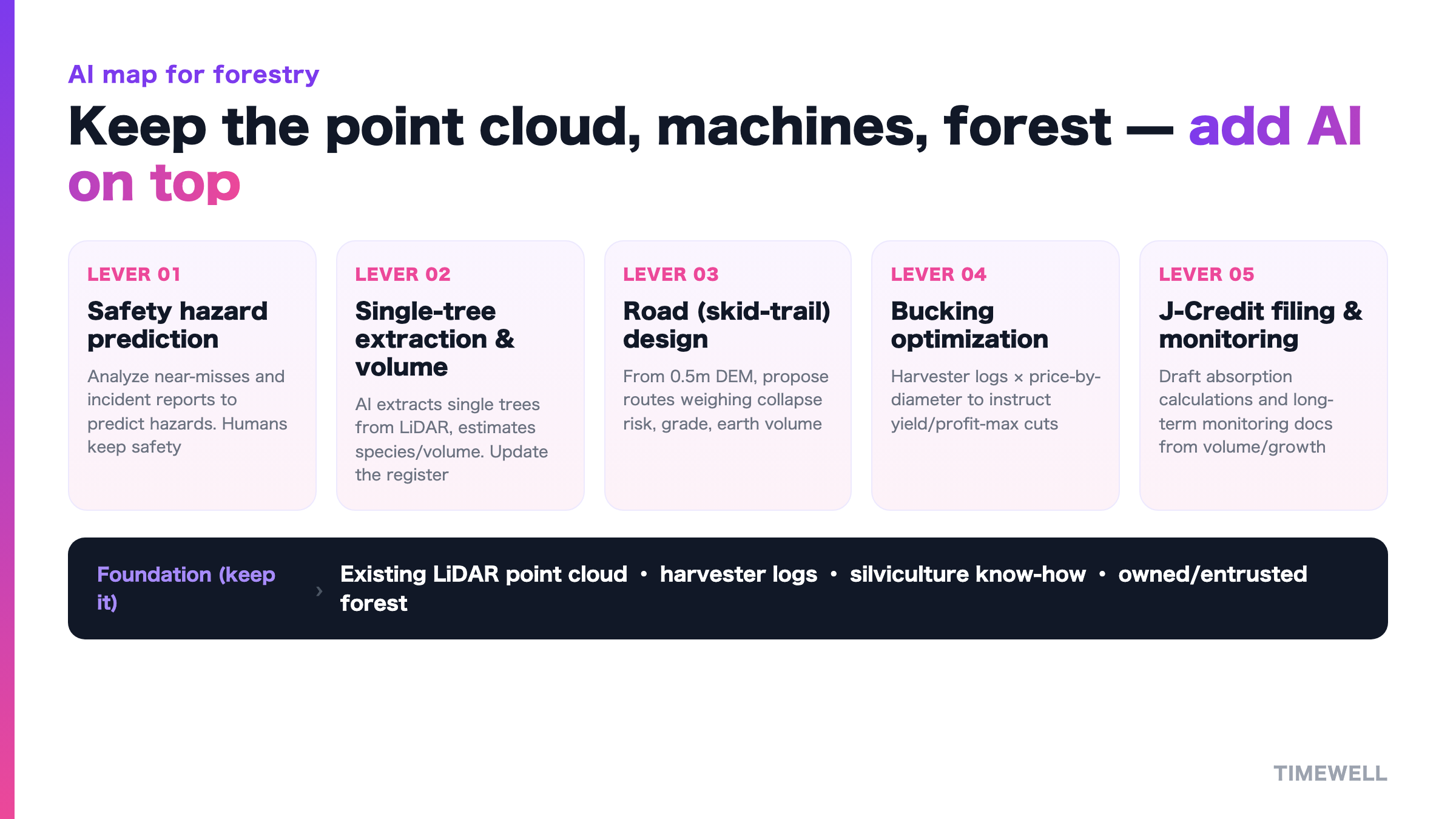
Here you can add AI. Have AI read past near-misses and incident reports to draw out hazard patterns—leaving, in a form even juniors can see, tendencies like "with this slope, this species, this wind direction, hung-up-tree accidents happen more easily." Add, as a supplement, systems that detect hung-up trees or poor retreat with cameras and wearables and prompt caution. The aim is to focus on felling accidents, which make up about 70% of fatal accidents.
But there is something I never want misunderstood. AI cannot take over safety itself. Forestry is a world dense with laws—the Industrial Safety and Health Act, special felling education, chainsaw handling. What ultimately protects people is training and the field's judgment. What AI can do stops at quietly offering the patterns people tend to overlook. The moment you think "safe because we added AI," it becomes more dangerous instead. This line must not be crossed.
Even so, this support has meaning. The fact that about 70% of the injured are 50 or over shows that safety management relying on veterans' experience thins with generational change. Preserving, in a form juniors can learn, the patterns drawn from past accidents is also inheriting the vanishing knack for safety as words anyone can read.
The first step: the owner talks "50 years ahead" with AI
Before laying out the moves, let me place what comes first in sequence. The owner personally becoming AI-native. In forestry, this has special meaning.
Forestry's judgments look 40 to 60 years ahead. Whether to reforest, which trees to plant, whether to monetize the forest as credits. None of these can be decided by a single floor staffer; they are super-long-term management judgments. And the forest data and systems that inform them are far too complex, with no room to place dedicated staff. Here, AI becomes the cheapest "first partner to consult" you can hire.
The top types their worry in their own words. "For our mountain, tentatively compare reforesting versus not after felling, by forest stock and risk 40 years out." "To turn the forest's CO2 absorption into a credit, list the points on what to prepare first." Even if half the answers need verification, becoming able to do that verification with your own eyes—that is the entrance to being AI-native.
Why the top themselves? Because if the person who gives the call doesn't move, even data captured from the sky lies dormant on the shelf. Even at sites that prepared LiDAR data regionwide, the organizations that actually moved were the ones whose top touched it first. The share of Japanese firms using generative AI is still about 55.2% in the MIC's FY2025 white paper. The most common concern was "we don't know how to use it effectively." That "don't know" is not filled by outsourcing or training. The top touches it, even 10 minutes a day. I have never seen an adoption that skipped this go well.
You can check where your company's AI use stands today with the AI literacy check. The AI transformation for parts manufacturers, written with the same thinking, is continuous ground.
Looking for AI training and consulting?
Learn about WARP training programs and consulting services in our materials.
Turn the data already captured from the sky into a field-usable form
Next is the foundation of this industry: visualizing forest resources.
In fact, in many regions, LiDAR 3D data of the forest has already been captured. The problem is that it doesn't match the ground or the forest register and isn't put to use. Here you add AI. Analyze the point cloud as an image, pick out trees one by one automatically, and estimate species, height, trunk diameter, and volume. Then rewrite the forest register to the current state. "Where, what trees, and how many are standing" becomes visible in numbers.
For instance, at one forest cooperative, the work of updating the forest register—until now done by people walking the ground—was reported to be greatly compressed by AI single-tree extraction from LiDAR point clouds (a demonstration case, own figures; accuracy depends on local conditions). It is not discarding the point-cloud asset, just adding its analysis. This is the starting point.
This data works on field logistics too. From elevation data, AI proposes skid-trail routes that account for collapse-prone spots, grade, and earth volume—reducing reconnaissance and survey hours and preventing rain-collapse disasters and rework. Bucking (log cross-cutting) too: match harvester sensor logs with prices by diameter and length at sawmills and biomass plants, and AI shows the cut positions that leave the most profit. Bucking that relied on veterans' intuition becomes something anyone can approach.
But accuracy depends on conditions. LiDAR-analysis accuracy changes with forest type, terrain, and season. It is not "accurate because we added AI"; verify on your own mountain before expanding. Do not skip this plain premise.
Let me note the nature of the numbers just once. The accident rate roughly 10x all industries, and the cumulative J-Credit volume that comes up below, are public statistics from the Forestry Agency and others. Meanwhile, "AI cut hours by X%" effect figures are mostly own figures from vendors or entities, with no guarantee the same number appears on your mountain. So rather than lining up flashy figures, I recommend measuring on one of your own mountains, in one process. This distinction is the premise throughout this article.
Here is one sparring prompt for sorting out, together with the owner and AI, where to start. Paste it as-is and replace the parts in brackets with your own information. The remaining prompt (a sparring session for producing seeds of a new pillar that earns without felling) is included in the free diagnostic sheet (Excel).
You are a management-improvement consultant well-versed in forestry DX and occupational safety. On the premise of adding AI without discarding the existing LiDAR point cloud, harvester logs, and silviculture know-how, help decide where to tackle first across safety and forest-resource use. The premise is that AI cannot replace safety.

# Input (I will fill this in)
- Type and scale of entity: [e.g., forest cooperative, log production, annual output X m3]
- Three issues you carry now: [e.g., felling safety / forest register out of date / reforestation decision]
- Data on hand: [e.g., government LiDAR point cloud, harvester logs, past near-miss records]
- Person-dependent tasks: [e.g., road design and bucking rely on one veteran's intuition]
- Involvement in systems: [e.g., forest-management system; J-Credit not yet started]

# Your tasks
(1) Evaluate the issues on "impact on safety," "effect on super-long-term decisions," and "ease of starting."
(2) For each, separate what AI can take over (analysis, drafting, hazard-prediction support) from what a human must carry (safety, final judgment).
(3) Choose the one to tackle first, and show the grounds (consider safety as top priority).
(4) Show a "small demonstration" plan for that one. Use the existing point cloud and machine logs.
(5) Define measurement indicators (accidents, near-misses, analysis accuracy, hours).

# Output format (follow exactly)
1. Evaluation table: columns are [Issue / Impact on safety / Effect on super-long-term / Ease of starting / What AI supports / What humans must carry / Metric to measure]
2. The one to tackle and the reason (within 3 sentences)
3. Small-demonstration plan (what, who, when, how to measure)
4. Definition of measurement indicators

# Constraints
- Do not use abstract words like "efficient" or "optimize"; write what changes and how, using verbs.
- Do not write that safety "can be replaced by AI." Don't bend the premise that AI is a hazard-prediction support.
- Add the premise that LiDAR-analysis accuracy depends on forest type, terrain, and season.
- Label effect figures "assumed" and add the premise. Do not fabricate.
- At the end, list the three weakest assumptions or risks most likely to break this plan.
Monetize the forest "without felling": turn data into a selling point
This is the very core of forestry's AI transformation. The forest data and silviculture know-how you carry as "internal cost" can become an asset you sell outside.
The most symbolic is the path of earning without felling. Organize the LiDAR point cloud, species and volume, terrain, growth, and silviculture history, and you can show in numbers how much CO2 the forest absorbs. Sell this—as the partner who measures and presents the forest's value—to forest-derived J-Credits and to firms now being asked to disclose their impact on the natural environment. This is revenue from the standing forest, separate from felled-and-sold timber.
But here I write honestly, without inflating expectations. A small mountain rarely pays off on J-Credit alone. A certain minimum area is required, screening costs money, and even after certification the labor of up-to-16-year long-term monitoring and paperwork continues. Do it alone at a few-hectare scale, and the burden of screening plus 16 years of clerical work tends to outweigh the credit revenue that comes in. Move on the words "even a small team can issue it" alone, and you usually run out of breath partway.
The realistic move is to bundle. Consolidate nearby small owners and the under-tended forests municipalities hold, up to a scale of tens of hectares. Only when the area piles up that far do the screening cost and long-term monitoring effort start to pay. And that "bundling" clerical work—name-matching owners, gathering consent, continuously producing 16 years of monitoring documents—is exactly where AI works best. From silviculture history and LiDAR-derived volume and growth, AI drafts the absorption-calculation documents and records. Issuance and maintenance that were given up at the wall of manpower come within realistic reach, once you presuppose consolidation.
Forest-derived J-Credits grew to a cumulative 1.208 million t-CO2 and 226 registrations as of January 2025. The certified period has also been extended to a maximum of 16 years. But prices and revenue fluctuate, and there are issues of "could it truly not have been reduced without this project (additionality)," permanence, and long-term monitoring cost. It is not a story that "credits are sure to profit." Keeping the forest has, at last, begun to carry a price—that is the stage we are at now.
There are other directions of selling. Turn log quality and diameter data into material for proposals to sawmills, and you are less beaten down in negotiated deals. Make the digital forest information itself—"where, what trees, how many are standing"—a weapon when you take in (consolidate) forests from nearby small owners and municipalities. Turn a legal-timber and reforestation track record from a compliance burden into a reason to be chosen.
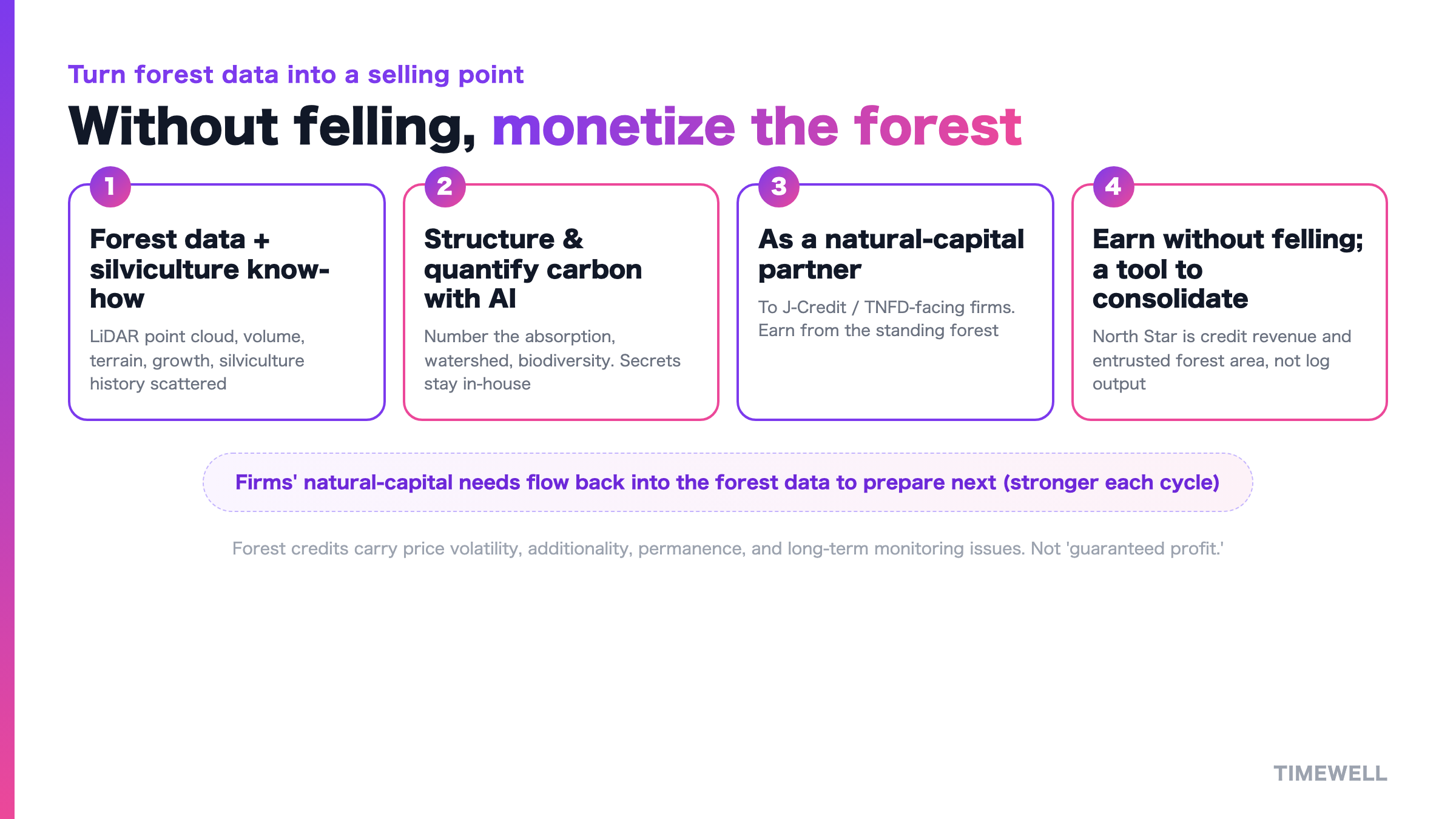
The numbers you track change too. Not only log output, but revenue from credits and natural capital, and the area of forest you have consolidated and taken on. How much did you earn by keeping the forest? That is the number to track from here.
Lighten the burden of system paperwork with AI
Complex systems weigh heavily on forestry—the forest-management system, the forest-environment transfer tax, and J-Credit. Each demands enormous paperwork for filing, obtaining owner consent, and long-term records. Yet there are no people to spare.
Here too you can add AI. Match registration, lot numbers, and the forest-land ledger to organize forests with unknown owners, and have AI manage the draft of the plan to take on a forest and the progress of consent-gathering. But since name-matching handles personal information such as registration, the premise is to proceed with care for personal information and within the scope of municipal procedures. The system's intention survey advanced within three years of its start to cover 94% of privately owned planted forest. Chip away at this mountain of paperwork with AI, little by little.
Keeping in-house knowledge—silviculture history, forestry laws, safety standards—searchable with AI also works. TIMEWELL's "ZEROCK" connects to this context as a base that, on domestic servers, makes such knowledge you don't want sent outside searchable in a linked form.
Don't stop the mainstay; stand a new pillar small beside it
Finally, protecting the fell-and-sell mainstay while standing, small, beside it, a new pillar that earns by keeping the forest.
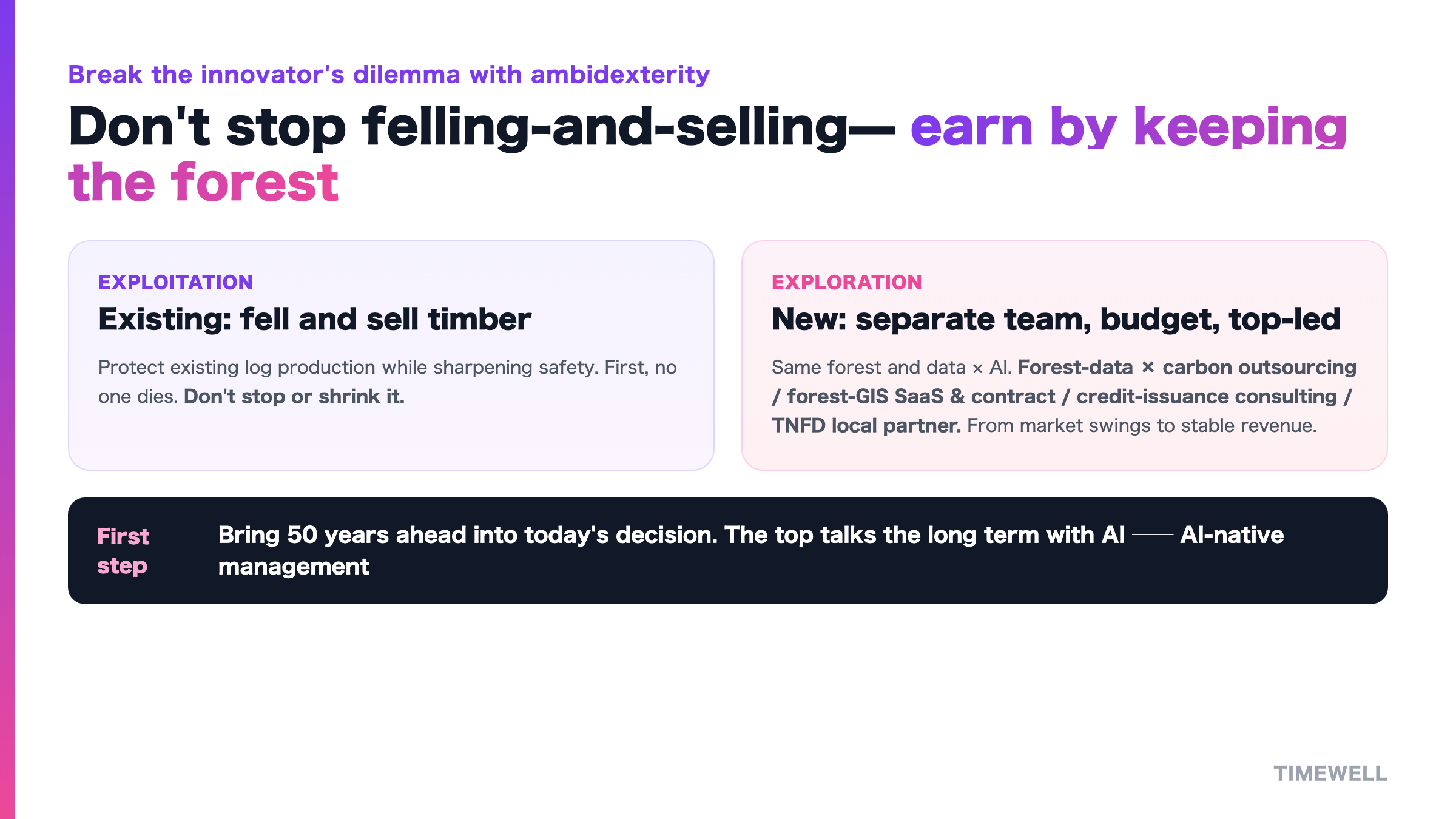
The more serious the entity, the more "getting through the log production in front of you" becomes the right answer, and there is no hand left for the new bud. The key to breaking out is not to measure the new effort by today's log output or short-term profit. Measure it that way and it is crushed as "not profitable" before it grows. If you have spare capacity, a small separate team; if not, the owner alone, even half a day a week. Set it apart from existing orders, and multiply AI onto the same mountain and the same data.
The seeds are unique to this industry. An outsourcing business that gathers nearby small forests and handles everything up to credit issuance—bundling forest data. Providing the forest mapping and resource analysis you honed to nearby entities as help. A consulting role bundling J-Credit issuance, sale to firms, and report writing. Each can be tried small, beside, without stopping existing log production.
Shift the center of gravity, little by little, from a structure swayed by timber markets to one that earns stably by keeping the forest. Without stopping existing log production, stand a pillar of forest data and carbon small, beside it. That, I think, is the plain but sure step out of a passive subcontracting structure. The sparring prompt for producing seeds of the new pillar is included in the diagnostic sheet. Before you think it through alone, try making AI your partner.
Conclusion: protect safety, earn by keeping the forest
Let me organize the key points.
- Forestry AI is not efficiency to fell faster. First, no one dies. It has a skeleton no other industry has: timescale (40-60 years), danger (accidents about 10x all industries), and the monetization of the standing forest.
- The top priority is occupational safety. But safety itself cannot be replaced by AI; AI stays a hazard-prediction support. Safety is protected by people.
- Turn the LiDAR data already captured from the sky into a field-usable form with AI single-tree extraction. It works on road design, bucking, and supply-demand forecasting too. But accuracy depends on forest type, terrain, and season.
- The core is monetizing the forest without felling. But J-Credit doesn't pay off for a small mountain alone, given screening cost and 16 years of paperwork. It works only once you consolidate the surroundings to tens of hectares. It is not "sure to profit."
- The first step is the owner talking the super-long term with AI. Run the new pillar in a separate frame without stopping the mainstay. If there's no spare capacity, the owner starts at half a day a week.
Let me write my honest view at the end. Forestry's decisions reach 50 years ahead, which you cannot confirm in your lifetime. The effect figures, and the credit market, are still developing. That is exactly why, rather than leaping at flashy talk, I recommend the plain sequence—the top first touches AI, tackles the heaviest matter of occupational safety first, and verifies the data captured from the sky on their own mountain. Today, protect safety, prepare the forest data, and open, little by little, the path to earning by keeping the forest. That, I believe, is management that hands the mountain to the next generation.
You can download the "AI Management Diagnostic Sheet (Forestry Edition)," for checking this article against your own company, free from the top of this page. It is an Excel that lets you fill in five areas—occupational safety, forest-resource visualization, silviculture/bucking/supply-demand, monetizing the forest without felling, and business & management—while organizing where to start, and it includes the sparring prompts touched on in the text. First, have the owner fill it in together with AI.
The easiest first step may be for us to show you your forest's data. In a model case (tentative): entrust us with the LiDAR point cloud of just one plot, and by single-tree extraction we return "in this plot, which trees, how many, what volume" as a single figure. The register groundwork that staff once spent days walking to update comes back, first, as a desk-level draft (a model case only; accuracy changes with forest type, terrain, and season).
When you want to sort out, together, where adding AI to your mountain and data would work, use WARP AI consulting or an individual consultation.
References and sources
- Forestry Agency, "FY2024 Forest and Forestry White Paper" (accidents, employment structure, reforestation) 1
- Forestry Agency, "Current state of forestry occupational accidents" (incident rate) 2
- Forestry Agency, "FY2023 Timber Supply and Demand Table" (published September 2024, revised January 2025) 3
- Forestry Agency, "Holdings of high-performance forestry machines" / "Digital-forestry strategy bases" 4
- Forestry Agency, "Forest-derived J-Credit" / "Status of the forest-management system" 5