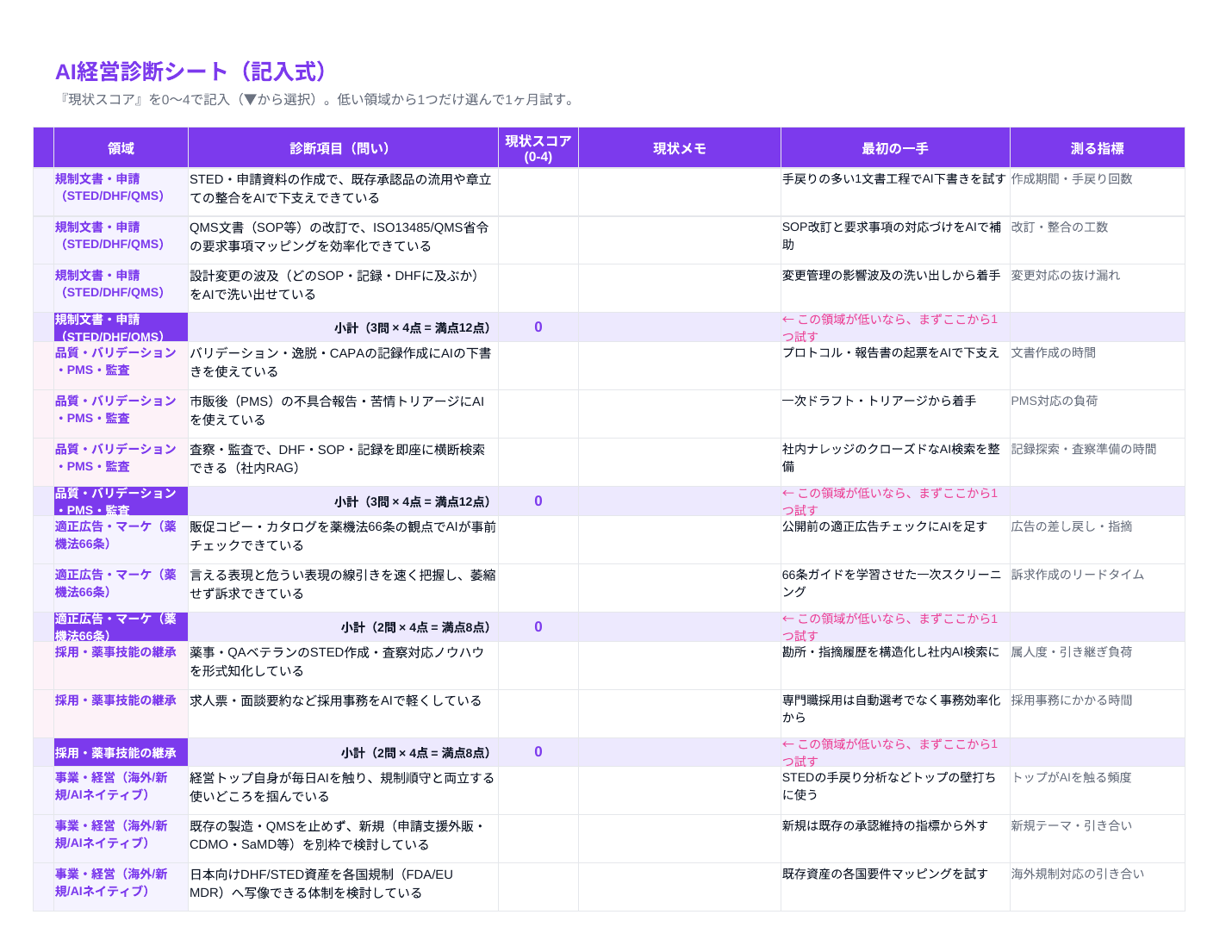
AI Management Diagnostic Sheet — Medical Device Maker (editable Excel)
A fill-in sheet that self-scores five areas—regulatory documents & submissions, quality/validation/PMS/audit, advertising compliance, hiring & regulatory skill transfer, and business & management—to decide where to add AI while preserving record integrity.
Download the Excel sheet (free)Excel (.xlsx) ・ no email required
Hello, this is Ryuta Hamamoto from TIMEWELL.
When I visit a small medical device or pharma-related maker, I sense a slightly different air than at other manufacturers. Half the conversation on the floor is not about the thing itself, but about "how to leave the evidence for it."
Say you want to change one part to a slightly better material. Even that small improvement moves design control, requires a risk re-evaluation (ISO14971), forces you to redo verification, update the DHF and DMR, and in some cases chains all the way to procedures with the PMDA or a certification body. One screw's improvement summons a chain of documents. Anyone at a medical maker knows this feeling all too well.
This, I think, is the one point where AI's use at a medical maker differs decisively from other industries. As much as the thing you make—sometimes more—the "evidence that you made it," the documents and records, is an inseparable part of the product. So the speed of improvement is decided by the speed at which you can produce regulatory documents correctly and fast. The management bottlenecks of approval, shipment, and audit response can be removed directly with AI. This is qualitatively different from other industries' AI, which aims at general productivity.
So in this article I never say to discard your equipment or QMS. Keep your existing QMS, your design and verification assets, and the knowledge of your regulatory and quality-assurance veterans—and add AI on top. I will follow all the way to turning quality-document knowledge that was only a defensive cost into a selling point: "the firm whose evidence comes out fast and correct." To put the backbone up front, every first step begins with the owner personally touching AI every day. The reason comes later.
One disclaimer, given the nature of this article. Here I portray AI strictly in the context of supporting regulatory compliance, quality documents, and traceability. I avoid asserting the effect of any product or method, in line with the spirit of Article 66 of the Act (prohibition of false or exaggerated advertising).
Start with the heaviest thing: regulatory documents
Isn't this a familiar scene? You have to finish an approval or certification submission (STED). But the only people who can really write it are that one regulatory-affairs staffer, or one veteran. They dig through past approved items from memory, arrange the section structure, and stack up the standard-conformity proof. When that person is out, it stops. Juniors can't learn it. Every rework pushes the launch back. Regulatory documents are what eats the most time and depends most on individuals at a medical maker.
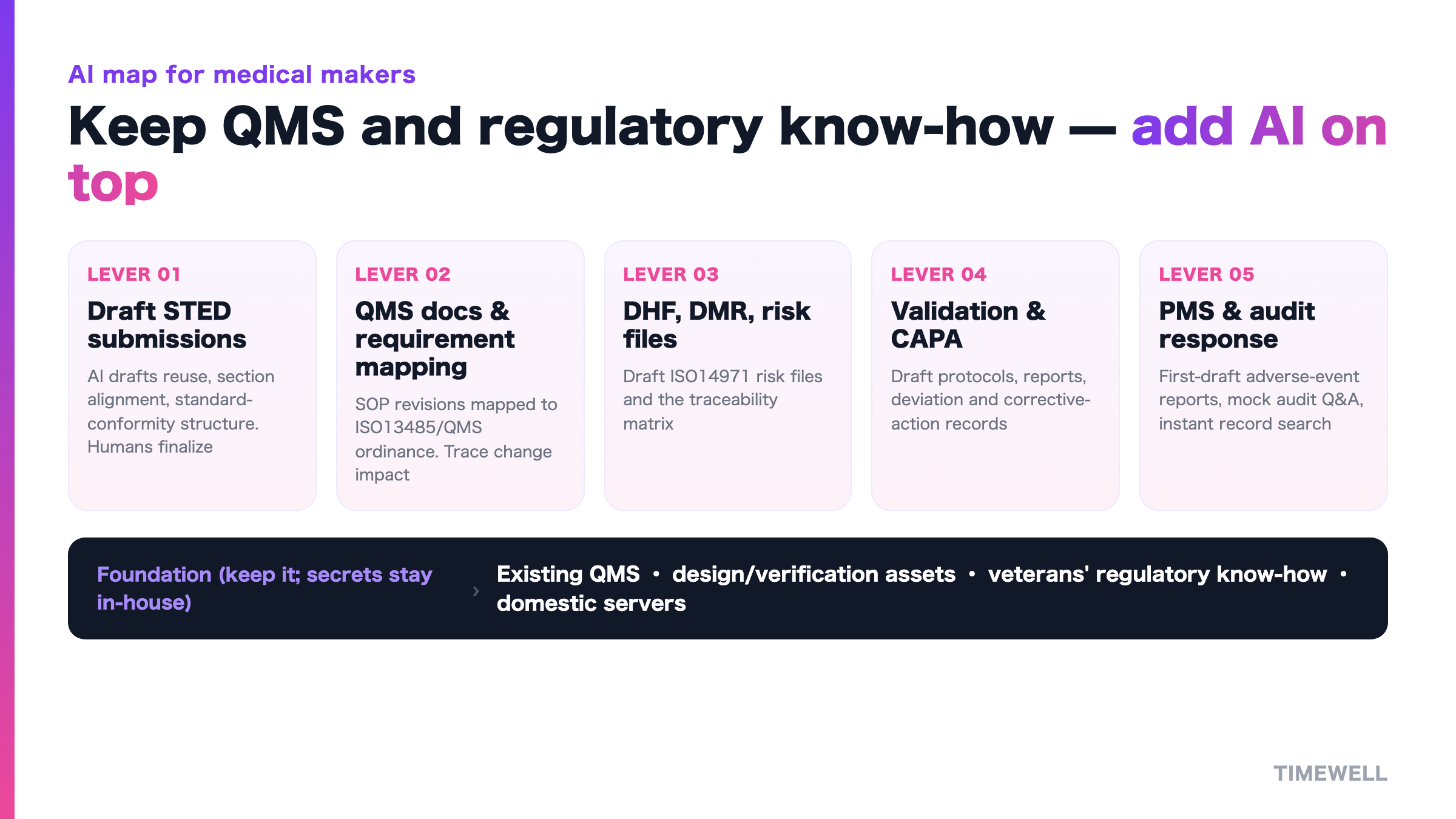
This is the easiest place to feel what AI can do. Have AI draft the reuse from existing approved submissions, the consistency check of the section structure, and the composition of the standard-conformity proof. The regulatory staffer concentrates only on reviewing and finalizing the content and accuracy. A junior can handle the first pass, and things don't stop when someone is out.
There is one more thing: the heart of change control—"which SOPs, records, and drawings does this improvement ripple into." Done by hand it is enormous, and gaps are frightening. Run AI across it and you grasp the whole picture of the document chain up front. It works at the deepest root of the document hell that one screw's improvement summons.
As a model case, imagine this: the prep for a submission that a regulatory staffer used to spend weeks writing from scratch is replaced by AI producing a first cut that a human reviews and corrects, shortening the time from start to first draft. (This is a hypothetical model case; the degree of shortening varies by the product's class and the state of the documents. AI only makes the rough cut; humans guarantee correctness.) This is emphatically not about "submitting an AI-written document as is." You change the work of building from zero into the work of reviewing and correcting. That is the essence.
What you cannot skip here is handling secrets. DHFs, DMRs, and submissions are a mass of quality knowledge that cannot leave the company. So if you handle these with AI, choose a setup that keeps information in-house—for example, a base you can use closed on domestic servers. TIMEWELL's "ZEROCK" connects to this context as a base that structures confidential internal knowledge without sending it outside and lets you cross-search it. (Accuracy varies with the type and condition of the underlying documents.)
Here is a sparring prompt for sorting out, together with the owner and AI, which document to start with. Paste it as is and replace the text in 【】 with your own information. The remaining two prompts (turning quality-document knowledge into a sales asset / producing seeds for a new pillar) are included in the free diagnostic sheet.
You are an operations-improvement consultant well-versed in regulatory affairs and quality assurance (QA) at medical device makers. On the premise of preserving the existing QMS and record integrity, help decide which regulatory-document process to add AI to first.

# Input (I will fill this in)
- Class and regulation of the main product: 【e.g., Class II general medical device, mostly certified items】
- Three regulatory-document processes with the most time and rework now: 【e.g., STED preparation / SOP revision / DHF update】
- Owner and time per case for each: 【e.g., STED is one regulatory staffer over X weeks; all hands before audits】
- Person-dependent tasks: 【e.g., mock audit Q&A is in one veteran's head】
- Record/confidentiality constraints: 【e.g., DHF and submissions cannot leave the company】

# Your tasks
(1) Evaluate the three processes on "amount of rework," "person-dependence," and "confidentiality."
(2) For each, separate the drafting and consistency-checking AI can take over from what a human (qualified person) must review and finalize.
(3) Choose the one process to add AI to first, and show the grounds.
(4) Outline operating rules that ensure record integrity, change control, and verification (who verifies and records what, and how).
(5) Define measurement indicators (preparation period, rework count, audit findings, etc.).

# Output format (follow exactly)
1. Evaluation table: columns are [Document process / Amount of rework (high-mid-low) / Person-dependence / Confidentiality / What AI drafts / What humans finalize / Estimated shortening (assumed, with formula)]
2. The one process to tackle and the reason (within 3 sentences)
3. Outline of audit-proof operating rules (verification, records, change control)
4. Definition of measurement indicators (what, when, how to record)

# Constraints
- Do not use abstract words like "efficient" or "high quality"; write what changes and how, using verbs.
- Do not propose submitting AI-generated content without human review. Always presuppose record integrity.
- Label effect figures "assumed" and add the premise and formula. Do not assert or fabricate.
- At the end, list the three biggest regulatory or quality risks in this plan.
The most important point: when the AI tool itself gets questioned in an audit
People in heavily regulated industries will pause here. "If we have AI write documents, and that AI tool itself is questioned in a QMS conformity assessment (an assessment by the PMDA or a registered certification body), how do we explain it?" This is a natural—and the most important—question. Put AI in without an answer to it, and you'll be tripped up later. First, to get the term right: for medical devices the official name is "QMS conformity assessment," not "inspection."
The foundation of the thinking is something medical makers already hold. A system that uses computers, if it touches the reliability of records, is verified properly before use—the idea behind computerized-system validation (CSV) and GAMP5. Records must trace who did what and when, and must not be rewritable afterward (the ALCOA+ idea). If you use electronic records and signatures, follow the guidance for them and keep an audit trail (a traceable record of operations). You simply put generative AI onto this existing yardstick.
That said, generative AI has one quirk. Even with the same input, the output isn't always exactly the same (non-determinism). This trait does not sit well, as is, with a medical world that prizes reproducibility of records. That is exactly why you need to decide how to handle it. I recommend making the following "one-page operating rule" first.
- Fix the model version. Record when and with which model something was generated. Don't set it to upgrade on its own.
- Preserve the prompt, output, reviewer, and timestamp as a log. Keep, in a traceable form, what went in, what came out, and who checked it when.
- Don't make AI output the "record original." The generated material stays in a draft area; only what a qualified person reviews and finalizes becomes an official record or submission.
- Keep the review and revision history (audit trail). Make it traceable who fixed what, where, and why.
With this one page, you can explain how you manage AI even when asked. AI is a tool for the prep work, and the reliability of records is guaranteed by people and systems as before—document that line. Conversely, the most dangerous thing in this industry is letting the floor start using AI as it pleases without deciding this operating rule first.
Looking for AI training and consulting?
Learn about WARP training programs and consulting services in our materials.
The first step: in a heavily regulated industry especially, the owner touches AI
Before expanding the moves, let me place what comes first in sequence. The owner personally touching AI every day. In a heavily regulated industry, this works precisely.
The reasoning is this. The "audit-proof operating rule" from the previous section is not something a single floor staffer can decide; it is a management decision. Unless the top grasps by hand what AI can do and where it is risky, they will get that line wrong. A practice of "submitting an AI-written application without human review" is out of the question—but you need to hold that as a felt sense, not just words.
Also, AI is now the cheapest sparring partner an owner can have. "In our STED preparation, list three hypotheses for the step with the most rework." "Organize, without gaps, the outline of a correction for this finding." Even if half the answers need verification, becoming able to do that verification yourself is the entrance to getting comfortable with AI.
Japan's generative-AI usage rate is 55.2% in the Ministry of Internal Affairs and Communications' 2025 white paper. The biggest adoption concern was "we don't know how to use it effectively." That "don't know" isn't filled by outsourcing or training. The top touches it even 10 minutes a day. I have rarely seen AI adoption work at a company that skipped this. TIMEWELL's AI consulting "WARP" also starts from thinking through with the owner where in the workflow of STED preparation, QMS revision, and audit response to embed AI, and how to design audit-proof operating rules. You can also check where your company's AI use stands today with the AI literacy check. This article is continuous with the same series' AI transformation for parts manufacturers.
Cutting cost: the document periphery, and the offense-vs-compliance bind
After the regulatory documents come their surrounding evidence. This too eats labor and time and is prone to person-dependence.
Have AI underpin the drafting of validation (process, software, sterilization) protocols and reports, and of deviation-handling and CAPA (corrective and preventive action) records. In post-market surveillance (PMS), have AI help with first drafts of adverse-event reports and reports to overseas regulators, triage of complaints and literature, and organizing safety signals. In this short-staffed area, leave the prep to AI so staff focus on judgment. Toward conformity assessments and internal audits, prepare mock Q&A, generate Q&A from the history of past findings, and instantly cross-search for "where was that record." You reduce the person-dependent "wait for the veteran." Of course the operating rule from the previous section is the premise, and responsibility for numbers, judgments, and submissions is always held by qualified people.
There is also a peculiar pain that sales and PR carry. They want to make an offensive appeal, but Article 66 means they cannot assert "it works" or "No.1." AI works on this bind in an unexpected way. Have AI pre-check the wording of promotional copy and catalogs from the standpoint of Article 66 and the medical-device advertising-compliance guide before publication. Surface in advance the spots that could become exaggerated advertising—efficacy overreach, misleading superiority via comparison, testimonial-style expressions. If you can quickly grasp the line between what you may say and where it gets risky, you can craft expressions you can state without flinching, within the bounds of regulation. The defensive check raises the speed of offense. That said, AI's check is only a first screening; the final judgment is made by regulatory affairs and legal. Article 66 and the medical-device advertising-compliance guide (for makers) and the medical advertising guidelines (for medical institutions) are separate regulations, so do not conflate them.
Let me note the nature of the numbers, just once. The review periods that come up later, and the fact that Article 66's surcharge is 4.5% of sales, are public statistics and systems. On the other hand, most "AI made it X% faster" effect figures are vendor or own estimates, with no guarantee the same numbers appear on your floor. So rather than lining up flashy figures, I recommend measuring on the single document with the most rework at your own company. This distinction is a premise throughout the article.
Turn quality-document knowledge from a "cost" into a "selling point"
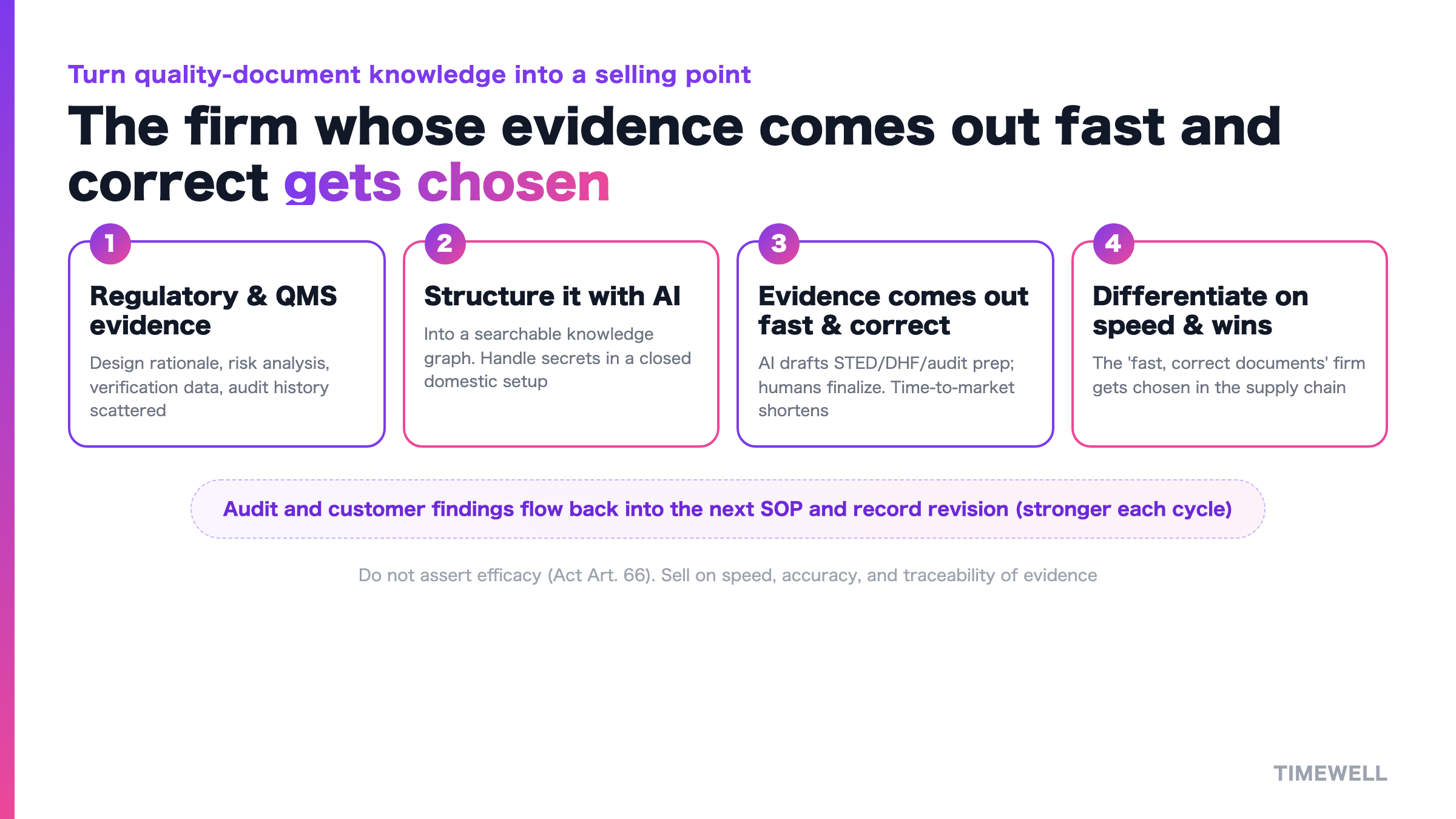
So far it's been cost. From here it's offense. Turn the "quality-document, evidence, and traceability knowledge" that is now only an internal cost into a searchable, reusable form with AI, and convert it into an outward-facing selling point.
First, structure the know-how that is person-dependent on your regulatory and QA veterans—the knack for STED preparation, the history of audit findings and responses, SOP interpretation—so anyone can pull it up through internal AI search. A junior can ask AI "how did we write the standard-conformity proof last time?" It is the act of preserving, as text, the foundation of judgment that would otherwise vanish with retirement. Of course, final regulatory judgment and submission responsibility stays with qualified staff. On hiring, you can lighten job-posting drafts and interview summaries with AI, but automatic screening does not fit small-scale hiring for specialists like regulatory and QA. It is realistic to keep this to clerical efficiency (AI implementation patterns in HR is a useful reference).
And that knowledge becomes an outward weapon. Structure the design rationale, risk analysis, and verification data built up through approval and audit, and present it as quality-assurance power toward OEM customers, hospitals, and trading companies. In the medical supply chain, "the firm whose documents come out fast and correct" gets chosen. The speed and accuracy of evidence itself becomes the differentiator at order time. What matters here is not to set the number you chase on document-work reduction alone. Track the lead time to launch and the "chosen rate" at order time—how much of the evidence knowledge you built on defense you connected to orders and launch speed. Rather than shouting efficacy, sell on the speed and accuracy of evidence. That, I think, is how to go on offense in a heavily regulated industry.
One line, though. What you may put outside is the stance and system of quality assurance; the core of design and verification, and approval information, stay in a closed internal database. Blur this and you end up giving away your livelihood for free.
Stand a new pillar small, right beside the main business, without stopping it
Finally, a word on reading the burden of regulation as an asset.
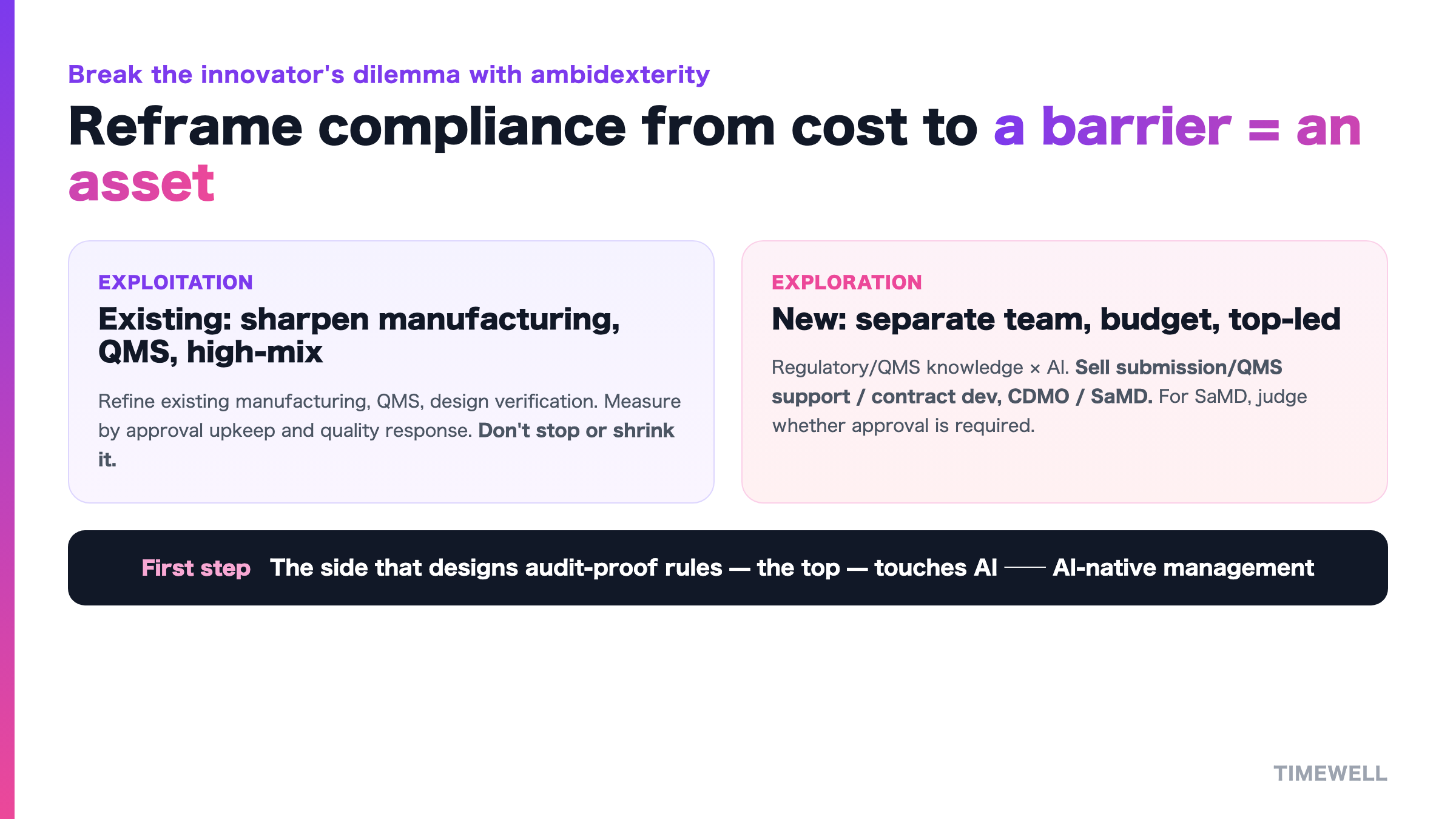
Many small medical makers are full-handed maintaining existing manufacturing and QMS, with no room for new business. Maintaining today's approvals and quality response becomes the correct answer, and there's no capacity for new sprouts. It is a trap the most diligent companies fall into. The key to escape is not to measure new efforts by the yardstick of current approval-upkeep or the short term. Measured that way, they are killed as "not worth it" before they can grow. With spare capacity, run a small separate team; without it, the owner can start with just half a day a week. Don't stop the existing manufacturing; stand a new pillar small right beside it.
A medical maker's new pillar has seeds specific to this industry. One, offer the accumulated regulatory and QMS knowledge externally to peer small firms as submission support, QMS-construction support, or a quality-document AI—turning regulatory-response capability itself into a service. Two, modularize the design and verification assets honed through high-mix low-volume, and extend into contract development and contract manufacturing. Three, step into programs as medical devices (SaMD). But here caution is needed. SaMD and AI-based diagnostic support can themselves become subject to the Act. An "AI diagnosis"-type idea always presupposes judging whether approval is required and the scope of QMS application.
The key to a breakthrough is reading heavy regulatory compliance not as a "cost" but as "a wall others cannot easily cross." Not many companies can carry it through, so that itself becomes an entry barrier—an asset. Turn what you built on defense into an offensive asset. Try it small next to the existing volume production, without stopping it. That, I think, is this industry's realistic way to go on offense. The sparring prompt for producing new-pillar seeds is also included in the diagnostic sheet. Before you brood alone, try making AI your partner.
Conclusion: evidence fast and correct—and the top changes first
Let me organize the key points.
- A medical maker's specialness is that "the evidence you made—documents and records" is part of the product, and improvement speed is decided by the speed of producing regulatory documents. One screw's improvement summons a chain of documents.
- Small firms' main battlefield is less the much-discussed new medical devices (total review roughly 11.7 months) than improved medical devices (no clinical, roughly 6.0 months), generic devices (roughly 3.8 months), and Class II certified items. What you want AI to make work there is seeing, fast and correctly, whether an improvement is a "partial-change approval" or a "minor-change notification," and which documents and records it ripples into. This ripple-impact assessment is where AI helps most.
- The first step is, in a heavily regulated industry especially, the top touching AI. Audit-proof operating rules are a management decision, and unless the top feels AI's limits by hand, they design them wrong.
- On the premise that the AI tool itself can become a subject of the assessment, make the operating rule first. Fix the model version, log the prompt, output, reviewer, and timestamp, and keep AI output in a draft area rather than as the record original.
- Quality-document knowledge turns into the selling point of "a firm whose evidence comes out fast and correct." The number to chase is not work reduction but the lead time to launch and the chosen rate at order time. A new pillar goes small, right beside the main business, without stopping it.
Let me end with my honest view. Many of the "AI made it X% faster" figures touched on here are vendor or own estimates, with no guarantee the same result appears on your floor. So rather than dancing to flashy cases, I recommend the plain sequence—the top first touches AI and grasps where it works while staying compliant, then tries it on the single most rework-heavy document process while preserving record integrity. For a medical maker, being able to produce evidence fast and correctly is not a cost but competitiveness. Strengthen that competitiveness a little with AI. Rather than shouting efficacy, become a firm chosen for its evidence. That, I think, is this industry's realistic winning path.
You can download the "AI Management Diagnostic Sheet (Medical Device Maker Edition)"—for checking this article against your own company—free from the top of this page. It's an Excel where you fill in five areas (regulatory documents; quality, validation, and PMS; advertising compliance; hiring and skill transfer; and business and management) while sorting out where to start, and it includes three sparring prompts, including the one in this article. Start by filling it in yourself, alongside AI.
When you want an outside eye to sort out where adding AI works while staying compliant, use WARP AI consulting or an individual consultation.
References and sources
- MHLW, "FY2023 Annual Report of Pharmaceutical and Medical Device Production Statistics" (published December 2024) 1
- MHLW, Pharmaceutical and Medical Device Production Statistics Survey 2
- Pharmaceuticals and Medical Devices Agency (PMDA), operating results and review periods 3
- MHLW, "On advertising regulation of pharmaceuticals etc. (Act Article 66)" 4
- Japan Federation of Medical Devices Associations (JFMDA), "Medical Device Advertising-Compliance Guide" (revised February 2024) 5