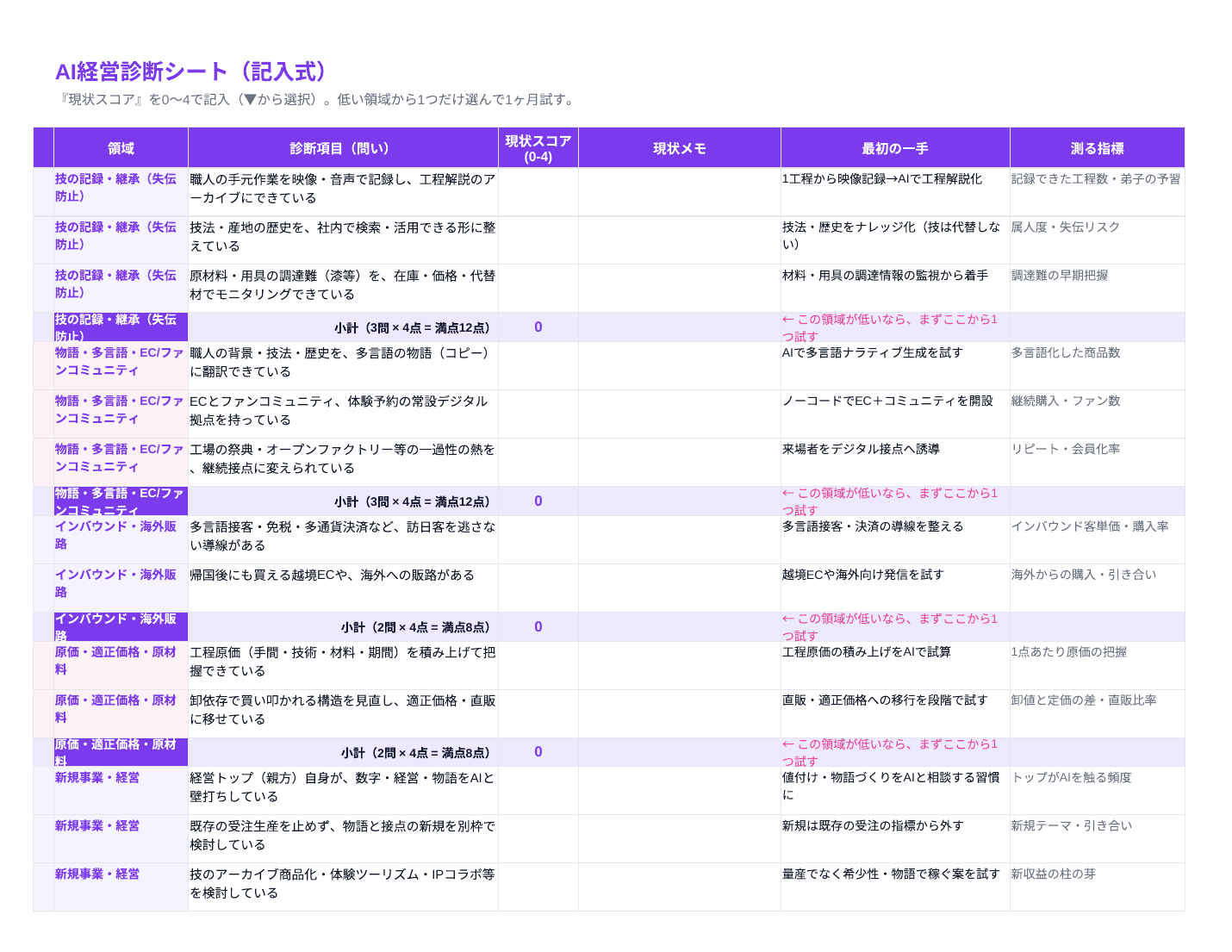
AI Management Diagnostic Sheet — Traditional Crafts (editable Excel)
A fill-in sheet that self-scores five areas—recording & transferring the craft, story/multilingual/e-commerce & community, inbound & overseas sales, cost & fair pricing, and new business & management—to decide where to add AI outside the process without changing the handwork.
Download the Excel sheet (free)Excel (.xlsx) ・ no email required
Hello, this is Ryuta Hamamoto from TIMEWELL.
When I visit workshops, I keep running into the same scene. An inbound tourist picks up a teacup from the shelf and, without even glancing at the price tag, asks, "How much is this?" Right beside them, a local customer looks at the same cup and quietly sets it back down: "It's probably good, but it's expensive." The very same single cup — overseas people say "that's cheap, if anything," and at home people say "expensive." The master stands in front of that gap every single day.
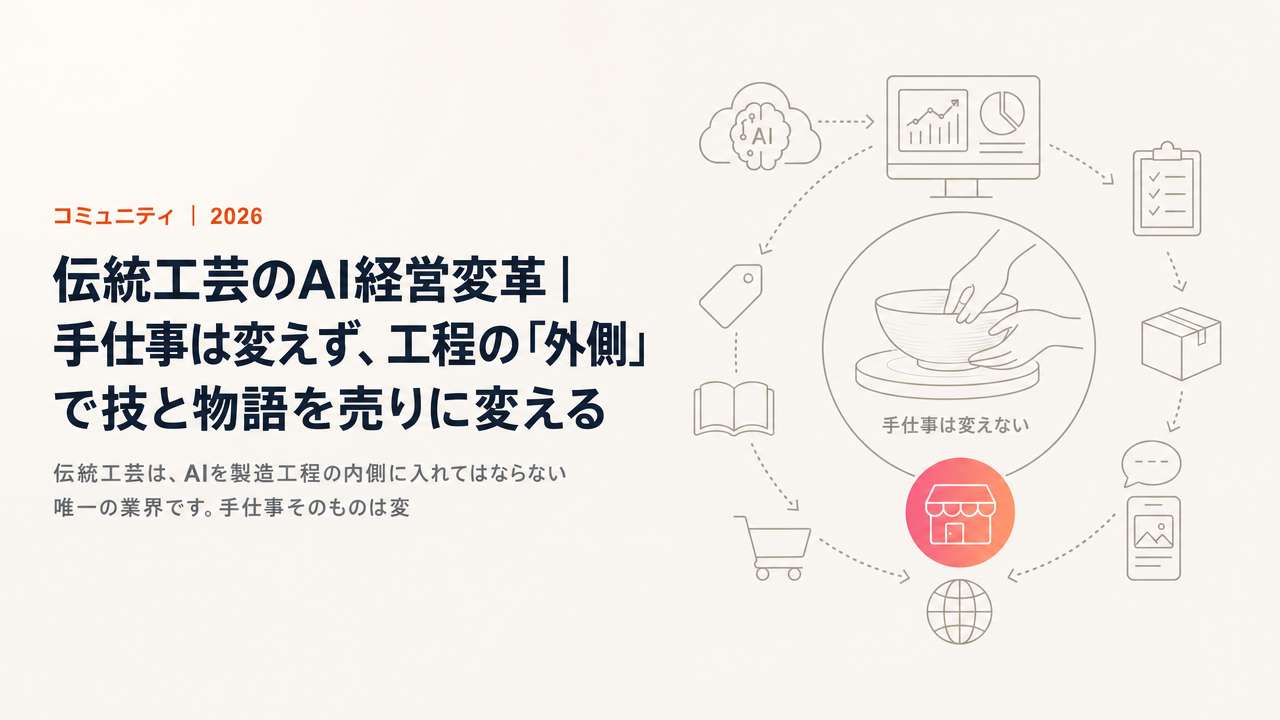
So let me state the most important thing first, plainly. In traditional crafts, you must absolutely never put AI inside the making process. In manufacturing, I've written about putting AI inside the process to replace an artisan's tacit knack. For this one industry, the story runs the exact opposite.
There are three reasons. One, the source of value is "the human hand itself" and the story behind it. Not being able to — and choosing not to — mass-produce is the pride; this is perhaps the only industry where making more is not the goal. Two, as with that cup, there's a large pricing gap: the same object is called "expensive" at home and prized as "craftsmanship" overseas. Three, the carriers are aging, and a craft that has run for decades — sometimes centuries — can end with the master's retirement.
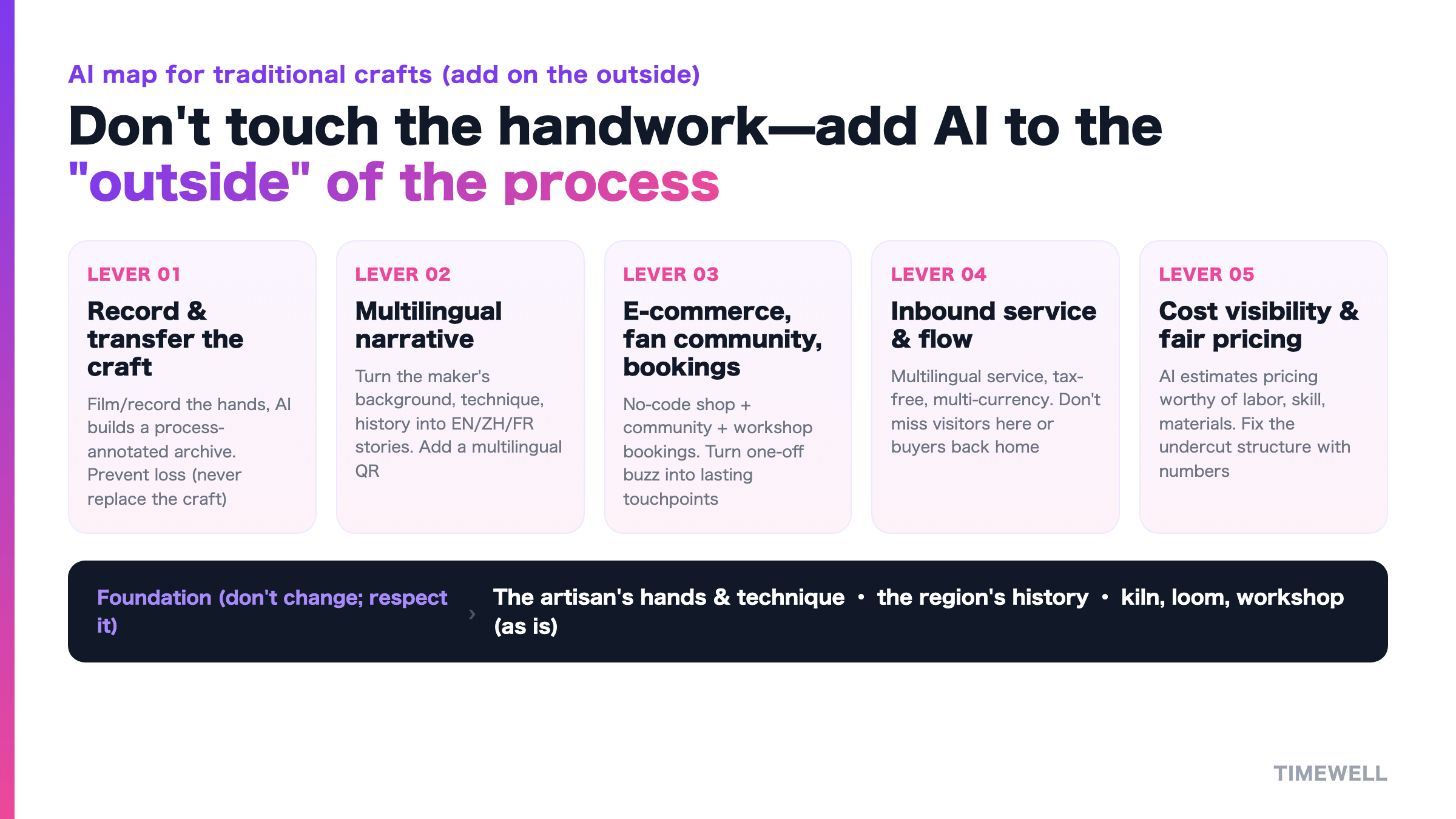
So what does AI do? Not the inside of the hand, but the "outside" of the process. Record the craft so it doesn't vanish, translate the region's history into words that land overseas, and open channels to the people who understand its value — overseas buyers, inbound visitors, and the people who love that craft. It is a tool for raising unit price and story, not for raising output. The kiln, the loom, the workshop stay as they are. You only add AI around them. Let me name the backbone up front: every first step begins with the master personally touching AI a little each day. I'll explain why later.
First, change "we don't know how to sell" from the outside
Every master is confident in quality. What they struggle with is usually the selling. A fine cup, and yet the storefront just puts out a tag: "Teacup, 3,000 yen." The maker's name, the kiln that's run for three generations, how much labor that glaze takes — none of it reaches the buyer. Only the price walks off on its own, and it gets called "expensive." This is the most wasteful spot of all.
Where AI first helps is exactly this "telling." Have AI draft the artisan's background, technique, materials, and the region's history, and turn it into a story not only in Japanese but in English, Chinese, and French. Make it readable from a QR (that square pattern you scan with a phone) attached to the product. Tell the cup's story in the words overseas customers receive as "craftsmanship." Those who can tell the craft can set the price. This is the one line I most want to convey.
And you need a "standing entry point" so the interest that story creates doesn't end in a single transaction. With no-code (meaning you can build it without writing any code), hold your online shop, a place to connect with fans, and workshop-experience bookings all together. An inbound customer stops by the workshop and buys again after going home. The heat that builds up at a festival or open-factory day doesn't stay a one-off; it becomes a continuing touchpoint. TIMEWELL's "BASE" is for standing up that combined entry point — shop, fan community, experience bookings — in a short time. The number you chase shifts from that day's sales to the count of people from overseas and fans who "buy again," and the spend per customer.
Here's one important entry point to share: you can begin this without touching a computer. So many regions stall at "we don't have anyone strong with the web." A phone call or a visit is fine to start. Tell us about your craft and your region's history, and we'll turn it into words and pricing on our side. The master just keeps working with their hands as always. The digital operations can come later.
To put it as a model case (hypothetical, to be clear): a five-person workshop had been calling a single cup nothing but "teacup, handmade." Retell it as "a one-of-a-kind piece fired in a climbing kiln run for three generations, using natural glaze," and add a multilingual POP and QR. Then the same cup rises, by the weight of its story, to a price people pay with understanding. This isn't a flashy brand-collaboration story. A small workshop changes how it tells the story of a single teacup. That life-sized step is, I think, actually the surest one. You can also check roughly where your own workshop stands today with the community check.
Looking for AI training and consulting?
Learn about WARP training programs and consulting services in our materials.
The first step: the master talks "numbers and management" with AI
Before laying out moves, let me place what comes first in sequence. The master personally touching AI.
Traditional crafts have a peculiar air: "To speak of numbers and management goes against the artisan's way." That pride is precious. But that same air has also kept management and marketing talent away from the regions and stopped the step toward change. You want to bring in designers and IT people from outside, but there's neither the people nor the budget. Here, AI becomes "the cheapest first partner to consult."
The master tries talking to AI. "Make a story from the technique and history of our teacup so it reaches people overseas — first in Japanese." "Break down, tentatively, whether this price is worthy of the labor, skill, and materials." Even if half of what comes back is off the mark, you become able to fix that off-mark part yourself. That's the entrance. What matters is that this is not about "selling the craft." The hand carries the craft. What you talk with AI about is only the outside — how to tell it, how to deliver it, and at what price.
The share of Japanese firms using generative AI sits at just 55.2% even in the MIC white paper, and the most common worry was "we don't know how to use it well." In the regions, the thin sense of "does this even concern us?" is more of a wall still. That is exactly why the master should touch it themselves and grasp the feel of "change the outside only, leave the craft." I've rarely seen a region change while skipping this. This article's companion piece, AI transformation for parts manufacturers, is written on the same backbone.
Record the craft, prevent its loss
The other thing AI reliably helps with, on the outside of the process, is recording the craft. If the master retires with no successor, a craft of decades — sometimes centuries — ends right there. Prevent that without changing any equipment. This is the part I most want to press on.
The method is strikingly plain. Record a veteran's handwork by video and audio — a phone is fine. Rather than every step at once, narrow it to one step, one material. Have them say out loud, while working, "why this temperature," "why stop the hand here." Transcribe it with AI, add a heading per step, and shape it into "footage plus process notes." You can start today, from a single teacup's worth.
What I never want misunderstood: the feel of the hand itself is not replaced. What AI does is only record and organize. That archive becomes pre-apprenticeship study material, prevents the loss of techniques, and becomes a base for growing multiple carriers. Picture adding to the region the same thinking the Agency for Cultural Affairs uses in its "selected preservation technique" recordings. A craft you've inherited is the region's treasure. Keep that treasure from vanishing, and deliver it to the people who understand its price. This is not a burden, nor a cost of storing something away — it is the surest defense there is for passing the craft to the next generation.
That archive also works directly for hiring. A record of a veteran's work becomes pre-apprenticeship study material and speeds the start of learning. Drafts of job postings and of communications conveying the region's appeal can be made with AI too. Here again, what AI carries is only the outside — recording and communication — while people teach the craft. For HR thinking, AI implementation patterns in HR is a useful reference. Procurement difficulty for raw materials and tools is an outside issue too. Watch, with AI, the prices of materials that keep rising, viable substitutes, and information on tools whose makers are dwindling. It isn't flashy, but it's an addition tied directly to a region's survival.
Turn craft and story into a "selling point"
Here is this industry's core. The artisan's craft and the region's history are not things to store away; they can be pushed outward as a "selling point." Let me widen that teacup story to the scale of a whole region.
Keep the handwork recorded and respected, and make its process and story into content. Whose craft, of what kind, why it's rare, in what scenes it's used. Tell that in multiple languages, and convey it consistently through the product's QR, the sales page, and the storefront POP. This closes the gap from the opening — "expensive" at home, "craftsmanship" overseas. Those who can tell the craft set the price.
Let me raise just one symbolic example. One Arita-ware kiln had been beaten down through a trading company to roughly 25% of list price; it switched to direct sales to regain proper pricing, teamed up with an overseas brand, and reportedly drew 45,500 visitors to an exhibition in Paris. Of course, this is an individual, fortunate case. You can't copy it as-is. But what such cases share is that they added, from outside, a function to put the region's story into words, into multiple languages, and into video. And that function is something you can now hold with AI and a little human effort.
On the defensive side, there's pricing. Estimate, with AI, a price worthy of the labor, skill, materials, and time. Review, with numbers rather than emotion, the structure of being beaten down to 25% of list price by wholesalers. The Arita kiln regaining fair pricing through direct sales is exactly this. Gently cross the air of "speaking of numbers goes against the artisan's way" through sparring with AI.
Here is the first sparring prompt, for translating your craft and the region's history into "a multilingual story." Paste it as-is and replace the parts in【brackets】with your own details. The remaining two prompts — building fair pricing from process cost, and standing a new pillar beside the core business — are included in the free diagnostic sheet.
You are a brand-story expert well-versed in overseas and inbound sales channels for traditional crafts. Help translate the artisan's craft and the region's history into a multilingual story that conveys value to overseas customers. The premise is that the handwork itself is not changed.

# Input (I will fill this in)
- Item and region: 【e.g., XX-ware, XX Prefecture, designated traditional craft】
- Features of technique/materials/process: 【e.g., climbing kiln, natural glaze, hand-forming over X generations】
- History or anecdotes of the region/maker: 【e.g., founded in year X, once the domain's official kiln】
- Assumed overseas customer: 【e.g., Western affluent buyers, inbound tourists, people who love this craft】

# Your tasks
(1) Translate this item's value into words overseas customers receive as "craftsmanship" and "cultural meaning."
(2) Build the outline of a brand story (whose, what craft, why rare, in what scenes it's used).
(3) Shape it to be told in Japanese plus the specified languages via product POP / e-commerce page / QR.
(4) Show how to change the telling and presentation for domestic vs. overseas (bridge the gap of "expensive" at home and "craftsmanship" overseas).
(5) Surface the points needing fact-checking (history, origin labeling, materials).

# Output format (follow exactly)
1. Value-translation table: columns are [Your feature / Words that resonate overseas / Supporting fact / Needs fact-check]
2. Brand-story outline (Japanese, ~300 chars) and cautions when translating
3. Differences in presentation for domestic vs. overseas (3 each)

# Constraints
- Do not end at "high quality" or "traditional craft"; specify what is rare, how, and why it has value.
- Presuppose fact-checking of history/origin/materials (mind proper geographic-indication, origin, and "handmade" labeling). Do not fabricate.
- Do not use expressions implying AI replaces the handwork. AI is only recording, translation, and channels.
- Make no assertion like "AI multiplies sales." Add the premise of economy, exchange rates, and geopolitics.
- At the end, list three points that could become factual-error or rights risks in this story-building.
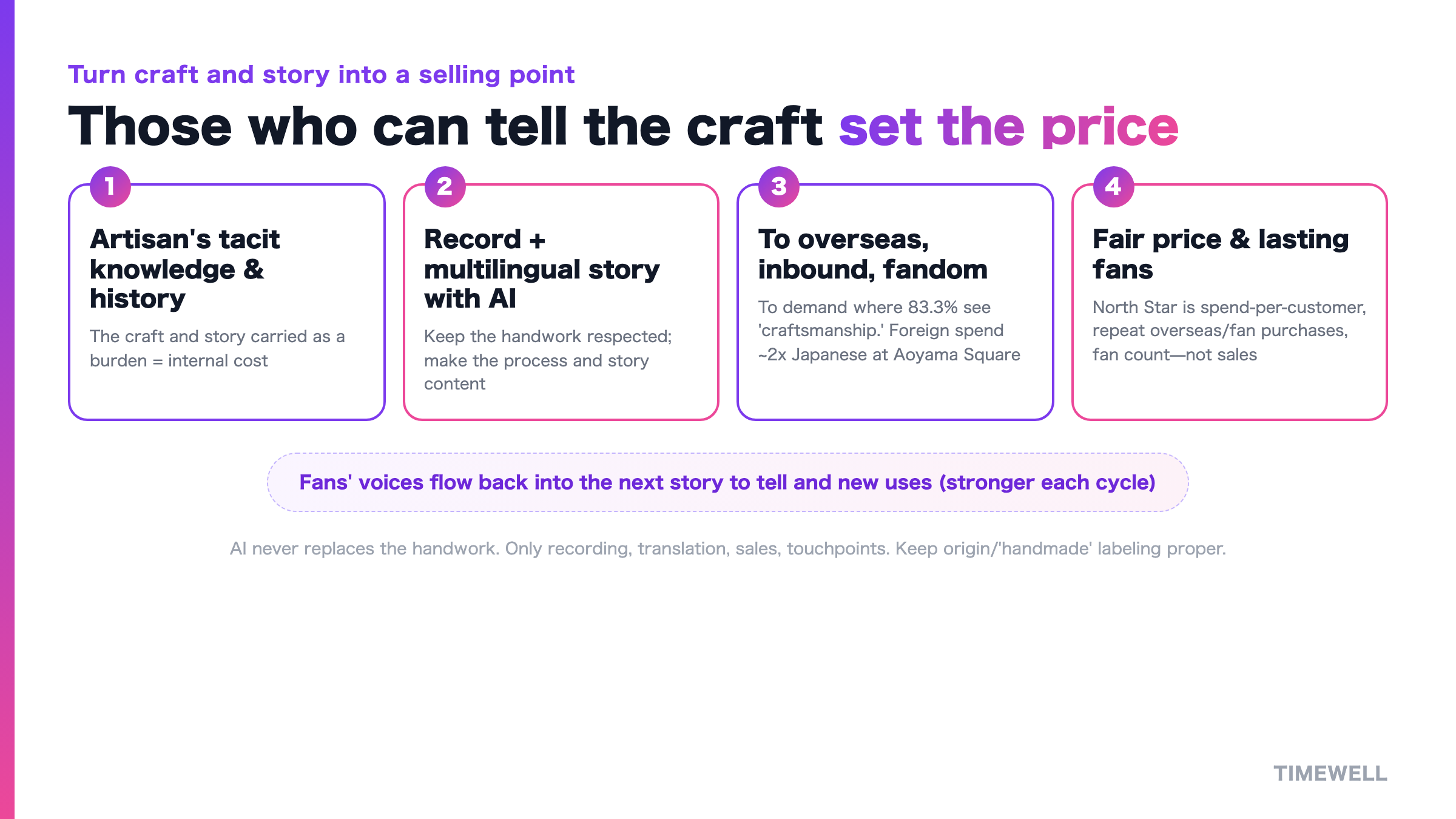
Let me note the nature of the numbers, just once. This industry holds both figures you want to look away from and figures of hope. Among the craft's carriers, 18.0% are 70 or older, and METI even points to the possibility that the workforce halves within ten years. On the other hand, 83.3% of people overseas see these crafts as "high quality, craftsmanship," and at the Traditional Crafts Aoyama Square, foreign visitors' spend per customer was about double the Japanese. These are public statistics and association reports. But the success cases touched on here, and any talk of "AI grows sales," are individual matters swayed by the economy and exchange rates; there's no guarantee the same figures appear in your region. So I'd rather you confirm it with your own eyes, from a single teacup, from a single item, than chase flashy numbers.
Don't stop the core business — stand a new pillar beside it, small
Last is the new revenue pillar. Don't stop the core business of made-to-order goods. Protect it as-is, and beside it, stand a pillar of "story and touchpoints," small.
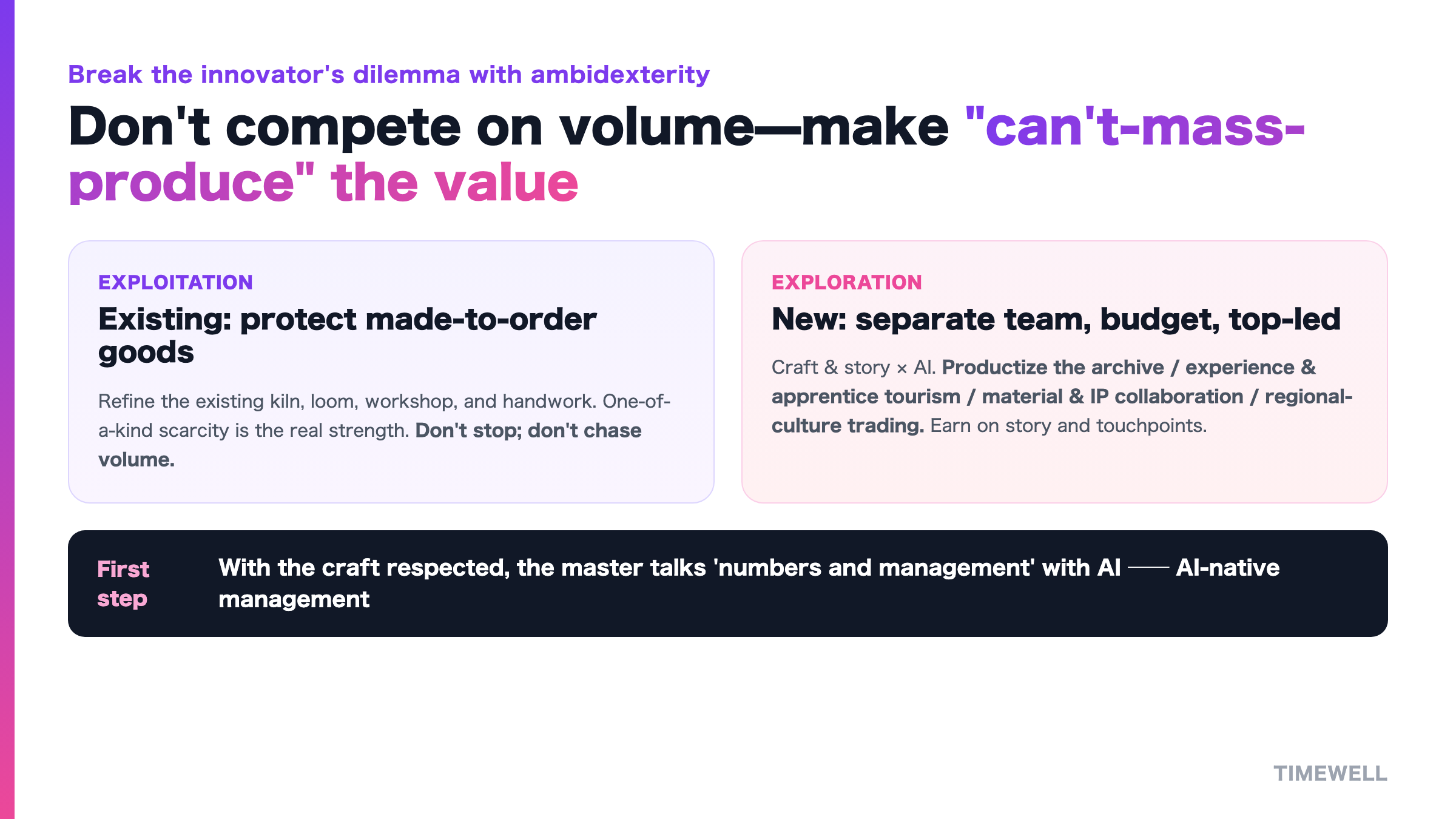
The seeds are unique to this industry. Productize the craft record itself (paid online courses, or provenance and authenticity certificates for one-of-a-kind pieces). Tourism where people stay and experience the craft. Ongoing arrangements where other makers or brands use your materials and techniques. A regional-window role that gathers a region's makers and sells them outward together. None of these compete on volume.
What matters is clear: don't fight on the field of mass production. Rather, turn "not being able to mass-produce" itself into value. On the field of one-of-a-kind scarcity, the trace of the hand, and story, this industry is originally the strongest. And this new pillar must not be measured by current sales or utilization. Measured that way, it gets killed as "unprofitable" before it grows. If you have spare capacity, use a small separate team; if not, the master doing half a day a week is enough. Without stopping the existing kiln, try it small beside it. That, I believe, is how traditional crafts break through.
A sparring prompt for producing the seeds of that new pillar is also included in the diagnostic sheet. Before you agonize alone, make AI your partner.
Conclusion: leave the handwork; raise unit price and story on the outside
Let me organize the key points.
- Traditional crafts are the one industry where you must not put AI inside the making process. Value lies in the hand and the story, and mass production is not the goal. So add AI on the outside — recording, translation, channels.
- The most wasteful spot is "we don't know how to sell." Turn the craft and history into a multilingual story, and deliver it through a QR and a standing entry point to the people who understand its value. Those who can tell the craft set the price.
- The first step is the master trying to talk "numbers and management" with AI. The hand carries the craft; what you talk with AI about is only the outside.
- Prevent loss by recording the craft. An inherited craft is a treasure — a defense that keeps it from vanishing. Pricing comes from numbers, not emotion.
- Stand the new pillar in a separate frame without stopping the core business. Don't compete on volume; turn "can't mass-produce" into value. If you have no spare capacity, the master can start with half a day a week.
Let me write my honest view at the end. The success cases touched on here are individual, with no guarantee the same result appears in your region. And I want to remain careful, to the very last, about speaking of AI in traditional crafts. I've said nothing about replacing the craft with AI. The trace of the hand and the story are the very source of this industry's price. That is exactly why, to protect the handwork, you change only the outside with AI. Those who can tell the craft set the price. When the master gains that "telling," a centuries-old craft, I believe, doesn't end — it reaches the world at the right price.
On that note, let me show you the easiest possible first step. You don't need to touch a computer. The steps are just these: (1) By phone or a visit, spend 30 minutes telling us about your craft and the region's history. (2) We transcribe it and make a first draft of a multilingual story. (3) Turn just one item into a storefront POP and QR, and watch how customers react. (4) If it feels right, expand to a standing entry point. We shape it and show it to you first, so the master just keeps working with their hands as always.
The "AI Management Diagnostic Sheet (Traditional Crafts Edition)" for checking this article against your own workshop is also downloadable free from the top of this page. It's an Excel where you fill in five areas — recording & transferring the craft; story, multilingual, and channels; cost & fair pricing; the new pillar — while sorting out where to start, and it includes the three sparring prompts referenced in the article. If computers aren't your thing, we can fill in its contents together over the phone.
When you want to sort out how to build a place for your region's fans, or a standing entry point for overseas and experiences, use BASE or an individual consultation.
References and sources
- METI, "Current state of the traditional-crafts industry and future promotion measures" (March 2026, 15th Entertainment & Creative Policy Study Group materials) 1
- METI, "Research study on the promotion of the traditional-crafts industry" 2
- Forestry Agency, "Special Forest Product Production Statistics Survey" (lacquer output) / Agency for Cultural Affairs (cultural-property repair and domestic lacquer) 3
- MAFF, "aff" feature (the current state of lacquer) 4
- Agency for Cultural Affairs, "Selected Preservation Techniques" (approach to recording) 5