![Export Control Guide for Semiconductor Equipment Makers | METI 23-Item Notice, TSMC Kumamoto, and ASML Coordination in Practice [2026 Update]](/images/columns/semiconductor-equipment-industry-export-control/cover.png?dpl=dpl_GTagW71VKjD4VDo3w4ymrXrCfn1y)
Hello, this is Hamamoto from TIMEWELL. The scenery on the semiconductor equipment side has shifted in the last two years. Since METI added 23 items to the Export Trade Control Order schedule in 2023, the leading players — Tokyo Electron, SCREEN Holdings, Nikon, Canon — have been staffing export control with the same kind of focus they bring to R&D. TSMC Kumamoto's JASM fab started mass production in December 2024, and since Rapidus brought ASML's NXE:3800E into Chitose that same month, even deals that look purely domestic now bring the messy side of FEFTA along with them.
Listening to equipment makers, the worries boil down to three: where exactly each of our products lands under the 23 items, how far we should tighten our China license workflow, and whether we are missing unexpected export-control risks hiding inside JASM or Rapidus business. In this guide I want to lay out the rules and the operational realities as of April 2026, together with the lessons I have picked up through building TRAFEED.
Work through a semiconductor classification on a fill-in sheet: A checklist covering semiconductor manufacturing equipment (3B-series) and advanced-computing ICs (3A090, 4A090, HBM), working from both Japan's Appended Table 1 Row 7 plus the goods ordinance and the US EAR (ECCN, TPP/PD thresholds, Country Group D:5, 744.23, FDP, License Exceptions). Because you write your reasoning into it, the sheet doubles as the draft behind your internal classification record and as something you can attach when explaining a call to suppliers or customers. → Download the Semiconductor Classification Checklist (2026) (Free. Your company name and work email are required.)
The 23-item notice rewrote day-to-day work, not just policy
METI's draft revision of the Ordinance on Goods Subject to Export Control, published on March 31, 2023, was promulgated on May 23 and entered into force on July 23 of the same year1. What was added were 23 items of high-performance semiconductor production equipment, spanning roughly nine domains — photomask pellicle manufacturing equipment, pellicles themselves, lithography equipment, coaters, deposition tools, etchers, annealers, cleaning equipment, and photomask inspection tools. Coverage is defined by technical specifications: for lithography it reaches advanced optical systems including those at 193 nm and above, while etch and deposition are scoped through combinations of technical conditions2.
What makes this awkward is that you cannot look only at the finished machine. As the CISTEC public comment points out, classification reaches not just the product but purchased components, accessories, subassemblies shipped separately, and embedded software3. A deposition equipment maker may conclude its own main unit is out of scope, and then find a high-performance pump or a dedicated gas supply unit inside it that is in scope on its own. The work of collecting "non-controlled" certificates from suppliers and assembling them has become roughly two to three times more granular than before.
42 countries and regions can be handled under bulk licensing, but China requires individual licenses. Bloomberg reported that Tokyo Electron's share price fell right after the notice was announced4. My read of the market reaction is that it was less about the controls themselves and more about the opacity around how much procedural cost would stack up in China business. On the ground, some equipment makers had to rewrite internal procedures within the four months between public comment and entry into force, and a few doubled their export control headcount.
What Tokyo Electron, SCREEN, Canon, and Nikon are actually dealing with
China matters too much to be brushed off. Tokyo Electron's fiscal year ending March 2026, reported on April 30, 2026, set another revenue record at 2.4435 trillion yen — up 0.5% year on year — with net income attributable to owners of the parent also at a record 574.4 billion yen. Operating profit, though, fell 10.4% to 624.9 billion yen, pulling the operating margin down from 28.7% to 25.6%5. China accounted for 34.1% of revenue for the full year and 26.8% in Q4, as Taiwan-bound sales surged. The prior year, ending March 2025, came in at 2.4315 trillion yen in revenue, 697.3 billion yen in operating profit, and 544.1 billion yen in net income6. The company holds roughly 15% global share — third place after the US players — and about one-third of its overseas revenue comes from China. That is structural.
SCREEN Holdings is the top maker of cleaning equipment and sits directly in the crosshairs of the cleaning category within the 23 items. Its revenue mix also leans heavily toward China, which means how well the individual-license process runs translates straight into the top line. Canon launched its nanoimprint lithography system "FPA-1200NZ2C" in October 2023, pursuing miniaturization along a different path from ASML's EUV7. The technology traces back to its 2014 acquisition of Molecular Imprints in the US and has been advanced together with Kioxia and Dai Nippon Printing. This means Canon has to watch not only whether its lithography tools fall under the controls but also deemed-export risk on the technology-information side.
Nikon carries history from the era when it and Canon together held roughly 80% of global lithography share; today it holds position with mid-range machines such as improved ArF immersion systems. In a market now effectively led by ASML, Nikon still has models that fall inside the 23-item wavelength thresholds, so its name keeps coming up in classification work. Across the industry, three tiers have become visible for each product line — "can be shipped to Chinese customers," "requires an individual license by default," and "cannot leave the country at all." Whether sales and export control share the same view of that three-layer picture is, in my opinion, what will decide the winners in 2026.
Replace siloed classification work with AI.
METI's FY2024 data shows 52% of foreign exchange law violations stem from classification errors. Download the TRAFEED product catalog covering features and rollout.
US BIS rules against China are indirectly moving Japanese makers
The US Department of Commerce's Bureau of Industry and Security (BIS) announced its third round of China-focused rules on December 2, 2024. The headline items were an interim final rule covering specific semiconductor manufacturing equipment and the addition of 140 companies to the Entity List (EL)8. BIS at that point carved Japan and a handful of allies out of the SME (Semiconductor Manufacturing Equipment) controls. The direct hit was avoided, but the MATCH Act — properly the Multilateral Alignment of Technology Controls on Hardware Act — is working its way through Congress. Rep. Michael Baumgartner introduced H.R.8170 on April 2, 2026, and the House Foreign Affairs Committee ordered it reported in the nature of a substitute on April 22, 2026 by a vote of 36 to 8. Sen. Pete Ricketts introduced the Senate companion, S.4281, on April 13, 2026; it sits with the Committee on Banking, Housing, and Urban Affairs. Neither has been enacted as of July 30, 20269. As introduced, the mechanism is this: if allied supplier countries have not adopted equivalent countrywide controls and license requirements with a policy of denial within 150 days of enactment, the US asserts jurisdiction over equipment and servicing originating from those countries into covered facilities in countries of concern, and applies a policy of denial. The House committee substitute extends that window to 240 days after enactment, with a one-time waiver of up to 60 days; the Senate bill still says 150 days. We follow the bill in the MATCH Act's legislative status and its impact on Japanese companies.
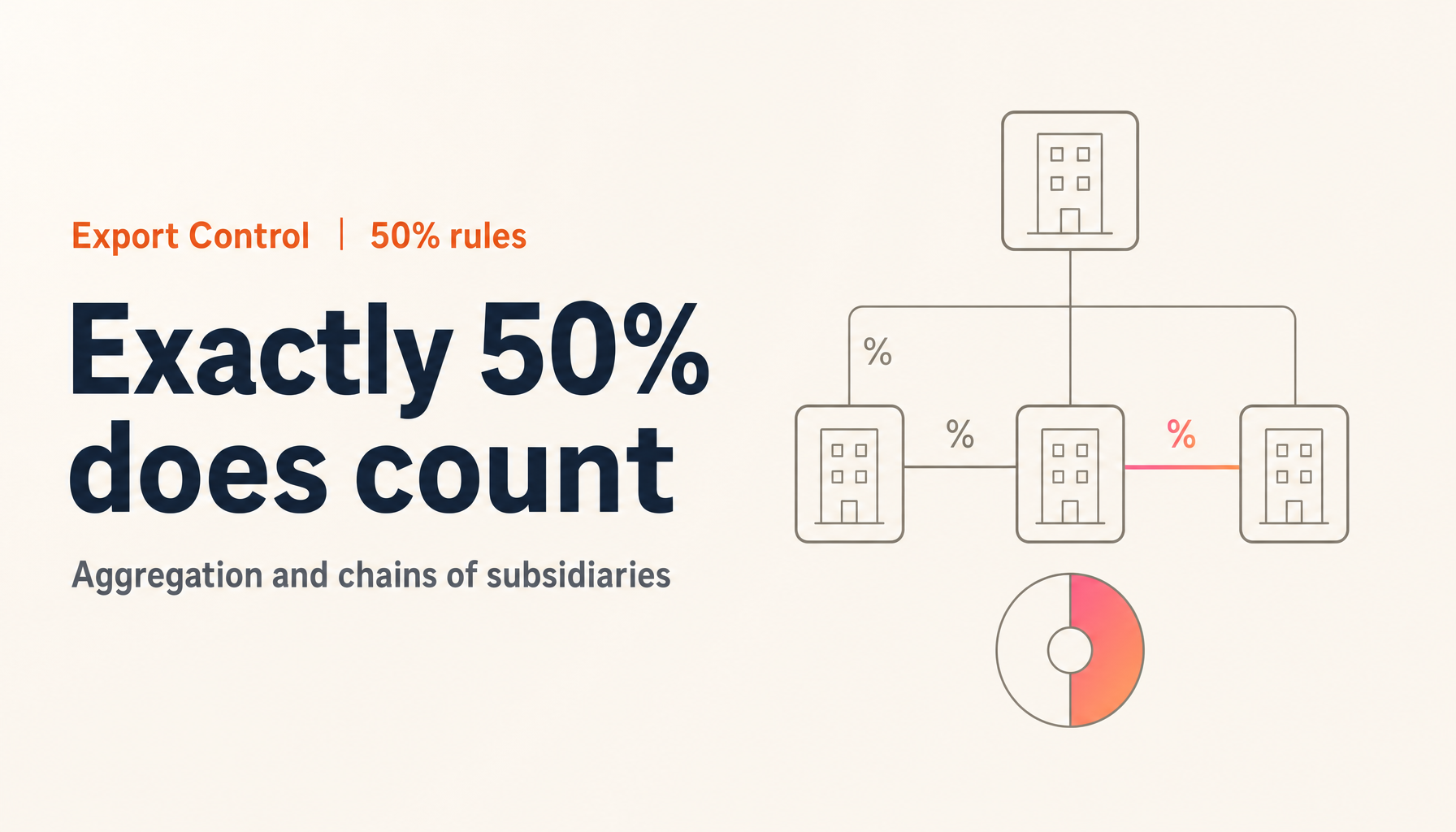
A September 2025 JETRO brief on the Trump administration also deserves attention. The so-called Affiliates Rule — an interim final rule published in the Federal Register on September 30, 2025 that automatically extends Entity List restrictions to entities 50% or more owned by listed entities — forced equipment makers to trace ownership further up the chain10. BIS has since issued a final rule suspending that expansion for one year: the suspension runs from November 10, 2025 to November 9, 2026, and absent an extension the Affiliates Rule license requirements are added back into the EAR effective November 10, 202611. The US and China have announced an extension to January 10, 2027, but BIS had not published it as of October 3 (see our BIS 50% rule guide). So the expansion is suspended for now — but with the stay's end date on the Federal Register only weeks away and any extension lasting just two months, the sensible move is to treat the suspension as breathing room for ownership tracing and data cleanup, not as a reason to stand down. Tokyo Electron has historically stationed engineers inside Chinese fabs for maintenance and upgrades, and Toyo Keizai has reported that tightening BIS rules are increasingly forcing separation of on-site support12. This is the sort of issue where, unless you also rethink software update delivery and remote-maintenance network paths, paperwork licensing alone will not keep you safe.
From where I sit, what hurts Japanese makers most is not the text of US rules but the instability in how they are operated. Rule text accretes every six to twelve months, while BIS's answers to individual inquiries and the pattern of exception licensing depend heavily on the institutional memory of the officer in charge. Closing that gap means either keeping US-qualified counsel in-house, exchanging intelligence with outside experts on a monthly rhythm, or building an AI-based system that monitors primary sources in real time. For the wider pressure coming at Japanese companies around China business, my companion piece on China's export controls and their impact on Japanese companies puts the structure together.
JASM Kumamoto and Rapidus: "domestic deals" that are actually FEFTA issues
JASM (Japan Advanced Semiconductor Manufacturing), led by TSMC, began mass production in December 2024. Sony Semiconductor Solutions, Denso, and Toyota joined as investors, and the fab in Kikuyo, Kumamoto is producing 12-inch wafers at 55,000 per month using 12/16nm FinFET and 22/28nm processes. JASM has stated it will raise the share of domestically sourced materials to 60% by 2030, reaching 46% in 2025 and more than 50% by 202613. In February 2024, construction of a second fab was announced, targeting 2027 start-up. Tokyo Electron has facilities near Kumamoto and has been supplying and servicing equipment throughout.
Rapidus received ASML's NXE:3800E EUV scanner at its IIM-1 fab in Chitose, Hokkaido, and started installation in December 202414. Press reports put the price at around 50 billion yen, and the roadmap targets 2nm mass production in 2027. ASML has signaled plans to expand its Japan headcount to roughly 600 people by the end of 2026, and Micron Hiroshima is preparing for EUV installation in 2025 and DRAM production in 202615. On the surface, this concentration of EUV sites in Japan is a tailwind. Looked at through an export-control lens, it creates more issues, not fewer.
First, EUV systems imported from ASML are foreign-origin equipment, so re-export, inter-site transfers, and technology access by foreign-national engineers can trigger deemed export considerations. Second, Japanese equipment makers shipping into JASM or Rapidus must design contracts anticipating that those tools could later move to overseas sites. Third, three-country trades involving parts and service — for example components processed in Taiwan or Korea and routed through Japan — put country-of-origin and classification analysis on a collision course. Cases where something booked as a domestic deal turns out to sit inside FEFTA's scope will keep showing up. I have written a standalone piece on deemed-export risk for reference: Deemed Export Risk Practical Guide.
Making 23-item classification stick inside the organization
Classification is the skeleton of export control. For equipment makers, two pain points dominate: the technical specifications for the 23 items are too granular for design engineers to parse on the fly, and non-controlled certificates arrive from suppliers as paper or Excel, making them hard to maintain as an asset. CISTEC's classification support services and lookup tools help, but routing every model and every customer through an outside check every time is not realistic16.
What works in practice usually runs like this. During development, engineers tag a provisional classification using CISTEC's Ordinance comparison tables. Export control reviews it, issues a classification memo, and stores it tied to the contract. Suppliers are polled once a year using the company's own non-controlled certificate form, with responses kept in a database. When a sales opportunity opens, the customer and destination are pushed through the credit system, and screening is run including possible catch-all exposure. Companies that run this flow on individual know-how tend to watch it evaporate when someone transfers or retires.
As a TRAFEED developer, I think this is where building a proper system pays off. TRAFEED is an AI agent aligned with METI's standards that drafts classifications against the latest text of the Ordinance — 23 items included — and runs counterparty screening inside the same UI. It cross-checks the Entity List, MOF's Foreign End User List, OFAC's SDN list, and METI's Foreign End User List across languages and catches Chinese or Korean spelling variants. Many equipment makers still run classification and counterparty screening on separate tools, and that seam is where accidents happen — the classification clears, and only later do you find the customer was a concern party. TRAFEED is the tool I built to close that seam. For the framework behind classification work itself, our ECCN classification guide works well as internal training material.
Three moves for equipment makers in 2026
Given all of the above, here is how I see the next moves. First, bake a China slowdown scenario into the business plan. Tokyo Electron's disclosed guidance for the first half of the fiscal year ending March 2027 is 1.57 trillion yen in revenue and 431.0 billion yen in operating profit — a 27.5% margin — which the company frames as record half-year performance, with the second half expected to come in above the first. From this year the company has stopped issuing next-year full-year guidance at the fiscal year-end and discloses the half-year figure only5. It is a bullish plan, but depending on how MATCH plays out, there is still a real chance of double-digit China declines. Beyond China-plus-one diversification, the mitigation has to include designing equipment that stays useful longer and shifting more service revenue domestic.
Second, I want export control upgraded from "a procedural department" to "a partner to the business." Keep destination lists per model number, write country-by-country playbooks for bulk versus individual licensing, and bake license lead times into sales planning. Companies that do this can tell customers what to expect the moment a regulatory announcement breaks. Companies that do not, scramble after METI's notice is out and end up facing shipment-stop risk. As the Makino Milling acquisition block case shows, individual deals are increasingly being stopped by national-security review, and export control belongs on the executive agenda, not on one section manager's desk.
Third, get suppliers and customers aligned on shared paperwork and systems. Non-controlled certificate templates, end-use confirmation workflows, and technology-handling clauses — if those three things are lined up, conversations with Applied Materials or Lam Research on the US side and ASML or ZEISS on the European side go much faster. The 23-item notice is a Japan-specific rule, but the operating mindset should be tuned to international standards. That raises your resilience against future rule changes.
Equipment makers run long value chains — R&D, manufacturing, sales, service. Threading export control through all of it is hard work, but companies that do it will be well positioned when the US-China and Japan-China relationships reshape through the 2030s. If TRAFEED or ZEROCK can help in any of that, do reach out anytime.
If you are reviewing export-control operations or classification workflows, download the TRAFEED product catalog (PDF) or contact us.
References
Footnotes
-
Ministry of Economy, Trade and Industry, "On the operation of Annex 1 of the Export Trade Control Order and the Annex of the Foreign Exchange Order" — Notice of entry into force of related ministerial ordinance revisions (July 2023) https://monoist.itmedia.co.jp/mn/articles/2305/25/news061.html ↩
-
Nikkei xTECH, "23 items of semiconductor manufacturing equipment under tightened export control — a readable breakdown of a difficult list" https://xtech.nikkei.com/atcl/nxt/column/18/01537/00767/ ↩
-
CISTEC, Public comment on the addition of 23 semiconductor manufacturing equipment items to the Ordinance on Goods Subject to Export Control https://www.cistec.or.jp/service/doushikoku/handotai23_pubcome00.pdf ↩
-
Bloomberg, "Japan's government to regulate exports of 23 semiconductor manufacturing equipment items; Tokyo Electron shares fall" https://www.bloomberg.co.jp/news/articles/2023-03-31/RSBP9PT0G1KW01 ↩
-
Tokyo Electron, "Consolidated Financial Results for the Fiscal Year Ended March 31, 2026" (April 30, 2026) https://www.tel.co.jp/ir/irta3a00000006g5-att/fy26q4tanshin-j.pdf and the accompanying earnings presentation https://www.tel.co.jp/ir/irta3a00000006g5-att/fy26q4transcript-j.pdf ↩ ↩2
-
Rakuten Securities Toushiru, "Earnings report: Tokyo Electron (FY ending March 2025)" https://media.rakuten-sec.net/articles/-/50629 ↩
-
Newswitch, "Canon achieves world's first commercialization — the full picture of a nanoimprint-based semiconductor lithography tool" https://newswitch.jp/p/38879 ↩
-
JETRO, "US Commerce Department announces new export rules against China centered on semiconductor manufacturing equipment" https://www.jetro.go.jp/biznews/2024/12/f4fdfe5162642930.html ↩
-
US Congress, H.R.8170 (MATCH Act, 119th Congress, introduced April 2, 2026) bill text https://www.govinfo.gov/content/pkg/BILLS-119hr8170ih/xml/BILLS-119hr8170ih.xml and legislative actions (House Foreign Affairs Committee ordered reported in the nature of a substitute, 36-8, April 22, 2026) https://www.govinfo.gov/bulkdata/BILLSTATUS/119/hr/BILLSTATUS-119hr8170.xml — Senate companion S.4281, "Multilateral Alignment of Technology Controls on Hardware (MATCH) Act" (introduced April 13, 2026) https://www.govinfo.gov/bulkdata/BILLSTATUS/119/s/BILLSTATUS-119s4281.xml ↩
-
JETRO, "Trump administration expands scope of export controls — subsidiaries of EL-listed entities are now covered" https://www.jetro.go.jp/biznews/2025/09/c92c704c4b353243.html ↩
-
Federal Register, "One Year Suspension of Expansion of End-User Controls for Affiliates of Certain Listed Entities" (BIS final rule, 90 FR 50857, published November 12, 2025; suspension from November 10, 2025 to November 9, 2026, provisions added back effective November 10, 2026 absent an extension) https://www.federalregister.gov/documents/2025/11/12/2025-19846/one-year-suspension-of-expansion-of-end-user-controls-for-affiliates-of-certain-listed-entities — original rule: Federal Register, "Expansion of End-User Controls To Cover Affiliates of Certain Listed Entities" (interim final rule, 90 FR 47201, September 30, 2025) https://www.federalregister.gov/documents/2025/09/30/2025-19001/expansion-of-end-user-controls-to-cover-affiliates-of-certain-listed-entities ↩
-
Toyo Keizai Online, "US tightens semiconductor export controls against China for the third time" https://toyokeizai.net/articles/-/845165 ↩
-
JETRO, "TSMC announces construction of a second JASM fab in Kumamoto" https://www.jetro.go.jp/biznews/2024/02/c371d942ba3a0472.html ↩
-
Daily Cargo, "Rapidus begins EUV scanner delivery and installation — NCA air-freights ASML equipment from the Netherlands" https://www.daily-cargo.com/news/logistics/2024/12/166651/ ↩
-
Nikkei, "EUV lithography, indispensable for AI chips, arriving one after another in Japan" https://www.nikkei.com/article/DGXZQOUC0840B0Y6A200C2000000/ ↩
-
CISTEC, "Classification quick-lookup tool" https://www.cistec.or.jp/service/gaihitool/gaihitool/denshi_device.html ↩