Hello, this is Hamamoto from TIMEWELL.
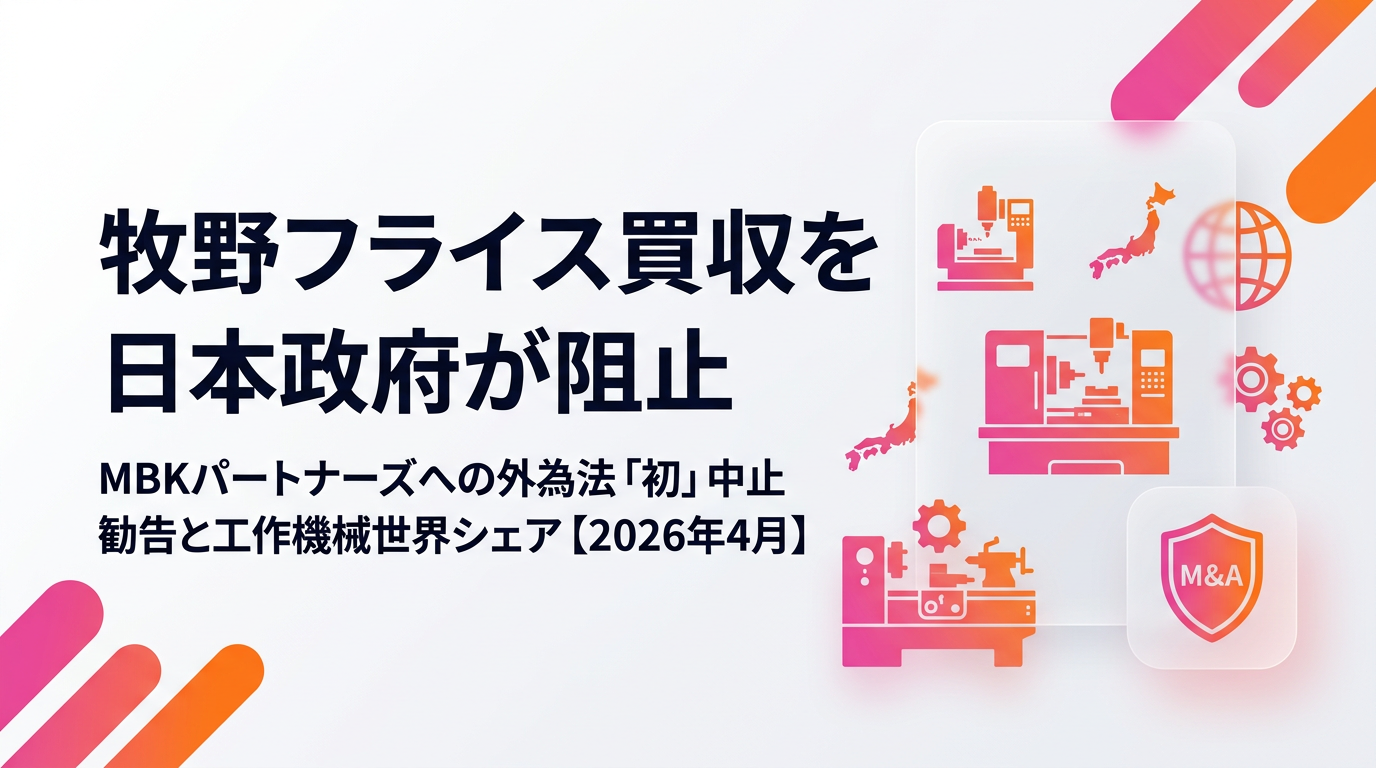
On April 22, 2026, the Japanese government issued a recommendation, under the Foreign Exchange and Foreign Trade Act (FEFTA), to halt a tender offer (TOB) from Asian private-equity firm MBK Partners for Makino Milling Machine Co., Ltd.12.
"PE fund," "TOB," "stop-order recommendation" — the articles were packed with jargon. But this is actually a landmark moment for Japan's economic-security policy. Roughly nine years after the 2017 FEFTA amendment, the "heirloom sword" that had never been drawn was finally drawn, and it was drawn against the Makino deal.
So what actually happened, why is this "historic," and how big a presence do Makino and Japan's other machine-tool makers really have on the world stage? Let's walk through it step by step.
The April 22, 2026 stop-order recommendation at a glance
The key points, in bullet form123:
| Item | Detail |
|---|---|
| Date | April 22, 2026 |
| Legal basis | FEFTA Article 27, Paragraph 5 |
| Target | MBK Partners' planned TOB for Makino Milling |
| TOB price | JPY 11,751 per share |
| Deadline | Notify acceptance/rejection within 10 days (by May 1, 2026) |
| If rejected | The government may issue a formal stop order |
| Outcome | On April 30, 2026 MM Holdings notified its acceptance under FEFTA Article 27(7). The tender offer agreement was terminated by mutual consent and the TOB was never launched4 |
FEFTA Article 27(5) provides that "the Minister of Finance and the minister in charge of the relevant business, if they determine after review that a notified inward direct investment relates to national security, may, after hearing the opinion of the Council on Customs, Tariff, Foreign Exchange and Other Transactions, recommend a modification or halt of the investment"5.
Finance Minister Satsuki Katayama told reporters that the recommendation was "judged to be unavoidable" and that the deal "could undermine national security." Chief Cabinet Secretary Minoru Kihara echoed that view67.
The road from the 2024 Nidec approach
This takeover saga did not arrive overnight. The timeline:
- 2024: Nidec (formerly Nidec Corporation) proposes a hostile bid. Makino resists, and Nidec later withdraws
- June 3, 2025: MM Holdings, the bid vehicle on the MBK Partners side, signs a tender offer agreement with Makino and announces the take-private plan
- April 22, 2026: the government issues its stop-order recommendation under FEFTA Article 27(5)
- April 30, 2026: MM Holdings accepts the recommendation under FEFTA Article 27(7), terminates the tender offer agreement by mutual consent, and the TOB is never launched4
- June 25, 2026: Makino Milling discloses that it has received a further non-binding proposal from Nippon Sangyo Suishin Kiko (NSSK) and has begun reviewing it, including deliberations by a special committee8 ← we are here
At the Nidec stage, both parties were Japanese, so the full economic-security machinery was not triggered. This time a foreign fund stepped into the lead role, which gave the government a much clearer basis to intervene.
Why is this "historic"?
The short answer: because it is the first.
The 2017 FEFTA amendment was designed to strengthen Japan's ability to review and correct inward direct investments that touch on national security. In the roughly nine years since, zero stop-order recommendations had been issued under that framework. In other words, it was "a framework that existed on paper but was never actually used." Article 27 itself is not entirely untested: the Ministry of Finance's annual report records an earlier case in which a stop-order recommendation and order were issued against a foreign investor's share acquisition in a Japanese electric-power-related company9. What is new here is the first use under the post-2017 framework.
That matters more than it might sound. As long as the framework is never invoked, foreign investors read Japan as "a country with rules on the books but no enforcement." This recommendation is the government's signal to the market that, when the moment calls for it, the sword will come out. Japan's economic-security regime just shifted from "written rules" to "enforced rules." This is not an overstatement — it is a genuine turning point.
Replace siloed classification work with AI.
METI's FY2024 data shows 52% of foreign exchange law violations stem from classification errors. Download the TRAFEED product catalog covering features and rollout.
What makes Makino Milling such a remarkable company?
So what kind of company is Makino Milling, really?
Founded in 1937 and headquartered in Kanagawa Prefecture, Makino Milling Machine is a Japanese machine-tool manufacturer. Its flagship product is the five-axis machining center, a high-precision machine that applies cutting tools to a workpiece from five directions simultaneously. Its strength lies in being able to machine not only simple shapes but also curved, three-dimensional geometries in a single setup10.
What five-axis machining centers actually produce
Concretely, these machines are used to manufacture11:
- Aircraft engine parts (titanium alloys, Inconel and other difficult-to-machine materials)
- Molds and dies (for automobiles, home appliances, semiconductor manufacturing equipment)
- Rocket and space-equipment components
- Medical devices
Five-axis machining centers are highly versatile equipment used for a wide range of high-precision work, from aircraft engine parts to molds and medical devices. Because of that machining precision, such technology can serve both civilian and defense purposes, which is why machine tools are sometimes classified in regulatory terms as a dual-use item. This reflects the regulatory character of precision-machining technology in general, not any indication that a specific product is put to a specific use.
How powerful is Japan's machine-tool industry, globally?
There is one more fact worth absorbing here. Makino is not alone. Japan has many machine-tool manufacturers, and most of them are world-class.
Pulling together multiple industry data points, six to seven of the global Top 10 machine-tool makers are Japanese1213:
| Tier (indicative) | Company | HQ | Primary products |
|---|---|---|---|
| Top | DMG MORI | Japan (co-managed with Germany) | Multi-tasking machines, CNC lathes |
| Top | Yamazaki Mazak | Japan (Aichi) | Multi-tasking machines, CNC lathes |
| Top | Amada | Japan (Kanagawa) | Sheet-metal machines, lasers |
| Top | Okuma | Japan (Aichi) | Full range of CNC machine tools |
| Mid | Makino Milling | Japan (Kanagawa) | Five-axis machining centers |
| Mid | JTEKT | Japan (Aichi) | Precision machine tools, auto parts |
| Mid | Komatsu | Japan (Tokyo) | Machine tools, construction equipment |
| — | TRUMPF | Germany | Lasers, sheet-metal machines |
| — | Haas Automation | US | General-purpose CNC |
| — | Hyundai WIA / Doosan | South Korea | Machining centers |
Rankings vary depending on the source. In recent share data DMG MORI is often ranked #1 globally and TRUMPF #2, and Japanese makers collectively account for an estimated 30–40% of the world machine-tool market.
This concentration of Japanese players is both a source of the country's manufacturing competitiveness and a strategic national-security asset. If several leading makers were acquired one after another by foreign capital, Japan's defense supply chain — and allied military industries — would feel the effects in chain reactions.
The Makino case may look like a single-company story, but it really poses a much bigger question: what does Japan's strategically protected industrial portfolio actually look like?
Decoding the government's logic
The stated grounds appear in MM Holdings' own disclosure of April 30, 2026. Makino Milling "manufactures high-performance machine tools that are also widely used by manufacturers of Japan's defense equipment, and holds the related technology and information," and among that information there is "information that, even if not sensitive on its own, could become information sensitive to the securing of national security when combined with other information." On that basis the share acquisition was found to constitute an "inward direct investment pertaining to national security" under FEFTA Article 27(3)4.
That is a determination about a regulatory category — not a verdict on the target company or the bidder. With that framing in place, commentary and reporting suggest the government's reasoning can be read in four layers14:
- Nature of the item: high-performance equipment that can serve both civilian uses and the manufacture of defense equipment
- Criticality in the supply chain: Japan's manufacturing base depends on equipment in this category
- The "mosaic effect": information that is not sensitive on its own can become sensitive when combined
- Fit with PE fund holding periods: an investment premised on an exit within a few years does not align well with the time horizon required to preserve sensitive technology
The fourth layer is the most interesting. The government is not saying "MBK is the bad guy." It is saying that the time horizon of the PE business model is not aligned with the time horizon required to preserve sensitive technology, and that structural mismatch is what triggered the intervention. Expect this logic to become the default framework for similar cases going forward.
A bitter lesson from 40 years ago: the Toshiba–COCOM incident
There is a reason the Japanese government treats machine-tool exports and investment with unusual seriousness. That reason goes back nearly 40 years, to the Toshiba–COCOM incident (1987).
In 1987, a case concerning the export of machine tools to the Eastern Bloc — the so-called Toshiba–COCOM incident — came to light. High-performance machine tools for submarines were reported to have reached the Soviet Union, which was said at the time to have contributed to quieter submarine propellers, and the matter shook US–Japan relations. It became a major catalyst for strengthening Japan's export-control system. It is referenced as historical background to that system and should be understood as separate from any assessment of the businesses operating today15.
The idea that machine tools sit at the heart of national security is not a new one. It is a lesson Japan has historically learned the hard way. The Makino case is, in a sense, a reminder of that lesson.
Transparency and what comes next
At the same time, there are real concerns about transparency.
The Nikkei editorial of April 23, 2026 raised the following points16:
- The government should explain the decision-making process in more detail
- Review criteria — investor requirements, the scope of "sensitive technology" — should be spelled out concretely
- Overly broad restrictions can hurt both market competition and the discipline that governance provides
- Japan needs a Japan-version CFIUS (Committee on Foreign Investment in the United States)-style institutional design, and it needs it soon
- Options other than an outright ban — such as carve-outs of sensitive business units or conditions on future acquirers — should also be on the table
How Japan balances economic security with an open market is a major piece of homework.
How companies should prepare
Large-scale cases like Makino do not come up every year. But the shift — economic-security enforcement has moved from paper to reality — hits the operations of every company.
More rigorous counterparty screening is going to be required in situations like:
- Transactions with foreign companies, especially those in countries of concern such as China, Russia and Iran
- Exports of dual-use technology or products
- Acquisitions by foreign capital, joint ventures, technology-licensing deals
- Hiring of foreign students or engineers (which may trigger "deemed exports")
Our AI export-control agent TRAFEED supports these scenarios with:
- Counterparty risk scoring: automated screening against the Entity List, Foreign End User List, EU sanctions list and other sources
- Classification assistance: AI-based assessment of whether a product's specifications fall under list-based controls
- Workflows aligned with METI guidelines: evidence management built with audits in mind
- Multi-language coverage: Chinese, English and Korean corporate records can all be screened in one place
Excel files kept by one or two specialists will not keep up with the economic-security environment of 2026. For the wider context of China's export controls targeting Japan, see "China's Export Controls Targeting Japan: The New Reality Japanese Firms Face". Reading them side by side will give you a clearer full picture.
If you are reviewing export-control operations or classification workflows, download the TRAFEED product catalog (PDF) or contact us.
Summary
The Makino stop-order recommendation looks like a single-company story but is actually a watershed moment for Japan's economic-security policy as a whole. The key takeaways:
- April 22, 2026: the first stop-order recommendation under the 2017-amended FEFTA
- Target: the TOB for Makino Milling by MM Holdings on the MBK Partners side. The recommendation was accepted on April 30, 2026 and the TOB was never launched
- Machine tools are "mother machines" with extremely high dual-use potential
- Japan accounts for 6–7 of the Top 10 machine-tool makers globally — a strategic industrial base
- The stated grounds were that Makino makes high-performance machine tools also widely used by manufacturers of Japan's defense equipment, plus the mosaic effect — a determination about a regulatory category, not a verdict on the company
- Next debate: transparency, and institutional design for a Japan-version CFIUS
- Companies must now systematize counterparty screening and export control
Read together with "The National Intelligence Council Establishment Act" — which cleared the House of Representatives on April 23, 2026, passed the House of Councillors on May 27, and was promulgated on June 3, 2026 as Act No. 28 of 202617 — you can see Japan's economic-security system moving simultaneously on three fronts: the council venue, enforcement and specific cases.
For TRAFEED details or to request materials, see this page.
References
Footnotes
-
Makino Milling buyout: stop-order recommended against Asia-based MBK citing security concerns – Nikkei (2026-04-22) ↩ ↩2
-
Government recommends halt to Asian fund's Makino Milling acquisition on security grounds – Jiji Press (2026-04-23) ↩ ↩2
-
Makino Milling MBK acquisition blocked under FEFTA: background and impact – Kyubei's news ↩
-
MM Holdings, "Notice regarding non-implementation of the tender offer for shares of Makino Milling Machine Co., Ltd. (securities code: 6135)" (April 30, 2026, timely disclosure) ↩ ↩2 ↩3
-
Finance Minister Katayama confirms stop-order recommendation for Makino deal: "risk of undermining national security" – Nikkei ↩
-
Chief Cabinet Secretary Kihara on the Makino stop-order: "risk of undermining national security" – Nikkei ↩
-
Makino Milling Machine Co., Ltd., "Regarding certain media reports about the Company" (June 25, 2026, timely disclosure) ↩
-
FEFTA Inward Investment Review System Annual Report (FY2024) – Ministry of Finance ↩
-
Five-axis control vertical machining center – Makino Milling Machine ↩
-
Global machine-tool share ranking and major Japanese players – Nikko Lease ↩
-
Makino Milling MBK acquisition blocked under FEFTA: background and impact ↩
-
Machine tools: leveraging the Toshiba-COCOM lesson to stop technology leaks in the Makino case – Nikkei ↩
-
Editorial: FEFTA enforcement on corporate M&A requires high transparency – Nikkei ↩
-
National Intelligence Council Establishment Bill – bill record (submitted March 13, 2026 / passed the House of Representatives April 23, 2026 / passed the House of Councillors May 27, 2026 / promulgated June 3, 2026 as Act No. 28) – House of Councillors ↩