Hello, this is Hamamoto from TIMEWELL.
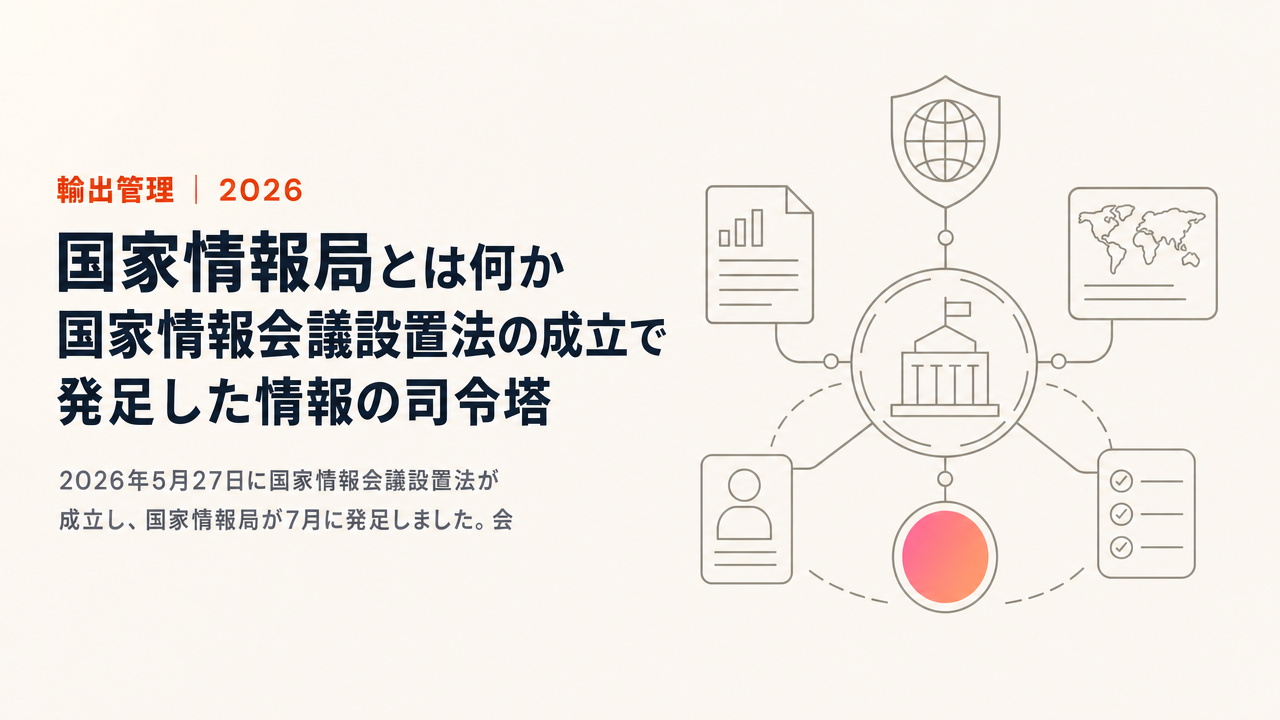
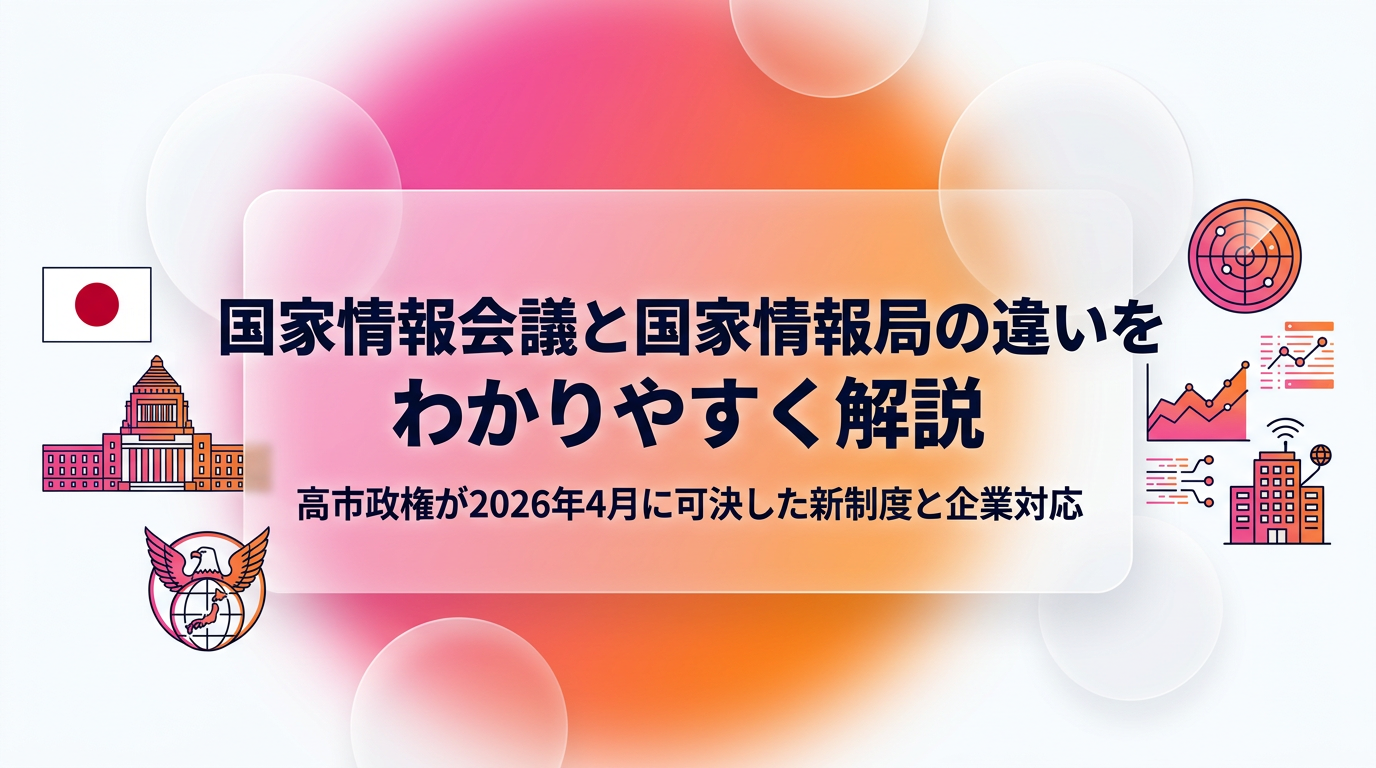
On April 23, 2026, the House of Representatives passed the "National Intelligence Council Establishment Bill." This is one of the signature bills of the Takaichi administration. The LDP, Ishin, the Democratic Party for the People and others voted in favor; the Communist Party opposed. The bill was subsequently passed by the House of Councillors on May 27, 2026 and promulgated on June 3, 2026 as the National Intelligence Council Establishment Act (Act No. 28 of 2026)123. The Act takes effect on a date to be fixed by cabinet order within six months of promulgation, and on July 24, 2026 the Cabinet adopted that enforcement-date order. At the same meeting it approved the appointment of Kazuya Hara as the first Director-General of the National Intelligence Agency, together with a tidy-up of earlier cabinet decisions and a cabinet order amending the related subordinate legislation4. Clearing the consequential ordinances in one sitting signals that commencement is imminent. Press reporting puts the launch at July 31, 2026. Note, though, that the cabinet agenda page does not state the commencement date itself, and I have not been able to check the ordinance as published in the Official Gazette. If you are putting the date into internal material, confirm it against the Gazette.
(This article was first published on April 24, 2026, the day after the lower-house vote. Post-enactment developments were added on July 30, 2026.)
If you watched the news and thought, "National Intelligence Council? Isn't that the same as the National Intelligence Agency?" or "The name sounds intense, but does it actually affect my job?", you are not alone. Honestly, that was my initial reaction too.
But once you look under the hood, this is not just a political-news item. It reshapes the backbone of Japan's economic-security architecture, and it lands especially directly on companies that export or do cross-border business.
What is the National Intelligence Council?
The National Intelligence Council (Kokka Joho Kaigi) is the highest-level decision-making body for intelligence policy, chaired by the Prime Minister. The easiest way to picture it is as the intelligence counterpart to Japan's existing National Security Council (NSC).
Membership
Based on the bill, the line-up looks like this56.
| Role | Minister |
|---|---|
| Chair | Prime Minister |
| Deputy-chair level | Chief Cabinet Secretary |
| Diplomacy and security | Foreign Minister, Defense Minister |
| Public safety | Justice Minister, Chair of the National Public Safety Commission |
| Economy and finance | Minister of Finance |
| Others | Relevant ministers |
Eleven members in total, including the chair. In short, Japan's core decision-making leadership will sit at one table to set intelligence and counter-intelligence policy.
Principal responsibilities
The Council is tasked with setting basic policy on what the bill calls "important intelligence activities"7:
- Counter-espionage (responding to foreign intelligence-gathering)
- Counter-terrorism (dealing with terrorist groups and extremists)
- Cybersecurity
- Countering foreign influence operations (disinformation on social media, election interference)
Until now, individual ministries have collected information and made judgments in their own silos. The Council is best understood as a deliberate attempt to shatter that vertical structure.
How does it differ from the National Intelligence Agency?
This is where people get confused. "National Intelligence Council" and "National Intelligence Agency" sound almost identical, but their roles could not be more different.
| National Intelligence Council | National Intelligence Agency | |
|---|---|---|
| Nature | Policy-setting body (decision venue) | Secretariat / operational body |
| Head | Prime Minister | Director-General (political-appointee class) |
| Structure | Meeting of relevant ministers | Upgraded Cabinet Intelligence Research Office |
| Role | Decide basic policy | Aggregate and analyze ministry information |
| Image | Boardroom | Analysis office |
It is a two-tier structure. The downstream Agency sweeps up information from the National Police Agency, Public Security Intelligence Agency, Ministry of Foreign Affairs, Ministry of Defense, Ministry of Economy, Trade and Industry (METI) and other ministries, analyzes it in one place, and feeds the results upstream to the Council, which then sets policy.
Because the Agency will be granted "comprehensive coordination authority," other ministries will be required to hand over information. This shift from fragmented intelligence to centralized intelligence is the single most important piece of the bill8.
Related reading: We previously covered the Agency itself in "What Is This 'National Intelligence Agency' All Over the News?". This article is the follow-up, taking on the higher-level "council." Read together, they give you the full picture of Japan's new intelligence architecture.
Replace siloed classification work with AI.
METI's FY2024 data shows 52% of foreign exchange law violations stem from classification errors. Download the TRAFEED product catalog covering features and rollout.
Why now?
Why is the Takaichi administration moving this fast? Three forces in the 2026 international environment explain it.
Driver 1: China's export controls targeting Japan
On February 24, 2026, China's MOFCOM published Announcement 2026 No. 11 (Control List, 20 entities, including Mitsubishi Heavy Industries group companies and JAXA) and Announcement No. 12 (Watch List, 20 entities, including SUBARU and TDK), covering 40 Japanese companies and organizations in total9. On June 29, 2026, Announcements No. 27 (Control List) and No. 28 (Watch List) each added 20 more entities, bringing the Japan-directed lists to 80 entities as of July 202610. This listing is a regulatory classification defined by the Chinese authorities; it does not mean that the listed firms engaged in any wrongdoing or in military diversion. In practice, categories of dual-use goods (items that can have both civilian and military applications) are drawn broadly, so legitimate commercial manufacturers can end up within the scope of a control classification. With exports of such items effectively restricted for the firms concerned, the affected Japanese companies' supply chains have had to adapt.
Defending against "economic statecraft"—the weaponization of trade—cannot rest on individual companies or ministries alone. It needs an organized, coordinated intelligence-analysis posture. That is the core premise behind the new structure.
Driver 2: Influence operations and election interference via social media
Disinformation campaigns and foreign-directed manipulation of public opinion via social platforms have become a global problem. Japan itself has seen clearly organized information operations around multiple elections.
Relying on the National Police Agency and the Ministry of Internal Affairs and Communications to improvise a response per election no longer scales. You need a horizontal command center for monitoring and analysis. That is the second rationale.
Driver 3: Proposals from figures like Shotaro Yachi and the MI6 model
Shotaro Yachi, who served as the first head of the National Security Secretariat, has long pointed out the shortcomings of Japan's intelligence posture. In interviews he has described the current bill as the first step of a broader plan that would eventually lead to the creation of an independent foreign-intelligence service modeled on the UK's MI611.
The government's blueprint is two-staged:
- Stage 1 (this bill): Stand up the National Intelligence Council plus the National Intelligence Agency
- Stage 2 (future): Enact an anti-espionage law and create an independent foreign-intelligence agency (Japan's MI6)
The public debate on Stage 2 is, frankly, still in its early days. At her press conference on the day the Act cleared the Diet (May 27, 2026), Prime Minister Takaichi called the new law a first step in strengthening Japan's intelligence capabilities; asked about anti-espionage legislation, she said only that she was not yet in a position to give specifics and that the government would proceed carefully while listening to a wide range of views12. But the signal is clear: the direction of travel points there.
What does this mean for companies?
Here is where it becomes directly relevant to most business readers.
With the Council in place, the line between "national security" and "economic activity" narrows sharply. Three concrete changes are likely.
Change 1: Expanding lists of entities of concern
China's lists targeting Japan—80 entities in total across Announcements No. 11 and 12 (February 2026) and No. 27 and 28 (June 2026)—were symbolic, but the set of regulatory lists companies must screen against will keep growing. It is worth keeping in mind that being placed on a list is a regulatory classification defined by the authorities in question—it does not mean the listed company engaged in wrongdoing or military diversion. Legitimate commercial manufacturers are not uncommonly caught within broad control classifications. The US Entity List, EU and UK sanctions lists, Japan's Foreign End User List—multiple regimes with frequent updates—mean that affected companies need the capacity to understand precisely where they and their counterparties stand, and to explain it to their trading partners.
Change 2: Stricter end-user screening
The catch-all rule, which asks whether an item risks being diverted to military use, is expected to be enforced more strictly. Do you actually know your counterparty's end use? Do you have the paper trail to prove it? Areas where companies have been quietly vague will now get flagged in audits.
Change 3: Heavier penalties for violations
Penalties under Japan's Foreign Exchange and Foreign Trade Act (FEFTA) — for unlicensed exports or false filings — are trending upward as economic security rises on the agenda. Beyond criminal penalties, an administrative export ban can do lasting damage to corporate reputation. "We didn't know" is no longer an acceptable defense.
Where TRAFEED fits
Against this backdrop of tightening regulation, our AI export-control agent TRAFEED is seeing rapidly growing demand.
TRAFEED uses generative AI to automate export-control and counterparty-screening workflows.
- Counterparty risk scoring: enter the company name, address, and officer information, and TRAFEED checks the record against the Foreign End User List, Entity List, EU sanctions list and other sources in about five seconds
- Classification support: enter a product's specifications and the AI assesses the likelihood that it falls under list-based controls
- Workflow aligned with METI guidelines: audit-ready evidence management built in
- Multi-language coverage: screen Chinese, English, and Korean corporate records in one place
With the Council in place, counterparty checks are only going to get harder. Excel files maintained by a handful of specialists no longer keep up, either in speed or in accuracy. That is already the reality in many compliance teams.
The concerns behind the convenience
Finally, a point we should not ignore as citizens, not just as businesspeople.
During the Diet debate, opposition lawmakers raised several concerns13:
- Privacy risk: the scope of information the Agency can collect is not clearly bounded in the statute
- Potential political use: Prime Minister Takaichi did not explicitly rule out surveillance of groups critical of government policy
- Effectiveness of supplementary resolutions: resolutions on privacy protection and political neutrality were attached but are not legally binding
- Weak Diet oversight: given the nature of intelligence activities, disclosure will be limited
All of these bear on the transparency of how the system is run and the real-world strength of democratic control. Those of us on the business side should not stop at "useful for compliance, so good" — we also want to hold a view on how this fits into the broader social architecture.
If you are reviewing export-control operations or classification workflows, download the TRAFEED product catalog (PDF) or contact us.
Summary
With the National Intelligence Council Establishment Act enacted on May 27, 2026 and promulgated on June 3, 2026 as Act No. 28, Japan's intelligence architecture is at an inflection point. The key takeaways:
- The Council is the top decision-making body for intelligence policy, chaired by the Prime Minister, with 11 members
- The Agency is its secretariat, centralizing intelligence drawn from across the ministries
- Drivers: China's export controls targeting Japan, social-media influence operations, rising terror and cyber threats
- The government is pursuing two-stage reform: Stage 1 now, Stage 2 being an anti-espionage law plus a foreign-intelligence service
- Companies will be pushed to raise the bar on export control and counterparty screening
- At the same time, real concerns about privacy and political misuse remain
The era in which national security lands directly on business operations is now fully underway. It is worth taking a hard look at whether your own export-control posture is ready for this new normal.
For more on TRAFEED, requesting materials, or booking a demo, see this page.
References
Footnotes
-
Takaichi administration's flagship bill clears the House: "National Intelligence Council" establishment bill – Nikkan Sports (2026-04-23) ↩
-
Intelligence Council bill passes the House: strengthening the government's intelligence capability – Jiji Press (2026-04-23) ↩
-
National Intelligence Council Establishment Bill – legislative record (submitted 2026-03-13 / lower house 2026-04-23 / upper house 2026-05-27 / promulgated 2026-06-03 as Act No. 28) – House of Councillors / House of Representatives record / National Intelligence Council Establishment Act (Act No. 28 of 2026) – e-Gov ↩
-
Cabinet agenda, July 24, 2026 (cabinet order fixing the entry-into-force date of the National Intelligence Council Establishment Act; appointment of the first Director-General of the National Intelligence Agency) – Prime Minister's Office ↩
-
National Intelligence Council Establishment Bill – House of Representatives ↩
-
National Intelligence Council Establishment Bill: Overview – Cabinet Secretariat ↩
-
Intelligence Agency establishment bill approved by House Committee on Cabinet Affairs – Nikkei (2026-04-22) ↩
-
One-minute explainer: Reorganizing the government's intelligence architecture – Dai-ichi Life Research Institute ↩
-
China's export controls targeting Japan: the new reality Japanese firms face – TIMEWELL ↩
-
MOFCOM Announcement 2026 No. 27 (20 Japanese entities added to the Control List, 2026-06-29) / Announcement 2026 No. 28 (20 Japanese entities added to the Watch List, 2026-06-29) / Announcement 2026 No. 11 / Announcement 2026 No. 12 ↩
-
Shotaro Yachi on what the National Intelligence Council bill is missing: MI6 as the model – Tokyo Shimbun ↩
-
Press conference on the enactment of the National Intelligence Council Establishment Act (2026-05-27) – Prime Minister's Office ↩
-
Whose privacy is being protected? Prime Minister Takaichi's evasive answers send the Intelligence Council bill to the Upper House with concerns unaddressed – Tokyo Shimbun ↩