Hello, this is Hamamoto from TIMEWELL.
When I wrote this article six months ago, the "National Intelligence Agency" was still a concept dominating the headlines. The government and ruling parties had settled on the policy, and things looked ready to move. Since then, matters have advanced quickly. The enabling law was enacted on May 27, 2026[1], and the National Intelligence Agency is now expected to launch as early as July 2026[5]. This is no longer a debate about whether to build it. It is a story about an organization that has already started to move.
So this time, I want to revisit what the National Intelligence Agency actually is, based on the text of the enacted law and the government's primary materials. This is not the plot of a spy film. It is a very real subject, and one that connects directly to corporate compliance.
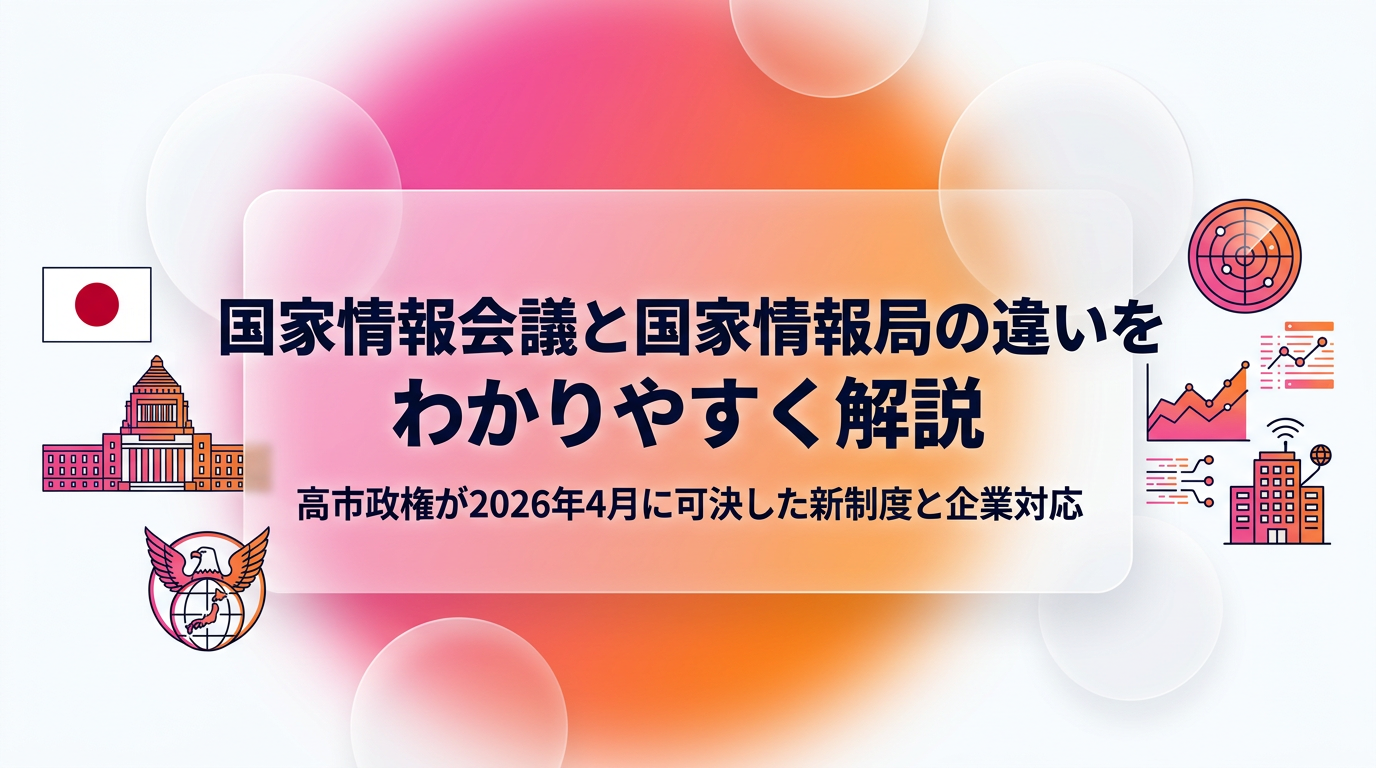
What Is the National Intelligence Agency? Understanding the "Council" and the "Agency" Separately
The first thing to grasp is that what the news lumps together as the "National Intelligence Agency" is in fact built from two vessels. Unless you separate them, the picture stays blurry even as you read the coverage.
The formal name of the enabling law is the National Intelligence Council Establishment Act (Act No. 28 of 2026)[3]. As the name suggests, the first thing this law creates is a body called the "National Intelligence Council." The National Intelligence Agency is the organization placed within the Cabinet Secretariat to serve as that Council's secretariat[2]. If the Council is where policy is decided, the Agency is the operational unit that carries out that policy and consolidates and analyzes the day-to-day flow of information. This relationship — the Council as decision-maker, the Agency as the working engine — is the backbone of the new system.
Japan already has several organizations that handle intelligence: the Cabinet Intelligence and Research Office, known as the "Naicho," within the Cabinet Secretariat; the National Police Agency; the Ministry of Foreign Affairs; the Ministry of Defense; and the Public Security Intelligence Agency[7]. Each has gathered information within its own domain. The problem was that the information collected could not be bound together well. Blocked by walls between ministries, the full picture stayed invisible to everyone — the classic dysfunction of organizational silos. Modern threats such as cyberattacks, the spread of disinformation, and economic security are not simple enough to be handled by a single ministry. Consolidate scattered information in one place, have specialists analyze it, and enable the Prime Minister to make accurate decisions. The Council and the Agency were designed to be exactly that brain.
Replace siloed classification work with AI.
METI's FY2024 data shows 52% of foreign exchange law violations stem from classification errors. Download the TRAFEED product catalog covering features and rollout.
From Concept to Enactment: What Happened in 2026
Six months ago, this article said the agency was "scheduled to be established during fiscal 2026." That tense is already out of date. In fact, the bill progressed as follows.
| Timing | Event |
|---|---|
| March 13, 2026 | Cabinet approval of the National Intelligence Council Establishment bill[2] |
| April 2, 2026 | Deliberations begin in the House of Representatives |
| April 22, 2026 | Passed by the House of Representatives Committee on Cabinet |
| April 23, 2026 | Passed by the House of Representatives plenary session[4] |
| May 26, 2026 | Passed by the House of Councillors Committee on Cabinet |
| May 27, 2026 | Passed by the House of Councillors plenary session and enacted[1] |
| July 2026 (expected) | Launch of the National Intelligence Agency[5] |
From Cabinet approval to enactment in just two and a half months. For a security-related bill, that is remarkably fast. Behind it lies the way Japan has sharply reoriented its security policy since Russia's invasion of Ukraine in February 2022. The Cabinet's adoption of the Three Security Documents in December 2022 set out the possession of counter-attack capability and a rise in defense spending to 2 percent of GDP[8], and the Economic Security Promotion Act, enacted in May 2022, put supply chains and advanced-technology protection into law[9]. The National Intelligence Council Establishment Act is the culmination of this sequence of policy shifts. For the broader picture of economic security itself, I have laid it out in Economic Security Promotion Act: The Four Pillars and the 2026 Amendment; reading the two together should make the flow easier to follow.
One point worth flagging is the way the dates are written. Coverage says the National Intelligence Agency is expected to launch as early as July 2026[5], but the enforcement date for this law shown on e-Gov Law Search is December 2, 2026[3]. Full enforcement of the law and the actual stand-up of the organization appear to happen in stages. For now, the accurate way to read it is something like: "the framework takes shape right after enactment in July, and full-scale operation ramps up toward the end of the year."
If you are wondering whether your own export control and counterparty screening are keeping pace with the changing security environment, a free export-control classification and counterparty-screening check lets you take stock in a few minutes. With the national framework now in motion, this is a good moment to revisit your own footing.
What the Organization Actually Does: The Core of Its Powers Lies in Article 7
Silos do not vanish simply because a new sign has been hung. What determines whether the system works in practice is its powers — how far the Agency and the Council can reach into the ministries.
The matters the National Intelligence Council investigates and deliberates are designed around two pillars. One is "important intelligence activities," the other is "responses to foreign intelligence activities"[2]. The latter includes responses to influence operations such as the spread of disinformation and manipulation of public opinion. The lessons of hybrid warfare, which the war in Ukraine forced the world to confront, are written straight into the statute. The development and operation of information-gathering satellites is also positioned as an important matter.
The Council's composition is spelled out specifically as well. The chair is the Prime Minister[2]. The members include the Acting Prime Minister, the Chief Cabinet Secretary, the Minister for Financial Services, the Chairperson of the National Public Safety Commission, the Minister of Justice, the Minister for Foreign Affairs, the Minister of Finance, the Minister of Economy, Trade and Industry, the Minister of Land, Infrastructure, Transport and Tourism, and the Minister of Defense (the chair may add or remove members as deemed necessary). The fact that economic ministries, financial affairs, and even land and transport are included reflects how "security" today is no longer solely a military matter.
The Agency's mission can be organized into two parts. First, handling the Council's administrative work and providing overall coordination of the intelligence activities conducted by the ministries. Second, collecting and investigating information on the Cabinet's key policies, and consolidating and comprehensively analyzing that information[2]. The head of the Agency is the Director of the National Intelligence Agency, a post created by upgrading the existing Director of Cabinet Intelligence, and positioned on par with the Secretary General of the National Security Secretariat. The existing post of Director of Cabinet Intelligence and the Cabinet Intelligence and Research Office will be developmentally reorganized, with their functions carried over to the new organization[5]. The workforce is put at roughly 700 people — by no means small.
And the single most important element of the new system is Article 7. It provides that the Chief Cabinet Secretary and the heads of relevant administrative organs bear a duty to provide materials and information to the Council in a timely manner, and, at the chair's request, to provide information, give explanations, and cooperate[2][3]. Six months ago I wrote that "whether an information-access right is written into law will be the key." That right has now been fixed as a legal obligation. Ministries are legally barred from hoarding — from saying "we're not handing over our information." As a device for overcoming silos, this single provision is the spine of the system.
Is It Japan's CIA? Comparing It to Intelligence Agencies Around the World
The word "command center" might conjure a spy organization wielding vast powers. But the National Intelligence Agency has a different character from the U.S. CIA or FBI.
In most democracies, the roles of intelligence agencies are broadly divided into two. One is an external intelligence agency that collects information abroad — the U.S. CIA and the UK's MI6 fall into this category. The other is a domestic security and counterintelligence agency that maintains internal order and cracks down on foreign spies, with the U.S. FBI and the UK's MI5 as the prime examples. Because concentrating power in a single organization risks threatening citizens' freedoms and privacy, the functions are deliberately kept apart.
So which is Japan's National Intelligence Agency? The answer is: neither. The National Intelligence Agency is not an operational intelligence service that conducts espionage itself. It has the strong character of a coordinating and analytical body — one that binds together the information flowing up from the various agencies, consolidates and analyzes it, and supports policy decision-making. It does not run its own overseas sources like the CIA, nor does it wield domestic investigative powers like the FBI. That is why it is said to be neither a Japanese CIA nor a Japanese FBI.
| Country | External intelligence | Domestic security/counterintelligence | Signals intelligence/analysis | Command center/coordination |
|---|---|---|---|---|
| Japan | Foreign Intelligence Agency (establishment under consideration) | National Police Agency, Public Security Intelligence Agency | — | National Intelligence Agency, National Intelligence Council |
| United States | CIA | FBI | NSA | ODNI |
| United Kingdom | MI6/SIS | MI5 | GCHQ | Joint Intelligence Committee |
| Israel | Mossad | Shin Bet | Unit 8200 | — |
The story does not end there. At the press conference following enactment (May 27), Prime Minister Sanae Takaichi framed the new law as "the first step in reforms to strengthen intelligence capabilities"[1]. She also signaled a desire to establish a Foreign Intelligence Agency that gathers information abroad on its own. On the substance, however, she went only so far as to say she was "not at a stage to speak to the specifics at this point." The enactment of an anti-espionage law also remains a continuing issue for study. It is true that six months ago there was talk of a plan to create a Foreign Intelligence Agency "by the end of 2027," but at the point of enactment the Prime Minister's phrasing was cautious: the intent is there, but the details are yet to come. It is fair to say the official position has been confirmed — the National Intelligence Agency is not the goal, but merely the first step in remaking Japan's intelligence architecture.
Expectations and Concerns: The Homework Left Behind by the Enactment Process
The law was not enacted amid unanimous welcome. If anything, the very process of enactment brought the system's homework into sharp relief.
In the vote, the LDP, Nippon Ishin no Kai, and the Democratic Party for the People voted in favor, while the Constitutional Democratic Party voted against. The point of contention was how to protect citizens' privacy. The opposition demanded that consideration for personal information protection and the political neutrality of the intelligence body be written explicitly into the body of the bill. The government refused to include these in the statutory text, settling instead for a supplementary resolution. A supplementary resolution is a political understanding; it does not carry the legal force of statutory provisions. The criticism that "the crucial safeguards were not written into the main text" stems from this.
Legal experts also voiced caution one after another. The Japan Federation of Bar Associations, along with the Sapporo Bar Association, the Hyogo Bar Association, and the Japan Lawyers Association for Freedom, expressed concerns. The issues fall into three main areas. First, no independent oversight body has been established. Without a third-party mechanism to check the intelligence body from the outside, no one can verify whether its operations are proper. Second is the so-called "absence of a conduct-regulating statute." Even though a law to establish the organization (an establishment act) is in place, the rules of conduct that define in what circumstances, and how far, investigation and information acquisition are permitted have not been put in place. Third is the risk of privacy infringement from centrally integrating the personal information held across the ministries.
For my part, I think the significance of Article 7 as a device for breaking down silos is considerable. Taking direct aim at the long-standing weakness of Japan's intelligence architecture — that information is not shared — is a step forward. But at the same time, if you are going to create a strong information-access right, you must build a mechanism to monitor it from the outside with equal strength; otherwise the balance is off. Japan carries the prewar memory of the Special Higher Police policing citizens' thoughts and speech. A pattern in which the "power to collect" runs ahead while the "safeguards" are put off should not be regarded as someone else's problem. Whether an oversight body and a conduct-regulating statute get built depends on the operation and additional legislation to come. This is a point worth watching closely.
If the State Builds an Intelligence Command Center, What Should Companies Put in Place?
The National Intelligence Agency may look like a distant affair at the level of the state. But this shift in the security environment is rebounding directly onto corporate activity.
From an economic security standpoint, the importance of export control rises year by year. The back-and-forth of regulation over semiconductors, rare earths, and critical minerals continues, and since the start of 2026 there have been successive cases of Japanese companies being added to China's export control lists. I track which companies are affected on a continuing basis in The List of Japanese Companies Added to China's Export Control Lists, and the reality there is that international supply chains are constantly exposed to risk.
In such an environment, what companies are asked to do is to screen, more rigorously than ever, whether their counterparties carry security risks or run afoul of export control regulations. Yet this work is cumbersome and demands specialized knowledge. It is not unusual for a single case to take two to three hours, and it weighs heavily on the practitioners who do it.
This is where AI-powered export control solutions come in. TRAFEED from TIMEWELL automates the background verification of export control and makes a counterparty's concern level visible in as little as five seconds[10]. It supports METI's standard formats, automatically matches against regulatory and sanctions lists, and includes a chain-check function that traces counterparties back through their shareholders and affiliated companies. In reaching a determination, multiple AI models cross-check one another, and the reasoning behind the judgment and the source URLs are shown, strongly backing up the practitioner's final decision. In a joint verification with Okayama University, we confirmed a determination accuracy of over 95 percent based on roughly 30,000 past screening records (internal study). Of course, the final classification decision is made by your company's export control officer; the AI is a tool to make that decision faster and more reliable.
If the state puts an intelligence command center in place, companies put their own compliance frameworks in place. Only when both wheels mesh does Japan's economic security function on the ground. I take the launch of the National Intelligence Agency as a signal that the underlying environment has begun to move in earnest.
If you are interested in improving export control operations or streamlining classification, review the feature overview in the TRAFEED product catalog (PDF), or reach out via our contact page.
References
[1] Prime Minister's Office of Japan. (May 27, 2026). Press conference on the enactment of the National Intelligence Council Establishment Act. https://www.kantei.go.jp/jp/105/statement/2026/0527kaiken.html
[2] Cabinet Secretariat. (March 13, 2026). [Overview] National Intelligence Council Establishment bill. https://www.cas.go.jp/jp/houan/260313/gaiyou.pdf
[3] e-Gov Law Search. National Intelligence Council Establishment Act (Act No. 28 of 2026). https://laws.e-gov.go.jp/law/508AC0000000028/20261202_000000000000000
[4] House of Representatives. National Intelligence Council Establishment bill (text of the bill). https://www.shugiin.go.jp/internet/itdb_gian.nsf/html/gian/honbun/houan/g22109024.htm
[5] Nikkei. "National Intelligence Agency" to launch as early as July — Intelligence command center, establishment act enacted. https://www.nikkei.com/article/DGXZQOUA25A5W0V20C26A5000000/
[6] Nikkei. Intelligence functions to be consolidated in the "National Intelligence Agency" — Government approves bill at Cabinet meeting. https://www.nikkei.com/article/DGXZQOUA1221K0S6A310C2000000/
[7] Cabinet Secretariat. About the role of the Cabinet Intelligence and Research Office. https://www.cas.go.jp/jp/gaiyou/jimu/jyouhoutyousa/yakuwari.html
[8] Ministry of Defense. (December 2022). National Security Strategy, National Defense Strategy, and Defense Buildup Plan. https://www.mod.go.jp/j/approach/agenda/guideline/index.html
[9] Cabinet Office. About the Economic Security Promotion Act. https://www.cao.go.jp/keizai_anzen_hosho/index.html
[10] TIMEWELL Inc. TRAFEED AI Export Control Agent. https://timewell.jp/trafeed