Hello, this is Ryuta Hamamoto from TIMEWELL.
Short answer first. An ECCN is the five-character code the U.S. Export Administration Regulations (EAR) assign to an item on the Commerce Control List (CCL). The first digit is the category, the letter is the product group, and the three digits after it tell you the type of control plus a sequence number. You can find one in three ways: ask the manufacturer, look it up on the CCL yourself, or ask BIS for a formal ruling. Items that are subject to the EAR but match no ECCN are EAR99. Once you have the number, licensing still depends on the destination, the end user, and the end use. Everything below was rechecked against eCFR and the Federal Register on October 4, 2026.
I keep hearing the same question from trading companies and manufacturing QA teams: "Where exactly do I look to get an ECCN?" A supplier's document may show five characters, but it will not tell you what they mean for your shipment. If you only need lookup tables for categories, reasons for control, and frequent numbers, start with the companion ECCN number list and cheat sheet. For EAR99 and the wider EAR workflow, see What Is EAR99?. To check where your own program stands, there is a three-minute export-control readiness check.
What is an ECCN? It describes a control box, not a product
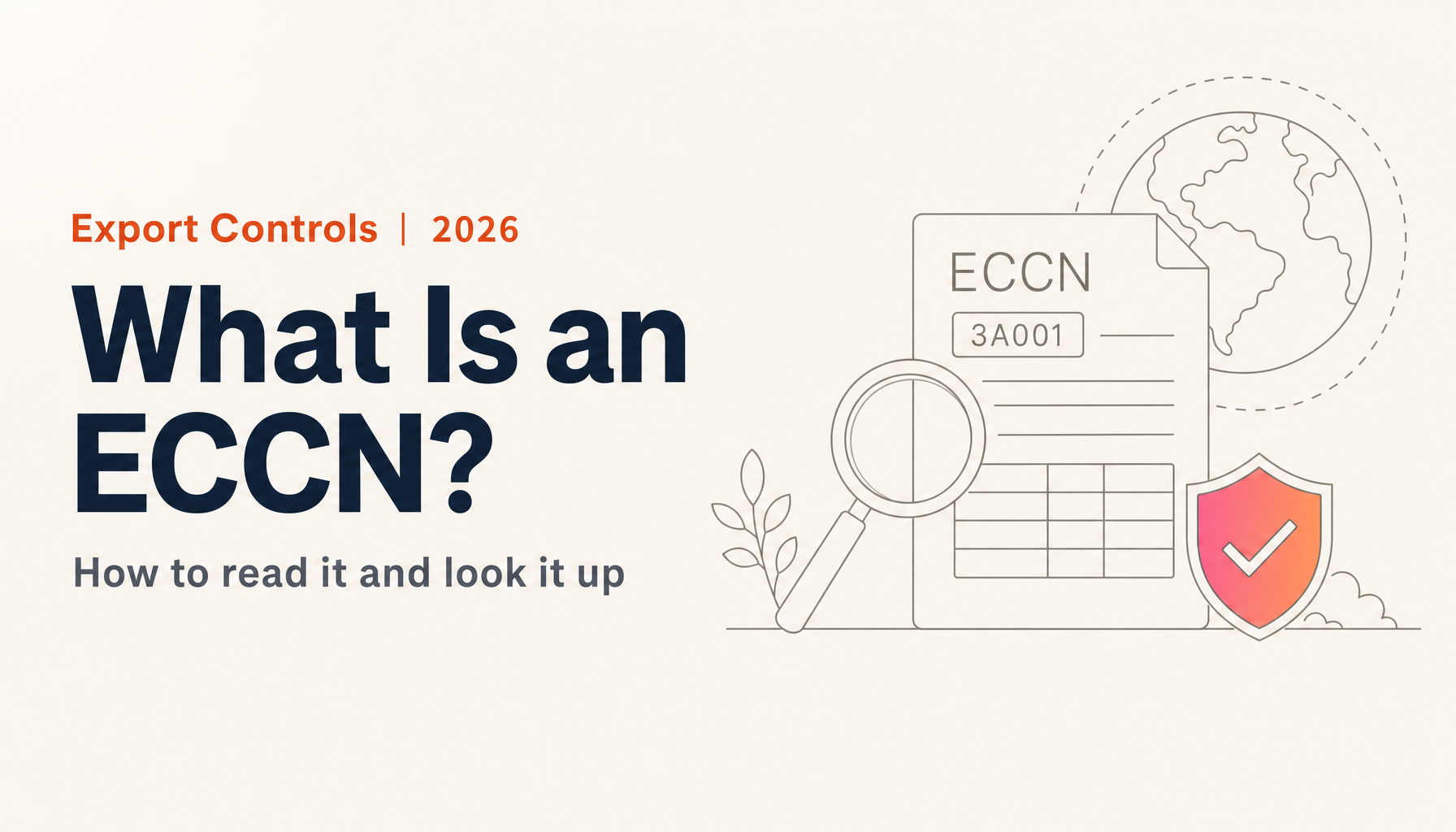
ECCN stands for Export Control Classification Number. It is the five-character alphanumeric code for controlled items, software, and technology on the Commerce Control List under the EAR. The Bureau of Industry and Security (BIS) at the U.S. Department of Commerce writes each entry, and the CCL itself sits in Supplement No. 1 to 15 CFR Part 7741. It has ten categories, and every category uses the same five product groups2.
An ECCN does not say what a product is. It says which regulatory box the product falls into. Two units with the same marketing name can carry different ECCNs if one of them crosses a performance threshold, and a different number means a different license analysis. That is why a part number never settles the question. You end up back in the spec sheet.
On supplier paperwork you will usually see one of three statements. The first is a specific ECCN, such as 3A991.a.1. The second is EAR99: the item is subject to the EAR but not listed under any ECCN, which is not the same as unregulated. The third is "Not subject to the EAR," meaning U.S. export controls do not reach the item at all. The last two look alike and behave very differently. EAR99 items can still need a license for embargoed destinations or prohibited end uses; items outside the EAR do not. The EAR99 explainer goes through that distinction step by step.
People also mix up ECCNs with the codes used for tariffs and trade statistics. Here is how they line up.
| Code | Used for | Administered by | Format |
|---|---|---|---|
| ECCN | U.S. export control (license or no license) | BIS, Department of Commerce | 5 characters (e.g., 3A001) |
| HS code | International tariff and statistics classification | World Customs Organization | 6 digits |
| Schedule B | U.S. export statistics | U.S. Census Bureau | 10 digits (first 6 = HS) |
| HTS | U.S. import duties | U.S. International Trade Commission | 10 digits (first 6 = HS) |
| Japan's Appended Table 1 item | Japan's list-based export control | METI | Items 1-16 and sub-items |
The HS family classifies goods by what they are, so the first six digits stay the same across countries3. ECCNs split items by performance and design thresholds, so there is no mechanical path from an HS code to an ECCN.
One more point for anyone with a Japanese supply chain. Japan runs its own list under the Foreign Exchange and Foreign Trade Act and Appended Table 1 of the Export Trade Control Order, and it does not map one-to-one onto the CCL. When goods leaving Japan contain U.S.-origin parts or technology, the exporter runs both classifications. The Japanese side is covered in Japan export classification and Appended Table 1.
Keep the reasoning, not only the number: We publish a fill-in sheet that walks through "subject to the EAR? Listed under an ECCN? Otherwise EAR99?" and then covers embargoed destinations, end use and end user checks, de minimis and the foreign direct product rules, restricted party screening, and a parallel check against Japan's classification. There are fields for the ECCN you found, how you found it, U.S. content, destination, and the outcome. → Download the EAR Classification Flow and EAR99 Checklist (Free. Company name and work email required.)
How to read an ECCN: every character carries meaning
The structure is written into the regulation at 15 CFR 738.22. The first digit is the category: 0 nuclear materials and miscellaneous, 1 materials, chemicals, microorganisms and toxins, 2 materials processing, 3 electronics, 4 computers, 5 telecommunications and information security, 6 lasers and sensors, 7 navigation and avionics, 8 marine, 9 aerospace and propulsion. The letter is the product group: A equipment, assemblies and components; B test, inspection and production equipment; C materials; D software; E technology. A chip usually starts at 3A, the tool that makes it at 3B, and its design software at 3D.
The part people skip is the three digits that follow. The last one is just a sequence number. The two before it identify the type of control. Under the table in 738.2, a number in the 000-099 range means national security (NS), the 100s missile technology (MT), the 200s nuclear nonproliferation (NP), the 300s chemical and biological (CB), the 500s firearms and spacecraft, the 600s military items that moved over from the U.S. Munitions List, 900-979 regional stability and other plurilateral reasons, the 980s crime control and short supply, and 990-999 anti-terrorism and other unilateral reasons. Reasons can overlap, and the number follows precedence: an item controlled for both NS and MT sits in the "0" family. A "99" in those positions marks a purely unilateral U.S. control, such as 2B991 for anti-terrorism. An earlier version of this article described the last three digits simply as an entry number. I have corrected that to match the regulation.
Two quick readings. 3A001 is electronics (3), equipment (A), national-security family (0), entry 001. 9A001 is aerospace (9), equipment (A), and covers aero gas turbine engines that incorporate certain technologies. Engines certified by a civil aviation authority for non-military aircraft, among other conditions in the note, fall outside 9A0011. Read the code alone and you would miss that note.
Now a code you will see constantly: 5A992.c. Category 5 is telecommunications and information security, and this entry sits in the information security (encryption) part. A is equipment. 992 belongs to the "99" family, so it is a unilateral U.S. control. Paragraph .c covers commodities classified as mass market encryption under the EAR. The License Requirements section lists anti-terrorism (AT) for the whole entry, with regional stability (RS) added only for the .z paragraphs that meet advanced AI chip parameters1. For AT-only items, the Commerce Country Chart does not mark individual countries in the AT columns. In practice the license questions come from destinations handled under separate rules, such as Cuba, Iran, North Korea, and Syria under Part 746, plus end-user and end-use controls4. That is why so many laptops, phones, and network devices carry 5A992.c.
Every ECCN entry has four parts: Heading, License Requirements, License Exceptions, and List of Items Controlled2. If "see List of Items Controlled" appears at the end of the heading, the Items paragraph is the complete scope. Subparagraphs such as .a or .b.1 hold the actual thresholds, so record the number down to the subparagraph. The full category and group tables and all fourteen reasons for control are in the ECCN cheat sheet.
Replace siloed classification work with AI.
METI's FY2024 data shows 52% of foreign exchange law violations stem from classification errors. Download the TRAFEED product catalog covering features and rollout.
Three ways to look up your product's ECCN
BIS lists three routes5: contact the manufacturer, producer, or developer; self-classify; or ask BIS for a formal classification. My order of preference is simple. Bought-in parts and equipment start with the manufacturer, in-house designs start with self-classification, and anything that stays uncertain goes to BIS.
Route 1: Ask the manufacturer
Plenty of large U.S. component and IT hardware makers publish ECCN lookup pages where you type in a part number. Many of the main ones are collected in the cheat sheet. Some Japanese manufacturers' classification sheets also carry a U.S. EAR field, filled in with an ECCN, EAR99, or "not subject to the EAR."
BIS adds a warning that is worth quoting in full: "Keep in mind that ECCNs may change over time, so please review the ECCN against the current Commerce Control List to ensure it is accurate."5 A recent example: a rule effective August 13, 2026 raised the national security threshold for certain drones from an endurance of 30 minutes to 3 hours6. The same aircraft could carry a different classification in October than it did in spring. Whenever a supplier gives you a number, write down when you got it, from which document, and from whom.
Route 2: Self-classify on the CCL
For your own products, or when a supplier will not answer, you classify it yourself. The easiest entry point is the BIS Interactive Commerce Control List, which pulls from the eCFR text of the CCL and lets you search by keyword and filter by category7. For the legal text, go to 15 CFR Part 774 on eCFR1, never an old PDF. The sequence comes from Supplement No. 4 to Part 774, the Order of Review.
- Gather the model, spec sheet, and catalog, plus the numbers that matter for thresholds (frequency, computing performance, encryption method).
- Confirm the item is subject to the EAR: U.S.-made, shipped from the U.S., incorporating U.S.-origin content, or made with certain U.S. technology. If the item is on the U.S. Munitions List under ITAR, it is not an EAR item and you do not classify it on the CCL.
- Use the item's general characteristics to pick a category (0-9), then the product group (A-E).
- Check the 600 series and 9x515 entries first. They take precedence over other ECCNs.
- If neither applies, read each ECCN in that product group from the top. Where an entry uses "specially designed," work through the definition.
- Match the entry's parameters to the configuration you actually ship, not the ceiling printed in the brochure.
- If nothing matches, the item is EAR99.
Do not stop at the first keyword hit. The failure I see most often is a gap between catalog values and shipped configuration. The brochure claims a figure right at the control threshold while the factory setting sits below it, and the classification ends up depending on who can document which figure.
Route 3: File a formal classification request (CCATS)
When you still cannot decide, ask BIS. The process is set out in 15 CFR 748.3. You file through BIS's online system, SNAP-R, and the answer comes back with a CCATS (Commodity Classification Automated Tracking System) number. The regulation says classification requests will be answered within 14 calendar days after receipt8. CCATS numbers begin with "G," and suppliers will sometimes tell you that a model already has one.
Honestly, I think rare edge cases are exactly where a formal request pays off. It takes effort, but it is cheap insurance against finding out later that the item was controlled all along. If you buy from Japan, expect your supplier's classification to arrive as a document; Japan's certificate of non-applicability explains what that paper does and does not cover.
Once you have the ECCN: licensing, EAR99, and de minimis
Finding the ECCN starts the analysis. It does not finish it. Read the License Requirements section for the reasons for control and their Country Chart columns, then check the destination's row in the Commerce Country Chart (Supplement No. 1 to Part 738)4. An X means a license is required; no X generally means no license. Some readers are surprised that Japan's row has Xs in the CB1, NS1, MT1, and RS1 columns, so an NS1 item can need a license even for a shipment from the U.S. to Japan. Look at License Exceptions only after you know a license is required, which is exactly the order the regulation sets out2.
Clearing the Country Chart, or landing on EAR99, still leaves the party and purpose questions. Embargoed destinations, restricted end users, and WMD-related end uses can require a license regardless of the ECCN. The classification is complete only once you know who the counterparty is and what the item will be used for. The cases where EAR99 still needs a license are laid out in this guide.
For companies outside the U.S., the de minimis rule carries the most weight. A product made abroad can still be subject to EAR reexport controls if it contains U.S.-origin controlled content above a set share of its value. Under 15 CFR 734.4, the threshold is 25% for most destinations and drops to 10% for Country Groups E:1 and E:2, which in eCFR as of October 2026 means Cuba, Iran, North Korea, and Syria910. Some items have no de minimis level at all: U.S.-origin 600 series or 9x515 content in items bound for Country Group D:5, certain semiconductor production equipment, and foreign technology that incorporates U.S. encryption technology controlled under 5E0029. The same section says U.S. software exported on its own is not eligible, that relying on de minimis for commingled technology requires a one-time report, and that you must keep records of how you calculated U.S. content in software and technology.
Two things that share the name but not the rules. The "$800 de minimis" threshold that made headlines was a U.S. customs import exemption; see our note on its suspension. And the foreign direct product rules are a separate route by which U.S. controls reach foreign-made items, explained in FDPR vs. de minimis.
Where non-U.S. teams run into ECCNs, and where TRAFEED fits
The EAR is a U.S. law, but extraterritorial reach puts it in front of exporters everywhere. Three situations come up again and again. The first is incorporating U.S. components or software and shipping the finished product to a third country, which is the de minimis analysis above. The math is easy. What usually breaks is gathering component-level country-of-origin and ECCN data. Because the threshold changes by destination, recalculate whenever the destination changes rather than treating one result as permanent.
The second is a purchase that looks purely domestic. Equipment bought through a local distributor turns out to have been produced with U.S. technology, and moving it to an overseas plant later triggers reexport rules. Counterparties change too. On December 5, 2024, BIS added 140 entities located in China, Japan, South Korea, and Singapore to the Entity List in a single rule11. By contrast, the BIS rules published in the Federal Register during 2026 contain no Entity List additions, only one removal rule and one revision rule on August 24 (checked October 4, 2026)12. A quiet year does not mean a quiet list. Keep in mind that list placement is a regulatory designation, not a judgment about the company. When a counterparty is listed, the task is to work out how the transaction must be handled, not to brief the counterparty as a bad actor. The differences between the U.S. lists are covered in Entity List vs. MEU List vs. SDN List.
The third is dual-use context. Research materials, test instruments, and analytics software can be civilian by design and still fall under controls depending on end use. The part I find hardest is the "knew or had reason to know" standard: you are expected to read the counterparty profile, the stated end use, and the transaction history together, and to pause when something does not fit. Getting it wrong is expensive. EAR civil penalties reach $374,474 per violation (the inflation-adjusted cap as of October 2026) or twice the transaction value, whichever is greater, and criminal penalties go up to $1 million and 20 years' imprisonment for individuals13. Japan's own economic-security moves, such as the National Intelligence Council and the Makino Milling takeover block, show how seriously boards on the Japanese side now take this.
At hundreds or thousands of line items a month, manual review stops scaling. TRAFEED is our AI agent for export-control teams, and to be clear up front: it does not determine ECCNs. For the U.S. EAR, it reads the ECCN or EAR99 stated in suppliers' classification documents and flags inconsistencies with the item data or entries that look out of date. It screens counterparties against the U.S. Consolidated Screening List, including the Entity List and SDN List, and other countries' sanctions lists. For Japan's export classification under FEFTA, it maps items against Appended Table 1 from specs and part numbers. Every result shows the clause or list entry it relied on, and your export control officer makes the final call. Nothing here is legal advice; the point is that the evidence behind each decision stays in one place.
What changed since the first edition (April 2026)
I first published this guide on April 24, 2026. In under six months, several assumptions behind ECCN work have moved.
| Item | At first publication (April 24, 2026) | Now (October 4, 2026) |
|---|---|---|
| BIS 50% rule (Affiliates Rule) | Stayed through November 9, 2026 | Same in the Federal Register. The U.S. and China announced an extension to January 10, 2027, but no BIS extension rule has been published |
| National security control on drones | 30-minute endurance threshold | Raised to 3 hours (effective August 13, 2026)6 |
| UAE country groups | D:3 and D:4 | Removed from D:3 and D:4, added to A:5 (effective July 10, 2026)14 |
| Entity List additions | Most recent additions rule in October 2025 | No additions rule in 2026; one removal and one revision rule on August 2412 |
The Affiliates Rule extends Entity List-style restrictions to foreign affiliates that are 50% or more owned by listed parties. It was published on September 30, 202515 and then stayed by a separate rule (90 FR 50857), which in the Federal Register runs through November 9, 202616. The U.S. and China have since announced that the arrangement containing that stay will run to January 10, 2027. China's Ministry of Commerce stated the extension in an official briefing on September 2817, and Treasury Secretary Bessent was reported to have described it on September 2318. I have not found a U.S. government document that expressly ties the extension to the Affiliates Rule, and as of October 4, 2026 BIS has not published an extension rule. So neither "it returns on November 10" nor "it is extended" can be stated as settled law yet. Ownership math and next steps live in our main guide, What Is the BIS 50% Rule?
The UAE change is a clean illustration of one point: the ECCN depends on the item, but the license outcome depends on the number, the destination, the end user, and the end use together. Another reason to date every classification record.
Semiconductors, AI, and quantum are where direction changes fastest. 2024 brought tightening, including new quantum ECCNs and expanded semiconductor controls1920. 2026 has leaned toward relief so far. On January 15, 2026, BIS moved license review for exports of certain advanced computing chips to China and Macau, the Nvidia H200 and its equivalents and less advanced chips, from a presumption of denial to case-by-case review, subject to exporter certifications on U.S. supply and independent third-party testing21. A rule effective April 7 extended the Approved IC Designer application deadline by about eight months, to December 31, 202622. On the tightening side, 4A906 for quantum computers, added in September 2024, sets its scope by combining qubit count with error rate; for example, 34 to 99 working physical qubits with a C-NOT error of 10^-4 or less191. Mistake the direction of a change and your internal guidance goes wrong all at once, so this is the area where reading the Federal Register text pays off most.
Three things to start this week
ECCN work is not a one-time task. It is a process you keep running.
First, inventory the ECCN and country of origin for your top 100 items, together with the date, the source document, and the contact who supplied each one. Items whose data never comes together are a warning about that supplier relationship, not just a gap in a spreadsheet.
Second, decide when numbers get rechecked. CCL amendments and country group changes appear in the Federal Register several times a year. Assign someone to watch BIS publications and set a cadence for re-reviewing the affected items, so changes like the drone threshold or the UAE move do not slip past.
Third, screen counterparties more often. An annual refresh cannot keep up with list changes; screening at transaction time is the goal. While you are at it, map parents, subsidiaries, and sister companies for your main counterparties, so you are ready whichever way the Affiliates Rule lands.
Export control looks like an endless swamp on day one. My experience is that once the process exists, the daily work gets much lighter, and reading a supplier's ECCN stops being a source of worry. If you want help with that first climb, book a consultation with the TRAFEED team. Features and rollout are in the TRAFEED product catalog (PDF).
References
Footnotes
-
eCFR, 15 CFR Part 774, "The Commerce Control List" (Supplement No. 1 is the CCL; Supplement No. 4 is the Order of Review; source for 9A001, 5A992, and 4A906). https://www.ecfr.gov/current/title-15/subtitle-B/chapter-VII/subchapter-C/part-774 ↩ ↩2 ↩3 ↩4 ↩5
-
eCFR, 15 CFR 738.2, "Commerce Control List (CCL) structure" (ECCN composition, reason-for-control number ranges, reading an entry). https://www.ecfr.gov/current/title-15/subtitle-B/chapter-VII/subchapter-C/part-738/section-738.2 ↩ ↩2 ↩3 ↩4
-
International Trade Administration, "Harmonized System (HS) Codes." https://www.trade.gov/harmonized-system-hs-codes ↩
-
eCFR, Supplement No. 1 to Part 738, "Commerce Country Chart." https://www.ecfr.gov/current/title-15/subtitle-B/chapter-VII/subchapter-C/part-738/appendix-Supplement%20No.%201%20to%20Part%20738 ↩ ↩2
-
Bureau of Industry and Security, "Classify Your Item" (accessed October 4, 2026). https://www.bis.gov/licensing/classify-your-item ↩ ↩2
-
Federal Register, "Streamlining Export Controls for Drone Exports" (91 FR 52501, published August 14, 2026, effective August 13, 2026). https://www.federalregister.gov/documents/2026/08/14/2026-16628/streamlining-export-controls-for-drone-exports ↩ ↩2
-
Bureau of Industry and Security, "Interactive Commerce Control List." https://www.bis.gov/regulations/ear/interactive-commerce-control-list ↩
-
eCFR, 15 CFR 750.2, "Processing of Classification Requests and Advisory Opinions." https://www.ecfr.gov/current/title-15/subtitle-B/chapter-VII/subchapter-C/part-750/section-750.2 ↩
-
eCFR, 15 CFR 734.4, "De minimis U.S. content." https://www.ecfr.gov/current/title-15/subtitle-B/chapter-VII/subchapter-C/part-734/section-734.4 ↩ ↩2
-
eCFR, Supplement No. 1 to Part 740, "Country Groups" (composition of E:1 and E:2). https://www.ecfr.gov/current/title-15/subtitle-B/chapter-VII/subchapter-C/part-740/appendix-Supplement%20No.%201%20to%20Part%20740 ↩
-
Federal Register, "Additions and Modifications to the Entity List; Removals From the Validated End-User (VEU) Program" (89 FR 96830, December 5, 2024). https://www.federalregister.gov/documents/2024/12/05/2024-28267/additions-and-modifications-to-the-entity-list-removals-from-the-validated-end-user-veu-program ↩
-
Federal Register, documents published by the Industry and Security Bureau (rules from January 1 to October 4, 2026 reviewed; the only Entity List rules were 91 FR 54657 and 54658). https://www.federalregister.gov/agencies/industry-and-security-bureau ↩ ↩2
-
Civil penalty cap: eCFR, 15 CFR 6.3(c)(6) ($374,474 after inflation adjustment). https://www.ecfr.gov/current/title-15/subtitle-A/part-6/section-6.3 . Criminal penalties and the twice-the-transaction-value rule: 50 U.S.C. 4819. https://uscode.house.gov/view.xhtml?req=granuleid:USC-prelim-title50-section4819&num=0&edition=prelim ↩
-
Federal Register, "Enhanced Favorable Treatment for the United Arab Emirates Under the Export Administration Regulations" (91 FR 43034, published July 14, 2026, effective July 10, 2026). https://www.federalregister.gov/documents/2026/07/14/2026-14132/enhanced-favorable-treatment-for-the-united-arab-emirates-under-the-export-administration ↩
-
Federal Register, "Expansion of End-User Controls To Cover Affiliates of Certain Listed Entities" (90 FR 47201, September 30, 2025). https://www.federalregister.gov/documents/2025/09/30/2025-19001/expansion-of-end-user-controls-to-cover-affiliates-of-certain-listed-entities ↩
-
Federal Register, "One Year Suspension of Expansion of End-User Controls for Affiliates of Certain Listed Entities" (90 FR 50857, November 12, 2025). https://www.federalregister.gov/documents/2025/11/12/2025-19846/one-year-suspension-of-expansion-of-end-user-controls-for-affiliates-of-certain-listed-entities ↩
-
Ministry of Commerce of the People's Republic of China, official briefing on the eighth round of China-U.S. economic and trade consultations (September 28, 2026, in Chinese). https://www.mofcom.gov.cn/syxwfb/art/2026/art_d9ea01824fc44fd8a29f7dc3f8ca9c72.html ↩
-
NBC News, report on the U.S.-China trade truce extension (September 23, 2026; press report). https://www.nbcnews.com/business/economy/us-china-extend-trade-truce-trump-rcna599525 ↩
-
Federal Register, "Commerce Control List Additions and Revisions; Implementation of Controls on Advanced Technologies Consistent With Controls Implemented by International Partners" (89 FR 72926, September 6, 2024). https://www.federalregister.gov/documents/2024/09/06/2024-19633/commerce-control-list-additions-and-revisions-implementation-of-controls-on-advanced-technologies ↩ ↩2
-
Federal Register, "Foreign-Produced Direct Product Rule Additions, and Refinements to Controls for Advanced Computing and Semiconductor Manufacturing Items" (89 FR 96790, December 5, 2024). https://www.federalregister.gov/documents/2024/12/05/2024-28270/foreign-produced-direct-product-rule-additions-and-refinements-to-controls-for-advanced-computing ↩
-
Federal Register, "Revision to License Review Policy for Advanced Computing Commodities" (91 FR 1684, January 15, 2026). https://www.federalregister.gov/documents/2026/01/15/2026-00789/revision-to-license-review-policy-for-advanced-computing-commodities ↩
-
Federal Register, "Extension of Authorized Integrated Circuit (IC) Designer Status and Application Deadline To Become an Approved IC Designer" (91 FR 17851, published April 9, 2026, effective April 7, 2026). https://www.federalregister.gov/documents/2026/04/09/2026-06851/extension-of-authorized-integrated-circuit-ic-designer-status-and-application-deadline-to-become-an ↩

![Automating Export Control Classification with AI | How to Cut Compliance Workload Without Losing Defensibility [September 2026 Edition]](/images/columns/export-control-classification-ai/cover.en.png?dpl=dpl_EqEUUyAKUKTQSbGy3dpNC6GrENCD)